Yes! You can use AI to fill out ACORD 132, Truckers / Motor Carriers Section

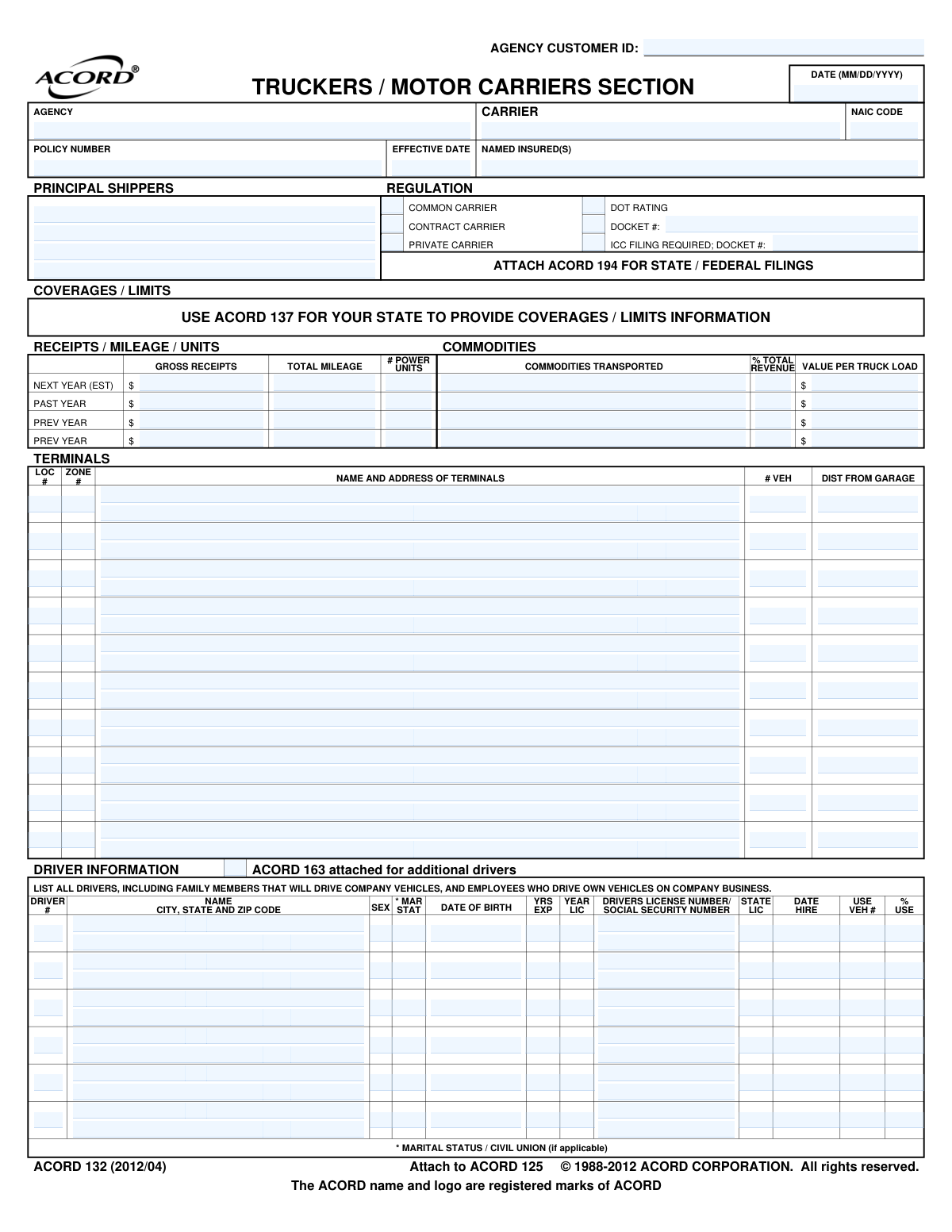
ACORD Form 132, the Truckers / Motor Carriers Section, is a supplemental document used in the insurance industry to gather specific details about a trucking company's operations for underwriting a commercial auto policy. It collects crucial data on drivers, vehicle fleets, commodities hauled, operational radius, and safety procedures. Today, this form can be filled out quickly and accurately using AI-powered services like Instafill.ai, which can also convert non-fillable PDF versions into interactive fillable forms.
Our AI automatically handles information lookup, data retrieval, formatting, and form filling.
It takes less than a minute to fill out ACORD 132 using our AI form filling.
Securely upload your data. Information is encrypted in transit and deleted immediately after the form is filled out.

Form specifications

Form name: ACORD 132, Truckers / Motor Carriers Section
Number of fields: 433
Number of pages: 1
Language: English
main-image

Instafill Demo: How to fill out PDF forms in seconds with AI

How to Fill Out ACORD 132 Online for Free in 2026

Are you looking to fill out a ACORD 132 form online quickly and accurately? Instafill.ai offers the #1 AI-powered PDF filling software of 2026, allowing you to complete your ACORD 132 form in just 37 seconds or less.
Follow these steps to fill out your ACORD 132 form online using Instafill.ai:
  1. 1 Navigate to Instafill.ai and upload or select the ACORD 132 form.
  2. 2 Provide the basic policy and insured information, such as the Named Insured, policy number, and agency details in the header section.
  3. 3 Complete the 'Driver Information' section by listing all drivers, their hire dates, license numbers, and other personal details.
  4. 4 Fill out the 'Equipment' and 'Vehicle Type' tables with details about your fleet, including the number of tractors, trailers, and their usage radius (local, long distance).
  5. 5 Enter financial and operational data in the 'Receipts / Mileage / Units' and 'Commodities Transported' sections.
  6. 6 Answer the 'General Information' questions regarding your business operations, maintenance programs, and safety protocols.
  7. 7 Review all the information you've entered for accuracy, make any final adjustments, and then download or submit your completed ACORD 132 form.

Our AI-powered system ensures each field is filled out correctly, reducing errors and saving you time.

Why Choose Instafill.ai for Your Fillable ACORD 132 Form?

Speed

Complete your ACORD 132 in as little as 37 seconds.

Up-to-Date

Always use the latest 2026 ACORD 132 form version.

Cost-effective

No need to hire expensive lawyers.

Accuracy

Our AI performs 10 compliance checks to ensure your form is error-free.

Security

Your personal information is protected with bank-level encryption.

Frequently Asked Questions About Form ACORD 132

The ACORD 132, known as the Truckers / Motor Carriers Section, is a supplemental application used to gather detailed information about a trucking business for commercial auto insurance. It is attached to the main ACORD 125 Commercial Insurance Application to help underwriters assess risk.

Any trucking or motor carrier business applying for a new commercial auto insurance policy or renewing an existing one will need to complete this form. It provides the specific operational details that insurers require.

Before you start, gather a complete list of your drivers with their license numbers and dates of birth, a detailed schedule of all vehicles and equipment, and your gross receipts and mileage data for the past two years.

Yes, you must list all drivers who will operate company vehicles, including owners, family members, and any employees who might use their personal vehicles for company business. This is critical for ensuring proper coverage.

These terms describe the operating radius of your vehicles. While definitions can vary, 'Local' is typically under 50-100 miles, 'Intermediate' is 100-200 miles, and 'Long' is any distance beyond that.

Insurers need to know what you are hauling to evaluate the risk. Hauling hazardous materials, or high-value 'target commodities' like electronics or pharmaceuticals, presents a different risk profile than hauling general freight.

You must indicate this by answering 'Yes' to question 9, 'Does applicant hire equipment from others?'. Be prepared to provide details on the arrangement, as it affects your insurance liability.

This refers to regulatory filings required by the Federal Motor Carrier Safety Administration (FMCSA) for operating in interstate commerce. If this applies to you, you'll need to provide your docket number.

You should list any entity that has a financial stake in your vehicles, such as a bank or leasing company that is a lienholder or loss payee. This ensures they are notified and included in any claim payments.

Yes, AI-powered services like Instafill.ai can help by accurately auto-filling form fields from your existing data. This saves time and reduces the chance of manual entry errors.

Simply upload the ACORD 132 PDF to the Instafill.ai platform. The AI will make the form fillable, and you can use its features to automatically populate your company, driver, and vehicle information.

Services like Instafill.ai can convert flat, non-fillable PDFs into interactive forms you can complete online. This saves you from having to print the form and fill it out by hand.

Yes, this form attaches to the ACORD 125. You may also need to attach ACORD 163 for additional drivers, ACORD 129 for vehicle details, and ACORD 194 for state/federal filings if applicable.

Target commodities are goods that are at a high risk for theft. This includes items like stereos, televisions, pharmaceuticals, liquor, meat, and seafood.

Compliance ACORD 132
Validation Checks by Instafill.ai

1
Driver's Date of Birth and Age Verification
This check validates that the 'DATE OF BIRTH' for each driver is a valid date in MM/DD/YYYY format and confirms the driver meets the minimum legal age for operating a commercial vehicle (e.g., 21 years old). This is critical for regulatory compliance and assessing underwriting risk. A failure would flag the driver's entry as invalid and require correction, as insuring an underage driver is a major liability.
2
Driver's License Expiration Date Check
Ensures the 'LIC YEAR EXP' for each driver's license is a date in the future. An expired license means the driver is not legally permitted to operate a vehicle, representing a significant and unacceptable risk. If the license is expired or the date is in the past, the application cannot be processed until proof of a valid, current license is provided.
3
Social Security Number Format Validation
Verifies that the 'SOCIAL SECURITY NUMBER' for each driver is entered in a valid 9-digit format (e.g., XXXXXXXXX or XXX-XX-XXXX). This number is essential for identity verification, running Motor Vehicle Reports (MVRs), and background checks. An invalid format would halt the automated lookup processes and require manual correction.
4
Conditional Explanation for General Information Questions
This validation ensures that if any question in the 'GENERAL INFORMATION' section is answered 'Y' (Yes), the corresponding 'EXPLAIN ALL "YES" RESPONSES' field is not empty. These explanations provide crucial context on high-risk activities (e.g., hauling hazardous materials, prior convictions). Missing explanations result in an incomplete risk profile and the form will be rejected pending completion.
5
Commodities Percentage Total Check
This check calculates the sum of all percentages listed in the '% TOTAL' column under 'COMMODITIES TRANSPORTED' and verifies that the total equals 100%. This ensures a complete and accurate breakdown of the types of goods being hauled, which directly impacts risk assessment and premium calculation. A total not equal to 100% would indicate an error or omission and must be corrected.
6
Docket Number Requirement for ICC Filing
If the 'ICC FILING REQUIRED' box is checked, this validation confirms that the 'DOCKET #' field has been filled out. The docket number is a required identifier for federal filings and is necessary for ensuring the carrier is compliant with interstate commerce regulations. Failure to provide it when required will result in an incomplete application and prevent the necessary filings from being made.
7
Logical Chronology of Hire Date
Validates that a driver's 'HIRE DATE' is chronologically after their 'DATE OF BIRTH'. This is a basic logical check to ensure data entry accuracy and prevent nonsensical data. An error here would suggest a typo in one or both date fields, requiring the user to review and correct the information.
8
Total Vehicle Count Consistency
This check cross-references the vehicle counts. It sums the number of vehicles entered in the 'EQUIPMENT' grid (across all types and ownership categories) and ensures this sum matches the number entered in the 'TOTAL VEHICLES' field. This verification prevents discrepancies in the fleet size, which is a fundamental factor for calculating premiums. A mismatch would require the user to reconcile the vehicle schedule.
9
Driver Information Completeness
For every driver row that is initiated, this check ensures that critical fields such as 'NAME', 'DRIVERS LICENSE NUMBER', 'LIC STATE', and 'DATE OF BIRTH' are not empty. This information is the minimum required to perform MVR checks and properly rate the policy. An incomplete driver entry would be flagged for completion before the submission can be accepted.
10
Moving Violations Explanation Requirement
If question 16, 'ANY DRIVERS WITH CONVICTIONS FOR MOVING TRAFFIC VIOLATIONS?', is answered 'Y' (Yes), this check ensures that the corresponding details section is filled out. Information about the driver, date, and type of violation is essential for underwriting to assess the risk associated with that driver. Answering 'Yes' without providing details would render the submission incomplete.
11
Receipts and Mileage Correlation
This validation analyzes the relationship between 'GROSS RECEIPTS' and 'TOTAL MILEAGE' for the past, previous, and next years. It flags anomalies, such as mileage increasing significantly while receipts remain flat or decrease, which could indicate operational issues or data entry errors. While not a hard failure, it would trigger a review or request for explanation to ensure the business's operational data is logical.
12
Value Per Truck Load Format
This check ensures that the 'VALUE PER TRUCK LOAD' for each commodity is a valid, positive numerical currency value. This figure is critical for determining cargo coverage limits and assessing the risk of high-value loads. An invalid or non-numeric entry would prevent accurate rating and would need to be corrected.
13
DOT Rating Field Validation
Verifies that the 'DOT RATING' field, if filled, contains a recognized and valid rating (e.g., 'Satisfactory', 'Conditional', 'Unsatisfactory'). The carrier's safety rating from the Department of Transportation is a key underwriting factor. An invalid entry would be rejected, and an 'Unsatisfactory' rating may make the applicant ineligible for coverage.
14
Terminal Vehicle Count Requirement
If a terminal is listed in the 'TERMINALS' section, this check ensures the '# VEH' (number of vehicles) field for that terminal is populated with a number greater than zero. This information is used to understand the distribution of the fleet and assess garaging risks. A missing vehicle count for a listed terminal would make the location data incomplete.

Common Mistakes in Completing ACORD 132

Failing to List All Drivers

Applicants often forget to list every individual who might operate a company vehicle, including family members, part-time staff, or employees who occasionally use their own car for business. This omission can lead to a denial of coverage in the event of an accident involving an unlisted driver, creating significant financial and legal liability for the business. To avoid this, meticulously review all potential drivers and ensure they are included; AI-powered tools like Instafill.ai can help manage and cross-reference driver lists to ensure completeness.

Incorrect Driver's License or Social Security Number

Simple typographical errors when entering a Driver's License Number or Social Security Number are extremely common due to the long strings of digits. These errors delay the underwriting process, as the insurer cannot pull the required Motor Vehicle Reports (MVRs) or run background checks. Always double-check these numbers for accuracy before submission. Using a tool like Instafill.ai can prevent these mistakes by validating data formats and saving correct information for future use.

Underestimating Mileage and Gross Receipts

In an attempt to secure lower premiums, applicants may intentionally or unintentionally underestimate their projected annual mileage or gross receipts. Insurers use this data to calculate risk and pricing, and significant discrepancies discovered during an audit can lead to back-charged premiums or even policy cancellation. It is crucial to provide realistic estimates based on past data and known future contracts to ensure the policy is rated correctly from the start.

Vague or Incomplete Commodity Descriptions

Applicants often use generic terms like 'General Freight' in the 'Commodities Transported' section instead of providing specific details. Failing to disclose the hauling of high-risk or 'target' commodities (e.g., electronics, liquor, hazardous materials) can result in coverage being denied for a related claim. Be specific about what you haul and accurately report the percentage of revenue and value per load for each commodity type to ensure proper coverage.

Misclassifying Radius of Operation

A frequent error is incorrectly categorizing the business's radius of operation (Local, Intermediate, Long Distance) in the 'Equipment' section. An applicant might select 'Local' (typically under 50-100 miles) when their trucks occasionally travel further, which misrepresents the risk profile. If an accident occurs outside the declared radius, the claim could be challenged or denied. Carefully review routes and contracts to select the correct radius for each vehicle.

Forgetting to Attach Required ACORD Forms

This form references several other forms that must be attached, such as ACORD 129 (Vehicle Section), ACORD 163 (Additional Drivers), and ACORD 194 (Filings). Applicants frequently overlook these instructions, leading to an incomplete submission that delays quoting and binding. To prevent this, read all instructions carefully and use the main form as a checklist for required attachments. If the form is a non-fillable PDF, a service like Instafill.ai can convert it to a fillable version and help manage all associated documents in one place.

Not Explaining 'Yes' Responses in General Information

The 'General Information' section contains numerous yes/no questions with a requirement to 'Explain all "YES" responses'. Applicants often check 'Yes' to a question, such as 'Does applicant haul for other truckers?', but fail to provide the necessary detailed explanation. This missing context forces the underwriter to follow up, delaying the entire process and potentially leading to incorrect assumptions about the risk.

Omitting Lienholders and Additional Insureds

Forgetting to list a lienholder (the entity that financed a vehicle) or an additional insured (a client or shipper requiring coverage under your policy) is a critical error. This can breach loan or service agreements, leading to financial penalties or loss of contracts. It also means the interested party won't be automatically notified of policy changes or receive payment in a covered loss. Always review financing and shipping contracts to identify all parties that need to be listed.

Entering Incorrect DOT or Docket Numbers

Transposing digits or entering an outdated DOT (Department of Transportation) or MC (Motor Carrier) docket number is a common data entry mistake. These numbers are essential for verifying the carrier's authority, safety rating, and compliance history. An incorrect number will halt the underwriting process until it is corrected, delaying the issuance of insurance certificates and the ability to operate legally.

Inconsistent or Missing Financial Data

The 'Receipts / Mileage / Units' section requires financial and operational data from the previous two years and an estimate for the next. Applicants sometimes provide inconsistent figures, leave past years blank if the data isn't readily available, or provide estimates that don't align with historical trends. This lack of clear, consistent data can be a red flag for underwriters, leading to more scrutiny and delays. Ensure all financial figures are accurate and sourced from company records.
Saved over 80 hours a year

“I was never sure if my IRS forms like W-9 were filled correctly. Now, I can complete the forms accurately without any external help.”

Kevin Martin Green

Your data stays secure with advanced protection from Instafill and our subprocessors

Robust compliance program

Transparent business model

You’re not the product. You always know where your data is and what it is processed for.

ISO 27001, HIPAA, and GDPR

Our subprocesses adhere to multiple compliance standards, including but not limited to ISO 27001, HIPAA, and GDPR.

Security & privacy by design

We consider security and privacy from the initial design phase of any new service or functionality. It’s not an afterthought, it’s built-in, including support for two-factor authentication (2FA) to further protect your account.

Fill out ACORD 132 with Instafill.ai

Worried about filling PDFs wrong? Instafill securely fills acord-132-truckers-motor-carriers-section forms, ensuring each field is accurate.