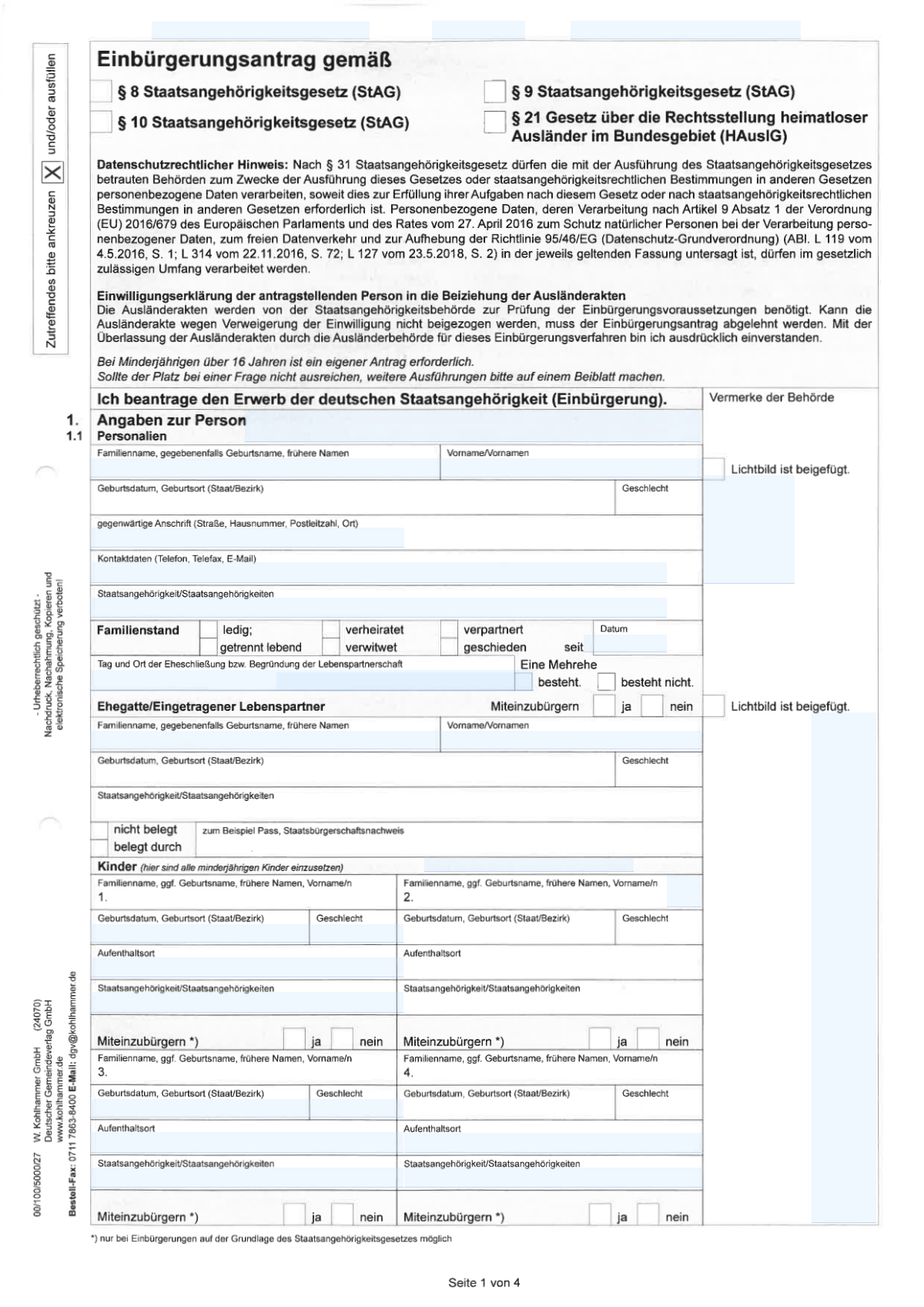
Yes! You can use AI to fill out Antrag auf Einbürgerung (Application for Naturalization)

The Antrag auf EinbĂŒrgerung, or Application for Naturalization, is the official German government form used by foreign nationals to apply for German citizenship. This comprehensive document is crucial as it collects all the personal, residential, financial, and legal information required by authorities to evaluate an applicant's eligibility under the German Citizenship Act (StAG). Completing this multi-page form accurately is the first step in the naturalization process, and today this form can be filled out quickly and accurately using AI-powered services like Instafill.ai, which can also convert non-fillable PDF versions into interactive fillable forms.
Our AI automatically handles information lookup, data retrieval, formatting, and form filling.
It takes less than a minute to fill out German Naturalization Application using our AI form filling.
Securely upload your data. Information is encrypted in transit and deleted immediately after the form is filled out.

Form specifications

Form name: Antrag auf Einbürgerung (Application for Naturalization)
Number of fields: 86
Number of pages: 4
Language: English
main-image

Instafill Demo: How to fill out PDF forms in seconds with AI

How to Fill Out German Naturalization Application Online for Free in 2026

Are you looking to fill out a GERMAN NATURALIZATION APPLICATION form online quickly and accurately? Instafill.ai offers the #1 AI-powered PDF filling software of 2026, allowing you to complete your GERMAN NATURALIZATION APPLICATION form in just 37 seconds or less.
Follow these steps to fill out your GERMAN NATURALIZATION APPLICATION form online using Instafill.ai:
  1. 1 Navigate to Instafill.ai and upload the 'Antrag auf Einbürgerung' form, or select it from their template library.
  2. 2 Use the AI assistant to accurately fill in your personal details, including your full name, current address, contact information, and any previous names.
  3. 3 Provide comprehensive details about your family, including your spouse or registered partner, children, and parents, as prompted by the system.
  4. 4 Detail your current and former citizenships, and provide a complete history of your residency both within Germany (Inlandsaufenthalte) and abroad (Auslandsaufenthalte).
  5. 5 Answer questions regarding your financial situation, military service, and any pending legal proceedings, and make the required declarations of loyalty.
  6. 6 Carefully review all the information entered by the AI for accuracy. Once confirmed, print the form to sign and date it in the designated sections.
  7. 7 Download the completed application, attach all required supporting documents (like your passport photo, proof of residence, etc.), and submit it to the appropriate German naturalization authority (Einbürgerungsbehörde).

Our AI-powered system ensures each field is filled out correctly, reducing errors and saving you time.

Why Choose Instafill.ai for Your Fillable German Naturalization Application Form?

Speed

Complete your German Naturalization Application in as little as 37 seconds.

Up-to-Date

Always use the latest 2026 German Naturalization Application form version.

Cost-effective

No need to hire expensive lawyers.

Accuracy

Our AI performs 10 compliance checks to ensure your form is error-free.

Security

Your personal information is protected with bank-level encryption.

Frequently Asked Questions About Form German Naturalization Application

This form is an application for German naturalization (EinbĂŒrgerung). It is used to collect the necessary personal, family, and legal information from individuals applying for German citizenship.

This form must be completed by the primary individual applying for German citizenship. It also includes sections for co-applicants, such as a spouse or children, who may be included in the same application.

You should enter the main legal statute your application is based on, for example, '§ 8 StAG'. If you are unsure which law applies to your case, you should consult with the naturalization authority or a legal advisor.

If you have not been assigned a file or reference number by the authority for this application, you can leave this field blank. This number is typically provided by the authority after you initiate the process.

The form has dedicated sections for your spouse/registered partner and children. You must provide their full names, birth details, nationality, and place of residence as requested in the specific fields for each family member.

You will need to attach a passport-style photograph ('Lichtbild / Foto') and provide documents as proof of your current citizenship, such as your passport or national ID card. Be prepared to submit other documents like birth certificates and proof of residence as requested by the authority.

In the 'Staatsangehörigkeit(en)' field, you should list all current nationalities or citizenships you hold. If you have more than one, separate them with commas.

The form includes a specific field, 'Date of death (Todestag)', in the mother's details section. You should enter her date of death in this field and fill out the other requested information about her, such as her name and place of birth.

In the 'Foreign stays / Aufenthalt, Ausbildung, Auslandsaufenthalte' section, you must list your stays outside of Germany. For each stay, provide the start and end dates ('von–bis') and the location (city, district, and country).

This section, which translates to 'Authority remarks', is for official use only and should be left blank. The processing authority will use this space for their internal notes, reference numbers, or decisions.

This field asks for the legal basis or reason you acquired your current citizenship. Common reasons include birth in the country, descent from a citizen parent, marriage, or a previous naturalization process.

Yes, services like Instafill.ai use AI to help you accurately auto-fill form fields from your profile, which can save time and help prevent errors. This is especially useful for long and detailed forms like a naturalization application.

To fill this form online, you can upload the PDF to the Instafill.ai platform. The service will make the form interactive, allowing you to click and type in each field or use its AI to auto-fill your information for you.

If you have a non-fillable or 'flat' PDF, you can use a service like Instafill.ai. It can convert the non-fillable PDF into an interactive, fillable form that you can complete and sign digitally.

Compliance German Naturalization Application
Validation Checks by Instafill.ai

1
Primary Law Section Presence
This check ensures the 'Primary law section' field is not empty. This field specifies the main legal basis for the application (e.g., § 8 StAG) and is fundamental for the authorities to process the request correctly. If this field is left blank, the application cannot be categorized, and the submission should be rejected with a message requiring the user to enter the relevant legal provision.
2
Contact Information Validity and Completeness
This validation verifies that at least one form of contact, either a telephone number or an e-mail address, is provided in the 'Kontaktdaten' field. It also checks that any provided e-mail address follows a valid format (e.g., [email protected]). This is critical for the authority to communicate with the applicant regarding their case. Failure to provide valid contact information would result in an error, prompting the user to correct the entry.
3
Logical Date of Marriage
This check validates the 'Tag der Eheschließung' (date of marriage). The date must be a valid calendar date, must occur before the current submission date, and should logically align with the 'Seit (Datum)' field, which indicates the start of the current family status. An illogical or future date would invalidate the family status information. If validation fails, the user will be prompted to enter a valid date that precedes today.
4
Mother's Date of Death Consistency
This validation rule applies if the 'Date of death (Todestag)' for the mother is filled. It checks that the provided date of death is logically possible, specifically that it occurs after the mother's 'Birth date'. This prevents data entry errors and ensures the integrity of the family history provided. An invalid entry would trigger an error message explaining the logical conflict between the birth and death dates.
5
Foreign Stay Period Logic
This check ensures that for any entry in 'Foreign stays / Aufenthalt, Ausbildung, Auslandsaufenthalte', the start date ('von') is before the end date ('bis'). This maintains the logical integrity of the timeline of foreign stays provided by the applicant. If the start date is on or after the end date, the system should flag it as an error and require the user to correct the period.
6
Full Residential Address Structure
This validation inspects the 'GegenwÀrtige Anschrift' field to ensure a complete residential address has been provided. It checks for the presence of key components like a street name, house number, postal code, and city, rather than just a city or country. A complete address is essential for official correspondence, so an incomplete entry will trigger a warning asking the user to provide their full address.
7
Child's Date of Birth Validity
This check validates that the 'Child's date of birth' is a valid date in the past. It also performs a logical check to ensure the child's birth date is after the parent's date of birth (which would be known in the context of the full application). This prevents impossible data, such as a child being born before their parent. An invalid or future date will be rejected.
8
Applicant Nationality Declaration
This validation ensures that the 'Staatsangehörigkeit(en)' field for the applicant is not left empty. Declaring current citizenship is a fundamental requirement for a naturalization or citizenship-related application. If this mandatory field is empty, the form submission will be blocked until the applicant lists at least one current nationality.
9
Conditional Previous Marriage Details
This validation enforces a dependency rule where fields in the 'Previous marriage / partnership details' section (like 'Dissolution details' and 'Former spouse/partner') can only be filled out if a specific condition is met. Based on the form's instructions, this condition is when the 'Document identifier' field is 'Yes'. If these fields are filled when the condition is false, or empty when it's true and they are required, an error is shown to the user.
10
Binary Question Constraint
This check targets fields that require a binary 'yes' or 'no' answer, such as 'Angaben ĂŒber anhĂ€ngige Ermittlungsverfahren' (which appears as 'f7ia nein', likely a typo for 'ja/nein'). The validation ensures that the submitted value is strictly one of the two expected options. This is crucial for legal declarations where ambiguity is not permissible. Any other value would be rejected.
11
Universal Date Format Validation
This is a global check applied to all date fields across the form (e.g., 'Child's date of birth', 'Date of marriage', 'Date of death'). It verifies that every date entry adheres to a standardized, expected format (such as DD.MM.YYYY). Consistent formatting is essential for automated processing and preventing data corruption. Any date not matching the format will be flagged for correction.
12
Loss of Citizenship Explanation Requirement
This validation creates a logical link between citizenship fields. If the applicant enters any information into the 'FrĂŒhere Staatsangehörigkeiten' (Former Nationalities) field, this check ensures that the 'Grund des Verlusts' (Reason for Loss) and 'Nachweis des Verlusts' (Proof of Loss) fields are also completed. This ensures that any claim of a change in citizenship status is properly explained and documented as required.
13
Co-applicant Residence Completeness
This check verifies that the address field for a co-applicant, 'Aufenthaltsort (Miteinzugehöriger 2)', is complete. Similar to the main applicant's address, it must contain a street, house number, postal code, and city. This is necessary to ensure all individuals on the application can be properly located and contacted. An incomplete entry would prompt the user for more detailed address information.
14
Applicant Name Completeness
This validation ensures the 'Familienname (ggf. Geburts‑/frĂŒhere Namen)' field is not empty, as the applicant's name is a primary identifier. The check confirms that a value has been entered for the current family name. Leaving this field blank would make the application unidentifiable, so the submission is blocked until a name is provided.

Common Mistakes in Completing German Naturalization Application

Entering an Incorrect or Incomplete Legal Basis

Applicants often enter the wrong legal provision (e.g., '§ 8 StAG') or leave the 'Primary law section' field blank because they are unsure. This is a critical error as the legal basis determines the eligibility criteria under which the entire application is evaluated. An incorrect entry can lead to significant processing delays or an outright rejection. To avoid this, applicants must research the specific legal paragraph that applies to their naturalization case before filling out the form.

Omitting Former or Birth Names

The form requires the current family name as well as any birth names or former names ('Familienname (ggf. Geburts‑/frĂŒhere Namen)'). A common mistake is to list only the current last name, omitting maiden names or names from previous marriages. This discrepancy with official records can cause identity verification issues and delays. It is crucial to list all legal names ever used, exactly as they appear on documents like birth certificates or marriage licenses.

Filling in Sections Reserved for Official Use

Applicants sometimes write their own notes or questions in fields clearly marked for administrative use, such as 'Vermerke der Behörde' (Authority remarks). These sections are exclusively for case officers to add notes, stamps, and reference numbers. Writing in these fields can confuse processors and may require a new, clean form to be submitted, causing delays. Applicants should never write in sections designated for the authorities.

Incomplete Listing of Nationalities

When asked for 'Staatsangehörigkeit(en)' (Nationality/Nationalities), applicants with dual or multiple citizenships may only list the primary one they use, or forget to list all of them. Similarly, in the 'FrĂŒhere Staatsangehörigkeiten' (Previous Nationalities) section, they may omit a citizenship they have renounced. This is considered a material omission and can lead to questions of misrepresentation and jeopardize the application. All current and former citizenships must be declared accurately.

Using Incorrect Date Formats

Many fields require dates, such as 'Seit (Datum)' or 'Child's date of birth'. Applicants, especially from different countries, often use their native date format (e.g., MM/DD/YYYY) instead of the German standard (DD.MM.YYYY). This inconsistency can lead to data entry errors by the processing authority and confusion, for example, misinterpreting April 6th (04.06.2024) as June 4th (06/04/2024). Always use the DD.MM.YYYY format unless specified otherwise to ensure clarity.

Incorrect Name Order for Family Members

For fields like 'Child's family and given name(s)', the instructions often specify a 'Surname first, then forenames' order. Many people instinctively write the given name first, as is common in many cultures. This forces manual correction by the authorities and can lead to errors in the final record. Applicants should carefully read the instructions for each name field and follow the specified order (Family Name, Given Name(s)).

Providing Vague Residence Information

Fields like 'GegenwÀrtige Anschrift' or 'Aufenthaltsort' require precise location details. A common error is providing an incomplete address, such as only the city and street without the postal code or house number. This can cause issues with official correspondence being returned as undeliverable. It is essential to provide the full, official residential address as registered with the local authorities ('Meldebehörde').

Misinterpreting the 'Family Status Since' Date

The field 'Seit (Datum)' asks for the date since the current family status has been valid (e.g., the date of marriage, divorce, or start of a registered partnership). Applicants sometimes mistakenly enter their birth date or the date they began cohabiting. An incorrect date can conflict with supporting documents like marriage certificates, leading to requests for clarification and delaying the application process. The date must correspond to the official start of the current legal marital status.

Ignoring Conditional Field Instructions

The form contains fields that are conditional, such as the 'Previous marriage / partnership details' section, which states 'Fill only if 'Document identifier' is 'Yes''. Applicants often overlook these conditions, either filling in information unnecessarily or, conversely, failing to provide required details when the condition is met. This creates extra work for the applicant and the authority. Carefully reading all instructions, including conditional logic, is crucial for a correctly filled form.

Incomplete History of Foreign Stays

The section on 'Foreign stays / Aufenthalt, Ausbildung, Auslandsaufenthalte' is critical for assessing residency requirements. Applicants frequently make the mistake of omitting shorter trips or only listing major, long-term stays. Any stay abroad that could interrupt continuous residency must be listed accurately with dates. Gaps or inaccuracies can lead to further investigation and may negatively impact the residency calculation. Using AI-powered tools like Instafill.ai can help prevent many of these errors by validating data formats, ensuring all required fields are completed, and even making non-fillable PDFs fillable to reduce manual entry mistakes.
Saved over 80 hours a year

“I was never sure if my IRS forms like W-9 were filled correctly. Now, I can complete the forms accurately without any external help.”

Kevin Martin Green

Your data stays secure with advanced protection from Instafill and our subprocessors

Robust compliance program

Transparent business model

You’re not the product. You always know where your data is and what it is processed for.

ISO 27001, HIPAA, and GDPR

Our subprocesses adhere to multiple compliance standards, including but not limited to ISO 27001, HIPAA, and GDPR.

Security & privacy by design

We consider security and privacy from the initial design phase of any new service or functionality. It’s not an afterthought, it’s built-in, including support for two-factor authentication (2FA) to further protect your account.

Fill out German Naturalization Application with Instafill.ai

Worried about filling PDFs wrong? Instafill securely fills antrag-auf-einbrgerung-application-for-naturalization forms, ensuring each field is accurate.