Yes! You can use AI to fill out Certification and Recertification (Skilled Nursing Facility)

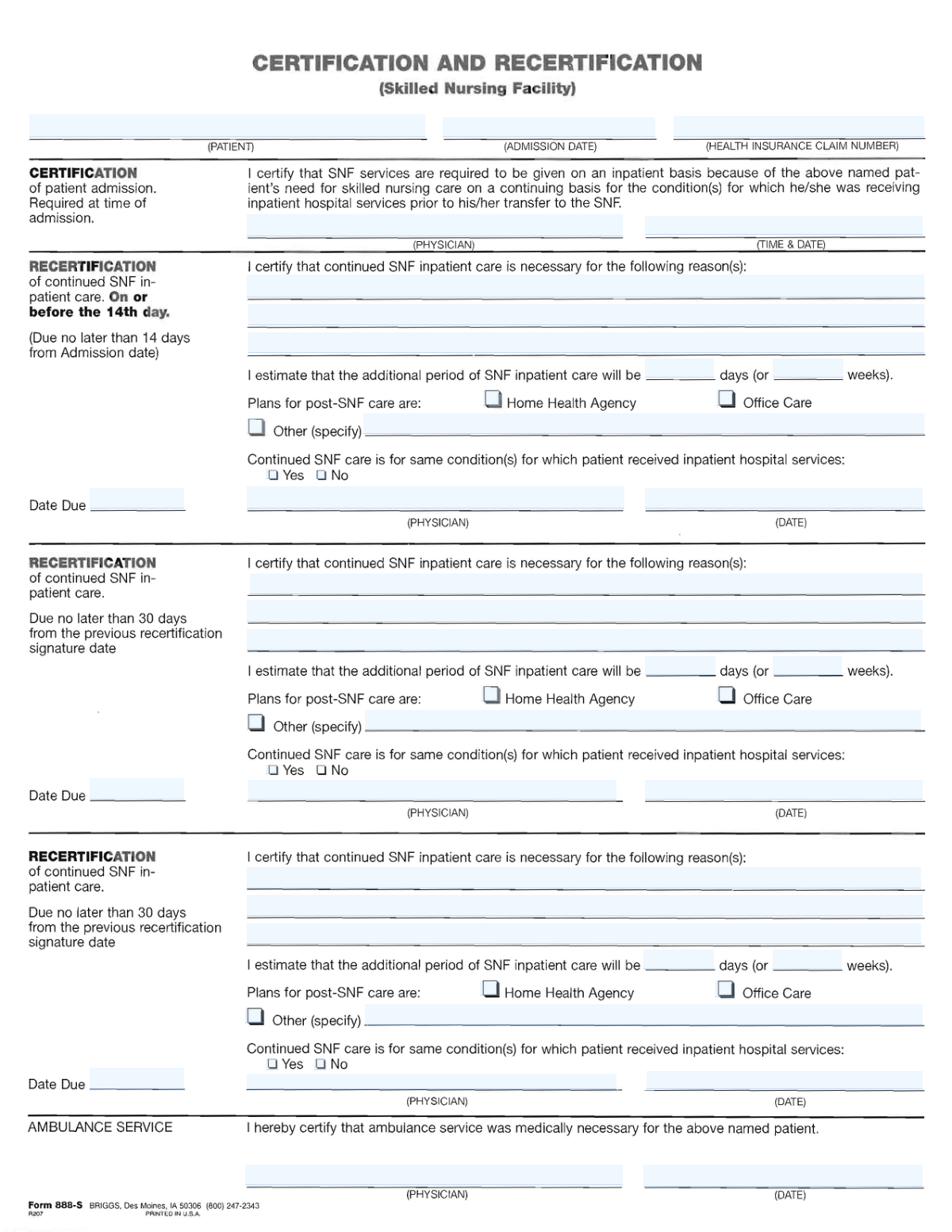
This form is a critical medical document used by physicians to certify that a patient requires inpatient services at a Skilled Nursing Facility (SNF) and to periodically recertify the ongoing need for such care. This documentation is essential for patient care management and for insurance and Medicare/Medicaid reimbursement purposes. Today, this form can be filled out quickly and accurately using AI-powered services like Instafill.ai, which can also convert non-fillable PDF versions into interactive fillable forms.
Form 888-5 has a basic Form Complexity Index of 42/100 — 48 fillable fields across 1 page. Instafill’s AI completes it accurately in under a minute.

Form specifications

Form name: Certification and Recertification (Skilled Nursing Facility)
Number of fields: 48
Number of pages: 1
FCI: Basic (42/100)
Language: English
Our AI automatically handles information lookup, data retrieval, formatting, and form filling.
It takes less than a minute to fill out Form 888-5 using our AI form filling.
Securely upload your data. Information is encrypted in transit and deleted immediately after the form is filled out.
Preview of Certification and Recertification (Skilled Nursing Facility)

Instafill Demo: How to fill out PDF forms in seconds with AI

How to Fill Out Form 888-5 Online for Free in 2026

Are you looking to fill out a FORM 888-5 form online quickly and accurately? Instafill.ai offers the #1 AI-powered PDF filling software of 2026, allowing you to complete your FORM 888-5 form in just 37 seconds or less.
Follow these steps to fill out your FORM 888-5 form online using Instafill.ai:
  1. 1 Navigate to Instafill.ai and upload the Certification and Recertification (Skilled Nursing Facility) form or select it from the template library.
  2. 2 Enter the patient's name, admission date, and health insurance claim number in the designated fields.
  3. 3 Complete the initial certification section, explaining the patient's need for skilled nursing care, and provide the physician's signature and date.
  4. 4 For subsequent recertifications, fill out the appropriate section with the reasons for continued care, the estimated duration, and plans for post-SNF care.
  5. 5 If ambulance services were used, complete the certification section to confirm it was medically necessary.
  6. 6 Carefully review all entered information, including patient details, certification reasons, and physician signatures, to ensure accuracy.
  7. 7 Securely download, print, or share the completed form directly from the Instafill.ai platform for patient records and billing.

Our AI-powered system ensures each field is filled out correctly, reducing errors and saving you time.

Why Choose Instafill.ai for Your Fillable Form 888-5 Form?

Speed

Complete your Form 888-5 in as little as 37 seconds.

Up-to-Date

Always use the latest 2026 Form 888-5 form version.

Cost-effective

No need to hire expensive lawyers.

Accuracy

Our AI performs 10 compliance checks to ensure your form is error-free.

Security

Your personal information is protected with bank-level encryption.

Frequently Asked Questions About Form 888-5

Form 888-5 has a Form Complexity Index of 42 out of 100, placing it in the basic complexity tier. This score is calculated deterministically from the form’s own structure using Instafill’s published Form Complexity Index methodology, so it can be reproduced and independently verified — it is not a subjective estimate.

For Form 888-5 specifically, the score reflects 48 fillable fields across 1 page. The number of fields is the largest factor in the base score (weighted 36%), followed by how difficult those fields are to complete based on their type, where free-text and signature fields count for more than simple checkboxes (26%). The number of pages that actually contain fields (15%), the amount of conditional “fill-only-if” logic (16%), and how many sections the form is divided into (7%) account for the rest of the base. On top of that base, the index adds points for tables and repeating lists, bundled instruction pages, and dense page layouts — capturing difficulty the base alone can miss.

In practical terms, a basic score means the form is relatively light, but still needs careful, accurate entry. Instafill removes that effort entirely: our AI reads your information, maps each value to the correct field — including the conditional ones — and completes Form 888-5 accurately in under a minute, with every field available for you to review before you download. See exactly how the Form Complexity Index is calculated.

This form is used by a physician to certify that a patient's admission to a Skilled Nursing Facility (SNF) is medically necessary. It is also used to periodically recertify the ongoing need for SNF care to ensure continued insurance or Medicare coverage.

A physician must complete, sign, and date this form. The physician's signature certifies the medical necessity of the patient's stay at the Skilled Nursing Facility.

The initial certification must be completed at the time of the patient's admission to the Skilled Nursing Facility (SNF). This confirms the patient requires inpatient skilled nursing care for the condition they were treated for in the hospital.

The first recertification must be completed on or before the 14th day after the patient's admission date. The physician must state the reasons for continued care and estimate the additional time needed.

After the first 14-day recertification, subsequent recertifications are required no later than 30 days from the previous recertification signature date. This ensures the patient's condition is regularly reviewed for continued medical necessity.

You will need the patient's full name, their admission date to the facility, and their Health Insurance Claim Number, which is often their Medicare number.

The physician should briefly describe the specific skilled nursing or therapy services the patient requires that justify their continued inpatient stay. This could include services like wound care, IV therapy, or intensive physical therapy.

In this section, the physician must indicate the expected care plan for the patient after they are discharged from the SNF. Options include a Home Health Agency, Office Care, or another specified plan.

This section is for a physician to certify that using an ambulance service was medically necessary for the patient. This certification is often required for insurance or Medicare reimbursement of the ambulance transport.

Failing to complete a recertification by the specified deadline can result in a denial of payment from Medicare or other insurance providers for that period of care. It is crucial to adhere to these timelines to ensure uninterrupted coverage.

Yes, AI-powered services like Instafill.ai can help by accurately auto-filling recurring information such as patient details and facility information. This saves time and reduces manual data entry errors, though the physician must still provide the medical justification and signature.

You can use a service like Instafill.ai to make the form interactive. Simply upload the flat PDF, and the tool will convert it into a fillable format, allowing you to type directly into the fields.

To fill this form online, upload the PDF to Instafill.ai. The platform's AI will identify the fields and can auto-populate them with saved patient information, after which the physician can complete the medical certification sections and sign.

Compliance Form 888-5
Validation Checks by Instafill.ai

1
Ensures Admission Date is a Valid Date
This check verifies that the 'ADMISSION DATE' field contains a valid, parseable date in a standard format (e.g., MM/DD/YYYY). This date is the baseline for all subsequent deadlines on the form, so its accuracy is critical for compliance. A failure would prevent the calculation of recertification due dates and could lead to claim denials.
2
Health Insurance Claim Number Presence and Format
Validates that the 'HEALTH INSURANCE CLAIM NUMBER' field is not empty and conforms to the expected format, such as the Medicare Beneficiary Identifier (MBI) format. This number is essential for correctly identifying the patient and processing claims with the insurer. An incorrect or missing number will result in processing failure and payment delays.
3
Initial Certification Date Logic
This check ensures the 'TIME & DATE' of the initial physician certification is on or after the patient's 'ADMISSION DATE'. A certification dated before admission is logically impossible and would invalidate the claim. This validation maintains the chronological integrity of the patient's care timeline.
4
First Recertification Deadline Compliance
Verifies that the date of the first recertification is no later than 14 days after the 'ADMISSION DATE', as explicitly stated on the form. This is a strict regulatory requirement for continued coverage of SNF services. Failure to meet this deadline can result in a gap in coverage and non-payment for services rendered after the 14th day.
5
Subsequent Recertification Deadline Compliance
This check confirms that each subsequent recertification is dated no more than 30 days after the signature date of the *previous* recertification. This rule ensures continuous, timely justification for the patient's stay. A late recertification can lead to claim denials for the period following the deadline.
6
Sequential Integrity of Recertification Dates
Ensures that the date of any recertification is strictly after the date of the preceding certification or recertification. For example, the second recertification cannot be dated on or before the first. This prevents illogical or fraudulent entries and ensures a clear, progressive timeline of care justification.
7
Completeness of Recertification Reason
If any recertification section is used (i.e., signed and dated), this check ensures the corresponding free-text field for 'reason(s)' for continued care is not empty. A blank reason fails to provide the required medical justification for the patient's continued stay. This omission would make the recertification invalid and could trigger an audit or claim denial.
8
Exclusive Selection for Estimated Care Period
Validates that for the 'estimated additional period of SNF inpatient care', either the 'days' field or the 'weeks' field is filled with a numeric value, but not both. This prevents ambiguity in the physician's prognosis for the length of stay. If both or neither are filled, the form is considered incomplete and cannot be processed correctly.
9
Conditional Requirement for 'Other' Post-SNF Plan
In any recertification section, if the 'Other (specify)' checkbox under 'Plans for post-SNF care' is selected, this validation ensures the adjacent text field is filled out. This provides necessary detail for the patient's discharge plan. A missing specification makes the plan unclear and the form incomplete.
10
Mandatory Selection of Post-SNF Care Plan
For any completed recertification section, this check verifies that at least one of the 'Plans for post-SNF care' checkboxes ('Home Health Agency', 'Office Care', or 'Other') has been selected. A care plan is a required component of the recertification process. Failure to indicate a plan results in an incomplete submission.
11
Physician Signature Presence for Completed Sections
This validation confirms that if any certification or recertification section contains data (e.g., a date), the corresponding 'PHYSICIAN' signature field must also be filled. The physician's signature is the legal attestation that makes the certification valid. A missing signature on a completed section renders that part of the form invalid.
12
Patient Name Completeness
Verifies that the 'PATIENT' name field at the top of the form is not empty. The patient's name is the primary identifier linking the entire document to a specific individual. A missing name makes the form useless as it cannot be associated with any patient's record or claim.

Common Mistakes in Completing Form 888-5

Missing or Late Initial Certification

The initial certification must be signed by the physician at the time of the patient's admission to the Skilled Nursing Facility (SNF). This is often missed during the busy admission process. Failure to obtain this timely signature can lead to non-compliance and denial of payment for the entire SNF stay, as it invalidates the medical necessity from day one. To avoid this, integrate this form into the mandatory admission checklist and ensure it is signed before the admission process is considered complete.

Untimely Recertification Signatures

The form clearly specifies deadlines for recertification: on or before the 14th day, and then every 30 days thereafter. Staff often lose track of these dates, resulting in late signatures. A gap in certification dates can lead to automatic claim denials for the uncovered period. To prevent this, use a calendar system or EHR alerts to track each patient's recertification due dates and proactively obtain the physician's signature in advance.

Vague Justification for Continued Care

In the recertification sections, physicians may write generic reasons like 'continued therapy' or 'slow progress.' These vague statements are insufficient for auditors, who require specific clinical justification for continued skilled care. This can result in retroactive denials for lack of medical necessity. To avoid this, physicians should document specific skilled needs, such as 'Daily physical therapy for gait and transfer training post-CVA' or 'Skilled nursing for wound care management of a non-healing surgical site.'

Incorrect Health Insurance Claim Number (HICN)

Typographical errors or transposing digits in the Health Insurance Claim Number (HICN) or Medicare Beneficiary Identifier (MBI) is a frequent data entry mistake. An incorrect identifier will cause the claim to be rejected immediately, delaying reimbursement and requiring administrative effort to correct and resubmit. Always double-check the number against the patient's official insurance card or admission face sheet. AI-powered tools like Instafill.ai can help by validating number formats and cross-referencing data to reduce such errors.

Incomplete Post-SNF Care Plan

The section for 'Plans for post-SNF care' is often left blank or the 'Other' box is checked without providing a specific plan. This indicates incomplete discharge planning, which is a red flag for auditors and a violation of care planning regulations. This can lead to claim scrutiny and potential denials. Ensure a box is always checked and if 'Other' is selected, a clear, specific plan like 'Transfer to assisted living' or 'Care at home with family support' is written in.

Ambiguous Estimate for Additional Care

When estimating the additional period of SNF care, staff may write a number without specifying 'days' or 'weeks,' leaving the duration ambiguous. For example, just writing '2' is unclear. This ambiguity can cause issues during audits as it reflects poor planning. To avoid this, always circle either 'days' or 'weeks' next to the number entered to provide a clear and defensible estimate of the expected length of stay.

Forgetting the Ambulance Service Certification

The certification for ambulance service is a small, separate section at the bottom of the form that is easily overlooked. If the patient was transported to the SNF via ambulance and this section is not signed by the physician, the claim for the ambulance service will likely be denied for lack of certified medical necessity. To prevent this, staff should verify if an ambulance was used for admission and, if so, ensure the physician signs this section along with the initial SNF certification.

Illegible Handwriting and Signatures

Since this form is often printed and filled out by hand, illegible handwriting for patient details, justifications, or physician names is a major problem. This can lead to data entry errors when information is keyed into the billing system and may make it impossible for an auditor to verify the physician's identity or the date of signature. Since this is a non-fillable PDF, using a tool like Instafill.ai to convert it into a fillable version allows for clear, typed text before printing for a final, legible signature.

Mismatched Physician Signature Dates

The date written next to the physician's signature must fall within the required certification period and accurately reflect when the form was actually signed. Back-dating or future-dating the form, or having a date that falls outside the 14-day or 30-day window, will invalidate the certification. This is a serious compliance issue that leads to claim denials. Ensure the form is signed and dated by the physician on the same day and within the correct timeframe.
Saved over 80 hours a year

“I was never sure if my IRS forms like W-9 were filled correctly. Now, I can complete the forms accurately without any external help.”

Kevin Martin Green

Your data stays secure with advanced protection from Instafill and our subprocessors

Robust compliance program

Transparent business model

You’re not the product. You always know where your data is and what it is processed for.

ISO 27001, HIPAA, and GDPR

Our subprocesses adhere to multiple compliance standards, including but not limited to ISO 27001, HIPAA, and GDPR.

Security & privacy by design

We consider security and privacy from the initial design phase of any new service or functionality. It’s not an afterthought, it’s built-in, including support for two-factor authentication (2FA) to further protect your account.

Fill out Form 888-5 with Instafill.ai

Worried about filling PDFs wrong? Instafill securely fills certification-and-recertification-skilled-nursing-facility forms, ensuring each field is accurate.