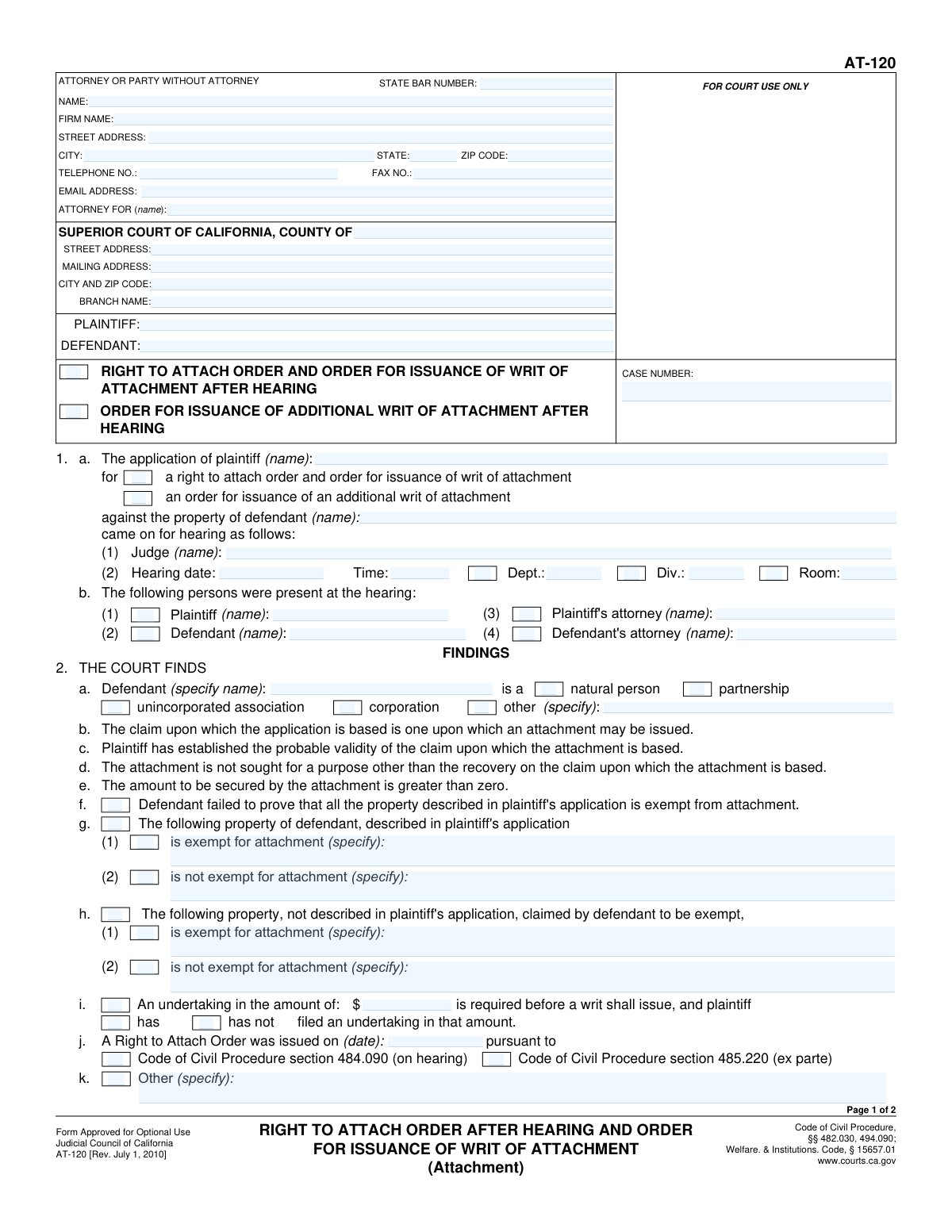
Yes! You can use AI to fill out Form AT-120, Right to Attach Order After Hearing and Order for Issuance of Writ of Attachment
The Right to Attach Order After Hearing and Order for Issuance of Writ of Attachment, Form AT-120, is a legal document issued by a California court. It formalizes the court's decision to grant a plaintiff the right to seize a defendant's assets to secure a potential judgment in a lawsuit. This order is crucial as it prevents the defendant from disposing of property that could be used to satisfy a future debt. Today, this form can be filled out quickly and accurately using AI-powered services like Instafill.ai, which can also convert non-fillable PDF versions into interactive fillable forms.
Our AI automatically handles information lookup, data retrieval, formatting, and form filling.
It takes less than a minute to fill out AT-120 using our AI form filling.
Securely upload your data. Information is encrypted in transit and deleted immediately after the form is filled out.
Form specifications
| Form name: | Form AT-120, Right to Attach Order After Hearing and Order for Issuance of Writ of Attachment |
| Number of fields: | 99 |
| Number of pages: | 2 |
| Language: | English |
Instafill Demo: How to fill out PDF forms in seconds with AI
How to Fill Out AT-120 Online for Free in 2026
Are you looking to fill out a AT-120 form online quickly and accurately? Instafill.ai offers the #1 AI-powered PDF filling software of 2026, allowing you to complete your AT-120 form in just 37 seconds or less.
Follow these steps to fill out your AT-120 form online using Instafill.ai:
- 1 Navigate to Instafill.ai and upload or select the AT-120 form.
- 2 Enter the court and case information, including the county, case number, and the names of the plaintiff and defendant.
- 3 Provide the details of the court hearing, such as the judge's name, hearing date, and a list of who was present.
- 4 Complete the 'Findings' section by checking the appropriate boxes to reflect the court's determinations on the claim's validity, exempt property, and any required undertaking.
- 5 Fill out the 'Order' section, specifying the total amount the plaintiff has a right to attach and describing the specific property subject to the writ of attachment.
- 6 Review all auto-filled information for accuracy and completeness before the form is presented to the judicial officer for signature.
- 7 Securely download, print, or share the completed Form AT-120 for filing with the court and service.
Our AI-powered system ensures each field is filled out correctly, reducing errors and saving you time.
Why Choose Instafill.ai for Your Fillable AT-120 Form?
Speed
Complete your AT-120 in as little as 37 seconds.
Up-to-Date
Always use the latest 2026 AT-120 form version.
Cost-effective
No need to hire expensive lawyers.
Accuracy
Our AI performs 10 compliance checks to ensure your form is error-free.
Security
Your personal information is protected with bank-level encryption.
Frequently Asked Questions About Form AT-120
Form AT-120 is a court order signed by a judge after a hearing. It officially grants a plaintiff the legal right to have a defendant's property attached (secured) to ensure funds are available to pay a potential future judgment.
This form is a court order that is completed based on a judge's findings from a hearing. Typically, the plaintiff's attorney prepares the form for the judge to review and sign.
Receiving this form means that after a court hearing, a judge has granted the plaintiff the right to attach your property. This is a pre-judgment action to secure assets for the amount specified in the order while the case is ongoing.
The Right to Attach Order (this form) is the judge's decision granting permission to attach property. The Writ of Attachment is the subsequent document issued by the court clerk that directs a levying officer, like a sheriff, to actually seize or place a lien on the property.
An undertaking is a financial bond that the plaintiff must purchase and file with the court. It serves as a financial guarantee to cover any damages you might incur if the attachment is later found to have been wrongful.
California law protects certain types of property from being seized to pay a debt, such as a portion of your wages, necessary household items, or a homestead exemption on your primary residence. The order will specify any of your property that the court has determined is legally exempt.
Once the order is signed and the plaintiff files the required undertaking, the court clerk will issue a Writ of Attachment. A levying officer will then use that writ to take legal control of the non-exempt property listed in the order.
The form includes a clear warning that failure to comply with the court's order is a serious matter. You could be held in contempt of court, which can result in fines and potentially even arrest and jail time.
The main opportunity to argue against the attachment was at the hearing that occurred before this order was created. You should consult with an attorney immediately to explore any remaining options, such as an appeal or filing a new claim of exemption.
Yes, AI-powered services like Instafill.ai can help you prepare Form AT-120 accurately and efficiently. These tools can auto-fill case information, party names, and other details, saving time and reducing the chance of clerical errors.
You can upload the AT-120 PDF to the Instafill.ai platform. The service will make the form fillable online, allowing you to quickly enter all the required information from the court's findings before printing the completed form for the judge's signature.
If you have a non-fillable or 'flat' PDF, you can use a tool like Instafill.ai. Simply upload the file, and the platform will automatically convert it into an interactive, fillable form that you can complete on your computer.
This is a legal finding made by the judge that the plaintiff is more likely than not to win the lawsuit. This determination is a crucial prerequisite before the court will grant a pre-judgment remedy like a right to attach order.
Compliance AT-120
Validation Checks by Instafill.ai
1
Case Number Presence and Format
This check verifies that the 'CASE NUMBER' field is not empty and conforms to the expected format for the specified court jurisdiction. A valid case number is crucial for correctly filing the document and associating it with the proper legal proceedings. If the case number is missing or incorrectly formatted, the form may be rejected by the court clerk, causing significant delays.
2
Attorney State Bar Number Validation
Ensures that if an attorney's name is provided in the 'ATTORNEY FOR' section, the 'STATE BAR NUMBER' field contains a valid, numeric identifier. This is important for verifying the attorney's credentials and active status with the state bar. A missing or invalid bar number could lead to questions about representation and potential rejection of the filing.
3
Exclusive Application Type Selection
Validates that in section 1.a, exactly one of the two checkboxes ('a right to attach order...' or 'an order for issuance of an additional writ...') is selected. The form cannot be processed if the application's purpose is ambiguous or if both options are selected. This check ensures the court's order is clear and addresses a single, specific request.
4
Hearing Date Validity
This check confirms that the 'Hearing date' in section 1.a.(2) is a valid calendar date and is not a future date. The order is issued *after* a hearing, so the date must be in the past or the present. An invalid or future date would render the finding illogical and cause the order to be legally questionable.
5
Conditional Defendant Entity Specification
Verifies that in section 2.a, one defendant entity type checkbox is selected. If the 'other' checkbox is selected, this validation ensures the corresponding text field is filled with a description of the entity type. This information is critical for determining which assets can be legally attached, and failure to specify the entity type can make the order unenforceable.
6
Undertaking Amount and Status
In section 2.i, this check ensures the undertaking amount is a valid, positive currency value (e.g., '$10,000.00'). It also validates that one of the two options, 'has' or 'has not', is selected to indicate the filing status of the undertaking. An invalid amount or missing status prevents the court from confirming that the plaintiff's financial obligation to protect the defendant has been met.
7
Prior Right to Attach Order Date
Validates that if section 2.j is completed, the provided date is a valid calendar date that occurs in the past. This section refers to a previously issued order, so the date cannot be in the future. An incorrect date would create an inconsistency in the case record and could invalidate the basis for an additional writ.
8
Attachment Amount Greater Than Zero
This check ensures the dollar amount specified in section 3.a is a valid currency format and is greater than zero. This corresponds to finding 2.e, which states the amount to be secured must be greater than zero. An amount of zero or less would make the attachment order meaningless and legally void.
9
Conditional Undertaking Amount for Writ Issuance
In section 3.c, if the checkbox 'upon the filing of an undertaking' is selected, this validation ensures that a corresponding dollar amount is entered. The order to the clerk to issue the writ is conditional upon this filing, so the amount must be specified. If the amount is missing, the clerk cannot verify the condition has been met and will not issue the writ.
10
Property Specification for Natural Person
Validates that if checkbox 3.c.(2) is checked, indicating attachment of property of a natural person, the associated 'specify' text field is not empty. The law requires specific identification of non-exempt property for natural persons. Failure to specify the property makes this part of the order vague and unenforceable by the levying officer.
11
Liquor License Number Requirement
Ensures that if checkbox 3.c.(4) is checked, relating to proceeds from the sale of a liquor license, the 'license number' field is filled in. The license number is a unique identifier required to properly direct the escrow holder and levying officer. Without the specific license number, the order cannot be executed against the correct asset.
12
Property Transfer Specification
In section 3.d, if the checkbox for item (3) 'the following property in defendant's possession' is checked, this validation ensures the 'specify' text field is filled. The order must clearly identify the specific property the defendant is compelled to transfer. A blank description makes the order ambiguous and unenforceable, and the defendant cannot be held in contempt for non-compliance.
13
Checkbox Total Verification
This check automatically counts the number of checkboxes selected within the entirety of section 3 ('ORDER') and compares it to the number entered in field 3.f. This serves as a cross-check to prevent clerical errors and ensure all intended orders are accounted for. A mismatch indicates a potential omission or an incorrectly filled form, which could lead to confusion or an incomplete execution of the court's order.
14
Party Name Consistency
Verifies that the Plaintiff and Defendant names entered in the header section match the names used in subsequent sections, such as 1.a, 2.a, and 3.a. Consistent naming is essential for legal clarity and to ensure the order applies to the correct parties in the lawsuit. Inconsistencies could create ambiguity and provide grounds for challenging the order's validity.
Common Mistakes in Completing AT-120
Users often enter a case number, party names, or court information that does not exactly match the official court record. This can happen due to typos or referencing an outdated document. An incorrect case caption can lead to the document being rejected by the court clerk, causing significant delays and requiring refiling.
In sections 2g, 2h, and 3c, filers must specifically describe the property to be attached or exempted. A common mistake is using general terms like 'bank account' without providing the institution name and account number. This ambiguity can render the order unenforceable, as the levying officer cannot identify the specific asset, leading to further hearings and disputes.
The top of page 2 requires the 'SHORT TITLE' and 'CASE NUMBER' to be re-entered. People frequently overlook this, assuming the information from page 1 is sufficient. If the pages are separated during processing, an incomplete page 2 header can cause the page to be lost or misfiled, potentially invalidating the entire order until the error is corrected.
Section 2a requires specifying whether the defendant is a 'natural person,' 'corporation,' 'partnership,' etc. Filers may guess or leave this blank, but the choice has major legal consequences, as the types of property that can be attached differ significantly between individuals and business entities. An error here can invalidate the attachment on certain properties and lead to legal challenges.
When ordering an attachment on specific types of property in section 3c, crucial identifiers are often missed. For example, a filer might check box 3c(4) for a liquor license but forget to enter the license number, or check 3c(2) for a natural person's property without providing the required detailed description. This omission makes the specific order for that property ineffective and requires an amended order to correct.
In sections 2i and 3c, the amount of the required undertaking (bond) must be stated, and the filer must indicate if it has been filed. Mistakes include entering conflicting amounts in the two sections or incorrectly stating the filing status. An incorrect bond amount or failure to file the required undertaking will prevent the clerk from issuing the writ of attachment, halting the entire enforcement process.
Throughout the form, the plaintiff and defendant names must be written exactly as they appear in the main case caption. Filers sometimes use abbreviations, alternate spellings, or omit 'Jr.'/'Sr.' in subsequent sections after writing it correctly on the first page. This inconsistency can create legal ambiguity and may be grounds for the opposing party to challenge the order's validity.
Section 3f asks for the 'Total number of boxes checked in item 3.' This is a simple clerical check that is easily forgotten. While a minor error, court clerks may return the form for correction, viewing it as incomplete. This adds an unnecessary delay to the process of getting the judicial officer's signature and having the order entered.
The top-left section for the 'ATTORNEY OR PARTY WITHOUT ATTORNEY' is often filled out incompletely. Filers may omit their State Bar number, fax number, or email address. This can impede communication from the court and opposing counsel, leading to missed deadlines or important notices. Ensuring all contact information is present and accurate is crucial for smooth case management.
In section 1a, the filer must choose between an application for 'a right to attach order' and 'an order for issuance of an additional writ of attachment.' These are legally distinct requests. Selecting the wrong one can result in the application being denied on procedural grounds, as the legal findings and requirements for an initial order differ from those for an additional writ.
Saved over 80 hours a year
“I was never sure if my IRS forms like W-9 were filled correctly. Now, I can complete the forms accurately without any external help.”
Kevin Martin Green
Your data stays secure with advanced protection from Instafill and our subprocessors
Robust compliance program
Transparent business model
You’re not the product. You always know where your data is and what it is processed for.
ISO 27001, HIPAA, and GDPR
Our subprocesses adhere to multiple compliance standards, including but not limited to ISO 27001, HIPAA, and GDPR.
Security & privacy by design
We consider security and privacy from the initial design phase of any new service or functionality. It’s not an afterthought, it’s built-in, including support for two-factor authentication (2FA) to further protect your account.
Fill out AT-120 with Instafill.ai
Worried about filling PDFs wrong? Instafill securely fills form-at-120-right-to-attach-order-after-hearing-and-order-for-issuance-of-writ-of-attachment forms, ensuring each field is accurate.