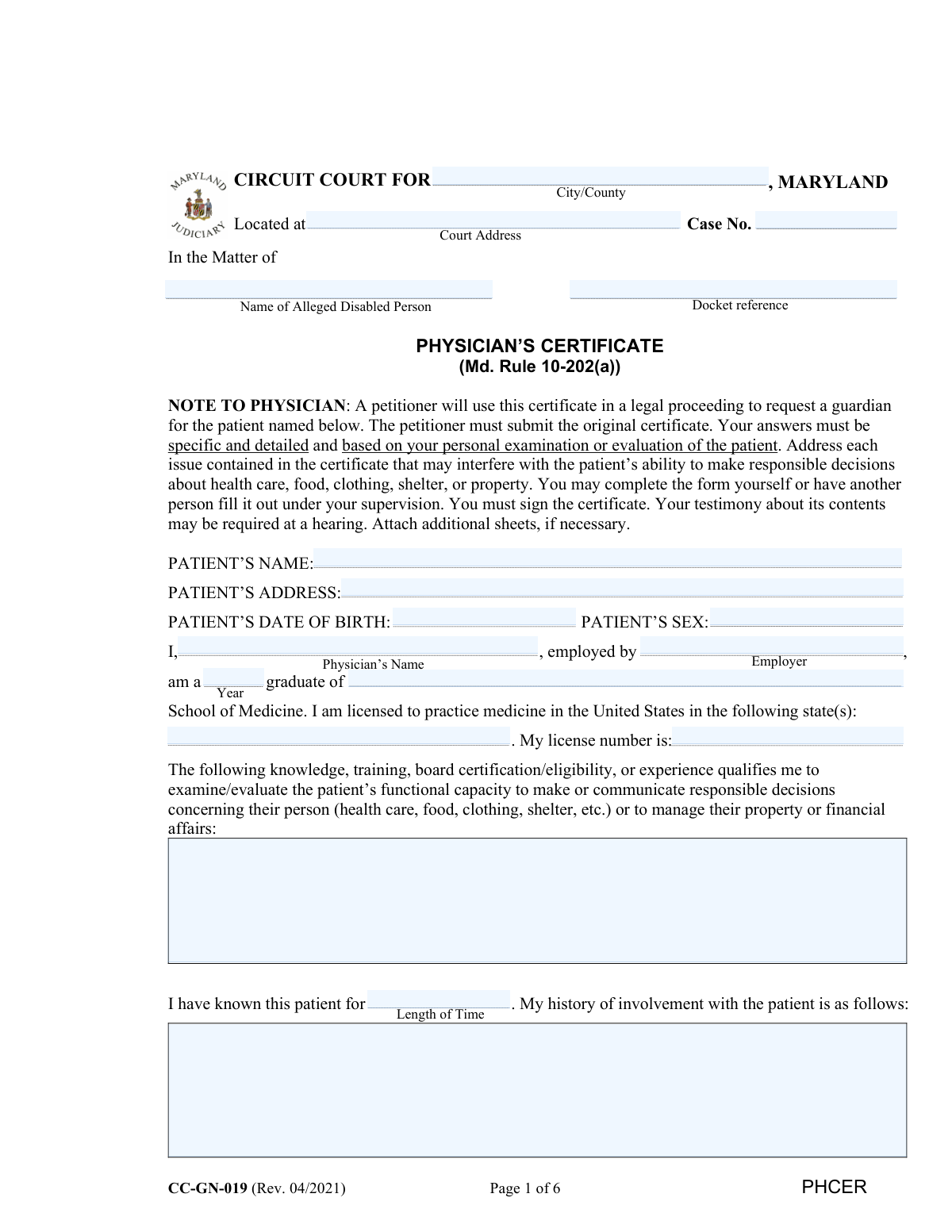
Yes! You can use AI to fill out Form CC-GN-019, Physician's Certificate (Md. Rule 10-202(a))
This form, known as the Physician's Certificate (CC-GN-019), is a legal document required by Maryland courts in guardianship cases. A licensed physician completes it to provide a detailed medical evaluation of an individual's physical and mental condition, cognitive function, and ability to make responsible decisions about their personal care and property. This certificate serves as critical evidence for the court to determine if a guardian is necessary. Today, this form can be filled out quickly and accurately using AI-powered services like Instafill.ai, which can also convert non-fillable PDF versions into interactive fillable forms.
Our AI automatically handles information lookup, data retrieval, formatting, and form filling.
It takes less than a minute to fill out CC-GN-019 using our AI form filling.
Securely upload your data. Information is encrypted in transit and deleted immediately after the form is filled out.
Form specifications
| Form name: | Form CC-GN-019, Physician's Certificate (Md. Rule 10-202(a)) |
| Number of fields: | 246 |
| Number of pages: | 6 |
| Language: | English |
Instafill Demo: How to fill out PDF forms in seconds with AI
How to Fill Out CC-GN-019 Online for Free in 2026
Are you looking to fill out a CC-GN-019 form online quickly and accurately? Instafill.ai offers the #1 AI-powered PDF filling software of 2026, allowing you to complete your CC-GN-019 form in just 37 seconds or less.
Follow these steps to fill out your CC-GN-019 form online using Instafill.ai:
- 1 Navigate to Instafill.ai and upload or select the Maryland Physician's Certificate, Form CC-GN-019.
- 2 Provide the physician's personal and professional information, including name, employer, medical qualifications, and license details.
- 3 Detail the patient's examination, specifying the date, location (in-person or remote), duration, and any tests performed.
- 4 Enter the patient's physical and mental diagnoses, overall health assessment, current medications, and an evaluation of their cognitive functions like memory and alertness.
- 5 Assess the patient's ability to perform daily living activities and participate in legal matters.
- 6 State your professional opinion on whether the patient's disability necessitates a guardianship of their person and/or property, detailing what decisions they can and cannot make.
- 7 Carefully review all entered information for completeness and accuracy, then electronically sign and date the certificate to affirm its contents under penalty of perjury.
Our AI-powered system ensures each field is filled out correctly, reducing errors and saving you time.
Why Choose Instafill.ai for Your Fillable CC-GN-019 Form?
Speed
Complete your CC-GN-019 in as little as 37 seconds.
Up-to-Date
Always use the latest 2026 CC-GN-019 form version.
Cost-effective
No need to hire expensive lawyers.
Accuracy
Our AI performs 10 compliance checks to ensure your form is error-free.
Security
Your personal information is protected with bank-level encryption.
Frequently Asked Questions About Form CC-GN-019
This form is a legal document used in Maryland courts to support a petition for guardianship. It provides a physician's professional assessment of a patient's ability to make responsible decisions about their personal care and property.
A physician licensed to practice medicine in the United States who has personally examined or evaluated the patient must complete and sign this certificate. The answers must be based on the physician's direct assessment.
The petitioner who is requesting the guardianship is responsible for submitting the original, signed certificate to the circuit court as part of the legal proceeding.
No, not necessarily. The form allows for the examination to be conducted in person at various locations or remotely using audio and visual technology, but you must explain why an in-person meeting did not occur if you choose the remote option.
Guardianship of the Person concerns decisions about health care, food, and shelter, while Guardianship of the Property relates to managing finances and assets. The form requires the physician to provide a separate opinion on the patient's capacity for each.
Your answers must be specific and detailed, based on your personal examination of the patient. You should attach additional sheets if the space provided is insufficient to fully explain the patient's conditions and functional limitations.
It is possible. The form explicitly states that your testimony about the certificate's contents may be required at a court hearing.
Yes, you may have another person fill out the form under your supervision. However, you are ultimately responsible for the accuracy of the information and must personally sign the completed certificate.
This information helps the court understand if the patient's condition could improve with treatment. It is crucial for determining whether a guardianship is necessary and, if so, what its scope and duration should be.
By signing, you are solemnly affirming under the penalties of perjury that the contents of the document are true and based on your personal knowledge and examination. Providing false information can have serious legal consequences.
Yes, AI-powered services like Instafill.ai can help you fill out this form more efficiently. These tools use AI to accurately auto-fill patient information, your credentials, and other data, which saves time and reduces errors.
To fill this form online with Instafill.ai, you can upload the PDF to their platform. The AI will identify the fields, allowing you to fill them out interactively or use auto-fill to populate information quickly before downloading the completed document.
If you have a non-fillable PDF, you can use a service like Instafill.ai to make it interactive. Their platform can convert flat, non-fillable PDFs into a fillable format online, so you don't have to print and fill it by hand.
Compliance CC-GN-019
Validation Checks by Instafill.ai
1
Patient's Date of Birth Format and Plausibility
This check validates that the 'Patient’s Date of Birth' is entered in a valid MM/DD/YYYY format and represents a date that is in the past. It also checks that the calculated age is plausible for a guardianship proceeding (e.g., not in the future, and not an extreme age like over 120). This is crucial for verifying the patient's identity and age correctly for the legal record. If validation fails, the form cannot be submitted, and the user will be prompted to enter a valid date.
2
Examination Date vs. Signature Date Logic
This validation ensures that any date entered for an examination or evaluation (in-person or remote) is on or before the physician's signature date at the end of the form. This is important because the physician's affirmation applies to findings from examinations that have already occurred. A future examination date would invalidate the certificate's claims. A failure would trigger an error message requiring the user to correct the dates before submission.
3
Mandatory Examination Method Selection
This check ensures that the physician has selected at least one primary method of examination, either 'in person' or 'remotely'. The entire certificate is based on the physician's evaluation, so the method must be documented. Failure to select a method would leave the basis of the medical opinion unclear, so the form submission would be blocked until a selection is made.
4
Conditional Requirement for Remote Evaluation Justification
If the 'remotely, with audio and visual access' checkbox is selected, this validation confirms that the 'I did not meet with the patient in person because' text field is not empty. The form explicitly requires a justification for not conducting an in-person exam. This is a critical detail for the court to assess the quality of the evaluation. If the reason is missing, the user will be prompted to provide it.
5
Patient Name Consistency Across Form
This validation compares the 'Name of Alleged Disabled Person' field at the top of the form with the 'Patient’s Name' field in the patient information section. The names must match exactly to ensure the medical certificate is correctly associated with the individual in the legal case. A mismatch could lead to serious legal complications, so an error is shown if the names are different.
6
Conditional Requirement for Mental Health Improvement Timeframe
This check is triggered if the physician selects 'Improve' for the patient's 'Overall mental health will:'. It validates that the corresponding field for re-examination timeframe ('in __ weeks') is filled with a numeric value. This is important for scheduling legally mandated follow-ups in cases where the condition is not permanent. If the timeframe is missing, the form will prompt the physician to enter the number of weeks.
7
Logical Consistency for Partial Guardianship Opinion
In the 'NEED FOR GUARDIANSHIP' sections, if the physician selects the option indicating a partial disability (i.e., the patient can make 'some' decisions), this check ensures that both the 'is able to make decisions regarding' and 'is unable to make decisions regarding' text areas are filled. A partial opinion is incomplete without specifying both capabilities and limitations. If either field is empty, the user will be required to provide the specific details.
8
Mandatory Physician Signature and Date
This validation ensures that the 'Physician’s Signature' and 'Date' fields on the final page are not empty. The signature is a legal affirmation of the document's truthfulness under penalty of perjury, and the date establishes its timeliness. Without these, the document has no legal standing. The system will prevent submission until these critical fields are completed.
9
Conditional Requirement for 'Other' Communication Method
If the 'Other means' checkbox is selected in the 'I communicated with the patient in the following manner' section, this validation ensures the corresponding description field is filled out. This information is vital for understanding how the physician overcame potential communication barriers to perform an accurate evaluation. If the description is missing, an error will prompt the user to specify the method used.
10
Conditional Requirement for IADL Assistance Details
In the 'EVERYDAY FUNCTIONING' section, for each Instrumental Activity of Daily Living (IADL), if the 'with assistance' option is selected, this check verifies that the corresponding text field describing the specific assistance needed is not empty. This level of detail is essential for the court to craft a guardianship order that is tailored to the patient's actual needs. A failure will prompt the user to describe the required assistance.
11
Mutually Exclusive Diagnosis Selection
This check ensures that for 'Physical conditions' and 'Mental conditions', the user cannot select both 'None' and 'The patient has the following... diagnoses' simultaneously. These options are mutually exclusive and selecting both creates a logical contradiction. If both are checked, the system will display an error and require the user to choose only one option to proceed.
12
Mandatory Final Opinion on Guardianship
This validation confirms that a selection has been made in both the 'NEED FOR GUARDIANSHIP OF THE PERSON' and 'NEED FOR GUARDIANSHIP OF THE PROPERTY' sections. The primary purpose of the form is to provide a clear medical opinion on these two matters. Failure to provide an opinion on either makes the certificate incomplete for the court's purposes, so submission will be blocked until both sections are answered.
13
Physician License Number Presence
This check verifies that the 'License Number' field is not empty. The physician's medical license number is a key piece of credentialing information that confirms their authority to make a medical assessment for a legal proceeding. This ensures the legitimacy of the certificate. If the license number is missing, the form submission will be blocked.
14
Phone Number Format Validation
This validation checks that all fields intended for phone numbers (e.g., physician's 'Telephone', assistant's 'Phone Number') adhere to a standard format, such as containing 10 digits, optionally with parentheses, spaces, or hyphens. This ensures that the contact information is valid and usable should the court or other parties need to contact the individual. An invalid format would trigger a correction prompt.
Common Mistakes in Completing CC-GN-019
Physicians or their staff may leave the top section of the form blank, assuming the petitioner will fill it in. This can cause confusion and delays if the certificate is submitted separately or misfiled. An incomplete form may be rejected by the court clerk, requiring resubmission and delaying the guardianship proceedings. To avoid this, obtain the 'Circuit Court For', 'Case No.', and 'Name of Alleged Disabled Person' from the petitioner or their attorney before completing the form.
Physicians sometimes provide a generic statement of their credentials instead of explaining why they are qualified to assess functional capacity. The court needs to understand the physician's specific expertise in geriatrics, psychiatry, neurology, or other relevant fields that pertain to the patient's condition. A vague description can weaken the certificate's credibility. Clearly state your board certifications, years of experience with similar patient populations, and any specialized training related to cognitive or functional assessments.
When listing mental conditions, physicians may write a general diagnosis like 'Dementia' or 'Depression' without the specific DSM-5 diagnostic code and severity level (Mild, Moderate, Severe). This lack of specificity makes the diagnosis less precise for legal purposes and may not meet the court's evidentiary standards. Always consult the DSM-5 to provide the exact code and select the appropriate severity, as this data is crucial for the court's determination of disability.
A common error is listing physical or mental diagnoses without clearly explaining how these conditions concretely affect the patient's ability to function and make decisions. For example, simply stating 'Alzheimer's Disease' is not enough; the court needs to know how it impairs memory, judgment, or communication. This omission forces the court to make assumptions. Always connect the diagnosis to real-world functional deficits in the narrative sections provided, such as 'The patient's short-term memory loss prevents them from recalling medication schedules.'
The medication list is often filled out with only the drug name, omitting the purpose, dosage, and schedule. This incomplete data prevents the court from understanding the patient's full treatment regimen and whether certain medications could be affecting their cognitive state. A partial list can lead to requests for more information, delaying the case. Ensure every field for each medication is completed accurately to provide a full clinical picture.
In the 'Cognitive Function' section, a physician might check a box for impairment level (e.g., 'Moderate') without providing any supporting details in the description field. The rating alone is subjective and lacks evidentiary weight. The court needs objective observations to understand the rating. Always supplement the checkbox selection with a brief narrative, such as 'Patient could not recall what they had for breakfast and was disoriented to the current date.'
When assessing Instrumental Activities of Daily Living (IADLs), a physician may indicate that a patient needs 'assistance' but fail to specify the nature of that assistance. For example, checking 'with assistance' for 'Managing finances' without explaining if the patient needs help with bill paying, budgeting, or preventing fraud is unhelpful. This ambiguity makes it difficult for the court to tailor the scope of a potential guardianship. Always detail the specific help required in the space provided.
This is a critical error in the final opinion sections. If the physician believes the patient has a partial disability, they must clearly separate the decisions the patient *can* make from those they *cannot*. Many filers leave one of these sections blank, creating an incomplete and confusing opinion. This can lead to a guardianship that is overly restrictive or insufficient. Be explicit and list specific tasks in both the 'able to make decisions regarding' and 'unable to make decisions regarding' fields.
If the examination was conducted remotely, the form explicitly requires a reason why an in-person meeting did not occur. This field is frequently overlooked, which can raise questions about the thoroughness and validity of the evaluation, especially if the patient's condition is complex. Always provide a clear and concise reason, such as 'Patient is non-ambulatory and resides in a facility with COVID-19 restrictions.' AI-powered tools like Instafill.ai can flag such required conditional fields to prevent submission with missing information.
Forgetting to physically or electronically sign and date the form is a simple but surprisingly common mistake, often made when rushing. An unsigned or undated certificate is legally invalid and will be immediately rejected by the court. This requires the entire form to be returned to the physician for signature, causing significant delays in the legal process. Always perform a final review to ensure the signature and date fields on the last page are properly completed before submission.
Saved over 80 hours a year
“I was never sure if my IRS forms like W-9 were filled correctly. Now, I can complete the forms accurately without any external help.”
Kevin Martin Green
Your data stays secure with advanced protection from Instafill and our subprocessors

Robust compliance program
Transparent business model
You’re not the product. You always know where your data is and what it is processed for.
ISO 27001, HIPAA, and GDPR
Our subprocesses adhere to multiple compliance standards, including but not limited to ISO 27001, HIPAA, and GDPR.
Security & privacy by design
We consider security and privacy from the initial design phase of any new service or functionality. It’s not an afterthought, it’s built-in, including support for two-factor authentication (2FA) to further protect your account.
Fill out CC-GN-019 with Instafill.ai
Worried about filling PDFs wrong? Instafill securely fills form-cc-gn-019-physicians-certificate-md-rule-10-202a forms, ensuring each field is accurate.