Yes! You can use AI to fill out Form DC-CV-002, Request for Service
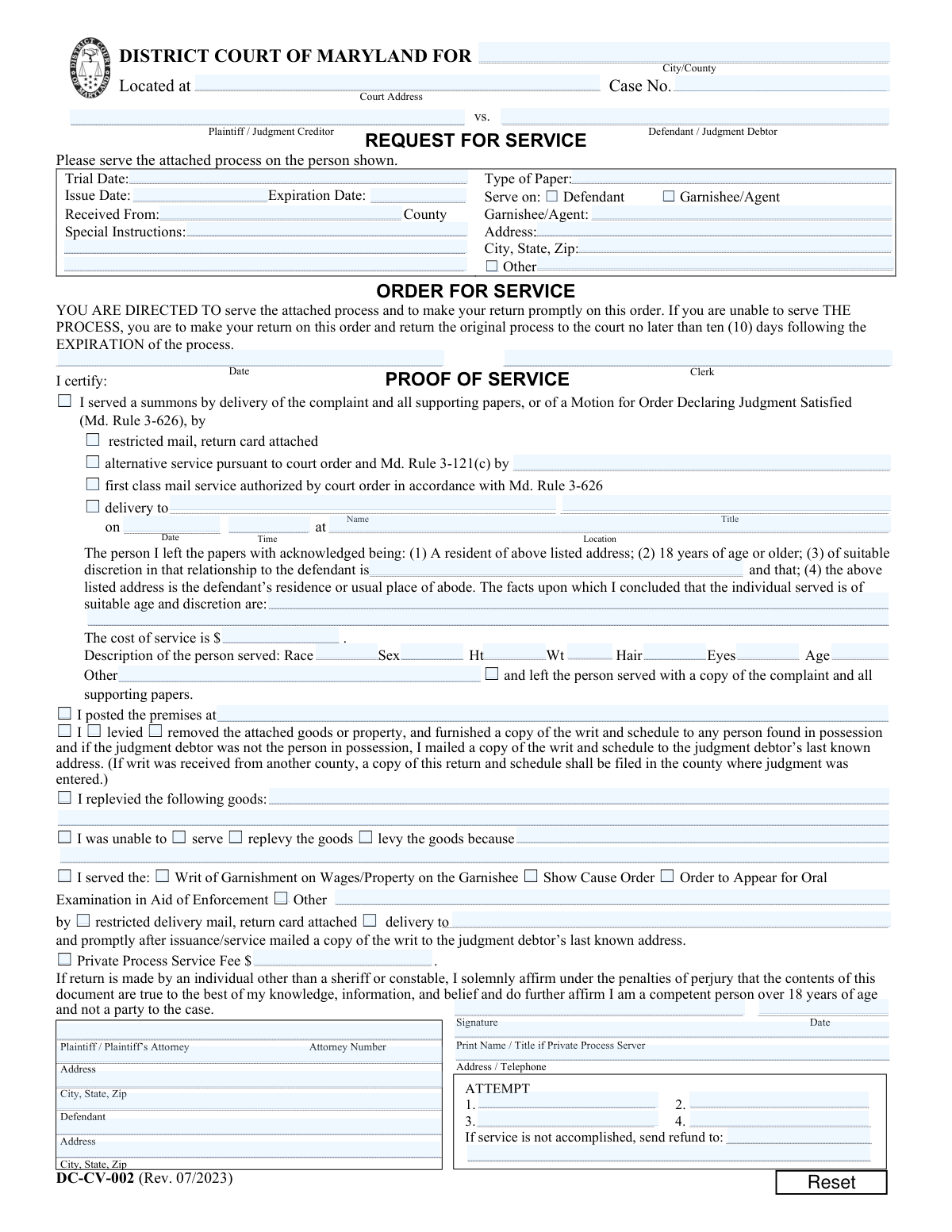
Form DC-CV-002, Request for Service, is a crucial legal document used within the District Court of Maryland to initiate the formal delivery of court papers, such as a summons or complaint, to a defendant or other party in a lawsuit. It provides the necessary instructions for the process server and serves as the official record, or 'Proof of Service,' once the delivery is completed or attempted, which is essential for ensuring due process. Today, this form can be filled out quickly and accurately using AI-powered services like Instafill.ai, which can also convert non-fillable PDF versions into interactive fillable forms.
Our AI automatically handles information lookup, data retrieval, formatting, and form filling.
It takes less than a minute to fill out DC-CV-002 using our AI form filling.
Securely upload your data. Information is encrypted in transit and deleted immediately after the form is filled out.
Form specifications
| Form name: | Form DC-CV-002, Request for Service |
| Number of fields: | 89 |
| Number of pages: | 1 |
| Filled form examples: | Form DC-CV-002 Examples |
| Language: | English |
Instafill Demo: How to fill out PDF forms in seconds with AI
How to Fill Out DC-CV-002 Online for Free in 2026
Are you looking to fill out a DC-CV-002 form online quickly and accurately? Instafill.ai offers the #1 AI-powered PDF filling software of 2026, allowing you to complete your DC-CV-002 form in just 37 seconds or less.
Follow these steps to fill out your DC-CV-002 form online using Instafill.ai:
- 1 Navigate to Instafill.ai and upload your Form DC-CV-002, or select it from the platform's template library.
- 2 Provide the case information, including the court location, case number, and the names of the plaintiff and defendant.
- 3 Complete the 'Request for Service' section by specifying the type of paper to be served, the recipient's details, and any special instructions for the server.
- 4 If you are the process server, fill out the 'Proof of Service' section after service is attempted, detailing the method, date, time, and outcome.
- 5 Describe the person served or explain why service could not be completed, and detail any costs or fees associated with the service.
- 6 Review all the information entered by the AI for accuracy, then e-sign and date the affirmation section if applicable.
- 7 Download, print, or electronically file the completed Form DC-CV-002 with the District Court of Maryland as required.
Our AI-powered system ensures each field is filled out correctly, reducing errors and saving you time.
Why Choose Instafill.ai for Your Fillable DC-CV-002 Form?
Speed
Complete your DC-CV-002 in as little as 37 seconds.
Up-to-Date
Always use the latest 2026 DC-CV-002 form version.
Cost-effective
No need to hire expensive lawyers.
Accuracy
Our AI performs 10 compliance checks to ensure your form is error-free.
Security
Your personal information is protected with bank-level encryption.
Frequently Asked Questions About Form DC-CV-002
This form is used to formally request the service of legal documents on a party in a Maryland District Court case. It also serves as the official Proof of Service, which is completed by the server and filed with the court.
The top portion, 'Request for Service,' is filled out by the plaintiff or their attorney. The bottom portion, 'Proof of Service,' is completed by the person who serves the documents, such as a sheriff or a private process server.
You must attach the legal papers that need to be served, which are referred to as the 'process.' This could include a complaint, summons, writ of garnishment, or other court orders.
Use this section to provide helpful details for the process server, such as gate codes, the best time to attempt service, a description of the person's vehicle, or instructions to serve at a work address.
The 'Expiration Date' is the deadline by which the legal documents must be served. If service is not completed by this date, the server must return the form to the court.
The server will complete the 'Proof of Service' section indicating they were unable to serve the papers, explain why, and return the form and original documents to the court.
A private process server must be a competent person over 18 years of age who is not a party to the case. They must sign the form affirming the truthfulness of the service details under penalty of perjury.
A 'Defendant' is the primary person or entity being sued. A 'Garnishee/Agent' is a third party, like an employer or bank, that holds assets for the defendant and is being legally notified to handle those assets as the court directs.
At the very top of the form, there is a section that says 'If service is not accomplished, send refund to:'. You must fill in the name and address of the person or firm that should receive the refund for the service fee.
This information helps to verify that the correct person received the legal documents. It serves as part of the official record to prevent disputes about whether service was properly made.
Yes, services like Instafill.ai use AI to accurately auto-fill form fields from your case data, which can save time and help prevent common errors.
You can use a service like Instafill.ai to complete the form online. Simply upload the PDF, and the AI-powered platform will create interactive fields for you to fill out, save, and print.
Tools like Instafill.ai can convert flat, non-fillable PDFs into interactive, fillable forms. This allows you to easily type your information directly onto the form before printing it.
Compliance DC-CV-002
Validation Checks by Instafill.ai
1
Ensures Date Chronology is Logical
This validation checks that the dates entered on the form follow a logical sequence. Specifically, the 'Issue Date' must be on or before the 'Expiration Date' and 'Trial Date', and any 'Delivery Date' must fall between the 'Issue Date' and 'Expiration Date'. This is critical for ensuring the service was performed within the legally mandated timeframe. A failure would indicate a data entry error that could invalidate the service itself.
2
Requires Case Number for Identification
This check verifies that the 'Case Number' field is not empty and, if possible, matches the expected format for the District Court of Maryland. The case number is the primary identifier for the entire legal action, and its absence would make it impossible to file the document correctly. If this validation fails, the form cannot be processed as it cannot be linked to a specific case.
3
Conditional Requirement for Garnishee/Agent Name
This validation ensures that if the 'Serve on Garnishee/Agent' checkbox is selected, the 'Garnishee/Agent Name' field must be filled in. It is impossible for a process server to complete service on a garnishee without knowing their name. A failure here would halt the process and require the user to provide the necessary recipient information before the request can be fulfilled.
4
Conditional Requirement for 'Other' Recipient Specification
This check mandates that the 'Other (specify)' text field must be completed if the 'Other' checkbox in the 'Serve on' section is selected. This prevents ambiguity by requiring the user to define who the 'Other' party is. Without this information, the service request is incomplete and cannot be acted upon, as the intended recipient is unknown.
5
Mutually Exclusive Service Outcome Validation
This validation ensures that the user selects only one logical outcome for the service attempt. For example, a user cannot indicate both successful service (e.g., 'I served a summons by delivery') and failure to serve ('I was unable to serve'). This check prevents contradictory information from being recorded on a legal document. If conflicting options are selected, the user must correct the entry to reflect a single, coherent outcome.
6
Conditional Requirement for Service Failure Explanation
This check verifies that if the 'I was unable to' checkbox is selected, the user must also select a failure type (serve, replevy, or levy) and provide a reason in the 'Service or Levy Failure Explanation' field. This is crucial for court records to understand why service was not accomplished and what steps may be needed next. A failure to provide this explanation would render the proof of non-service incomplete.
7
Conditional Completeness of Personal Delivery Details
This validation ensures that if service is made via personal delivery ('Delivery to specified person or location' is checked), then the 'Delivery Recipient Name', 'Delivery Date', 'Delivery Time', and 'Delivery Location' fields are all mandatory. These details constitute the core facts of the service and are legally required for the proof of service to be valid. Missing any of this information would make the service record deficient and potentially challengeable.
8
Validates Format for Service Cost and Fee
This check ensures that the 'Cost of Service' and 'Private Process Service Fee' fields contain valid numerical currency values (e.g., 40.00). This prevents the entry of text or improperly formatted numbers, which would cause errors in accounting and reimbursement processes. The system should reject any non-monetary values to maintain data integrity for financial records.
9
Ensures a Service Recipient is Selected
This is a fundamental completeness check to verify that at least one recipient checkbox ('Defendant', 'Garnishee/Agent', or 'Other') is selected in the 'Serve on' section. A service request is meaningless without a designated target. If no recipient is selected, the form is considered incomplete and cannot be submitted, as the process server would have no instruction on who to serve.
10
Validates Affirmation Date Logic
This check ensures the 'Affirmation Date' is on or after the 'Delivery Date' of the service. A process server cannot legally swear to the facts of a service before the service has actually occurred. This validation upholds the integrity of the sworn statement and prevents logical impossibilities in the legal record. An invalid date order would require correction before submission.
11
Completeness of Process Server's Identity
This validation mandates that if the 'Proof of Service' section is filled out, then the 'Process Server Name and Title', 'Process Server Address and Telephone', and 'Affirmation Signature' fields must be completed. This information is essential for identifying the individual attesting to the service and holding them accountable for the information provided. An anonymous or incomplete attestation is legally insufficient.
12
Conditional Requirement for Replevied Goods Description
This check ensures that if the 'I replevied the following goods' checkbox is selected, the corresponding 'Replevied goods description' text area must not be empty. The court and all parties must have a clear record of exactly what property was seized under the writ of replevin. Failure to provide this description makes the record of the seizure incomplete and legally deficient.
13
Validates ZIP Code Format
This check verifies that all ZIP code fields, such as in 'Recipient City, State, Zip', contain a valid 5-digit or 9-digit (ZIP+4) numeric format. Correctly formatted ZIP codes are essential for ensuring mailability and accurate location data for all parties involved, including the court, plaintiff, and defendant. An invalid format would trigger an error, prompting the user to correct the entry to improve data quality.
14
Ensures All Service Attempts are Documented
This validation checks that if the 'Proof of Service' section indicates a failure to serve, the 'Service Attempts Record' fields are filled out. Courts often require documentation of due diligence, meaning the server must show multiple good-faith attempts were made. Leaving this section blank after a failed service would result in an incomplete return of service, which the court may reject.
Common Mistakes in Completing DC-CV-002
Users often enter the wrong Case Number, misspell the Plaintiff/Defendant names, or list the incorrect court location. This happens due to typos or referencing outdated case documents. An incorrect case number can lead to the filing being rejected or associated with the wrong case, causing significant legal delays and potential dismissal of the service request.
Filers frequently provide a vague description like 'Notice' or 'Court Papers' in the 'Type of Paper' field. This is insufficient for the process server, who needs to know the exact legal document being served, such as 'Summons and Complaint' or 'Writ of Garnishment'. This ambiguity can lead to improper service or the server returning the request for clarification, delaying the legal process.
A common error is failing to provide a complete and accurate address for the person being served. This often results from using old or unverified address information. If the address is wrong, the process server will be unable to complete service, leading to a 'non-est' return, wasted fees, and critical delays that could jeopardize the case timeline.
The private process server's signature and the date under the perjury affirmation are absolutely critical, yet frequently missed. An unsigned Proof of Service is legally invalid and will be rejected by the court clerk. This oversight completely nullifies the service attempt, requiring the form to be corrected and re-filed, which can cause the plaintiff to miss important deadlines.
When performing substituted service (leaving papers with someone else), servers often provide a weak justification in the 'Facts upon which I concluded...' field. Simply writing 'appeared to be of age' is not enough; courts require specific facts about the person's maturity and understanding. This mistake can cause a judge to rule the service improper, forcing a re-serve and delaying the case.
Process servers sometimes check boxes that contradict each other, such as checking both 'I served a summons by delivery...' and 'I was unable to serve...'. This usually happens from rushing or misunderstanding the form's complex layout. Such contradictions make the form logically incoherent and legally void, forcing the court to reject it.
The form provides space to log multiple service attempts, which is crucial for demonstrating due diligence, especially if service is ultimately unsuccessful. Many servers fail to log the date, time, and result of each individual attempt. This lack of documentation can weaken a subsequent motion for alternative service, as the court has no record of the efforts made to serve the party personally.
When serving a garnishee, filers may check the 'Garnishee/Agent' box but fail to enter the specific name of the agent or department authorized to accept service. They might list the company's general address instead of the specific address for the registered agent. This leads to the documents being rejected or lost within the company, resulting in failed service.
The 'If service is not accomplished, send refund to:' section is often left blank. The person requesting service pays a fee upfront, and if service cannot be completed, this fee may be partially refundable. Without this information, any refund could be delayed, sent to the wrong address, or forfeited. Always provide a clear name and address to ensure any owed refund is processed correctly.
The 'Trial Date', 'Issue Date', and 'Expiration Date' are essential for establishing the legal timeline for service. Leaving these blank can render the request invalid, as the process server has no context for the urgency or legal window for service. The expiration date is particularly important, as service attempted after this date is void. AI-powered tools like Instafill.ai can help prevent this by flagging mandatory date fields before submission and ensuring correct formatting.
Saved over 80 hours a year
“I was never sure if my IRS forms like W-9 were filled correctly. Now, I can complete the forms accurately without any external help.”
Kevin Martin Green
Your data stays secure with advanced protection from Instafill and our subprocessors

Robust compliance program
Transparent business model
You’re not the product. You always know where your data is and what it is processed for.
ISO 27001, HIPAA, and GDPR
Our subprocesses adhere to multiple compliance standards, including but not limited to ISO 27001, HIPAA, and GDPR.
Security & privacy by design
We consider security and privacy from the initial design phase of any new service or functionality. It’s not an afterthought, it’s built-in, including support for two-factor authentication (2FA) to further protect your account.
Fill out DC-CV-002 with Instafill.ai
Worried about filling PDFs wrong? Instafill securely fills form-dc-cv-002-request-for-service forms, ensuring each field is accurate.



