Yes! You can use AI to fill out Form DE 4, Employee's Withholding Allowance Certificate
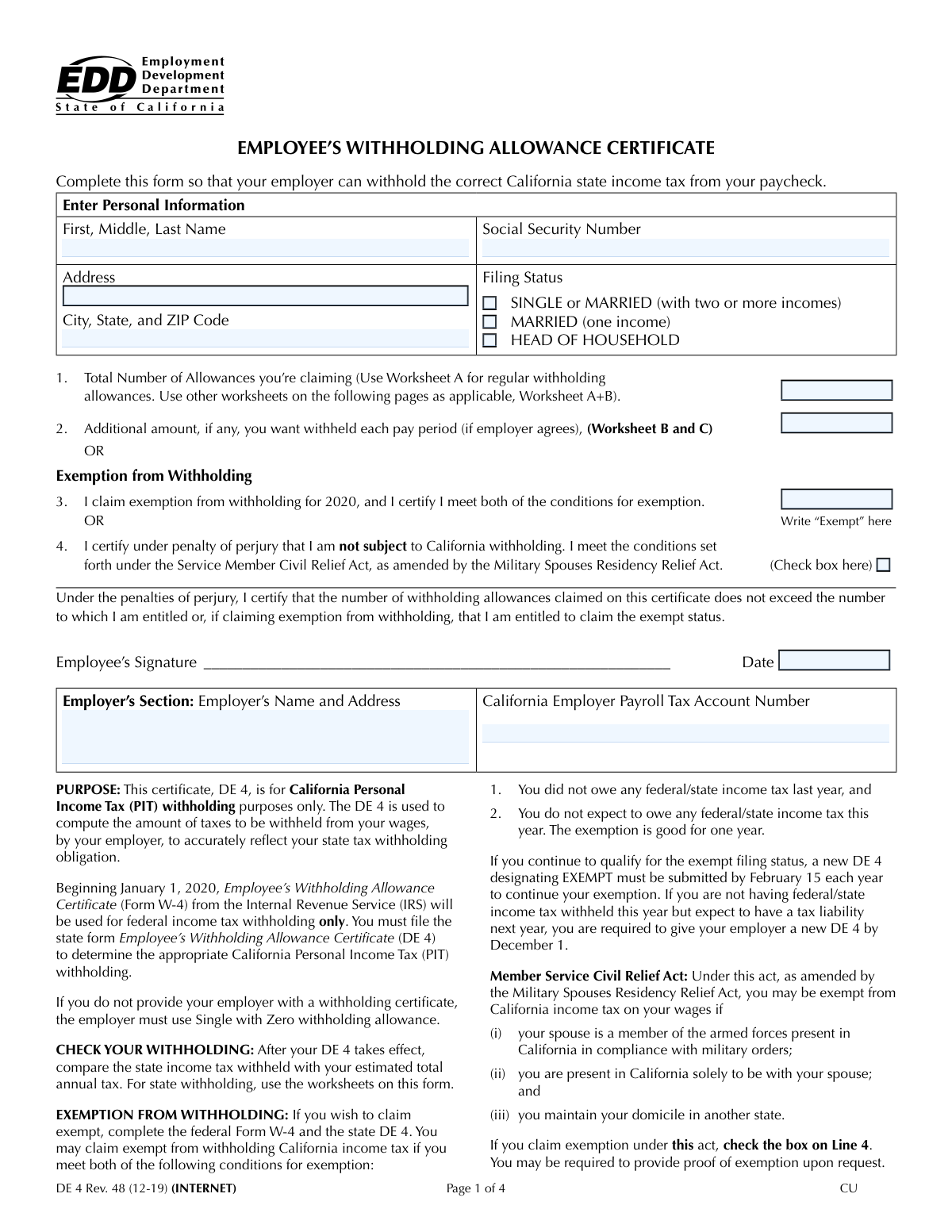
Form DE 4, the Employee's Withholding Allowance Certificate, is a California state tax form that employees complete to inform their employer how much state income tax to withhold from their wages. Correctly filling out this form is crucial for managing your tax liability throughout the year, helping you avoid owing a large sum or overpaying with each paycheck. Today, this form can be filled out quickly and accurately using AI-powered services like Instafill.ai, which can also convert non-fillable PDF versions into interactive fillable forms.
DE 4 is part of the
employee forms, employee withholding forms and withholding forms categories on Instafill.
Our AI automatically handles information lookup, data retrieval, formatting, and form filling.
It takes less than a minute to fill out DE 4 using our AI form filling.
Securely upload your data. Information is encrypted in transit and deleted immediately after the form is filled out.
Form specifications
| Form name: | Form DE 4, Employee's Withholding Allowance Certificate |
| Number of fields: | 47 |
| Number of pages: | 4 |
| Filled form examples: | Form DE 4 Examples |
| Language: | English |
More forms in Employee forms
Instafill Demo: How to fill out PDF forms in seconds with AI
How to Fill Out DE 4 Online for Free in 2026
Are you looking to fill out a DE 4 form online quickly and accurately? Instafill.ai offers the #1 AI-powered PDF filling software of 2026, allowing you to complete your DE 4 form in just 37 seconds or less.
Follow these steps to fill out your DE 4 form online using Instafill.ai:
- 1 Navigate to Instafill.ai and upload your Form DE 4 or select it from the platform's template library.
- 2 Enter your personal details, such as your full name, Social Security Number, and address, into the designated fields.
- 3 Indicate your tax filing status—Single, Married, or Head of Household—based on your personal circumstances.
- 4 Complete the form's worksheets to accurately determine your withholding allowances, considering dependents, deductions, and other income sources.
- 5 Enter the total number of allowances you are claiming and specify any additional amount you wish to have withheld from each paycheck.
- 6 Carefully review all entered information for accuracy, then electronically sign and date the form to certify it.
- 7 Download the completed Form DE 4 and submit it to your employer for their payroll records.
Our AI-powered system ensures each field is filled out correctly, reducing errors and saving you time.
Why Choose Instafill.ai for Your Fillable DE 4 Form?
Speed
Complete your DE 4 in as little as 37 seconds.
Up-to-Date
Always use the latest 2026 DE 4 form version.
Cost-effective
No need to hire expensive lawyers.
Accuracy
Our AI performs 10 compliance checks to ensure your form is error-free.
Security
Your personal information is protected with bank-level encryption.
Frequently Asked Questions About Form DE 4
This form, the California Employee's Withholding Allowance Certificate (DE 4), is used to inform your employer how much California state income tax to withhold from your paycheck.
All new employees in California must complete this form when they start a job. You should also submit an updated form if your financial or personal situation changes, such as getting married or having a child.
You should give the completed and signed form directly to your employer's payroll or human resources department. Do not send this form to any state agency.
Choose 'Single or Married (two or more incomes)' if you are single or if both you and your spouse work. Select 'Married (one income)' if you are married and your spouse does not earn an income. 'Head of Household' is for unmarried individuals supporting a qualifying person.
Use the 'Regular Withholding Allowances' worksheet on the form to calculate your total allowances. You can claim allowances for yourself, your spouse, your dependents, and for blindness.
This is an optional field where you can request an extra flat dollar amount to be withheld from each paycheck. This is useful if you have other income or want to avoid owing taxes at the end of the year.
Claiming 'Exempt' certifies that you had no tax liability last year and expect none this year, so your employer will not withhold any state income tax from your pay. You must meet specific criteria to claim this status.
You may be exempt from California withholding if you meet the conditions of the Military Spouses Residency Relief Act. If you qualify, you should check the 'Service Member Withholding Exemption' box.
The worksheets for estimated deductions and additional tax are optional but helpful for accuracy if you plan to itemize deductions or have significant non-wage income. For simple tax situations, you may only need to complete the main section.
Claiming too many allowances will cause less tax to be withheld, potentially leading to a tax bill at the end of the year. Claiming too few allowances will result in more tax being withheld, likely leading to a refund.
Yes, services like Instafill.ai use AI to accurately auto-fill form fields, which saves time and helps prevent common errors. These tools can guide you through the process of completing the form.
You can use a service like Instafill.ai to complete the form digitally. Simply upload a copy of the form, and the platform will allow you to fill in all the required fields online before downloading the completed document.
Tools like Instafill.ai can convert non-fillable PDFs into interactive, fillable forms. This allows you to easily type your information directly onto the document and save or print it.
Compliance DE 4
Validation Checks by Instafill.ai
1
SSN Format and Presence
Checks that the Social Security Number is provided and follows the 9-digit format, either as a continuous string of numbers or with hyphens (XXX-XX-XXXX). This is a critical field for correctly identifying the employee for tax reporting purposes. A missing or malformed SSN will prevent the form from being processed by payroll and tax authorities, leading to rejection.
2
Mutually Exclusive Filing Status
Validates that only one filing status box ('Single or Married (two or more incomes)', 'Married (one income)', or 'Head of Household') is selected. Selecting multiple statuses is a logical contradiction that makes it impossible to determine the correct tax withholding table. The submission should be rejected, requiring the user to select only one option.
3
Exemption Claim vs. Allowance Calculation Conflict
Ensures that if the employee claims exemption from withholding by writing 'Exempt', the sections for 'Regular Withholding Allowances' and 'Estimated Deductions' are left blank. Filling out allowance details while also claiming exemption is a direct contradiction of the form's rules. This check prevents logically invalid forms that would require manual correction and clarification.
4
Signature Date Validity
Verifies that the 'Signature Date' field contains a valid date and is not a date in the future. The signature date establishes when the withholding instructions become effective. An invalid or future date can cause legal and processing issues, so the form should be rejected until a valid date is provided.
5
Total Regular Allowances Calculation Accuracy
Confirms that the value entered for 'Total Regular Withholding Allowances' is the correct mathematical sum of the individual allowances claimed for self, spouse, blindness, and dependents (lines A through E). This check ensures the integrity of the worksheet calculations, as this total directly impacts the amount of tax withheld. An incorrect sum would lead to incorrect withholding.
6
Spousal Allowance Logical Consistency
Checks that if an allowance is claimed for a spouse or for a spouse's blindness, the filing status selected is one of the 'Married' options. Claiming a spousal allowance while filing as 'Single' or 'Head of Household' is a logical error. This validation prevents incorrect allowance claims and ensures the form data is internally consistent.
7
Required Employee Information
Ensures that the employee's 'Full Name', 'Street Address', 'City', 'State', and 'ZIP Code' are all filled in. This information is essential for both the employer's records and for any necessary correspondence or state reporting. A form with missing contact information is incomplete and should be flagged for correction.
8
ZIP Code Format
Validates that the 'ZIP Code' field contains exactly five digits. An incorrect ZIP code can cause issues with mail delivery and data validation in other systems. This simple format check improves data quality and ensures the address is properly structured.
9
Required Employer Information
Verifies that the employer has filled in their 'Employer Name and Address' and the 'CA Employer Payroll Tax Account Number'. These fields are the employer's responsibility and are required for the form to be complete and correctly associated with the right company. A submission lacking this information is invalid from the employer's side.
10
Standard Deduction Value Constraint
Checks that the value entered for 'Applicable Standard Deduction' is one of the two specified amounts: $9,074 or $4,537. Using any other value would be based on incorrect assumptions and would invalidate the entire 'Estimated Deductions' worksheet calculation. This check enforces the rules of the form and prevents downstream calculation errors.
11
Estimated Deductions Worksheet Calculation Check
Performs a check on a key calculation within the 'Estimated Deductions' worksheet, verifying that 'Sum (Line 3 plus Line 4)' correctly equals the sum of its preceding lines. This ensures the employee has followed the worksheet instructions correctly. If the arithmetic is wrong, the resulting allowance claim will be inaccurate, leading to incorrect tax withholding.
12
Worksheet C Calculation Integrity
Validates a key calculation within Worksheet C, such as ensuring 'Income After Deductions' (Line 7) is the result of subtracting 'Sum of Deductions and Adjustments' (Line 6) from 'Sum of Wages and Nonwage Income' (Line 3). This check confirms the arithmetic integrity of the estimated tax calculation. Errors here would render the final 'Additional Tax Withholding Needed' amount incorrect.
13
Conditional Worksheet Logic
Verifies that worksheet sections are filled out according to their stated conditions. For example, it checks that the 'Regular Withholding Allowances' worksheet is only filled if the employee has not claimed an exemption. This ensures that users are not providing data in sections that are irrelevant to their filing situation, which reduces confusion and processing errors.
14
Total Allowances Consistency
Validates that the 'Total Withholding Allowances' number entered on the main part of the form is consistent with the totals calculated in the worksheets (e.g., 'Total Regular Withholding Allowances'). A mismatch indicates either a calculation error or a manual override that needs to be flagged. This ensures the final allowance number used for payroll is the one derived from the detailed worksheets.
Common Mistakes in Completing DE 4
This form offers specific filing statuses like 'Single or Married (two or more incomes)' and 'Married (one income)'. A common error is for a married person with a working spouse to select the 'Married (one income)' status, which can lead to significant under-withholding. This results in a large, unexpected tax bill and potential penalties at the end of the year. It is crucial to choose the status that accurately reflects the entire household's income situation.
Employees sometimes write 'Exempt' in the withholding exemption field without meeting the strict legal criteria (having no tax liability in the prior year and expecting none in the current year). This is a major compliance error that stops all state income tax from being withheld. The consequence is a large tax bill due in April, along with potential underpayment penalties and interest.
The form contains multiple worksheets for calculating allowances based on deductions, adjustments, and nonwage income. These worksheets involve several steps of addition, subtraction, and division. Manual arithmetic is prone to error, and a single mistake can lead to an incorrect total allowance number, causing either too much or too little tax to be withheld from each paycheck.
Transposing digits or simply mistyping the nine-digit Social Security Number is a frequent and critical mistake. An incorrect SSN will cause payroll processing to fail and will lead to incorrect tax reporting to government agencies. This error can delay pay and requires the form to be corrected and resubmitted, creating administrative hassle for both the employee and employer.
The form has many fields with conditional logic, such as 'Fill only if 'I claim exemption from withholding for 2020' is 'No''. People often overlook these instructions and fill out sections that should be left blank, or vice-versa. For example, filling out the allowance calculation worksheets after claiming 'Exempt' status creates a contradictory and invalid form that payroll must return.
A withholding certificate is a legal document that is invalid until it is signed and dated by the employee. Forgetting this final step is a very common oversight. An unsigned form cannot be processed by the employer, which means the employee's previous withholding status remains in effect or a default, less favorable status may be applied until a valid form is submitted.
When using the 'Additional Withholding Amount' field, employees sometimes enter a total annual goal instead of the per-pay-period amount. For instance, writing '$1,200' with the intention of withholding an extra $100 per month can cause the entire $1,200 to be deducted from a single paycheck. This can create significant financial hardship and requires careful calculation, ideally using the provided worksheets, to determine the correct per-paycheck figure.
Employees often mistakenly believe the 'Total Withholding Allowances' line is simply for their number of children or dependents. In reality, this number is a calculated result from a detailed worksheet that also includes allowances for oneself, a spouse, and adjustments for deductions. This misunderstanding typically leads to claiming too few allowances, resulting in over-withholding and a smaller paycheck throughout the year.
When filling out their street address, employees living in apartments, condos, or other multi-unit buildings frequently forget to include their specific unit number. While it seems minor, this omission can cause critical documents mailed by the employer, such as the year-end W-2 tax form, to be returned as undeliverable. Ensuring the address is complete prevents delays and potential issues with tax filing.
The worksheets for calculating allowances require estimating itemized deductions, adjustments to income, and nonwage income. Many people are unsure what these figures are and resort to guessing or leaving the fields blank. Inaccurate estimates render the worksheet calculation useless and lead to an improper number of allowances, defeating the purpose of the detailed form and resulting in incorrect tax withholding.
Saved over 80 hours a year
“I was never sure if my IRS forms like W-9 were filled correctly. Now, I can complete the forms accurately without any external help.”
Kevin Martin Green
Your data stays secure with advanced protection from Instafill and our subprocessors

Robust compliance program
Transparent business model
You’re not the product. You always know where your data is and what it is processed for.
ISO 27001, HIPAA, and GDPR
Our subprocesses adhere to multiple compliance standards, including but not limited to ISO 27001, HIPAA, and GDPR.
Security & privacy by design
We consider security and privacy from the initial design phase of any new service or functionality. It’s not an afterthought, it’s built-in, including support for two-factor authentication (2FA) to further protect your account.
Fill out DE 4 with Instafill.ai
Worried about filling PDFs wrong? Instafill securely fills form-de-4-employees-withholding-allowance-certificate-1 forms, ensuring each field is accurate.



