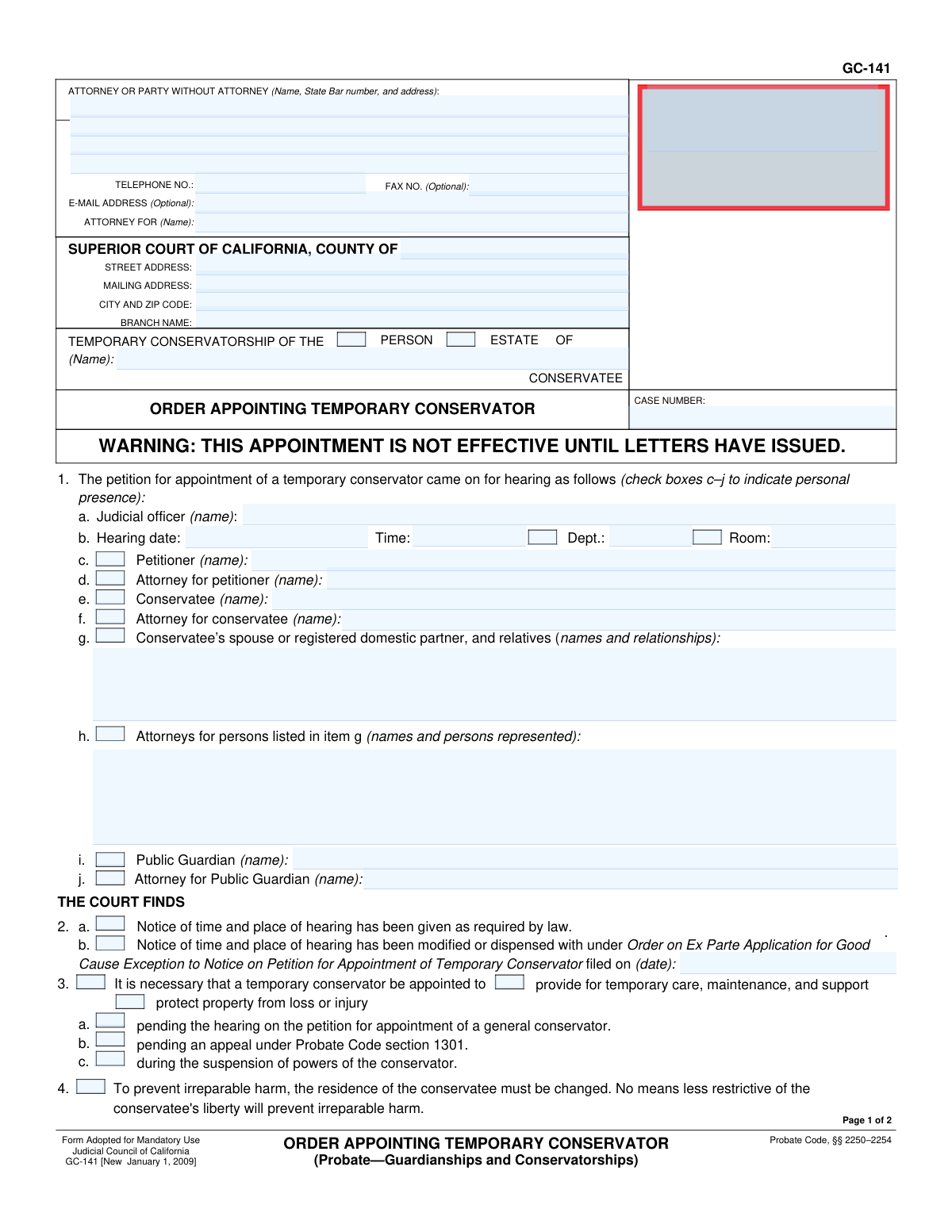
Yes! You can use AI to fill out Form GC-141, Order Appointing Temporary Conservator (Probate—Guardianships and Conservatorships)
Form GC-141, the Order Appointing Temporary Conservator, is a legal document issued by a California Superior Court to grant temporary legal authority to an individual or entity (the conservator) over another person's personal affairs or finances. This order is crucial for protecting a vulnerable person or their assets when immediate action is needed before a general conservator can be appointed. Today, this form can be filled out quickly and accurately using AI-powered services like Instafill.ai, which can also convert non-fillable PDF versions into interactive fillable forms.
Our AI automatically handles information lookup, data retrieval, formatting, and form filling.
It takes less than a minute to fill out GC-141 using our AI form filling.
Securely upload your data. Information is encrypted in transit and deleted immediately after the form is filled out.
Form specifications
| Form name: | Form GC-141, Order Appointing Temporary Conservator (Probate—Guardianships and Conservatorships) |
| Number of fields: | 92 |
| Number of pages: | 2 |
| Language: | English |
Instafill Demo: How to fill out PDF forms in seconds with AI
How to Fill Out GC-141 Online for Free in 2026
Are you looking to fill out a GC-141 form online quickly and accurately? Instafill.ai offers the #1 AI-powered PDF filling software of 2026, allowing you to complete your GC-141 form in just 37 seconds or less.
Follow these steps to fill out your GC-141 form online using Instafill.ai:
- 1 Navigate to Instafill.ai and upload the GC-141 form or select it from the platform's template library.
- 2 Enter the court and case information, including the county, court address, case number, and hearing details.
- 3 Identify all parties involved by providing the names and addresses of the petitioner, conservatee, and their attorneys.
- 4 Detail the court's findings by checking the appropriate boxes regarding notice of hearing and the necessity for the temporary conservatorship.
- 5 Specify the appointment details in Section 7, naming the temporary conservator of the person and/or estate.
- 6 Indicate any bond requirements, special powers, or restrictions, such as changing the conservatee's residence or managing blocked accounts.
- 7 Review the entire completed order for accuracy, then download or print the form for the judicial officer's signature and filing with the court.
Our AI-powered system ensures each field is filled out correctly, reducing errors and saving you time.
Why Choose Instafill.ai for Your Fillable GC-141 Form?
Speed
Complete your GC-141 in as little as 37 seconds.
Up-to-Date
Always use the latest 2026 GC-141 form version.
Cost-effective
No need to hire expensive lawyers.
Accuracy
Our AI performs 10 compliance checks to ensure your form is error-free.
Security
Your personal information is protected with bank-level encryption.
Frequently Asked Questions About Form GC-141
Form GC-141, 'Order Appointing Temporary Conservator,' is the official court order signed by a judge to appoint a temporary conservator. It grants someone the legal authority to care for another person or manage their finances on an urgent, short-term basis until a general conservator can be appointed.
Typically, the petitioner or their attorney prepares this form for the judge to review and sign at a court hearing. The judge makes the final decisions, indicated by checked boxes and their signature, which makes the order legally binding.
A temporary conservator of the 'person' (Item 7a) makes decisions about the conservatee's care, such as housing and medical needs. A temporary conservator of the 'estate' (Item 7b) manages the conservatee's finances, like paying bills and protecting assets.
A temporary conservatorship is short-term and expires on the date specified by the court in Item 14 of the order. It is designed to be effective only until the hearing for a general conservatorship can be held.
A bond is a type of insurance that protects the conservatee's assets from loss or mismanagement by the conservator of the estate. The court decides if a bond is necessary and sets the amount, which is specified in Item 8b.
A blocked account, as described in Item 8c, is a bank account that restricts the conservator from withdrawing funds without a specific court order. This is a protective measure used to safeguard the conservatee's money, often as an alternative to requiring a large bond.
This means that even after the judge signs this order, the temporary conservator's authority is not official until a separate document, 'Letters of Temporary Conservatorship,' is issued by the court clerk. The conservator must complete all requirements, such as filing a bond, before Letters are granted.
A temporary conservator can only change the conservatee's residence if the court finds it necessary to prevent harm and explicitly grants this power in the order (Item 9). The new address must be specified on the form.
A temporary conservatorship is an emergency measure for a short, specific period to address an urgent need. A general conservatorship is a more long-term arrangement established after a full court process for ongoing care and management.
While attendance is typical, the court can decide the conservatee does not need to be present. The judge will indicate this decision by checking the box in Item 6 or Item 11 on the order.
Yes, services like Instafill.ai use AI to help you accurately fill out court forms. These tools can auto-fill fields with your case information, which saves time and helps reduce errors.
You can use a service like Instafill.ai to complete this form online. Simply upload the form, and the AI will identify all the fields, allowing you to type your information digitally before printing for submission.
If you have a non-fillable or 'flat' PDF, you can use a tool like Instafill.ai. It can convert the static document into an interactive, fillable form so you can easily type your information into the correct fields.
Compliance GC-141
Validation Checks by Instafill.ai
1
Case Number Presence and Format
This check verifies that the 'Case Number' field is not empty and conforms to the standard format used by the court. A valid case number is essential for correctly filing the order and linking it to the existing case file. If the case number is missing or incorrectly formatted, the document cannot be processed by the court clerk, leading to filing rejection and delays.
2
Conditional State Bar Number Requirement
Validates that the 'State Bar Number' field is populated if an attorney's name is entered in the 'Attorney or Party Name' field. This ensures that any individual identified as an attorney is properly registered with the California State Bar. Failure to provide a valid State Bar number for a listed attorney will result in a request for correction, as the court must verify the attorney's credentials.
3
Consistent Conservatee Name
This validation ensures that the 'Conservatee Name' entered at the top of the form is identical to the names entered in sections 7a ('Conservatee Name') and 7b ('Estate Conservatee Name'), if those sections are completed. Consistency is critical to avoid legal ambiguity about who is the subject of the court order. Discrepancies could lead to the order being deemed invalid or requiring clarification and amendment.
4
Conditional Presence Field Completion
Verifies that if any checkbox indicating personal presence at the hearing is checked (items 1c through 1j), the corresponding name field is filled out. For example, if box 1e for 'Attorney for conservatee' is checked, the attorney's name must be provided. This check ensures a complete and accurate record of hearing attendance, which is a formal requirement. An incomplete record may require correction before the order is finalized.
5
Mutually Exclusive Notice Findings
This check ensures that only one of the two options in item 2 ('Notice...has been given' or 'Notice...has been modified') is selected. These two findings are mutually exclusive; notice cannot be both given as required by law and simultaneously dispensed with. Selecting both options creates a logical contradiction that makes the order legally unclear and will require correction.
6
Conditional Ex Parte Application Date
Ensures that if the box for 'Notice of time and place of hearing has been modified or dispensed with' (item 2b) is checked, the 'Ex Parte Application Filing Date' field is populated with a valid date. This date provides the legal basis for dispensing with standard notice requirements. Without this date, the finding is unsupported and the order may be challenged for improper notice, potentially invalidating the appointment.
7
Appointment Selection Requirement
This validation confirms that at least one of the appointment boxes, either 7a ('Temporary Conservator of the PERSON') or 7b ('Temporary Conservator of the ESTATE'), is checked. The entire purpose of the order is to appoint a temporary conservator, so at least one appointment must be made. If neither box is checked, the order has no effect and is fundamentally incomplete.
8
Conditional Appointment Details
Verifies that if box 7a or 7b is checked, all corresponding detail fields (Name, Address, Telephone, and Conservatee Name) for that section are completed. This information is necessary to properly identify the appointed conservator and the scope of their authority. Missing details would render the appointment ambiguous and unenforceable until the information is provided.
9
Mutually Exclusive Bond Requirements
This check validates that the user has not selected both 'Bond is not required' (item 8a) and 'Bond is fixed at' (item 8b). These options are mutually exclusive, and selecting both creates a direct contradiction in the court's order regarding financial security for the estate. The form must be corrected to reflect a single, clear decision on the bond requirement.
10
Conditional Bond Amount
Ensures that if 'Bond is fixed at' (item 8b) is checked, the 'Item 8b Bond Fixed Amount' field contains a valid, positive numerical value. A fixed bond requires a specific amount to be legally binding. Failure to specify the amount makes the order incomplete and unenforceable, as the surety company would not know the value of the bond to be issued.
11
Conditional Residence Change Address
This validation confirms that if 'The temporary conservator is authorized to change the residence of the conservatee' (item 9) is checked, the corresponding address field is filled out. Authorizing a change of residence is a significant action, and the order must specify the new location to be valid. An empty address field would make this part of the order void for vagueness.
12
Order Expiration Date Logic
Verifies that the 'Item 14 Expiration Date' is a valid date and occurs after the 'Hearing Date'. A temporary conservatorship is, by definition, for a limited time, and its expiration date must be in the future. An expiration date that is in the past or before the hearing itself is a logical error that would invalidate the order.
13
Checkbox Count Verification
This check automatically counts the number of boxes checked between items 7 and 14 and compares it to the number manually entered in 'Item 15 – Number of Boxes Checked'. This serves as a cross-check to prevent accidental omissions or incorrect entries, ensuring the summary count accurately reflects the specific orders made by the court. A mismatch indicates a clerical error that must be resolved.
14
Hearing and Signature Date Logic
Validates that the 'Date Signed' by the judicial officer is on or after the 'Hearing Date'. An order cannot be signed before the hearing where the findings were made has occurred. This chronological check ensures the procedural integrity of the court order, and a failure would indicate a significant clerical or dating error.
Common Mistakes in Completing GC-141
A self-represented individual (party without attorney) often mistakenly fills out the 'Attorney For' field or gets confused by the 'State Bar number' field. This causes processing delays as the court clerk must clarify who is filing the document. To avoid this, parties without an attorney should enter their name in the top box and leave the 'State Bar number' and 'Attorney For' fields blank.
Using variations of names (e.g., 'John Doe' vs. 'John A. Doe') for the conservatee, petitioner, or conservator across the form creates legal ambiguity. Courts require the precise and consistent use of full legal names to ensure orders are sound and enforceable. This error can lead to rejection or the need for amended filings, causing significant delays.
Filers often misunderstand the distinction in the case caption, checking the wrong box or both without proper legal basis. A conservatorship of the 'Person' relates to healthcare and personal decisions, while the 'Estate' covers financial matters. This error can result in the court granting incorrect or insufficient authority, necessitating a new petition and hearing.
In item 7, filers may enter the name of the proposed temporary conservator but neglect to include their full address and telephone number. This information is mandatory, as it is essential for the court and other parties to be able to contact the conservator. An incomplete entry will delay the issuance of the official Letters of Temporary Conservatorship.
Item 8, which details the financial bond, is a frequent source of errors. Filers may incorrectly check 'Bond is not required' when one has been ordered, or check 'Bond is fixed at' but fail to enter the specific dollar amount. Such errors will halt the process, as the bond is a critical safeguard for the conservatee's assets and the order cannot be finalized without this detail being correct.
When requesting powers in item 12, filers sometimes use vague language like 'manage all affairs.' Courts require highly specific, justified requests (e.g., 'power to sell the real property at 123 Main Street, Anytown, CA'). A vague request will be denied by the judge, limiting the conservator's ability to act and potentially requiring another costly court appearance.
The form allows for crucial details to be included in attachments (e.g., items 8c, 12, 13). A critical mistake is checking a box that refers to an attachment but then failing to label and include that document with the filing. This renders the corresponding order incomplete and unenforceable, leading to certain rejection by the court clerk.
The case number is the primary identifier for the legal proceeding, yet it is often entered with transposed digits, missing letters, or an incorrect format. This simple data entry error can cause the document to be misfiled or rejected, delaying urgent court action. AI-powered form filling tools like Instafill.ai can prevent this by saving and accurately populating case information across all related forms.
In item 2, a filer might check both box 2a ('Notice...has been given as required') and box 2b ('Notice...has been modified or dispensed with'). These are mutually exclusive findings that create a logical contradiction. This signals an error to the court, requiring clarification and delaying the signing of the order.
Often, court forms are only available as flat, non-fillable PDFs, leading to filers printing them and filling them out by hand, sometimes missing fields entirely. This can result in an illegible or incomplete submission that the court will reject. Tools like Instafill.ai can convert any non-fillable PDF into an interactive, fillable form, ensuring all required fields are presented clearly and can be completed digitally.
Saved over 80 hours a year
“I was never sure if my IRS forms like W-9 were filled correctly. Now, I can complete the forms accurately without any external help.”
Kevin Martin Green
Your data stays secure with advanced protection from Instafill and our subprocessors

Robust compliance program
Transparent business model
You’re not the product. You always know where your data is and what it is processed for.
ISO 27001, HIPAA, and GDPR
Our subprocesses adhere to multiple compliance standards, including but not limited to ISO 27001, HIPAA, and GDPR.
Security & privacy by design
We consider security and privacy from the initial design phase of any new service or functionality. It’s not an afterthought, it’s built-in, including support for two-factor authentication (2FA) to further protect your account.
Fill out GC-141 with Instafill.ai
Worried about filling PDFs wrong? Instafill securely fills form-gc-141-order-appointing-temporary-conservator-probateguardianships-and-conservatorships forms, ensuring each field is accurate.