Yes! You can use AI to fill out JDF 1000 – Case Information Sheet

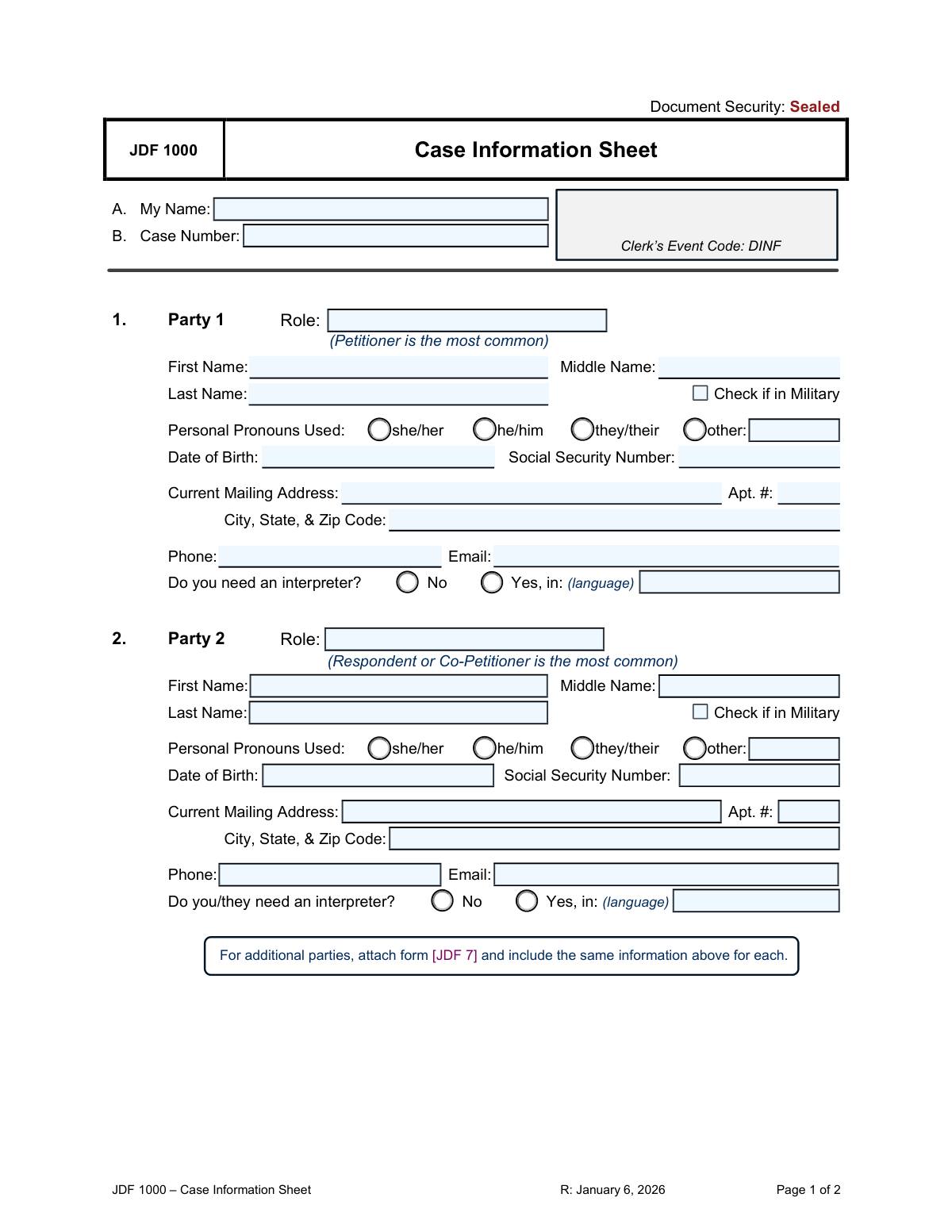
The JDF 1000 Case Information Sheet is a foundational document for initiating many types of legal cases in Colorado, collecting vital identifying information for all parties and children involved. This includes names, contact details, dates of birth, and Social Security numbers, which are essential for the court to maintain accurate records and manage case communications. The information is marked as sealed for security but is fundamental to the administrative processing of the case. Today, this form can be filled out quickly and accurately using AI-powered services like Instafill.ai, which can also convert non-fillable PDF versions into interactive fillable forms.
Our AI automatically handles information lookup, data retrieval, formatting, and form filling.
It takes less than a minute to fill out JDF 1000 using our AI form filling.
Securely upload your data. Information is encrypted in transit and deleted immediately after the form is filled out.

Form specifications

Form name: JDF 1000 – Case Information Sheet
Number of pages: 2
Language: English
main-image

Instafill Demo: How to fill out PDF forms in seconds with AI

How to Fill Out JDF 1000 Online for Free in 2026

Are you looking to fill out a JDF 1000 form online quickly and accurately? Instafill.ai offers the #1 AI-powered PDF filling software of 2026, allowing you to complete your JDF 1000 form in just 37 seconds or less.
Follow these steps to fill out your JDF 1000 form online using Instafill.ai:
  1. 1 Navigate to Instafill.ai and upload your JDF 1000 form, or select it from their library of official documents.
  2. 2 Allow the AI to scan and identify all the fields on the Case Information Sheet, such as party details, children's information, and signature blocks.
  3. 3 Answer simple questions in a chat-like interface to provide the personal details for Party 1 and Party 2, including names, roles, addresses, and contact information.
  4. 4 Enter the required information for any children involved in the case, such as their full names, dates of birth, and Social Security numbers.
  5. 5 Review the auto-filled form, where the AI will have populated all your answers into the correct fields on the JDF 1000.
  6. 6 Electronically sign the document in the verified signature section and download the completed, sealed-document-ready Case Information Sheet.

Our AI-powered system ensures each field is filled out correctly, reducing errors and saving you time.

Why Choose Instafill.ai for Your Fillable JDF 1000 Form?

Speed

Complete your JDF 1000 in as little as 37 seconds.

Up-to-Date

Always use the latest 2026 JDF 1000 form version.

Cost-effective

No need to hire expensive lawyers.

Accuracy

Our AI performs 10 compliance checks to ensure your form is error-free.

Security

Your personal information is protected with bank-level encryption.

Frequently Asked Questions About Form JDF 1000

The JDF 1000 Case Information Sheet is used to provide the court with essential, confidential background information about the parties and any children involved in a case. This data helps the court manage the case file and is not accessible to the public.

Party 1 is typically the person initiating the case, known as the Petitioner. Party 2 is the other person involved, who is usually the Respondent or a Co-Petitioner if you are filing the case together.

This notice indicates that the form contains sensitive personal information, such as Social Security Numbers. The document will be kept confidential by the court and will not be part of the public record to protect your privacy.

Yes, you should provide Social Security Numbers for all parties and children if they are available. This information is required for case identification and for matters like child support enforcement, and it is kept confidential by the court.

Fill out the form as completely as you can with the information you have. If you do not know certain details for Party 2, you may have to leave them blank, but be prepared that the court might require you to make a diligent effort to find the missing information.

If your case involves more than two parties, you must complete and attach form JDF 7 for each additional person. You will need to provide the same detailed information for them as you did for Party 1 and Party 2.

The form has space to list several children under the age of 19. If you have more children than the space provided, simply attach additional pages with the required information (Full Name, Sex, Date of Birth, Social Security No.) for each child.

Party 2 only needs to sign the form if they are filing jointly with Party 1 as a Co-Petitioner. If Party 2 is a Respondent, they will not sign this initial filing.

This information is important because active-duty service members have specific legal protections under laws like the Servicemembers Civil Relief Act (SCRA). The court needs to know a party's military status to ensure legal procedures are followed correctly.

You will file the completed Case Information Sheet with the court clerk at the same time you file your initial petition or complaint to start your case. It is a standard part of the initial case filing packet.

Yes, you can use AI-powered services like Instafill.ai to help fill out your form. These tools can auto-fill fields accurately, saving you time and helping to prevent common errors.

To fill out this form online, you can upload the PDF to a platform like Instafill.ai. The service will make the document interactive, allowing you to type your information directly into the fields and then download the completed form for printing and filing.

If you have a non-fillable or 'flat' PDF, services like Instafill.ai can convert it into an interactive, fillable form. This allows you to easily type your answers instead of having to print the form and complete it by hand.

Compliance JDF 1000
Validation Checks by Instafill.ai

1
Validates Social Security Number Format
This check ensures that all Social Security Number fields for Party 1, Party 2, and any children are entered in the standard XXX-XX-XXXX format. Correct formatting is crucial for accurate identification and data processing with government agencies. If the format is incorrect, the system should prompt the user to re-enter the number correctly before submission.
2
Ensures Date of Birth is a Valid Past Date
This validation verifies that all 'Date of Birth' fields are entered in a recognizable date format (e.g., MM/DD/YYYY) and that the date is not in the future. This is important for confirming identity and eligibility for legal proceedings. A failure would prevent submission and require the user to enter a valid, historical date.
3
Verifies Child's Age is Under 19
This check calculates the age of each child listed based on their 'Date of Birth' and the current date. It confirms that the child is under the age of 19, as specified by the form's instructions in Section 3. This is critical for determining jurisdiction and matters of custody or support. If a child is 19 or older, an error message should explain they do not meet the criteria for this section.
4
Conditional Requirement for Interpreter Language
This validation checks if the 'Yes' box for needing an interpreter is selected for either Party 1 or Party 2. If 'Yes' is checked, the corresponding 'language' text field must be filled out. This ensures the court can arrange for necessary interpretation services. If the language is not specified, the form submission will be blocked until the language is provided.
5
Party 1 Core Information Completeness
This check ensures that the most critical fields for Party 1 are not empty, including First Name, Last Name, Role, and the full mailing address (Street, City, State, Zip). This information is fundamental for case initiation, party identification, and official correspondence. A failure would halt submission and highlight the required fields that need to be completed.
6
Signature Execution Date Validity
This validation confirms that the execution date in the 'Verified Signature' section is a complete, valid calendar date (e.g., not April 31) and is not a future date. The execution date is a legal attestation of when the document was signed under penalty of perjury. An invalid or future date would render the signature block legally questionable and must be corrected.
7
Signature Name Consistency for Party 1
This check compares the 'Print Your Name' field in the Party 1 signature block against the 'First Name' and 'Last Name' fields for Party 1 in Section 1. The names should match to ensure the person signing the document is the same person identified as Party 1. A mismatch could indicate an error or potential fraud and should prevent form submission until corrected.
8
Child Information Group Completeness
This validation rule ensures that if a child's 'Full Name' is entered in Section 3, then the associated 'Sex', 'Date of Birth', and 'Social Security No.' fields for that same child are also filled. Incomplete records for a listed child can cause processing delays and legal complications. The system should flag the incomplete child record and require all associated fields to be filled.
9
Validates Email Address Format
This check verifies that any email address entered for Party 1 or Party 2 follows the standard '[email protected]' format. An accurate email address is essential for modern court communications and notifications. If the format is invalid, the user will be prompted to correct it, reducing the risk of missed communications.
10
Validates Phone Number Format
This check ensures that the phone numbers provided for Party 1 and Party 2 contain a valid number of digits (e.g., 10 digits for a US number) and conform to a standard format. This is a primary method of contact for the court and legal representatives. An invalid number would be flagged for correction to ensure the parties can be reached.
11
Conditional Requirement for 'Other' Pronouns
This validation ensures that if the 'other' checkbox for 'Personal Pronouns Used' is selected for either party, the adjacent text field to specify the pronouns is not left blank. This is important for respecting the party's identity and ensuring correct language is used in all proceedings. If the text field is empty after 'other' is checked, a prompt should ask the user to specify the pronouns.
12
Party 2 Signature Requirement for Co-Petitioner
This is a logical check that verifies if Party 2's role is 'Co-Petitioner', the entire signature block for Party Two must be completed. Co-petitioners file jointly and must both sign the declaration. If the role is 'Respondent', this section should be blank. This validation prevents incorrect or incomplete joint filings.
13
Completeness of Signature Location
This check ensures that the 'City' and 'State' fields within the 'Verified Signature' block for any signing party are filled out. The location of execution is a required component of the declaration under penalty of perjury. Missing location information can affect the legal validity of the signature, so the form should not be submittable without it.
14
Party Role Logic Check
This validation ensures that the roles assigned to Party 1 and Party 2 are logical and not contradictory. For example, both parties cannot be assigned the role of 'Petitioner'. This check helps maintain the logical integrity of the case structure from the outset. An error would prompt the user to review and correct the assigned party roles.

Common Mistakes in Completing JDF 1000

Using Nicknames or Inconsistent Legal Names

People often enter a nickname or an abbreviated version of their name instead of the full legal name that appears on official documents like a driver's license or birth certificate. This can cause the court to reject the filing because the name doesn't match official records, leading to delays. To avoid this, always use your complete and official legal name for Party 1, Party 2, and all children listed.

Forgetting to Sign or Date the Declaration

The verified signature section is one of the most critical parts of the form, yet it is frequently left incomplete. Forgetting to sign, print your name, or enter the date of execution invalidates the document, as you have not legally sworn to the truthfulness of the information. The court will reject an unsigned form, forcing you to correct and refile it, which delays your case. Always double-check that both signature sections (if applicable) are fully completed.

Providing an Incomplete Mailing Address

A common error is omitting the apartment, suite, or unit number, or making a typo in the street name or zip code. An incomplete or incorrect address prevents the court and other parties from sending you critical legal notices about your case. This could cause you to miss a hearing or an important deadline, which could have severe negative consequences. Carefully review all address fields for accuracy before submitting.

Omitting or Incorrectly Formatting the Case Number

If this form is being filed in an existing case, filers often forget to enter the case number at the top of the page or enter it with incorrect formatting (e.g., missing letters or dashes). Without the correct case number, the court clerk cannot link the document to the proper case file, causing it to be misplaced or rejected. To prevent this, carefully copy the case number exactly as it appears on other official court documents for this matter.

Overlooking the Military Service Checkbox

The checkbox to indicate a party's active military status is small and easily missed, but it is legally significant. Federal laws, like the Servicemembers Civil Relief Act (SCRA), provide special protections to active-duty military personnel, and failing to report this status can complicate and delay legal proceedings. Always confirm the military status for both parties and check the box if it applies.

Confusing Party Roles like 'Petitioner' and 'Respondent'

Individuals unfamiliar with legal terminology may incorrectly identify their role, for example, listing themselves as the 'Respondent' when they are the one initiating the case ('Petitioner'). This creates confusion for the court and may require an amended filing to correct the error. As a rule, the person who starts the case is the Petitioner, and the other party is the Respondent; if filing together, both are Co-Petitioners.

Forgetting to List All Minor Children

Filers sometimes accidentally omit a child under the age of 19 or mistakenly list children who are 19 or older. The court requires a complete list of all minor children of the relationship for matters related to custody and support. An incomplete or inaccurate list can create significant legal problems later on, so ensure every child under 19 is listed with their correct information.

Requesting an Interpreter Without Specifying the Language

A user might check the 'Yes' box to request an interpreter but then forget to write in the specific language needed in the space provided. This makes the request unusable, as the court staff will not know which language interpreter to schedule for a hearing. If you need an interpreter, always remember to specify the language to avoid delays. AI-powered form fillers like Instafill.ai can help by reminding you to complete conditional fields like this.

Missing Signature from Party 2 on a Joint Filing

When two parties file together as 'Co-Petitioners,' both must sign the form in their respective signature blocks. It's a common mistake for only one party to sign, rendering the joint petition incomplete. The court will not accept a jointly filed document unless both parties have signed and dated it, which will halt the case until a properly signed version is submitted.

Illegible Handwriting from Filling a Non-Fillable PDF

Many court forms are only available as flat, non-fillable PDFs, forcing users to print and complete them by hand. This often results in illegible handwriting, which can lead to data entry errors by the court clerk or outright rejection of the form. To ensure clarity and professionalism, it is better to use a tool like Instafill.ai, which can convert a non-fillable PDF into an interactive form that you can type into directly.
Saved over 80 hours a year

“I was never sure if my IRS forms like W-9 were filled correctly. Now, I can complete the forms accurately without any external help.”

Kevin Martin Green

Your data stays secure with advanced protection from Instafill and our subprocessors

Robust compliance program

Transparent business model

You’re not the product. You always know where your data is and what it is processed for.

ISO 27001, HIPAA, and GDPR

Our subprocesses adhere to multiple compliance standards, including but not limited to ISO 27001, HIPAA, and GDPR.

Security & privacy by design

We consider security and privacy from the initial design phase of any new service or functionality. It’s not an afterthought, it’s built-in, including support for two-factor authentication (2FA) to further protect your account.

Fill out JDF 1000 with Instafill.ai

Worried about filling PDFs wrong? Instafill securely fills jdf-1000-case-information-sheet forms, ensuring each field is accurate.