Yes! You can use AI to fill out Petition to Enforce Tenant Privacy (CV-House-100)
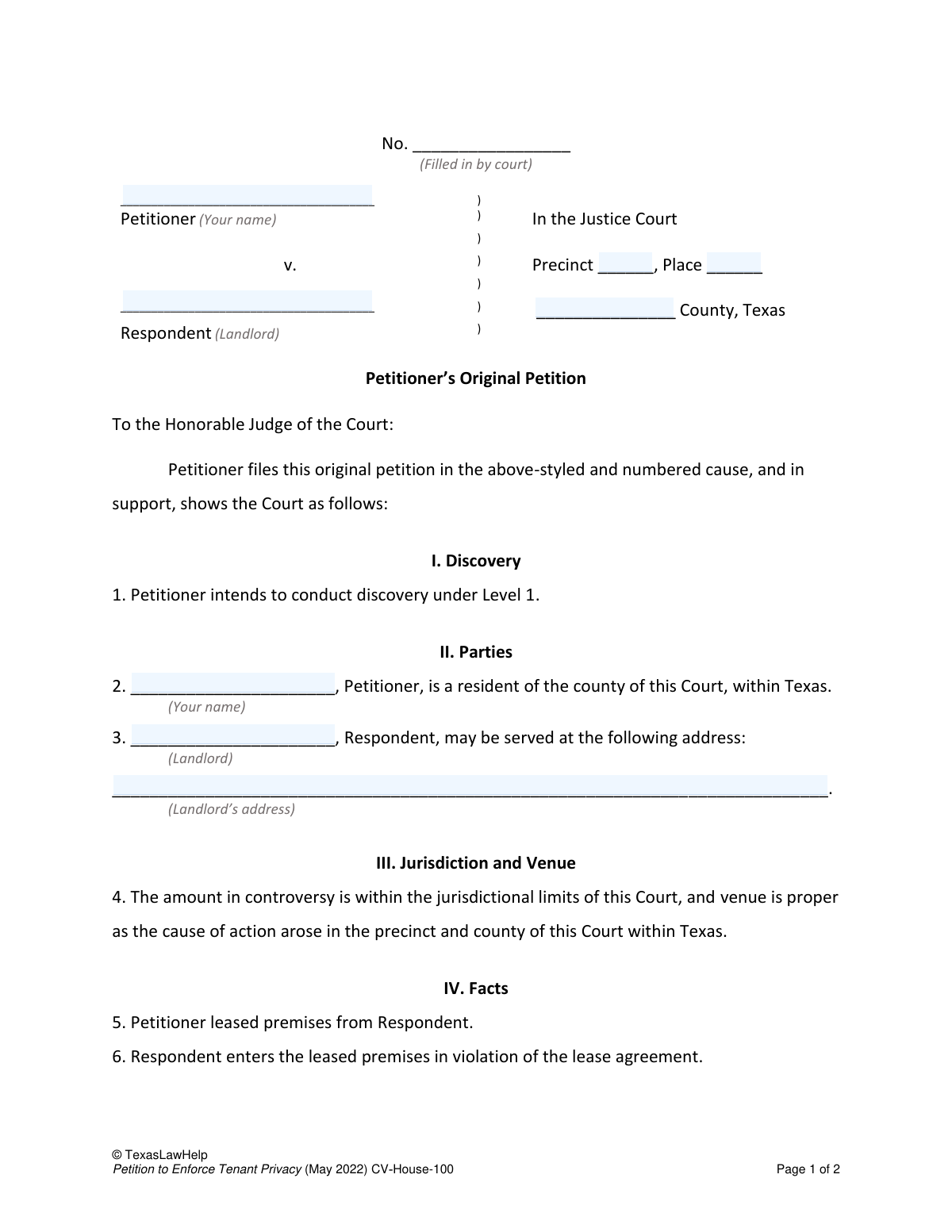
The Petition to Enforce Tenant Privacy is a formal legal document used in Texas for a tenant (Petitioner) to initiate a lawsuit against their landlord (Respondent) in justice court for violating their right to privacy. This petition outlines the specific violations, such as unauthorized entry, and seeks relief in the form of actual damages and court costs up to the court's $20,000 limit. Today, this form can be filled out quickly and accurately using AI-powered services like Instafill.ai, which can also convert non-fillable PDF versions into interactive fillable forms.
Our AI automatically handles information lookup, data retrieval, formatting, and form filling.
It takes less than a minute to fill out CV-House-100 using our AI form filling.
Securely upload your data. Information is encrypted in transit and deleted immediately after the form is filled out.
Form specifications
| Form name: | Petition to Enforce Tenant Privacy (CV-House-100) |
| Number of fields: | 23 |
| Number of pages: | 1 |
| Language: | English |
Instafill Demo: How to fill out PDF forms in seconds with AI
How to Fill Out CV-House-100 Online for Free in 2026
Are you looking to fill out a CV-HOUSE-100 form online quickly and accurately? Instafill.ai offers the #1 AI-powered PDF filling software of 2026, allowing you to complete your CV-HOUSE-100 form in just 37 seconds or less.
Follow these steps to fill out your CV-HOUSE-100 form online using Instafill.ai:
- 1 Navigate to Instafill.ai and upload or select the 'Petition to Enforce Tenant Privacy' form.
- 2 Provide your personal details as the Petitioner, including your full name and address.
- 3 Enter the landlord's information as the Respondent, including their name and the address for legal service.
- 4 Specify the court information, including the county, precinct, and place number where the lawsuit will be filed.
- 5 Detail the facts of the case by checking the boxes that correspond to the landlord's actions and adding any other specific privacy violations in the provided space.
- 6 Review the entire petition auto-filled by the AI for accuracy, then provide your digital signature, printed name, and contact information.
- 7 Download the completed, signed petition and follow the instructions to print copies and file them with the appropriate justice court.
Our AI-powered system ensures each field is filled out correctly, reducing errors and saving you time.
Why Choose Instafill.ai for Your Fillable CV-House-100 Form?
Speed
Complete your CV-House-100 in as little as 37 seconds.
Up-to-Date
Always use the latest 2026 CV-House-100 form version.
Cost-effective
No need to hire expensive lawyers.
Accuracy
Our AI performs 10 compliance checks to ensure your form is error-free.
Security
Your personal information is protected with bank-level encryption.
Frequently Asked Questions About Form CV-House-100
This form is used by a tenant in Texas to file a lawsuit in justice court against their landlord for violating their privacy, such as entering the property without proper notice or for an unauthorized reason.
You, the tenant filing the lawsuit, are the 'Petitioner.' Your landlord, who is the property owner, is the 'Respondent.'
You can find the precinct by checking online or calling a nearby justice court with the property's address. If a precinct has multiple courts, each has a 'place number,' and you can file in any 'place' within your precinct.
You should leave the 'Case Number' field blank. The court clerk will assign a number to your case and write it in this space when you file the petition.
The Respondent must be the property owner, which may be a business. The form instructions suggest resources to help you find the legal owner's name and address for proper service.
This form is for use in Texas justice court, which has a jurisdictional limit of $20,000. This includes any actual damages and court costs you are requesting.
In Section IV, item 7, there is a blank space provided for you to write in any additional privacy violations that are not already listed on the form.
Sign the original form and make two complete copies. Take the original and both copies to the justice court clerk for filing; you will receive one file-stamped copy back for your records.
A constable will serve the lawsuit papers to your landlord, who then has about two weeks to file an answer. After they respond or the time limit passes, you can ask the court to set a hearing date.
Yes, services like Instafill.ai use AI to accurately auto-fill form fields, which can save you time and help prevent common errors.
Simply upload the PDF of the 'Petition to Enforce Tenant Privacy' to the Instafill.ai platform. The AI will identify all the fields, allowing you to enter your information once and have it populated correctly throughout the document.
Instafill.ai can convert flat, non-fillable PDFs into interactive forms. Just upload your PDF to the platform, and it will become a fillable document that you can complete and download.
You will need your full name and address, your landlord's legal name and service address, and specific details about how and when your privacy was violated. Having your lease agreement available for reference is also recommended.
Compliance CV-House-100
Validation Checks by Instafill.ai
1
Petitioner Name Consistency and Completeness
This check verifies that the Petitioner's name is entered in both the header and the 'Parties' section, and that the names match. Consistency is crucial for legal documents to clearly identify the person filing the lawsuit. If the names are missing or inconsistent, the petition may be considered defective and rejected by the court clerk.
2
Respondent Name Completeness
Ensures the landlord's (Respondent's) name is filled in. This field is mandatory because it identifies the party being sued. Without the Respondent's name, the lawsuit cannot proceed, and the court cannot issue any orders against the landlord.
3
Respondent Address for Service
Validates that a complete and valid physical address is provided for the Respondent (Landlord). This address is used by a constable to serve the official court papers, a legal requirement to notify the landlord of the lawsuit. An incomplete or incorrect address will prevent service and delay or halt the case.
4
County Name Validation
Verifies that a valid Texas county name is entered in the court information section. This is essential for establishing the correct jurisdiction for the case, as lawsuits must be filed in the proper venue. Filing in the wrong county can lead to the case being dismissed.
5
Precinct Number Format
Checks that the 'Precinct' field contains a numeric value. Justice courts are organized by precinct, so this number is a critical part of the court's address and is necessary for filing the case in the correct location. An invalid or missing precinct number will cause the filing to be rejected.
6
Minimum Violation Selection
Confirms that at least one checkbox in the 'Facts' section (item 7) is checked or that the 'Additional privacy violations' text field is filled. The petition must state a specific cause of action, so at least one violation must be alleged. If no violations are specified, the petition lacks a factual basis and will likely be dismissed.
7
Petitioner Signature Presence
Verifies that the Petitioner has provided a signature in the designated signature field. An unsigned petition is not legally valid and will be rejected by the court clerk upon filing. The signature affirms that the information provided is true to the best of the Petitioner's knowledge.
8
Petitioner Printed Name Completeness
Ensures the Petitioner's printed name is provided next to their signature. This clarifies the identity of the signatory, especially if the signature is illegible. It is a standard requirement for legal documents to prevent ambiguity and ensure proper identification.
9
Petitioner Address Completeness
Checks that the Petitioner has provided their full mailing address. The court and the opposing party will use this address to send official notices and correspondence related to the case. Failure to provide a valid address could result in the Petitioner missing important deadlines or hearings.
10
Petitioner Phone Number Format
Validates that the Petitioner's phone number is in a recognizable format, such as a 10-digit number. This allows the court clerk or other officials to contact the Petitioner quickly if needed. An invalid format could lead to communication failures and delays in the case.
11
Petitioner Email Format Validation
Verifies that the email address provided by the Petitioner follows a standard email format (e.g., [email protected]). This is an essential modern contact method for receiving electronic notices and communications from the court. An invalid email address could cause the Petitioner to miss critical information.
12
Place Number Format (If Provided)
Checks that if a value is entered into the 'Place' field, it is a numeric value. While not all precincts have a place number, for those that do, it is a critical part of identifying the specific court. Entering non-numeric text could cause confusion or rejection of the filing.
13
Petitioner Name and Printed Name Consistency
Compares the Petitioner's name entered in the 'Parties' section with the printed name entered in the signature block. These two fields should be identical to maintain consistency throughout the legal document. Discrepancies could raise questions about the identity of the filer and the validity of the petition.
Common Mistakes in Completing CV-House-100
Tenants often list the property management company as the Respondent because that's who they interact with daily for rent and repairs. However, the legal owner of the property is the correct party to sue, and failing to name them can lead to the case being dismissed or severely delayed. To avoid this, use public records or follow the form's instructions to find the legal owner's name and correct address for service.
Filers may guess the precinct or not realize that some precincts have multiple 'places,' leading them to enter the wrong court details. Filing in the wrong court can cause significant delays or lead to the case being rejected, forcing you to refile and pay fees again. Always verify the correct precinct and place for the property's address by checking online or calling a justice court clerk before filing.
This error often occurs when a tenant only has a PO Box or a management office address, not the legal address required for serving court papers. An incorrect address will prevent the constable from serving the lawsuit, halting the case before it even begins and wasting your filing fee. It is crucial to research and provide the full, correct address where the landlord (Respondent) can be legally served.
In the stress of filing a lawsuit, it's easy to overlook the signature line at the bottom of the form. An unsigned legal document is invalid and will be rejected by the court clerk, delaying the entire process until a signed copy is submitted. Always perform a final review of the form, paying special attention to the signature block, before making copies and going to the courthouse.
The form has a blank for 'No. ______' at the very top, which filers might mistakenly try to fill in themselves with a date or account number. This field is exclusively for the court clerk, who will assign a unique case number upon filing. Leaving this blank is the correct procedure; filling it in can cause confusion and may require you to complete a new form at the clerk's office.
A petitioner might focus only on writing their own description in the blank space and overlook the pre-listed violations in Section IV, Part 7. Failing to check all relevant boxes weakens the petition by not fully cataloging the landlord's wrongful actions as defined by the law. Carefully read each option and check every box that applies to your situation to build the strongest possible case.
In the 'add any additional privacy violations' section, tenants might write emotional statements ('my landlord is a jerk') instead of specific, factual events. The court needs clear, objective facts about what happened, including dates and details of the unauthorized entry. To avoid this, stick to a factual timeline of events, describing each violation of the lease or privacy rights clearly and concisely.
The court and the opposing party will use the phone number and email address on the form to send critical information, including hearing dates and motions. Providing an old number or an email address you rarely check can cause you to miss important deadlines or even the trial itself, potentially resulting in your case being dismissed. Ensure you provide a current phone number and an email address that you monitor daily.
Since this form is often a non-fillable PDF, it must be printed and filled out by hand, which can result in messy or illegible writing. If the clerk, judge, or constable cannot read the names, addresses, or facts of the case, it can lead to filing errors or a failure to serve the lawsuit. To prevent this, print clearly in block letters or use a tool like Instafill.ai, which can convert flat PDFs into fillable forms that can be typed into for maximum clarity.
The document packet includes introductory pages with instructions that explicitly state 'Do not file this page.' Filers might mistakenly include these pages when they submit the petition to the court. This is unprofessional and creates unnecessary paperwork for the court clerk, who will simply discard them. Only file the actual petition pages (labeled Page 1 of 2 and Page 2 of 2).
Saved over 80 hours a year
“I was never sure if my IRS forms like W-9 were filled correctly. Now, I can complete the forms accurately without any external help.”
Kevin Martin Green
Your data stays secure with advanced protection from Instafill and our subprocessors

Robust compliance program
Transparent business model
You’re not the product. You always know where your data is and what it is processed for.
ISO 27001, HIPAA, and GDPR
Our subprocesses adhere to multiple compliance standards, including but not limited to ISO 27001, HIPAA, and GDPR.
Security & privacy by design
We consider security and privacy from the initial design phase of any new service or functionality. It’s not an afterthought, it’s built-in, including support for two-factor authentication (2FA) to further protect your account.
Fill out CV-House-100 with Instafill.ai
Worried about filling PDFs wrong? Instafill securely fills petition-to-enforce-tenant-privacy-cv-house-100 forms, ensuring each field is accurate.