Yes! You can use AI to fill out Standard Bill of Lading
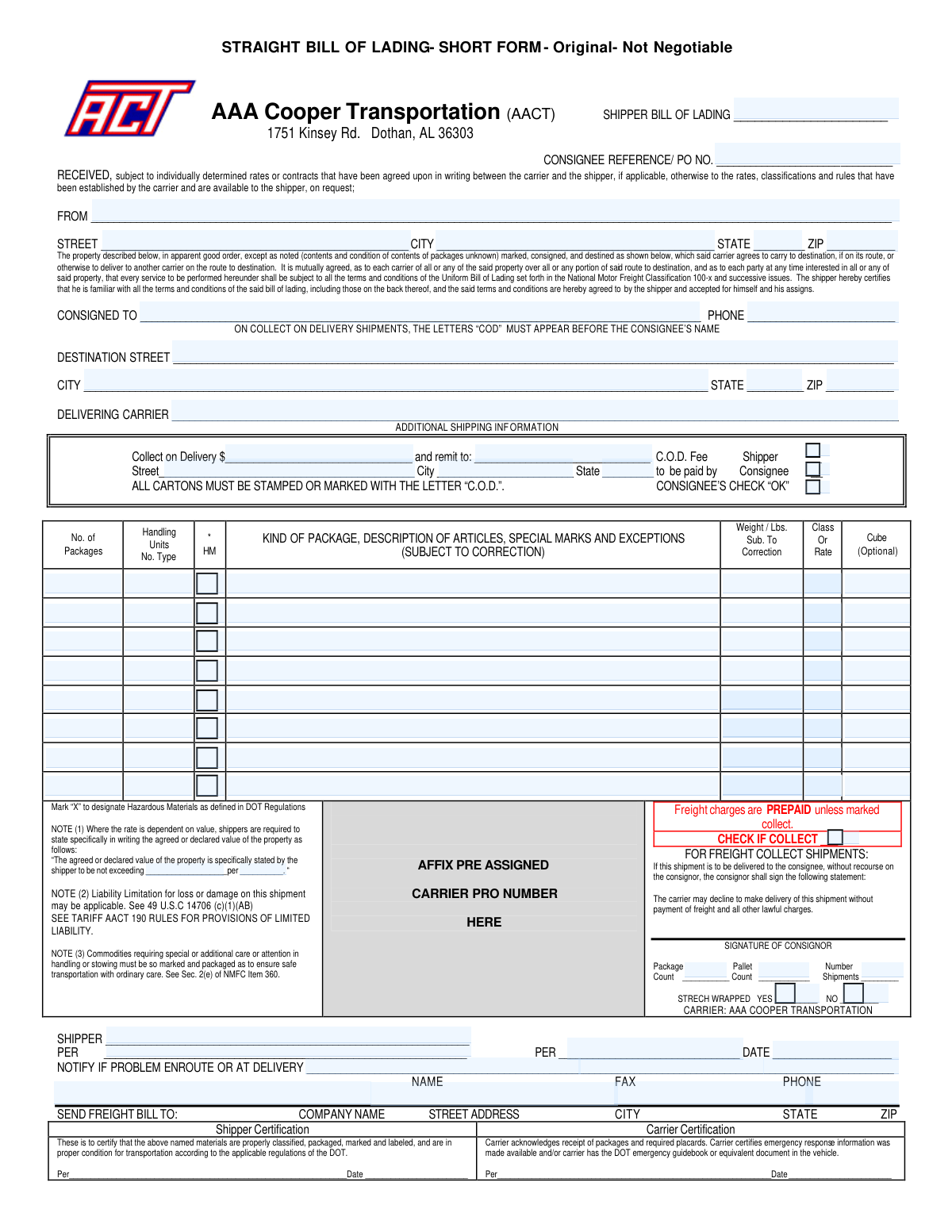
A Standard Bill of Lading (BOL) is a legally binding document that serves as a contract between a shipper and a carrier, a receipt for the goods being shipped, and a document of title. It contains detailed information about the shipment, including the type, quantity, and condition of the goods, as well as the origin and destination, making it essential for logistics management and legal accountability. Today, this form can be filled out quickly and accurately using AI-powered services like Instafill.ai, which can also convert non-fillable PDF versions into interactive fillable forms.
Our AI automatically handles information lookup, data retrieval, formatting, and form filling.
It takes less than a minute to fill out BOL using our AI form filling.
Securely upload your data. Information is encrypted in transit and deleted immediately after the form is filled out.
Form specifications
| Form name: | Standard Bill of Lading |
| Number of fields: | 110 |
| Number of pages: | 1 |
| Filled form examples: | Form BOL Examples |
| Language: | English |
Instafill Demo: How to fill out PDF forms in seconds with AI
How to Fill Out BOL Online for Free in 2026
Are you looking to fill out a BOL form online quickly and accurately? Instafill.ai offers the #1 AI-powered PDF filling software of 2026, allowing you to complete your BOL form in just 37 seconds or less.
Follow these steps to fill out your BOL form online using Instafill.ai:
- 1 Navigate to Instafill.ai and upload or select the Standard Bill of Lading form.
- 2 Provide the complete Shipper and Consignee information, including names, addresses, and contact details. Instafill.ai can often pre-populate this from your saved contacts.
- 3 Detail each item in the shipment, entering the number of packages, description, weight, and freight class for each line item.
- 4 Specify any special handling or payment instructions, such as Collect on Delivery (COD) details, declared value, or hazardous material declarations.
- 5 Enter the delivering carrier's name and provide the correct address for sending the freight bill.
- 6 Review all entered information for accuracy. Instafill.ai's AI will help flag any potential errors or missing fields before you proceed.
- 7 Electronically sign and date the form to certify the shipment details, then download or share the completed Bill of Lading with the carrier and other relevant parties.
Our AI-powered system ensures each field is filled out correctly, reducing errors and saving you time.
Why Choose Instafill.ai for Your Fillable BOL Form?
Speed
Complete your BOL in as little as 37 seconds.
Up-to-Date
Always use the latest 2026 BOL form version.
Cost-effective
No need to hire expensive lawyers.
Accuracy
Our AI performs 10 compliance checks to ensure your form is error-free.
Security
Your personal information is protected with bank-level encryption.
Frequently Asked Questions About Form BOL
This is a Shipper's Bill of Lading, a legal contract between a shipper and a carrier for the transportation of goods. The shipper (the person or company sending the goods) is responsible for accurately completing this form before the shipment is picked up.
The 'Shipper' is the party sending the shipment, while the 'Consignee' is the party receiving the shipment at the destination. You must provide complete and accurate address information for both.
This section is for shipments where the carrier must collect payment for the goods from the consignee upon delivery. If this applies, you must fill in the amount to be collected and where the funds should be sent.
For each item that is a hazardous material, you must check the 'Hazardous Material' box on that specific line. Ensure you also provide the required descriptions and classifications as per transportation regulations.
Freight class is a standardized number used to classify commodities, which directly impacts the shipping cost. It's crucial to determine the correct class based on your item's density, handling, and value to avoid billing adjustments.
The 'Declared Value' is the maximum liability of the carrier for your shipment in case of loss or damage. You should enter the total value of the goods being shipped to ensure you have adequate coverage.
The shipper's signature certifies that all information on the Bill of Lading is correct and that the goods are ready for transport. It is a legally binding confirmation of the agreement with the carrier.
If you have more items than the available lines, you may need to attach an additional, clearly marked page. Alternatively, you can use a second Bill of Lading form, ensuring both are referenced together (e.g., 'Page 1 of 2').
If you check 'Freight Charges Collect', the consignee is responsible for paying the shipping costs. If left blank, the charges are typically considered 'prepaid' by the shipper.
This should be the person who can make decisions about the shipment if the carrier encounters an issue. Provide their direct contact information to ensure swift communication and resolution.
Yes, services like Instafill.ai use AI to accurately auto-fill form fields from your existing data, which can save significant time and reduce errors. This is especially helpful for repetitive information like shipper and consignee addresses.
Simply upload the Bill of Lading PDF to the Instafill.ai platform. The AI will identify the fields, allowing you to fill them out interactively or connect your data sources to auto-fill the information instantly.
You can use a service like Instafill.ai, which can convert flat, non-fillable PDFs into interactive, fillable forms. This allows you to easily type your information directly into the fields before printing or saving.
Compliance BOL
Validation Checks by Instafill.ai
1
COD Information Completeness
This validation ensures that if the 'Collect on Delivery Amount' field contains a monetary value greater than zero, then all associated 'Remit to' fields (Name, Street Address, City, State, Zip Code) must be populated. This is critical for ensuring the collected funds can be correctly processed and sent to the intended recipient. If this check fails, the form submission should be rejected with an error message indicating that the remittance information is missing for the C.O.D. amount specified.
2
COD Fee Payer Exclusivity
This check verifies that the 'COD Fee Paid by Shipper' and 'COD Fee Paid by Consignee' checkboxes are mutually exclusive. A user cannot select both options, as the fee can only be assigned to one party. This prevents billing ambiguity and potential disputes. If both boxes are checked, the system should display an error prompting the user to select only one.
3
State Abbreviation Format
Validates that all state fields ('Shipper State', 'Destination State', 'Remit to State', 'Freight Bill State') contain a valid two-letter abbreviation. This ensures data consistency and compatibility with shipping carrier systems and address validation services. An invalid entry could lead to routing errors or delivery delays, so the system should reject non-standard entries and suggest a correction.
4
Zip Code Format Validation
This check ensures that all zip code fields ('Shipper Zip Code', 'Destination Zip Code', etc.) adhere to a standard 5-digit (NNNNN) or 9-digit (NNNNN-NNNN) format. Correctly formatted zip codes are essential for accurate mail and freight routing, as well as for calculating shipping rates. A failure would prompt the user to correct the format before submission.
5
Shipping Item Line Completeness
For each shipping item row, this validation confirms that if a 'Number of Packages' is entered, the corresponding 'Package and Article Description' and 'Weight in Pounds' fields are also filled. This ensures that every item listed on the bill of lading has the minimum required information for handling, classification, and billing. An incomplete item line would trigger an error, highlighting the missing fields for that specific item.
6
Total Package Count Consistency
This validation cross-references the sum of all 'Number of Packages' fields from the individual shipping items against the total 'Package Count (Shipment Counts)' field. The two values must match to ensure the manifest is internally consistent. A mismatch could indicate a data entry error and would require the user to review and correct the package counts before proceeding.
7
Stretch Wrap Selection Exclusivity
This check ensures that the 'Stretch Wrapped Yes' and 'Stretch Wrapped No' checkboxes are mutually exclusive. A shipment cannot be both stretch-wrapped and not stretch-wrapped, so only one of these options can be selected. This provides clear handling instructions and prevents contradictory information. If both are selected, an error should be displayed.
8
Certification Date Validity
This validation verifies that the 'Certification Date' is a real, valid date in a recognized format (e.g., MM/DD/YYYY) and is not a date in the future. This is important for establishing the legal timeline of the shipment contract. An invalid or future date would be flagged, requiring the user to input a correct and current or past date.
9
Shipper Certification Completeness
This check ensures that if the form is being finalized, the 'Shipper Signature/Initials', 'Signatory Name', and 'Certification Date' fields are all populated. These fields are legally required to certify that the shipment details are accurate and the goods are in proper condition for transport. Failure to complete this section would prevent the bill of lading from being considered a valid, executed document.
10
Phone Number Format
Validates that the 'Consignee Phone Number' and 'Contact Phone' fields are in a recognizable North American phone number format (e.g., 10 digits, possibly with parentheses, spaces, or hyphens). A valid phone number is crucial for communication in case of delivery issues or emergencies. The system should attempt to reformat the number or prompt the user for correction if the entry is invalid.
11
Address Block Completeness
This check ensures that for any given address block (Shipper, Destination, Remit To), if one field like 'Street Address' is filled, then 'City', 'State', and 'Zip Code' must also be filled. An incomplete address is unusable and will cause significant delivery failures. This validation prevents submissions with partial addresses, forcing the user to provide all necessary components for a valid location.
12
Hazardous Material Description Requirement
This validation checks that if a 'Hazardous Material' checkbox is ticked for any shipping line, the corresponding 'Package and Article Description' field contains appropriate keywords or formatting as required by transportation regulations. Shipping hazardous materials without proper documentation is illegal and dangerous. If the checkbox is ticked but the description appears generic, the system should flag it for manual review or require more specific information.
Common Mistakes in Completing BOL
Shippers often guess the freight class or use generic terms like 'general goods' in the 'Package and Article Description' field. This leads to carriers re-classifying the shipment, which almost always results in higher freight charges, re-weigh fees, and significant transit delays. To avoid this, always use the precise National Motor Freight Classification (NMFC) number and provide a detailed, accurate description of the articles being shipped.
When a shipment is Collect on Delivery (COD), users frequently enter the 'Collect on Delivery Amount' but forget to specify who pays the fee (by checking 'COD Fee Paid by Shipper' or 'Consignee') or omit the 'Remit to' address details. This ambiguity can cause the carrier to refuse the shipment or hold the collected funds indefinitely, delaying payment. Always complete all related COD fields, including the amount, fee responsibility, and full remittance address, if applicable.
Overlooking the 'Hazardous Material' checkbox for a line item is a critical and dangerous error, often happening due to haste or a lack of awareness. Shipping undeclared hazmat is a serious compliance violation that can result in substantial fines, legal liability, and catastrophic safety incidents. Always verify if any item requires hazmat designation and check the corresponding box for each line item.
Shippers often forget to check the 'Freight Charges Collect' box when the consignee is supposed to pay for shipping. By default, if this box is left unchecked, the charges are considered 'Prepaid' by the shipper. This oversight leads to billing disputes and can cause delays if the carrier needs to clarify payment terms before delivery.
A common data entry error is when the sum of packages listed in the item details does not match the 'Package Count' entered in the 'Shipment Counts' section. This discrepancy forces the carrier to perform a manual count at the terminal to resolve the difference, leading to delays and potential fees for sorting and segregation. Double-check that the line-item quantities add up to the shipment totals before signing.
The shipper's signature legally certifies that all information on the Bill of Lading is correct and turns the document into an enforceable contract. Forgetting to sign, date, or print the 'Signatory Name' can invalidate the document, weaken the shipper's position in a claim dispute, and cause carriers to reject the shipment at pickup. Always ensure the 'Shipper Certification' section is fully and legibly completed.
Typos, missing suite numbers, or incorrect zip codes in the Shipper, Consignee, or Freight Bill address sections are frequent mistakes. These seemingly small errors are a primary cause of delivery delays, failed delivery attempts, and costly re-delivery fees. To prevent this, verify every address for accuracy and completeness before finalizing the form. AI-powered tools like Instafill.ai can help by validating addresses and auto-populating from saved contacts to ensure consistency.
Many shippers leave the 'Declared Value' fields blank, often because they are unsure what to enter or want to avoid extra charges. This can be a costly mistake, as it may limit the carrier's liability to a default, minimal amount per pound in the event of loss or damage, which is often far less than the actual value of the goods. Shippers should understand their cargo's value and the carrier's liability rules to make an informed decision about declaring value.
The 'Shipper Bill of Lading Number' and 'Consignee Reference / PO Number' are critical for tracking and accounting. It's easy to transpose digits or enter the wrong number, especially when creating multiple BOLs. An incorrect number can make it impossible for the shipper and consignee to track the shipment's progress or reconcile invoices, leading to confusion and payment delays.
For shipments with multiple items, users sometimes fail to complete all required fields for each line, such as listing the weight but forgetting the freight class. Each line item must be a complete record. Incomplete lines force the carrier to make assumptions or halt the shipment for clarification, causing delays and billing adjustments. If the form is a non-fillable PDF, a tool like Instafill.ai can convert it to a fillable version, helping to ensure all required fields are addressed.
Saved over 80 hours a year
“I was never sure if my IRS forms like W-9 were filled correctly. Now, I can complete the forms accurately without any external help.”
Kevin Martin Green
Your data stays secure with advanced protection from Instafill and our subprocessors

Robust compliance program
Transparent business model
You’re not the product. You always know where your data is and what it is processed for.
ISO 27001, HIPAA, and GDPR
Our subprocesses adhere to multiple compliance standards, including but not limited to ISO 27001, HIPAA, and GDPR.
Security & privacy by design
We consider security and privacy from the initial design phase of any new service or functionality. It’s not an afterthought, it’s built-in, including support for two-factor authentication (2FA) to further protect your account.
Fill out BOL with Instafill.ai
Worried about filling PDFs wrong? Instafill securely fills standard-bill-of-lading forms, ensuring each field is accurate.



