
Instafill.ai
7 days free
AI form filling · 123 fields · 6 pages · done in seconds

Yes! You can use AI to fill out Form 1099-MISC, Miscellaneous Information

Don't type 123 fields by hand. Tell our AI about yourself, or upload your W-2 or last year's return, and it fills every field in seconds. You check it, then download, print or sign.
7 days free, then $19.99/month · Cancel anytime
AI fills it, no typingEncrypted, never used to train AICancel in two clicks
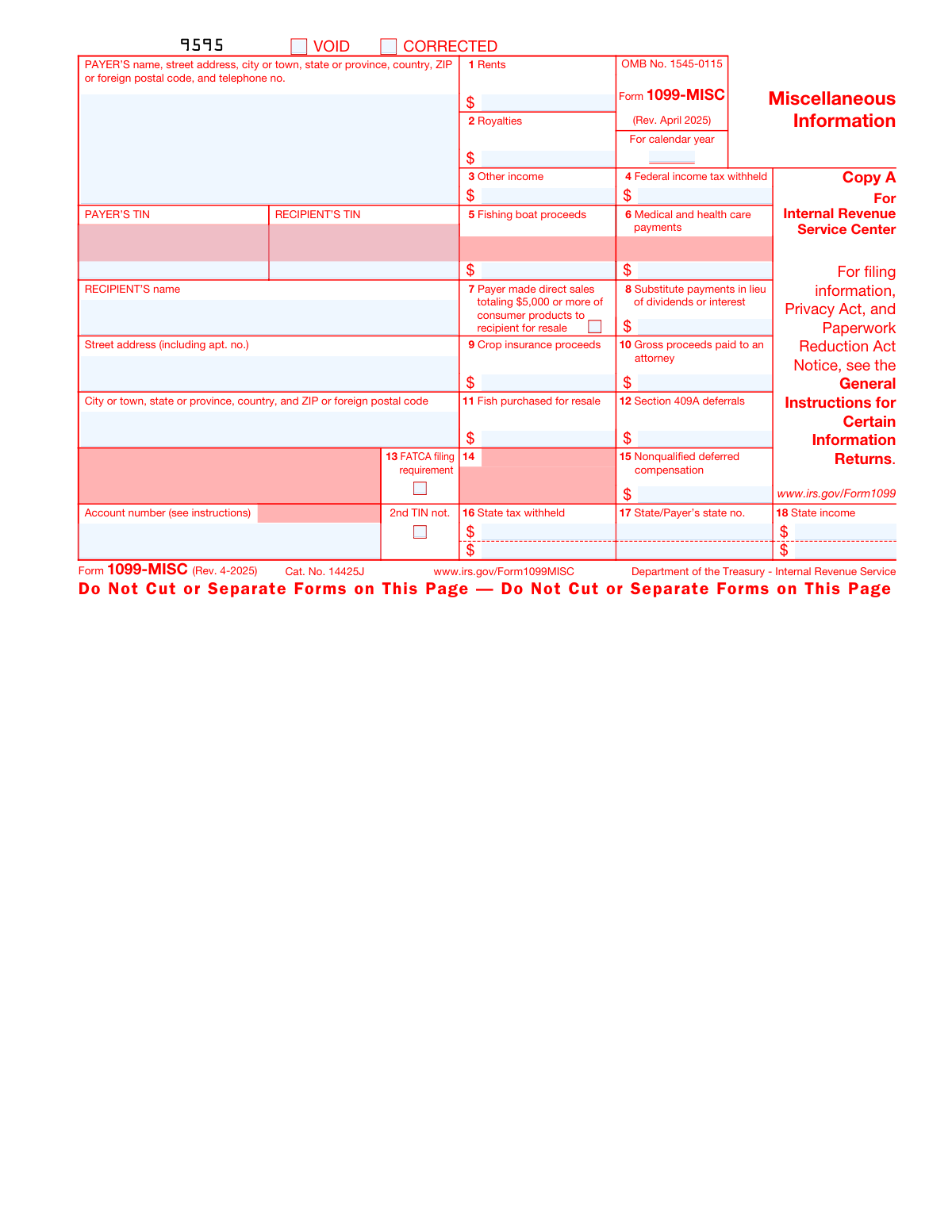
Form 1099-MISC, Miscellaneous Information, page 1
Moderate · 61/100Form Complexity Index

The AI does the filling. You just check it.

No typing into boxes, nothing to install.

Tell the AI about youAnswer a few questions in plain words, or upload your W-2 or last year's return. That is all the typing there is.
AI fills every field in secondsIt puts each answer in the right box on every page, tables and checkboxes included.
Check it and downloadReview every field, change anything, then download, print or sign the PDF.

What this form asks for

The AI fills all of it, from your answers or your documents.

Form 1099-MISC is a tax form used to report miscellaneous income to the Internal Revenue Service (IRS). It covers income such as rents, royalties, medical and healthcare payments, non-employee compensation, and other types of payments not covered by traditional employment tax forms. It's important for accurate tax reporting and compliance.
Fillable fields123
Pages6
Sections23
Tables and lists1
Form Complexity IndexModerate, 61/100

The AI checks your answers before you download

15 checks built for this form, so a wrong date or a missing answer is caught before anyone else sees it.

Ensures the correct version of Form 1099-MISC is used for the specified calendar year

The software ensures that the version of Form 1099-MISC being filled out corresponds with the appropriate tax year. It checks the form's year against the calendar year for which the information is being reported. This is crucial as tax laws and form requirements can change annually, and using an outdated form could result in filing errors. The system alerts the user if there is a mismatch in the year to prevent submission of an incorrect form.

Confirms that Copy A is not downloaded from the IRS website but ordered if filing on paper

The software confirms that if the user is filing a paper copy of Form 1099-MISC, Copy A has not been downloaded from the IRS website, as these copies are not scannable and cannot be processed by the IRS. It prompts the user to order official paper forms from the IRS or an authorized provider. The system ensures compliance with IRS regulations by preventing the use of non-scannable forms and guiding the user on how to obtain the correct paper forms.

Verifies that e-filing is used for 10 or more information returns

The software verifies whether the user is required to e-file Form 1099-MISC by checking the number of information returns being submitted. If the user is filing 10 or more information returns, the system will recommend or mandate e-filing in accordance with IRS requirements. This check ensures that users are adhering to the IRS's e-filing threshold and helps streamline the filing process.

Checks that the 'CORRECTED' box is marked if the form is a correction

The software checks to ensure that if the Form 1099-MISC being submitted is a correction to a previously filed form, the 'CORRECTED' box is marked. This is an important step to notify the IRS that the form is amending previously submitted information. The system helps maintain accurate records and ensures that the IRS can properly process the corrected information.

Validates the payer's full name, address, and telephone number are accurately entered

The software validates that the payer's full name, address, and telephone number are accurately entered on Form 1099-MISC. It checks for completeness and proper formatting of the information to ensure that the IRS can contact the payer if necessary. This validation is essential for maintaining accurate records and for the potential need for clarification or additional information from the payer.

Confirms the payer's Taxpayer Identification Number (TIN) is correctly provided

This validation check ensures that the payer's Taxpayer Identification Number (TIN) is entered accurately on Form 1099-MISC. It cross-references the provided TIN with the IRS database to confirm its validity and checks for the correct format, including the appropriate number of digits and/or letters. This step is crucial to ensure proper reporting and to avoid potential issues with the IRS.

And 9 more checks
  • Verifies the recipient's Taxpayer Identification Number (TIN) is accurately entered
  • Validates the recipient's full name and address details are correctly filled out
  • Ensures any account or unique number is included if applicable
  • Checks that all applicable boxes (1-18) contain the correct dollar amounts
  • Confirms compliance with the 'Instructions for Recipient' for each box
  • Verifies the form is used for its intended purpose (IRS, Recipient, State Tax Department)
  • Ensures the FATCA filing requirement box is checked if applicable
  • Validates state tax information is correctly entered in boxes 16-18 if applicable
  • Confirms the form is kept for records and advises consultation with a tax professional if needed

Let AI fill out your Form 1099-MISC

No typing. Every field filled in seconds, checked, ready to sign.

7 days free, then $19.99/month · Cancel anytime

How to Fill Out Form 1099-MISC Online for Free in 2026

What the AI walks you through.

  1. Visit instafill.ai and select Form 1099-MISC
  2. Enter payer's information
  3. Input recipient's TIN and name
  4. Fill in income amounts in appropriate fields
  5. Add state tax withheld if applicable
  6. Sign and date the form electronically
  7. Review for accuracy and submit the form

Common Mistakes in Completing Form 1099-MISC

The ones the AI is built to catch.

Entering incorrect or incomplete payer's information
Failure to provide accurate and complete payer's information, such as name, address, and Taxpayer Identification Number (TIN), can lead to processing delays and potential penalties. Ensure that all required fields are filled out correctly and completely. Double-check the TIN for accuracy, as even a single digit error can result in significant issues. Recommendation: Verify the payer's information before submitting the form to avoid potential errors and delays.
Entering incorrect or incomplete recipient's information
Providing incorrect or incomplete recipient's information, including name, address, or TIN, can result in processing delays and potential penalties. Ensure that all required fields are filled out correctly and completely. Double-check the TIN for accuracy, as even a single digit error can result in significant issues. Recommendation: Verify the recipient's information before submitting the form to ensure that all required fields are filled out correctly and completely.
Using an outdated or incorrect form revision
Using an outdated or incorrect form revision can result in processing delays and potential penalties. The IRS frequently updates forms to reflect changes in tax laws and regulations. Ensure that you are using the most recent form revision by checking the IRS website or contacting the IRS directly. Recommendation: Always use the most recent form revision to ensure that all required information is captured accurately and completely.
Filing Copy A downloaded from the IRS website instead of ordering official forms
Filing Copy A forms downloaded from the IRS website instead of ordering official forms can result in processing delays and potential penalties. The IRS may not accept forms that are not official, and using unofficial forms can lead to errors and delays. Recommendation: Always order official forms from the IRS to ensure that you are using the correct forms and that they meet the IRS's requirements.
Failing to report all required income categories in Boxes 1-18
Failing to report all required income categories in Boxes 1-18 can result in underreporting of income and potential penalties. Ensure that all required income categories are reported accurately and completely. Recommendation: Review the instructions carefully and report all required income categories to ensure that your Form 1099-MISC is complete and accurate.
Incorrect or Incomplete Taxpayer Identification Numbers (TINs)
Misreporting or omitting the correct Taxpayer Identification Number (TIN) for the recipient or payer can lead to significant errors and potential penalties. Ensure that all TINs are entered accurately and completely, including the correct type (Social Security Number, Employer Identification Number, or Individual Taxpayer Identification Number) and format (nine digits for SSNs and ITINs, and eleven digits for EINs). Double-check the TINs against the official documentation to minimize the risk of errors.
Failing to check the 'CORRECTED' box for corrected forms
If you are submitting a corrected Form 1099-MISC, it is essential to check the 'CORRECTED' box in the top right corner of the form to indicate that corrections have been made. Failing to do so can result in the IRS treating the corrected form as a new form, leading to duplicate reporting and potential penalties. Always remember to check this box when submitting corrected forms.
Neglecting to follow the specific instructions for each box
Form 1099-MISC contains various boxes that require specific information to be reported. Failing to follow the instructions for each box can result in incorrect reporting and potential penalties. Be sure to read and understand the instructions for each box carefully and report the correct information accordingly.
Failing to report amounts on the tax return as instructed
It is essential to report the correct amounts on the tax return as instructed on Form 1099-MISC. Failing to do so can result in underreporting or overreporting of income, leading to potential penalties and incorrect tax calculations. Be sure to report all income as required by the instructions.
Not keeping a copy of the form for records
Maintaining accurate records is essential for tax purposes. Failing to keep a copy of Form 1099-MISC for your records can make it difficult to verify the information reported and may result in potential issues during an audit. Always keep a copy of the form for your records.
Ignoring the latest updates and instructions from the IRS website
The Form 1099-MISC, Miscellaneous Information, is subject to frequent updates and modifications by the Internal Revenue Service (IRS). Failing to check the IRS website for the latest instructions and forms can lead to filling out an outdated or incorrect form. This mistake can result in penalties, delays in processing, or even rejection of the form. To avoid this error, it is recommended to regularly visit the IRS website and review the instructions for Form 1099-MISC before filling it out. Additionally, setting up email notifications or subscribing to IRS newsletters can help ensure that you receive the most current information.

Frequently Asked Questions About Form 1099-MISC


Is it really free for 7 days?
Yes. You pay $0 today. Cancel before Oct 31 and you are never charged. Keep it, and it is $19.99 a month for 5 fills of your Form 1099-MISC.
Can I fill other forms too?
This plan is for your Form 1099-MISC: your own AI agent fills it as often as 5 times a month. To fill other forms and upload your own, choose a Professional plan from your account.
How do I cancel?
From your account, in two clicks, any time. No email, no call.
How does the AI fill out Form 1099-MISC?
You answer a few questions in plain words, or upload your W-2 or last year's return. The AI reads what you give it and puts each answer into the right field of Form 1099-MISC, on every page, in seconds. It checks the answers against the form's own rules, and you review and change anything before you download, print or sign.
What happens to my information?
It is encrypted in transit and at rest, and it is never used to train AI.
How complex is Form 1099-MISC to fill out?
Form 1099-MISC has a Form Complexity Index of 61 out of 100, in the moderate tier: 123 fillable fields across 6 pages. Instafill.ai's AI fills it in under a minute, with every field there for you to review before you download.
What is the purpose of Form 1099-MISC, and when is it due?
Form 1099-MISC is used by businesses to report various types of income other than wages, salaries, and tips to the IRS and the recipients. The due date for filing Form 1099-MISC is January 31 if filing by paper, or February 1 if filing electronically. Recipients should receive their copies by February 15.
Who is required to file Form 1099-MISC and how many copies are needed?
Businesses are required to file Form 1099-MISC for payments made during the calendar year for rents, prizes and awards, medical and health care payments, cash payments over $10 in a trade or business, and payments to independent contractors. Three copies of the form are required: one for the IRS, one for the recipient, and one for the business records.
What is the difference between Copy A, Copy B, and Copy 1 of Form 1099-MISC?
Copy A is the version sent to the IRS, Copy B is the version given to the recipient, and Copy 1 is the version kept by the business for its records.
What information is required to be reported on Form 1099-MISC?
Form 1099-MISC reports income payments made during the calendar year, including the name and TIN (Taxpayer Identification Number) of the recipient, the name and TIN of the payer, the total amount paid, and the nature of the business relationship between the payer and the recipient.
What is the penalty for filing an incorrect or late Form 1099-MISC?
The penalty for filing an incorrect or late Form 1099-MISC can be significant. The penalty for late filing is $50 per form, with a maximum penalty of $1.5 million for large businesses. The penalty for incorrect or incomplete information is $100 per form, with a maximum penalty of $500,000 for large businesses. These penalties can be increased if the failure to file or furnish is due to intentional disregard.
What is backup withholding and when is it required?
Backup withholding is a tax requirement that applies to certain payments made to individuals. It's called backup withholding because the payer is required to withhold taxes from the payment if the recipient fails to provide a valid Taxpayer Identification Number (TIN). Backup withholding is typically required for payments related to rents, royalties, prizes and awards, and other types of income, as well as for payments to non-resident alien individuals or foreign entities. The withholding rate is generally 24% for federal income taxes, but it can be higher for certain types of payments. Form 1099-MISC reports these backup withholding payments.
How do individuals report rents, royalties, and other income on their tax return?
Individuals reporting rents, royalties, and other income on their tax return should report this income on Schedule E (Form 1040), Supplemental Income and Loss. This includes income from real estate, royalties, partnerships, S corporations, and other sources. The income reported on Schedule E is subject to ordinary income tax rates. Individuals may also be required to make estimated tax payments throughout the year based on this income. Form 1099-MISC may report some of this income, but it's important to report all sources of income, even if not reported on a Form 1099-MISC.
What is the difference between Box 12 and Box 15 of Form 1099-MISC?
Box 12 and Box 15 on Form 1099-MISC serve different purposes. Box 12 is used to report various types of income that are subject to federal income tax withholding, but are not reported in other boxes on the form. This includes things like fishing boat proceeds, crop insurance proceeds, and income from the sale of timber, mineral or oil and gas properties. Box 15, on the other hand, is used to report income that is subject to state or local income tax withholding. This includes income paid to nonresident alien individuals or foreign entities, as well as income paid to residents of certain states. It's important to note that not all income reported in Box 12 or Box 15 is subject to tax, and taxpayers should consult the instructions for Form 1099-MISC and their tax advisor for more information.
What is the FATCA filing requirement and how does it affect Form 1099-MISC?
The Foreign Account Tax Compliance Act (FATCA) is a U.S. tax law designed to prevent tax evasion by U.S. taxpayers with foreign financial assets. Under FATCA, certain U.S. taxpayers, including individuals, must report specified foreign financial assets to the Internal Revenue Service (IRS) if the total value of those assets exceeds certain thresholds. Form 1099-MISC may report payments made to foreign individuals or foreign entities, and payers of these payments may be required to report this information to the IRS under FATCA. Payers may also be required to withhold taxes on certain payments made to foreign individuals or entities. It's important for taxpayers to understand their reporting obligations under FATCA and consult the instructions for Form 1099-MISC and their tax advisor for more information.
How do individuals report excess golden parachute payments on their tax return?
Excess golden parachute payments are payments made to an individual as a result of a change in control or termination of employment, and they may be subject to special tax rules. These payments can include severance pay, bonuses, and other forms of compensation. Individuals receiving excess golden parachute payments must report these payments on Form 1099-MISC, and they may also be required to report them on Form 4136, Payment of Excise Tax on Excess Parachute Payments. The tax on excess golden parachute payments is generally imposed on the employer or transferor, but individuals may be required to file the Form 4136 to report and pay the excise tax. It's important for individuals receiving excess golden parachute payments to consult their tax advisor for more information and to understand their reporting and tax payment obligations.
What is the role of the IRS in Form 1099-MISC and what is its purpose in taxation?
The Internal Revenue Service (IRS) is the United States government agency responsible for the collection and enforcement of federal taxes. Form 1099-MISC is a tax document used to report various types of income that are not subject to withholding, such as rent, prizes, awards, and fees. The IRS uses Form 1099-MISC to ensure that reported income is properly recorded and taxed. The purpose of Form 1099-MISC in taxation is to provide the IRS with accurate information about income earned during the tax year, allowing them to assess and collect the appropriate taxes.
What are the e-filing options for Form 1099-MISC?
The IRS offers electronic filing options for Form 1099-MISC through its Business Filing System (BFS). Eligible filers can use certified software to submit their forms electronically. The benefits of e-filing include faster processing times, reduced paper usage, and increased accuracy. It is important to note that there may be fees associated with using certified software for e-filing.
How can individuals obtain the official printed version of Form 1099-MISC?
Individuals can obtain the official printed version of Form 1099-MISC from the IRS website or by contacting the IRS order department. The form is also available at local IRS offices and tax professionals' offices. It is important to ensure that the form obtained is the most current version to ensure accuracy in tax reporting.
What publications should individuals refer to for more information about Form 1099-MISC?
The IRS provides several publications to help individuals understand Form 1099-MISC and its reporting requirements. Some of the most relevant publications include: - Publication 17, Your Tax Guide - Publication 530, Tax Information for Individuals - Publication 561, Determining the Amounts and Deducting Your Allowable Deductions - Instructions for Form 1099-MISC Individuals can access these publications on the IRS website or by contacting the IRS order department.
What is the process for correcting errors on Form 1099-MISC?
If an error is discovered on a Form 1099-MISC that has already been filed, the correcting party must file a corrected Form 1099-MISC with the IRS and provide a copy to the recipient. The corrected form should be filed as soon as possible to minimize any potential penalties or interest charges. It is important to note that the IRS may assess penalties for late or incorrect filings, so it is important to address any errors promptly.
What is the difference between Form 1099-MISC and Form 1096?
Form 1099-MISC and Form 1096 serve different purposes in reporting income to the Internal Revenue Service (IRS). Form 1099-MISC is used to report various types of income that are not covered by other forms, such as rent, prizes, awards, and fees. Form 1096, on the other hand, is used to summarize and report the total amounts paid to recipients on all Forms 1099-MISC issued during the tax year. The IRS uses Form 1096 to ensure the accuracy of the information reported on all Forms 1099-MISC.
What is the purpose of the instructions for the recipient of Form 1099-MISC?
The instructions for the recipient of Form 1099-MISC provide detailed information on how to complete and file the form. The instructions explain the meaning of each field on the form, provide guidance on how to calculate certain amounts, and explain the tax reporting requirements for the recipient. It is important for recipients to carefully review and follow the instructions to ensure that the information reported on the form is accurate and complete.
What is the difference between Schedule C and Schedule E for reporting income on Form 1040?
Schedule C and Schedule E are two different forms used to report income on Form 1040. Schedule C (Form 1040) is used to report income from a business or profession, while Schedule E (Form 1040) is used to report income from rental properties, partnerships, S corporations, estates, trusts, and royalties. The primary difference between the two forms is the type of income being reported. Schedule C is used for income from self-employment activities, while Schedule E is used for income from passive investments or income-producing activities where the taxpayer does not materially participate.
What is the difference between a working interest and a royalty interest in oil, gas, or mineral properties?
A working interest and a royalty interest are two different types of ownership interests in oil, gas, or mineral properties. A working interest owner has the right to participate in the drilling, production, and operation of the well. They are responsible for paying operating expenses and are entitled to a share of the production based on their working interest percentage. A royalty interest owner, on the other hand, does not have the right to participate in the operation of the well. They receive a percentage of the production as royalty payments, which are typically based on the volume of production rather than the operating expenses incurred.
Encrypted in transit and at restNever used to train AIDelete your forms any time

Get your Form 1099-MISC filled out by AI

$0 today. Cancel before Oct 31 and you pay nothing.

7 days free, then $19.99/month · Cancel anytime