Yes! You can use AI to fill out Antrag auf Wohngeld (Mietzuschuss)

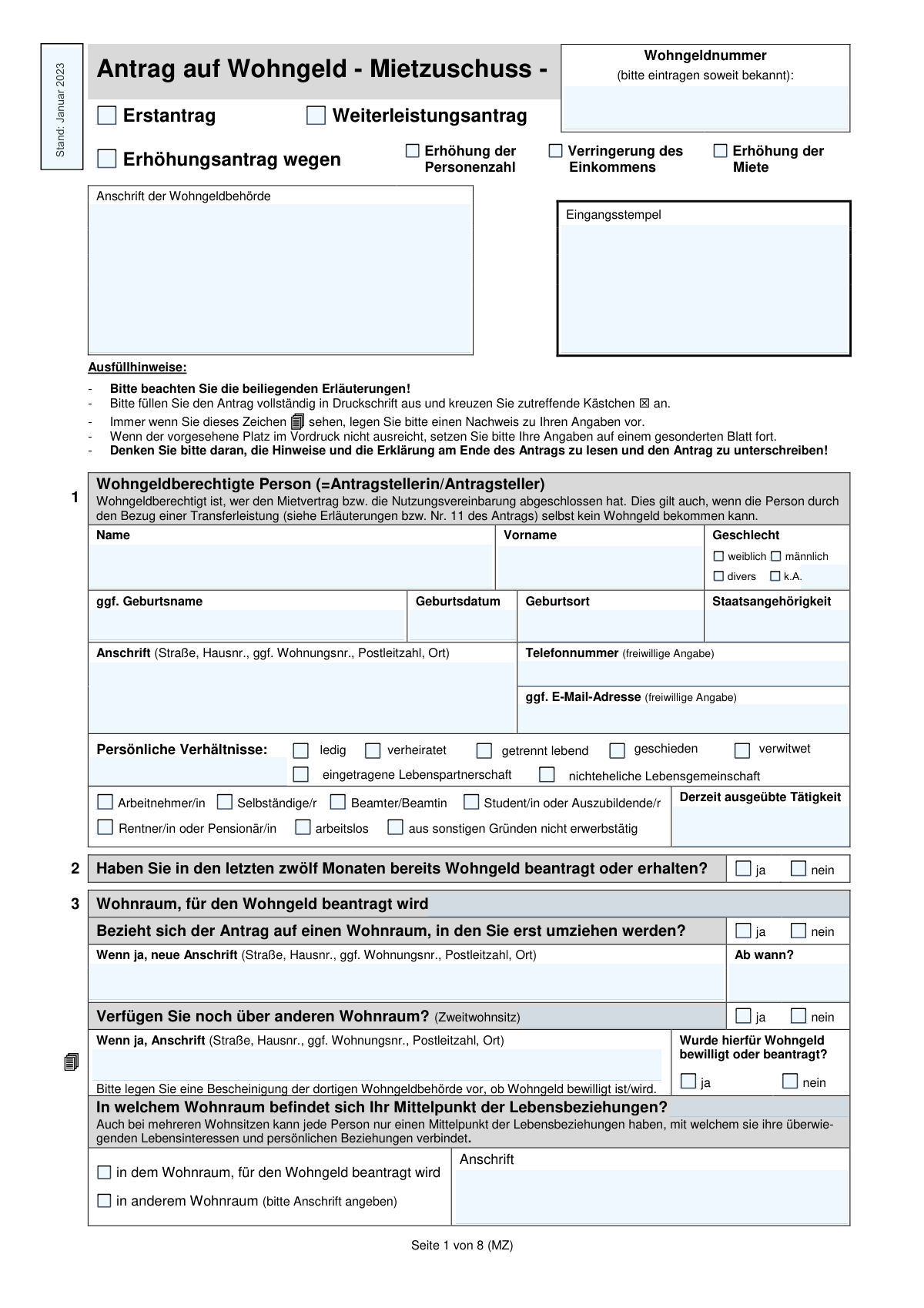
The Antrag auf Wohngeld is the official German form used to apply for a housing benefit (Wohngeld), a state subsidy to help low-income households afford their rent or mortgage payments. This application is crucial for ensuring housing security for eligible individuals and families by collecting detailed information on personal details, household composition, income, and housing costs to assess eligibility. Today, this form can be filled out quickly and accurately using AI-powered services like Instafill.ai, which can also convert non-fillable PDF versions into interactive fillable forms.
Our AI automatically handles information lookup, data retrieval, formatting, and form filling.
It takes less than a minute to fill out Wohngeldantrag using our AI form filling.
Securely upload your data. Information is encrypted in transit and deleted immediately after the form is filled out.

Form specifications

Form name: Antrag auf Wohngeld (Mietzuschuss)
Number of fields: 487
Number of pages: 8
Language: English
Categories: Wohngeld forms
main-image

Instafill Demo: How to fill out PDF forms in seconds with AI

How to Fill Out Wohngeldantrag Online for Free in 2026

Are you looking to fill out a WOHNGELDANTRAG form online quickly and accurately? Instafill.ai offers the #1 AI-powered PDF filling software of 2026, allowing you to complete your WOHNGELDANTRAG form in just 37 seconds or less.
Follow these steps to fill out your WOHNGELDANTRAG form online using Instafill.ai:
  1. 1 Navigate to Instafill.ai and upload or select the 'Antrag auf Wohngeld' form.
  2. 2 Provide your personal details in the applicant section, including your name, address, date of birth, and marital status.
  3. 3 List all members of your household, providing their personal information, relationship to you, and current occupation or activity.
  4. 4 Enter detailed information about the dwelling for which you are applying for benefits, including the address and any planned moves.
  5. 5 Answer all related questions regarding other residences, shared child custody arrangements, and any legal guardianship.
  6. 6 Review all the information auto-filled by the AI for accuracy, make any necessary corrections, and then e-sign the document.
  7. 7 Download the completed form and submit it to the responsible 'Wohngeldbehörde' (housing benefit authority).

Our AI-powered system ensures each field is filled out correctly, reducing errors and saving you time.

Why Choose Instafill.ai for Your Fillable Wohngeldantrag Form?

Speed

Complete your Wohngeldantrag in as little as 37 seconds.

Up-to-Date

Always use the latest 2026 Wohngeldantrag form version.

Cost-effective

No need to hire expensive lawyers.

Accuracy

Our AI performs 10 compliance checks to ensure your form is error-free.

Security

Your personal information is protected with bank-level encryption.

Frequently Asked Questions About Form Wohngeldantrag

This form is an application for German housing benefit, known as 'Wohngeld'. It is used to apply for the first time, request a continuation of benefits, or apply for an increase in your current housing benefit.

This form should be completed by individuals or families with low income who need financial assistance to cover their housing costs. This includes employees, retirees, self-employed individuals, students, and unemployed persons.

Select 'Erstantrag' if you are applying for housing benefit for the very first time. Choose 'Weiterleistungsantrag' to renew your benefits before your current approval period ends. Select 'Erhöhungsantrag' if your circumstances have changed (e.g., rent increase, income decrease, more people in the household) and you need to request a higher benefit amount.

For every person living in your household, you must provide their full name, date and place of birth, gender, nationality, marital status, relationship to you, and current occupation or main activity.

Yes, you can. Check the box indicating the application is for a residence you will move into, and provide the new address and the planned move-in date in the designated fields.

This term translates to your 'center of vital life relations'. You must indicate whether the home you are applying for is your main residence, where you have your primary social and personal ties.

You should submit an 'Erhöhungsantrag' (application for an increase). On the form, check the box for 'Verringerung des Einkommens' to specify that the reason for your application is a reduction in income.

The form includes a specific section for shared care arrangements. You will need to provide the names of the children and the percentage of care provided by both you and the other parent.

You must declare any other residential property you have access to. The form requires you to provide the address of the other residence and state whether you have applied for or are receiving Wohngeld for it.

You need to submit the completed form to your local housing benefit authority ('Wohngeldbehörde'). The form includes a field where you should write the full address of the responsible authority.

Yes, services like Instafill.ai use AI to accurately auto-fill form fields with your personal information, which can save you significant time and help prevent errors.

To fill this form online, upload the PDF to the Instafill.ai platform. The AI will make the document interactive, allowing you to easily type your information into the correct fields before downloading the completed form.

If your PDF is flat or non-fillable, you can use a service like Instafill.ai. It can convert the document into an interactive, fillable form that you can complete on your computer or mobile device.

The form has a section to declare 'weitere Personen' (additional persons). You should list anyone living in your residence who is not considered a household member for the purpose of the Wohngeld calculation, such as a subtenant.

Compliance Wohngeldantrag
Validation Checks by Instafill.ai

1
Exclusive Application Type Selection
This check ensures that the applicant selects only one primary application type. An application cannot be a 'First-time application' (Erstantrag), a 'Renewal application' (Weiterleistungsantrag), and an 'Increase application' (Erhöhungsantrag) simultaneously. This is crucial for routing the application correctly and applying the right processing rules. If more than one type is selected, the form submission should be rejected with an error asking the user to choose only one.
2
Conditional Requirement for Increase Application Reason
Validates that if the applicant selects 'Erhöhungsantrag' (Application for an increase), they must also select at least one reason for the increase. The possible reasons are 'Erhöhung der Miete' (Rent increase), 'Erhöhung der Personenzahl' (Increase in household size), or 'Verringerung des Einkommens' (Decrease in income). This information is essential for the authority to assess the legitimacy of the increase request. A failure would prompt the user to specify why they are requesting more benefits.
3
Date of Birth Format and Plausibility
This validation checks that all date of birth fields for the applicant and household members are entered in a valid format (e.g., DD.MM.YYYY) and represent a plausible date. The date cannot be in the future, and it should correspond to a reasonable age for an applicant or household member (e.g., applicant must be of legal age). This prevents data entry errors and ensures accurate age-related eligibility calculations. If the date is invalid, the user will be prompted to correct it.
4
Conditional Fields for Future Move-In
If the applicant indicates the application is for a residence they will move into in the future ('Bezieht sich der Antrag auf einen Wohnraum, in den Sie erst umziehen werden? – ja'), this check ensures the 'Neue Anschrift (bei Umzug)' (New address) and 'Ab wann? (Einzugsdatum)' (Move-in date) fields are completed. The move-in date must also be a future date. This is critical for determining the start date of potential benefits and the correct property. Failure to provide this information would halt the application process.
5
Conditional Fields for Additional Dwellings
This validation ensures that if an applicant checks 'VerfĂŒgen Sie noch ĂŒber anderen Wohnraum? – ja' (Do you have other living space? - yes), they must provide the address in the 'Anschrift des sonstigen Wohnraums' field. Furthermore, they must answer the follow-up question 'Wurde hierfĂŒr Wohngeld bewilligt oder beantragt?'. This information is vital for assessing eligibility, as having multiple properties can affect the right to receive housing benefits. An incomplete submission would require the user to provide the missing details.
6
Logical Consistency of 'Center of Life' Declaration
This check verifies the logical consistency between the declaration of other dwellings and the location of the 'Mittelpunkt der Lebensbeziehungen' (center of life). An applicant cannot state their center of life is in 'anderem Wohnraum' (other living space) if they previously indicated they do not have any other living space. This prevents contradictory statements that would complicate the eligibility assessment. A validation failure would require the applicant to correct their declarations.
7
Exclusive Marital Status Selection
Ensures that for the applicant and each household member, only one marital status option (e.g., 'ledig', 'verheiratet', 'geschieden') is selected. A person cannot be both single and married at the same time. This check maintains data integrity and is fundamental for correctly determining the household composition and income assessment rules. If multiple options are selected, an error message should force a single choice.
8
Completeness of Household Member Data
For each household member added to the application (e.g., 'First Household Member', 'Second Household Member'), this validation ensures that essential information is provided. At a minimum, 'Full name', 'Date of birth', and 'Relationship to applicant' must be filled out. This data is necessary to calculate the household size and total income, which are core components of the Wohngeld calculation. Missing information for a listed member would trigger an error.
9
Shared Child Care Percentage Sum
When parents share care for a child, this check validates that the percentages entered for the applicant's share and the other parent's share add up to exactly 100%. For example, 'Applicant's share of care — first child (%)' + 'Other parent/guardian's share of care — first child (%)' must equal 100. This ensures the care arrangement is fully and accurately accounted for, which can impact benefit calculations. If the sum is not 100, the user must correct the percentages.
10
Conditional Requirement for Legal Guardianship Details
This validation rule checks that if the applicant answers 'ja' to the question 'Stehen Sie oder ein volljÀhriges Haushaltsmitglied unter gesetzlicher Betreuung?' (Are you or an adult household member under legal guardianship?), the fields 'Name der betreuten Person' (Name of the person under care) and 'Name und Anschrift des Betreuers' (Name and address of the guardian) must be filled. This information is legally required to ensure the application is handled correctly and communications are sent to the right person. The application cannot proceed without these details if guardianship is indicated.
11
Address Field Structure and Completeness
Verifies that all mandatory address fields (e.g., applicant's address, address for which benefit is sought) are filled completely. The validation should check for the presence of a street name, house number, postal code, and city. The postal code should also be checked for a valid German format (5 digits). This ensures mail can be delivered and the location of the residence can be accurately identified for eligibility purposes. An incomplete address would block submission.
12
Consistency between Employment Status Checkbox and Description
This check compares the selected employment status checkbox (e.g., 'Arbeitnehmer/in', 'Rentner/in', 'Student/in') with the free-text entry in 'Derzeit ausgeĂŒbte TĂ€tigkeit' (Current occupation). While not a strict failure, it can flag potential inconsistencies, for instance, if 'arbeitslos' (unemployed) is checked but the text field contains a job title. This helps ensure the applicant's situation is clearly and accurately represented, reducing the need for follow-up questions. A mismatch could generate a warning for the user to review their entries.

Common Mistakes in Completing Wohngeldantrag

Incorrect Application Type Selection

Applicants often confuse 'Erstantrag' (first-time), 'Weiterleistungsantrag' (continuation), and 'Erhöhungsantrag' (increase). Selecting the wrong type sends the application down the incorrect processing path, causing significant delays or rejection as the required documents and review criteria differ. To avoid this, use 'Erstantrag' only if you have never received Wohngeld before, 'Weiterleistungsantrag' if your current benefit period is ending, and 'Erhöhungsantrag' if your circumstances (rent, income, household size) have changed during a benefit period.

Misinterpreting 'Mittelpunkt der Lebensbeziehungen'

The concept of 'Mittelpunkt der Lebensbeziehungen' (center of vital relations) is crucial but frequently misunderstood, especially by those with multiple residences. Applicants may incorrectly identify the dwelling they are applying for, when their family, social life, and work are centered elsewhere, which can lead to denial of the application. To prevent this, you must declare the address where your primary social and family ties are located and where you spend the majority of your time.

Incomplete Information on Additional Residences

When an applicant checks 'ja' for 'VerfĂŒgen Sie noch ĂŒber anderen Wohnraum?' (Do you have other living space?), they often fail to provide the required follow-up details. This includes the full address of the other property and whether housing benefit has been applied for or received for it. This omission halts the application, as the authority must verify eligibility and prevent duplicate benefits. Always complete all dependent fields if you declare an additional residence.

Forgetting the 'Wohngeldnummer' on Subsequent Applications

For any application that is not a first-time request ('Erstantrag'), the 'Wohngeldnummer' (housing benefit reference number) is a key identifier. Applicants often omit this number, forcing the authority to manually search for their case file, which significantly slows down the processing of continuation or increase requests. To avoid delays, always find this number on previous correspondence from the 'Wohngeldbehörde' and enter it in the designated field.

Failing to Complete Details for a Future Move

If the application is for a residence you plan to move into ('Bezieht sich der Antrag auf einen Wohnraum, in den Sie erst umziehen werden? – ja'), it is a common mistake to not fill in the 'Neue Anschrift' (new address) and 'Ab wann?' (move-in date). The application is considered incomplete without this information and cannot be processed, leading to immediate delays. Always double-check that you have provided the complete future address and the exact date of the move.

Inconsistent or Incomplete Household Member Data

The form requires complete details for every person in the household, but applicants often make errors like forgetting to list a member, entering incorrect birth dates, or leaving the 'Relationship to applicant' field blank. Since household size and composition are fundamental to calculating the benefit amount, any missing or inconsistent data will require clarification and delay the decision. It is crucial to list all members accurately and completely. AI-powered tools like Instafill.ai can help ensure all required fields for each household member are filled out.

Omitting Shared Child Care Percentages

For separated parents with shared custody, simply stating that care is shared is not enough; the form requires the specific percentage of care provided by the applicant and the other parent for each child. Applicants frequently check 'ja' for shared care but then neglect to enter these crucial percentages. This information is vital for determining the official household size for benefit calculations, and its absence will stall the application. Ensure you provide a clear percentage breakdown for all relevant children.

Contradictory Checkbox Selections for Personal Status

Applicants sometimes check multiple, conflicting boxes for their personal status, such as selecting both 'ledig' (single) and 'verheiratet' (married), or 'Arbeitnehmer/in' (employed) and 'arbeitslos' (unemployed). Such contradictions create ambiguity and force the processing agent to request clarification, which delays the entire process. You must carefully review and select only the single most accurate option for your marital and employment status. If the form is a non-fillable PDF, a tool like Instafill.ai can convert it to a smart, fillable version that can help prevent such logical errors.

Entering Dates in an Incorrect Format

German administrative forms require dates to be in the DD.MM.YYYY format, but applicants often use their native format, such as MM/DD/YYYY. This can lead to data entry errors and misinterpretation of critical information like birth dates or move-in dates, potentially affecting eligibility or causing record-keeping issues. To ensure accuracy, always use the DD.MM.YYYY format. Smart form-filling tools like Instafill.ai can automatically validate and correct date formats to prevent these mistakes.

Failing to Detail Additional Persons in the Household

The form distinguishes between 'Haushaltsmitglieder' (household members for benefit calculation) and other persons living in the same residence. If you answer 'ja' to 'Wohnen in Ihrem Wohnraum neben den unter Nummer 4 genannten Haushaltsmitgliedern noch weitere Personen?', you must provide the name and relationship of these additional people. Forgetting to do so makes the declaration of living situation incomplete and can lead to questions about potential undeclared income or household members, delaying the application.
Saved over 80 hours a year

“I was never sure if my IRS forms like W-9 were filled correctly. Now, I can complete the forms accurately without any external help.”

Kevin Martin Green

Your data stays secure with advanced protection from Instafill and our subprocessors

Robust compliance program

Transparent business model

You’re not the product. You always know where your data is and what it is processed for.

ISO 27001, HIPAA, and GDPR

Our subprocesses adhere to multiple compliance standards, including but not limited to ISO 27001, HIPAA, and GDPR.

Security & privacy by design

We consider security and privacy from the initial design phase of any new service or functionality. It’s not an afterthought, it’s built-in, including support for two-factor authentication (2FA) to further protect your account.

Fill out Wohngeldantrag with Instafill.ai

Worried about filling PDFs wrong? Instafill securely fills antrag-auf-wohngeld-mietzuschuss forms, ensuring each field is accurate.