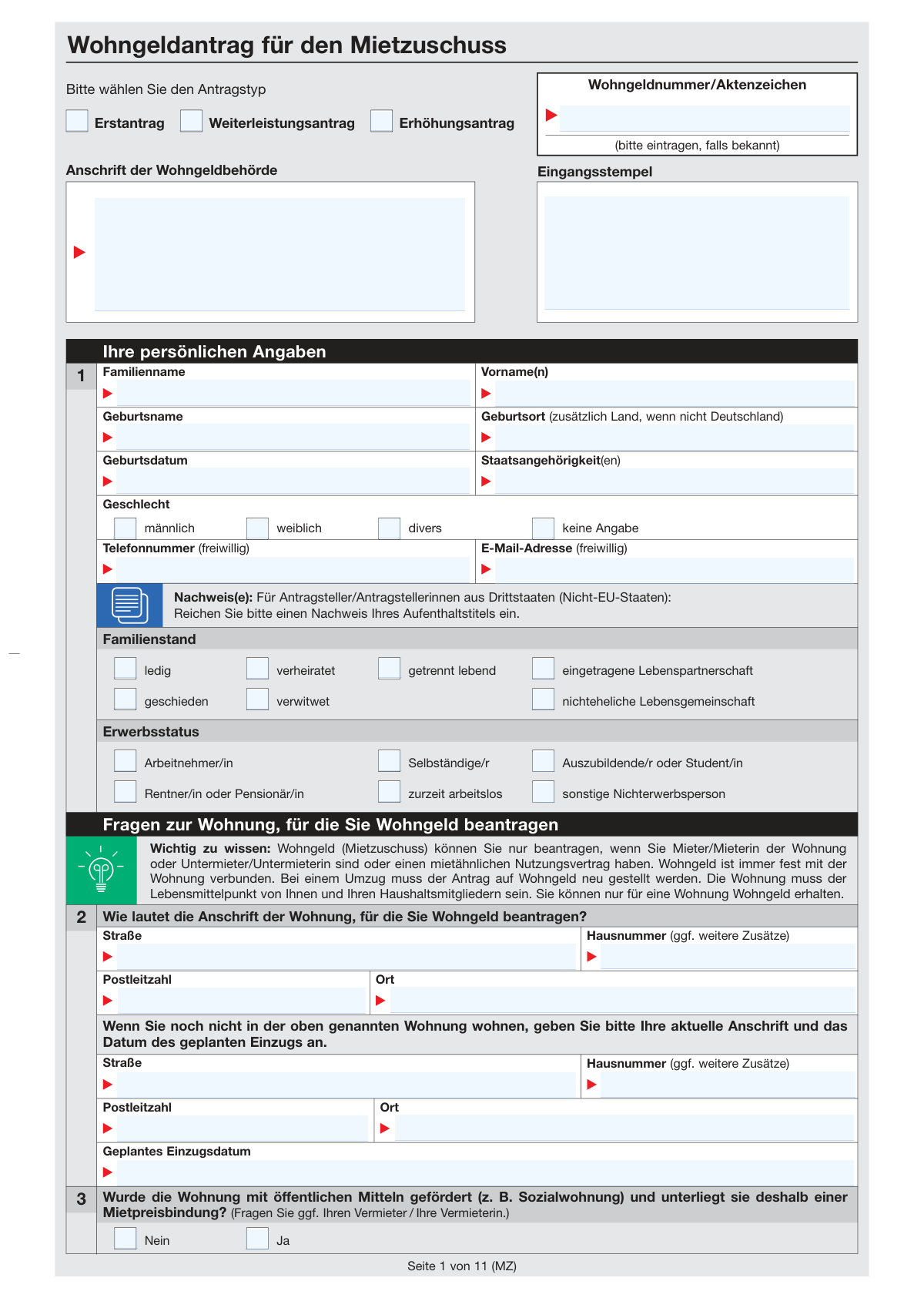
Yes! You can use AI to fill out Wohngeldantrag für den Mietzuschuss
This form is the official application used in Germany to apply for 'Wohngeld' (housing benefit) in the form of a 'Mietzuschuss' (rent subsidy) for tenants. It is essential for individuals and families with lower incomes to gather detailed information about household members, income, rent costs, and assets to determine eligibility and the amount of financial support for housing. Today, this form can be filled out quickly and accurately using AI-powered services like Instafill.ai, which can also convert non-fillable PDF versions into interactive fillable forms.
Our AI automatically handles information lookup, data retrieval, formatting, and form filling.
It takes less than a minute to fill out Wohngeldantrag (MZ) using our AI form filling.
Securely upload your data. Information is encrypted in transit and deleted immediately after the form is filled out.
Form specifications
| Form name: | Wohngeldantrag für den Mietzuschuss |
| Number of pages: | 11 |
| Language: | English |
Instafill Demo: How to fill out PDF forms in seconds with AI
How to Fill Out Wohngeldantrag (MZ) Online for Free in 2026
Are you looking to fill out a WOHNGELDANTRAG (MZ) form online quickly and accurately? Instafill.ai offers the #1 AI-powered PDF filling software of 2026, allowing you to complete your WOHNGELDANTRAG (MZ) form in just 37 seconds or less.
Follow these steps to fill out your WOHNGELDANTRAG (MZ) form online using Instafill.ai:
- 1 Navigate to Instafill.ai and upload or select the 'Wohngeldantrag für den Mietzuschuss' form.
- 2 Provide your personal information in Section 1, including your name, address, date of birth, and marital status.
- 3 List all members of your household in Section 6, providing their personal details, relationship to you, and employment status.
- 4 Declare all sources of income for every household member in Section 12, including wages, pensions, benefits, and any other earnings.
- 5 Enter detailed information about your rental agreement in Sections 21-27, including the total rent, apartment size, and what costs are included in the rent.
- 6 Answer questions regarding assets, potential deductions (like childcare costs or disability), and any expected changes in your financial situation.
- 7 Review all the AI-populated fields for accuracy, sign the declaration, and submit the completed form along with all required supporting documents (e.g., rental agreement, income statements) to your local Wohngeld authority.
Our AI-powered system ensures each field is filled out correctly, reducing errors and saving you time.
Why Choose Instafill.ai for Your Fillable Wohngeldantrag (MZ) Form?
Speed
Complete your Wohngeldantrag (MZ) in as little as 37 seconds.
Up-to-Date
Always use the latest 2026 Wohngeldantrag (MZ) form version.
Cost-effective
No need to hire expensive lawyers.
Accuracy
Our AI performs 10 compliance checks to ensure your form is error-free.
Security
Your personal information is protected with bank-level encryption.
Frequently Asked Questions About Form Wohngeldantrag (MZ)
This form is an application for 'Wohngeld' (housing benefit) in Germany, specifically the 'Mietzuschuss' (rent subsidy) for tenants. It is used to determine your eligibility for government assistance with your rental costs.
You should fill out this form if you are a tenant, sub-tenant, or have a similar rental-like contract for an apartment in Germany and need financial assistance to cover your housing costs. Homeowners use a different form for the 'Lastenzuschuss'.
An 'Erstantrag' is for your first-ever application. A 'Weiterleistungsantrag' is a renewal application to continue receiving benefits, and an 'Erhöhungsantrag' is used to request an increase in your current benefit amount, for example, if your rent has increased.
Household members are all people who live with you in the apartment and consider it their main center of life, including partners and children. Sub-tenants or roommates in a shared flat (WG) are generally not considered household members.
Generally, no. If you or a household member receives a 'Transferleistung' (transfer payment) like Bürgergeld or Sozialhilfe that already includes an allowance for housing costs, you are typically excluded from receiving Wohngeld.
You must declare all sources of income for every household member, including salary, pensions, child support, unemployment benefits, capital gains, and even non-cash benefits. The form provides a detailed list of examples.
You will need your rental agreement, proof of current rent payments, proof of all declared income (e.g., pay stubs, pension statements), and for non-EU citizens, a valid residence permit. Additional documents may be required for deductions like childcare costs or disability.
Yes, there is a significant asset limit. You are generally not eligible if your household's total assets exceed €60,000 for the first person plus €30,000 for each additional household member.
The benefit is calculated based on your total rent, but costs for heating, hot water, household energy (electricity), and any separate rent for a garage or parking space are deducted. You must provide details for these separate costs if they are included in your total rent.
You are legally obligated to immediately inform the Wohngeld authority of any changes that could affect your eligibility or benefit amount. This includes changes in income, rent, or the number of people in your household.
Yes, services like Instafill.ai use AI to accurately auto-fill form fields, which can save you time and help prevent errors. This is especially useful for long and complex forms like the Wohngeld application.
To fill out the form online, you can upload the PDF to the Instafill.ai platform. The service will make the document interactive, and its AI will help you fill in the required information quickly and accurately.
If you have a non-fillable or 'flat' PDF, you can use a service like Instafill.ai. It can convert the static PDF into an interactive, fillable form that you can complete on your computer.
Compliance Wohngeldantrag (MZ)
Validation Checks by Instafill.ai
1
Exclusive Application Type Selection
This check ensures that the applicant selects exactly one application type from 'Erstantrag' (Initial), 'Weiterleistungsantrag' (Continuation), or 'Erhöhungsantrag' (Increase). Selecting more than one or none at all makes the application's purpose ambiguous. A failure in this validation would prevent the form submission and prompt the user to choose only one option to clarify their intent.
2
Conditional Requirement of Wohngeld Number
This validation verifies that the 'Wohngeldnummer/Aktenzeichen' (Housing Benefit Number/File Reference) is provided if the application type is 'Weiterleistungsantrag' or 'Erhöhungsantrag'. This number is essential for the authority to locate the existing case file for continuation or modification. If the number is missing for these application types, the form cannot be processed efficiently and will be rejected, asking the user to provide the required reference.
3
Date of Birth Validity and Plausibility
This check validates that all 'Geburtsdatum' (Date of Birth) fields for the applicant and all household members contain a valid date in the past. It ensures the date is formatted correctly (e.g., DD.MM.YYYY) and is not a future date. This is critical for determining age-related eligibility and calculating benefits, and an invalid date would halt the application processing until corrected.
4
Move-in Date Logic for New Residence
This validation ensures that if the applicant provides a current address that is different from the address for which benefits are sought, the 'Geplantes Einzugsdatum' (Planned Move-in Date) field must be completed. The date provided must be a plausible date, typically in the near future or very recent past. This is important to establish the start date of eligibility, and failure to provide it would create an incomplete application.
5
Transfer Payment Ineligibility Flag
This check analyzes the answer to Question 10 regarding the receipt of 'Transferleistungen' (transfer payments like Bürgergeld). If the applicant answers 'Ja', it triggers a validation requiring them to specify who receives which benefit. This is a critical eligibility check, as receiving certain benefits disqualifies the household from receiving Wohngeld, and a 'Ja' answer will flag the application for immediate review or potential rejection.
6
Household Asset Threshold Verification
This validation checks the response to Question 20 regarding household assets. It calculates the specific asset limit for the household (€60,000 for the first person plus €30,000 for each additional member) and cross-references it with the applicant's 'Ja' or 'Nein' answer. If 'Ja' is selected, it confirms that the asset details are filled out, as exceeding this limit typically results in ineligibility for housing benefits.
7
Rent Component Sum Consistency
This check ensures that the sum of individual costs included in the rent (Question 24, e.g., heating, hot water, garage) does not exceed the total rent amount specified in Question 23. This prevents logical errors and ensures the rent breakdown is accurate for calculating the eligible housing cost. If the components sum to more than the total rent, an error message will require the user to correct the amounts.
8
IBAN Format and Checksum Validation
This validation verifies that the IBAN provided in Question 31 for payment is in the correct format for a German bank account (22 alphanumeric characters starting with 'DE') and passes the MOD-97 checksum algorithm. This is crucial to ensure that any approved benefit payments can be successfully transferred to the correct account. An invalid IBAN would cause payment failure and require manual correction, delaying the receipt of funds.
9
Completeness of Household Member Income Data
This check ensures that for every person listed as a household member in Question 6, the corresponding income section in Question 12 is filled out. Even if a person has no income, this must be explicitly stated. Missing income data for any member makes it impossible to calculate the total household income and determine eligibility, so the application would be considered incomplete.
10
German Postal Code (PLZ) Format
This validation ensures that all 'Postleitzahl' (PLZ) fields contain exactly five numeric digits. This is the standard format for German postal codes and is essential for correct mail delivery and address verification. An incorrectly formatted PLZ could lead to returned mail and significant delays in communication from the housing authority.
11
Conditional Detail Requirement for Future Changes
This check verifies that if an applicant answers 'Ja' to questions about expected future changes (e.g., rent increase in Question 27 or income change in Question 19), the corresponding detail fields must be completed. These details, such as the date and reason for the change, are mandatory for the authority to anticipate adjustments to the benefit amount. Answering 'Ja' without providing details results in an incomplete submission.
12
Deceased Household Member Date Range
This validation applies if the applicant answers 'Ja' to Question 8, indicating a household member has passed away. It checks that the date of death provided is within the last 12 months from the application date. This rule is important because a recently deceased member can still be counted for a limited time to prevent a sudden drop in benefits, and an invalid or out-of-range date would require correction.
13
Relationship and Marital Status Consistency
This check verifies the logical consistency between the applicant's marital status (Question 1) and the relationship listed for household members (Question 6). For example, if an applicant is 'verheiratet' (married), it is expected that another household member is listed with the relationship '(Ehe-)Partner/in' (spouse/partner). Inconsistencies can indicate data entry errors and would flag the application for review to ensure the household composition is correctly understood.
Common Mistakes in Completing Wohngeldantrag (MZ)
Applicants often incorrectly list all residents, such as flatmates in a shared apartment (WG), or fail to include qualifying members like children who are co-parented. This happens because the official definition of a 'Haushaltsmitglied' is specific and only includes those who form a single economic unit. Incorrectly defining the household leads to a flawed benefit calculation, potentially causing rejection or a significantly lower payment. To avoid this, carefully read the instructions on page 2 and only list individuals who share finances and living arrangements as a family unit.
The form explicitly asks for 'Brutto' (gross) income in section 12, but applicants frequently enter their net (take-home) pay out of habit. This mistake leads to an inaccurate assessment of financial need and can result in the application being delayed for clarification or an incorrect, often lower, benefit amount being approved. Always refer to your official pay stub or income statement to find the gross amount before taxes and deductions are taken out. AI-powered tools like Instafill.ai can help by prompting for the correct income type and validating the data.
Applicants often overlook smaller or irregular income sources, such as 'Minijobs', income from capital assets (Zinsen), or financial support from relatives, as listed on page 5. Failing to declare all income, no matter how small, is a serious omission that can lead to application rejection, demands for repayment, and even fines for providing false information. To prevent this, gather all financial documents for the last 12 months for all household members and list every single income source, cross-referencing the examples provided in the form.
In section 23, applicants must state their total rent and then break out the specific costs for heating, hot water, and garage fees. A common error is to enter the base rent ('Kaltmiete') instead of the total rent ('Gesamtmiete') or to fail to separate the non-eligible costs. This is critical because Wohngeld does not cover heating or garage costs, and incorrect figures will lead to processing delays and an inaccurate calculation of the eligible rent portion. Always use your rental agreement and latest utility statements to provide precise figures for each category.
Many applicants fail to claim valid deductions on page 7, such as childcare costs ('Kinderbetreuungskosten'), high work-related expenses ('Werbungskosten'), or alimony payments ('Unterhalt'). This oversight happens because people are either unaware of these allowances or don't think their expenses qualify. The consequence is receiving a lower Wohngeld payment than they are legally entitled to. Carefully review questions 13-16 and declare any applicable expenses to maximize your potential benefit.
The form repeatedly prompts for 'Nachweis(e)' (proof) for nearly every section, including income, rent, childcare costs, and residency status. A very common mistake is submitting the application without all the necessary documents, such as the rental contract, income statements, or bank records. This is the leading cause of significant processing delays, as the Wohngeld office must send a follow-up request and wait for the missing paperwork. To avoid this, create a checklist of all required documents as you fill out the form and ensure they are all included with your submission.
On page 1, applicants must select whether it is a first-time ('Erstantrag'), renewal ('Weiterleistungsantrag'), or increase ('Erhöhungsantrag') application. Choosing the wrong type, especially selecting 'Erstantrag' for a renewal, can cause significant administrative confusion and delays. The office may not be able to link the application to an existing file, slowing down the entire process. Always double-check if you have an existing 'Wohngeldnummer' to determine the correct application type.
Applicants who receive certain other social benefits, like 'Bürgergeld' (SGB II) or 'Grundsicherung' (SGB XII), are generally not eligible for Wohngeld, as stated in question 10. Many people apply anyway, not understanding this mutual exclusion, which results in an automatic rejection of their application. This wastes time and effort. Before applying, confirm that no household member receives a transfer payment that includes a housing cost component.
When submitting a 'Weiterleistungsantrag' (renewal) or 'Erhöhungsantrag' (increase), applicants often forget to enter their existing 'Wohngeldnummer/Aktenzeichen' at the top of the form. While it seems minor, omitting this number forces the processing office to manually search for the applicant's file, causing unnecessary delays. To ensure a smooth continuation of benefits, always locate this number on previous correspondence from the Wohngeld authority and enter it correctly. Using a tool like Instafill.ai can help by saving this information from previous applications for easy reuse.
Question 20 asks about significant assets, and many applicants are unsure what counts as 'Vermögen' or miscalculate the threshold (€60,000 for the first person plus €30,000 for each additional member). People may forget to include assets like savings contracts ('Bausparvertrag'), life insurance policies, or property abroad, leading to an incorrect declaration. Under-declaring assets can lead to application denial and accusations of fraud if discovered later. It is crucial to honestly assess all assets for all household members and declare them if they exceed the legal limit.
Saved over 80 hours a year
“I was never sure if my IRS forms like W-9 were filled correctly. Now, I can complete the forms accurately without any external help.”
Kevin Martin Green
Your data stays secure with advanced protection from Instafill and our subprocessors
Robust compliance program
Transparent business model
You’re not the product. You always know where your data is and what it is processed for.
ISO 27001, HIPAA, and GDPR
Our subprocesses adhere to multiple compliance standards, including but not limited to ISO 27001, HIPAA, and GDPR.
Security & privacy by design
We consider security and privacy from the initial design phase of any new service or functionality. It’s not an afterthought, it’s built-in, including support for two-factor authentication (2FA) to further protect your account.
Fill out Wohngeldantrag (MZ) with Instafill.ai
Worried about filling PDFs wrong? Instafill securely fills wohngeldantrag-fr-den-mietzuschuss forms, ensuring each field is accurate.