
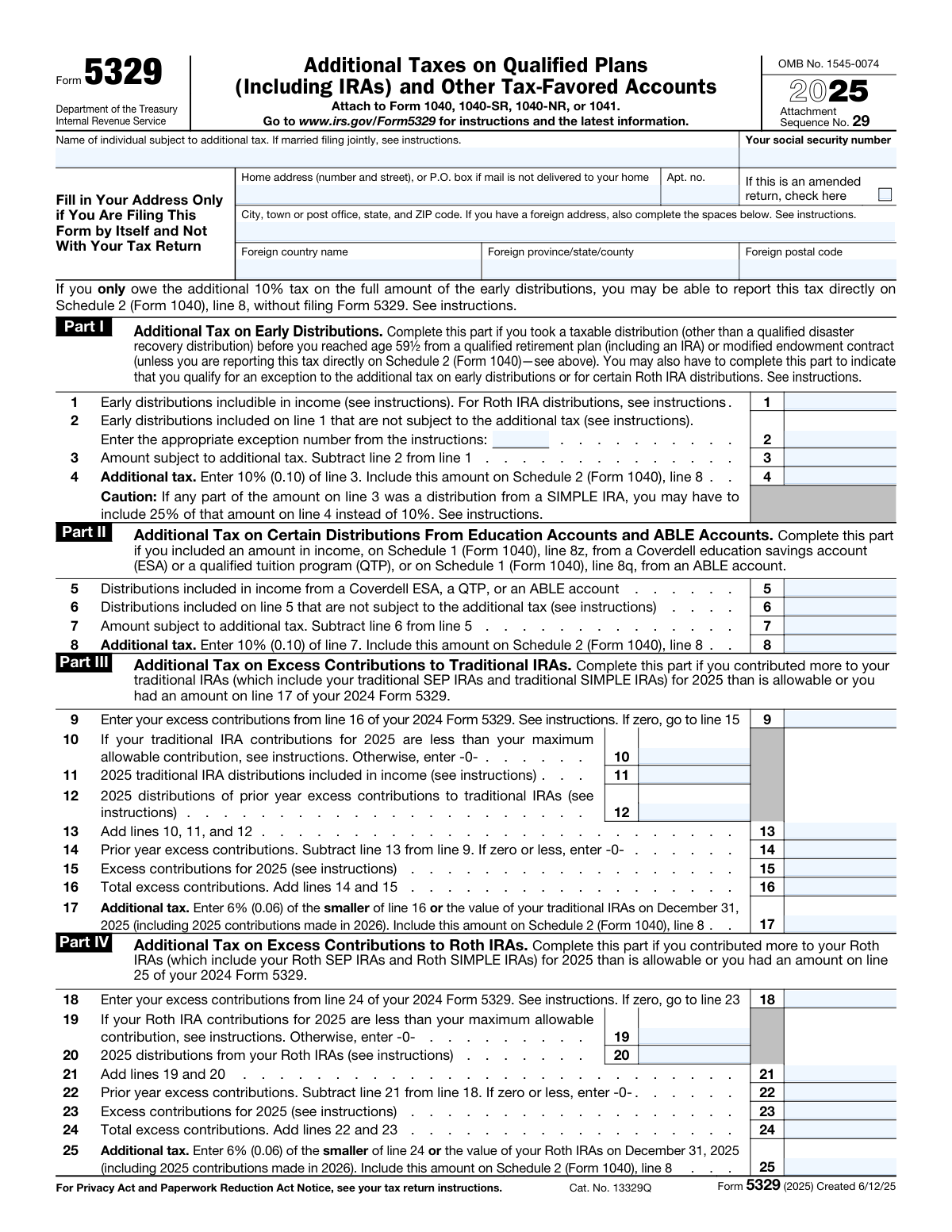
Yes! You can use AI to fill out Form 5329, Additional Taxes on Qualified Plans (2023)
Don't type 73 fields by hand. Tell our AI about yourself, or upload a document you already have, and it fills every field in seconds. You check it, then download, print or sign.
The AI does the filling. You just check it.
No typing into boxes, nothing to install.
What this form asks for
The AI fills all of it, from your answers or your documents.
The AI checks your answers before you download
18 checks built for this form, so a wrong date or a missing answer is caught before anyone else sees it.
Ensures that the Additional Taxes on Qualified Plans form is properly attached to the appropriate income tax return form, such as Form 1040, 1040-SR, 1040-NR, or 1041, when required. If the form is being filed independently, it confirms that the taxpayer's address and signature are duly provided on Form 5329. This check is crucial to ensure compliance with IRS filing procedures and to avoid processing delays.
Confirms that Part I - Additional Tax on Early Distributions is accurately calculated. It verifies the total early distributions that are includible in income, ensuring that the figures reported are correct and substantiated by the appropriate documentation. This validation is essential to prevent errors that could result in incorrect tax calculations and potential penalties.
Verifies that the amount not subject to the additional tax in Part I is correctly identified and that the corresponding exception number is provided. This check is important to ascertain that only the eligible distributions are excluded from the additional tax, thereby ensuring the accuracy of the taxable income reported on the form.
Calculates the amount subject to additional tax in Part I by subtracting the non-taxable amount from the total early distributions. This computation is vital to determine the correct base for the additional tax, ensuring that the taxpayer is neither overpaying nor underpaying the tax due.
Computes the additional tax as 10% of the taxable amount in Part I and ensures that this tax is correctly included on Schedule 2 (Form 1040), line 8. This validation confirms that the additional tax due is accurately reflected in the taxpayer's overall tax liability, which is critical for the final tax assessment.
Ensures that distributions reported from Coverdell ESA, QTP, or an ABLE account in Part II are entered accurately. The AI cross-references the amounts with the corresponding documentation to confirm their validity. It checks for common input errors and discrepancies that could lead to incorrect tax calculations. The AI also alerts the user if the reported distributions do not align with the expected figures based on the account type.
And 12 more checks
- Non-Taxable Amount Calculation
- Taxable Amount Determination
- Additional Tax Computation
- Excess Contributions Tax Calculation
- Ensures accurate calculation and reporting of additional tax on excess contributions to Roth IRAs in Part IV
- Verifies the calculation and reporting of additional tax on excess contributions to Coverdell ESAs in Part V
- Checks for correct calculation and reporting of additional tax on excess contributions to Archer MSAs in Part VI
- Confirms the calculation and reporting of additional tax on excess contributions to Health Savings Accounts (HSAs) in Part VII
- Ensures the calculation and reporting of additional tax on excess contributions to an ABLE account in Part VIII are correct
- Verifies the calculation and reporting of additional tax on excess accumulation in qualified retirement plans in Part IX
- Confirms that the form is signed and dated by the taxpayer and, if applicable, by the paid preparer in the 'Paid Preparer Use Only' section
- Performs a final review of the entire form for accuracy and completeness before it is considered ready for filing
Let AI fill out your Form 5329
No typing. Every field filled in seconds, checked, ready to sign.
How to Fill Out Form 5329 Online for Free in 2026
What the AI walks you through.
- Visit instafill.ai site and select Form 5329.
- Enter your personal information and address.
- Complete the relevant sections for additional taxes.
- Sign and date the form electronically.
- Check for accuracy and submit the form.
Common Mistakes in Completing Form 5329
The ones the AI is built to catch.
Not attaching Form 5329 to the tax return when required
Failing to sign and date the form if filing Form 5329 by itself
Incorrectly calculating the additional tax as 10% of early distributions
Omitting the exception number for distributions not subject to additional tax
Miscalculating the amount subject to additional tax by not subtracting line 2 from line 1 in Part I
Forgetting to include the additional tax on Schedule 2 (Form 1040), line 8
Not reporting the correct amount of distributions from education accounts
Failing to calculate and report additional tax on excess contributions to traditional IRAs
Incorrectly reporting additional tax on excess contributions to Roth IRAs
Miscalculating additional tax on excess contributions to Coverdell ESAs
Not calculating additional tax on excess contributions to Archer MSAs correctly
Failing to report additional tax on excess contributions to Health Savings Accounts (HSAs)
Not calculating additional tax on excess contributions to an ABLE account properly
Incorrectly reporting additional tax on excess accumulation in qualified retirement plans
Paid preparer not signing, dating, and providing their information if applicable
Not reviewing the entire form for accuracy and completeness before signing
Filing Form 5329 by itself when not eligible to do so
Not following detailed instructions for each part of the form
Entering incorrect information due to misunderstanding the form's requirements
Missing to report the correct amounts on the corresponding lines of the form
Frequently Asked Questions About Form 5329
Is it really free for 7 days?
Can I fill other forms too?
How do I cancel?
How does the AI fill out Form 5329?
What happens to my information?
How complex is Form 5329 to fill out?
What is Form 5329 used for?
Who is required to file Form 5329?
What is the deadline for filing Form 5329?
What information is required on Part I of Form 5329?
What is the additional tax rate on early distributions from a qualified plan?
What is the deadline for making corrections to Form 5329?
What is the penalty for failing to file Form 5329?
What is the maximum contribution limit for traditional and Roth IRAs in 2023?
What is the maximum contribution limit for Coverdell ESAs in 2023?
What is the maximum contribution limit for Archer MSAs in 2023?
What is the maximum contribution limit for Health Savings Accounts in 2023?
Get your Form 5329 filled out by AI
$0 today. Cancel before Nov 2 and you pay nothing.
Other forms like this one
tax forms: W-9, Request for Taxpayer Identification Number and Certification, Form W-2, Wage and Tax Statement, Form 1040-X, Amended U.S. Individual Income Tax Return, Form 130, Taxpayer's Notice to Initiate an Appeal, Form 1040-C, U.S. Departing Alien Income Tax Return, Form 940, Employer’s Annual FUTA Tax Return, Form 720, Quarterly Federal Excise Tax Return, Form 982, Reduction of Tax Attributes, Form 4137, Social Security and Medicare Tax on Unreported Tip Income, Form 911, Request for Taxpayer Advocate Service Assistance, Form 8960, Net Investment Income Tax, Form 8959, Additional Medicare Tax, Form 8919, Uncollected Social Security and Medicare Tax, Form 8801, Credit for Prior Year Minimum Tax, Form 990-T, Exempt Org Business Income Tax Return, Form 945, Annual Return of Withheld Federal Income Tax, Form 5330, Return of Excise Taxes, Form FTB 3514, California Earned Income Tax Credit, Form 100, CA Corp Tax Return, Form 8288, U.S. Withholding Tax Return
Let AI fill out your Form 5329
Your trial starts once a card is added. You pay nothing before Nov 2.
Our AI already knows this form, all 73 fields of it. Skip the typing: tell it about yourself, or upload what you have, and it fills the whole form in seconds.
- AI fills every field on both pages, checkboxes included
- No typing into boxes: answer a few questions, or upload a document you already have, an old copy of this form, a photo of a document
- The AI checks the answers; you review and change anything before you download
- Download the finished PDF, print it, or sign it online
- Encrypted, and never used to train AI
Cancel before Nov 2 and you pay nothing.
A card is needed to start the trial. Cancel in two clicks from your account.
Terms · Privacy