Fill out family court forms
with AI.
Family court forms are the essential foundation for legal proceedings involving domestic relations, ranging from marriage declarations and divorce petitions to complex child custody arrangements. These documents are necessary for establishing legal facts—such as residency, financial status, and parental rights—and they ensure that the court has the required information to make informed decisions regarding family welfare. Whether you are initiating a dissolution of marriage or establishing a safety-focused parenting plan, the accuracy of these filings is critical to avoiding procedural delays or legal complications.
By continuing, you acknowledge Instafill's Privacy Policy and agree to get occasional product update and promotional emails.
About family court forms
Individuals typically encounter these forms during significant life transitions or disputes. This includes spouses seeking an uncontested divorce, parents needing to enforce out-of-state custody decrees, or parties filing an appellant’s notice to challenge a prior court ruling. Because these situations are often time-sensitive and emotionally demanding, having access to the correct paperwork—such as the UCCJEA Affidavit for child jurisdiction or a Designation of Current Mailing Address—is vital for maintaining clear communication with the court and protecting one's legal interests. Tools like Instafill.ai use AI to fill these forms in under 30 seconds, handling your data accurately and securely to save you time during the filing process.
Every form on this page can be completed without typing. Instafill is form filling software that reads a PDF and fills it for you — including flat and scanned documents that carry no fillable fields at all.
Forms in This Category
The forms in this category have a median Form Complexity Index of 45/100 (Basic), measured across 94 forms by field count, input difficulty, length, conditional logic and structure. See how it is calculated.
- Enterprise-grade security & data encryption
- 99%+ accuracy powered by AI
- 1,000+ forms from all industries
- Complete forms in under 60 seconds
How to Choose the Right Form
Navigating family court requires specific documentation based on your location and the nature of your legal matter. Whether you are filing for a simple divorce in Florida or proving a marriage in California, selecting the correct form is the first step toward a legal resolution.
Florida Divorce and Case Management
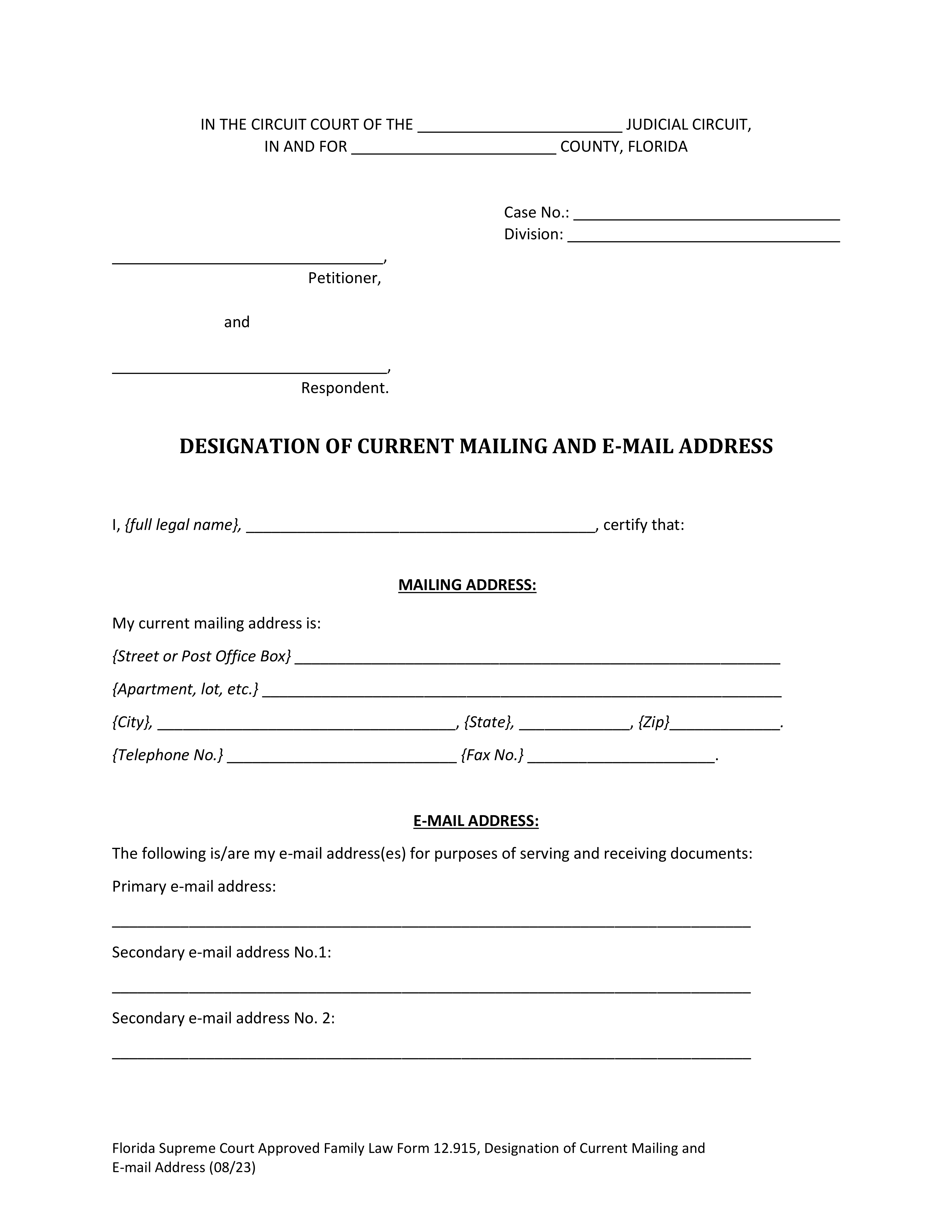
If you are seeking a divorce in Florida and have no minor children, no shared property, and no request for spousal support, use the Petition for Dissolution of Marriage (Form 12.901(b)(3)). This is designed for straightforward, uncontested cases. For any active Florida family law case, you must also file the Designation of Current Mailing and E-mail Address (Form 12.915) to ensure you receive all official court notices and legal documents.
Child Custody and Parenting Plans
Florida cases involving children require specific jurisdictional and safety-related documents:
- UCCJEA Affidavit (Form 12.902(d)): This is a mandatory filing for any case involving parental responsibility or time-sharing. It establishes the child's residency history so the court can confirm its jurisdiction.
- Safety-Focused Parenting Plan (Form 12.995(c)): Choose this specific plan if there are concerns regarding a child's safety, such as domestic violence or substance abuse. It allows for supervised or restricted visitation.
- Enforcement of Out-of-State Custody (Form 12.941(a)): Use this if you have a custody order from another state and need a Florida court to recognize and enforce it, especially in emergency situations where a child has been wrongfully retained.
Marriage Verification and Appeals
- California Proceedings: If you need to formally attest to the facts of a marriage for a California Superior Court, use the Declaration of Marriage for Court Proceeding.
- Appealing a Decision: If you need to challenge a court ruling in a civil or family matter (excluding small claims), use the Appellant’s notice (Form N161). This form initiates the appeal process and captures essential details like your grounds for appeal and the specific order being challenged.
Form Comparison
| Form | Purpose | Legal Context | Key Requirement |
|---|---|---|---|
| Declaration of Marriage for Court Proceeding (California Family Law) | Formally attests to marriage facts for use in court. | California Superior Court family law proceedings. | Sworn statement regarding the ceremony date and location. |
| Florida Supreme Court Approved Family Law Form 12.901(b)(3), Petition for Dissolution of Marriage with No Dependent or Minor Child(ren) or Property (02/18) | Opens a divorce case with no children or assets. | Florida Circuit Court dissolution of marriage cases. | Six months of residency and no marital liabilities. |
| Florida Supreme Court Approved Family Law Form 12.902(d), Uniform Child Custody Jurisdiction and Enforcement Act (UCCJEA) Affidavit | Details child residential history for court jurisdiction purposes. | Florida family law cases involving minor children. | Disclosure of residential history for the past five years. |
| Florida Supreme Court Approved Family Law Form 12.915, Designation of Current Mailing and E-mail Address | Notifies the clerk and parties of updated contact details. | Florida family court cases requiring official service. | Current mailing and e-mail addresses for legal service. |
| Florida Supreme Court Approved Family Law Form 12.941(a), Petition for Enforcement of Out-of-State Custody Decree and for Order to Pick Up Minor Child(ren) | Seeks recognition and enforcement of external custody orders. | Florida courts enforcing out-of-state custody decrees. | Evidence of wrongful retention or violation of existing orders. |
| Form 12.995(c), Safety-Focused Parenting Plan | Establishes a parenting plan focused on protecting the child. | Florida family courts addressing child safety concerns. | Provisions for supervised visitation or restricted parental responsibility. |
| Form N161, Appellant’s notice (All appeals except small claims track appeals and appeals to the Family Division of the High Court) | Formally initiates an appeal against a specific court decision. | Civil courts within the England and Wales jurisdiction. | Grounds of appeal and permission from the original court. |
| Form N161, Appellant's Notice (All appeals except small claims track appeals and appeals to the Family Division of the High Court) | Formally initiates an appeal against a specific court decision. | Civil courts within the England and Wales jurisdiction. | Grounds of appeal and permission from the original court. |
Tips for family court forms
When filling out multiple family court forms, such as a petition and a parenting plan, double-check that names, dates, and addresses are identical on every page. Discrepancies in basic information between different forms can lead to processing delays or administrative rejections by the court clerk.
Many family law documents, especially Florida Supreme Court forms, must be signed under oath in the presence of a notary public or a deputy clerk. Do not sign these forms at home; wait until you are in front of the authorized official to ensure the document is legally valid and accepted by the court.
Dealing with complex family court paperwork can be overwhelming, but AI-powered tools like Instafill.ai can complete these forms in under 30 seconds with high accuracy. Your data stays secure during the process, making it a reliable way to handle multiple forms quickly without manual data entry.
For forms like the UCCJEA Affidavit, you are often required to provide a complete five-year residential history for any minor children involved. Gathering these previous addresses and the names of the people the children lived with beforehand will save you significant time when you begin the filing process.
Always file a designation of current mailing and e-mail address form to ensure the court and the other party can reach you. If you move or change your email during the proceedings, you must file an updated form immediately to avoid missing critical hearing notices or court orders.
If your case involves safety concerns like domestic violence or substance abuse, ensure you use safety-focused parenting plan forms rather than standard versions. These documents provide specific sections for supervised visitation and restricted communication that are necessary for protecting children in high-conflict situations.
Many family court filings, such as appeals or petitions for enforcement, require supporting evidence like previous court orders or marriage certificates. Create a digital folder for these exhibits so they are ready to be uploaded or attached as soon as your primary forms are completed.
Frequently Asked Questions
Anyone involved in legal proceedings regarding marriage, divorce, child custody, or parental rights will likely need specific family court forms. These documents are used to officially petition the court, provide evidence, or update the court on personal information throughout the duration of a case.
If you are seeking a divorce in Florida with no minor children, no marital property to divide, and no request for spousal support, you should use Florida Family Law Form 12.901(b)(3). This petition establishes basic eligibility, such as residency requirements and the legal grounds for the dissolution of marriage.
The Uniform Child Custody Jurisdiction and Enforcement Act (UCCJEA) Affidavit is required in cases involving child custody or time-sharing. It provides a detailed five-year residential history for the child to help the court determine if it has the legal authority and jurisdiction to make decisions regarding their welfare.
Yes, if there are concerns regarding issues like domestic violence or substance abuse, you can file a Safety-Focused Parenting Plan. This document allows parents to outline specific protections, such as supervised visitation or restricted decision-making authority, to ensure the child's safety.
To ensure you receive all official court correspondence, you must file a Designation of Current Mailing and E-mail Address. In Florida, Form 12.915 is used for this purpose, and it must be filed with the clerk of court to ensure all legal service is sent to your correct address.
If a child is being wrongfully retained or a custody order from another state is violated, you can file a Petition for Enforcement of Out-of-State Custody Decree. This allows a local court to recognize and enforce the existing order, and in some cases, it can be filed as an emergency.
A Declaration of Marriage is typically used in California legal proceedings to formally attest to the facts of a marriage ceremony when proof of the union is required. It serves as a sworn statement from someone with personal knowledge of the marriage details, such as the date and location.
Yes, you can fill out family court forms using AI-powered tools like Instafill.ai. These tools accurately extract data from your source documents and place it into the correct fields on the PDF, ensuring the forms are completed professionally and accurately.
Using AI tools like Instafill.ai, most family court forms can be filled out in under 30 seconds. This significantly reduces the time spent on manual data entry and helps ensure that information is consistently placed across multiple legal documents.
Once completed and signed, these forms are typically filed with the Clerk of the Circuit Court in the county where the case is being heard. Many jurisdictions now allow for electronic filing, though some may still require physical copies to be delivered in person or by mail.
An Appellant’s notice, such as Form N161, is used to formally start the process of appealing a court's decision to a higher tribunal. It outlines the specific grounds for the appeal and provides the court with essential details about the original order being challenged.
Many family court forms, especially petitions and affidavits, require a signature under oath before a notary public or a deputy clerk. You should check the specific instructions on each form to see if a 'Statement of Truth' or a notarized signature is required before filing.
Glossary
- Form Complexity Index
- Instafill’s 0–100 measure of how much effort a form takes to complete, calculated deterministically from the form’s own structure rather than estimated. It combines the number of fillable fields (the largest factor), how difficult those fields are to complete based on their type, the number of pages that contain fields, the amount of conditional “fill-only-if” logic, and how many sections the form is divided into, then adds modifiers for tables and repeating lists, bundled instruction pages, and dense page layouts. A higher score means the form is harder to fill out by hand. The forms in this category have a median Form Complexity Index of 45/100 (Basic). See exactly how it is calculated.
- Dissolution of Marriage
- The formal legal term for a divorce, which is the process of legally ending a marriage contract.
- Petitioner
- The person who starts a family law case by filing the initial legal documents with the court.
- Time-Sharing
- A modern legal term used to describe the schedule and arrangement of when a child spends time with each parent.
- Parenting Plan
- A detailed document that outlines how parents will share responsibilities for raising their children, including schedules and decision-making authority.
- UCCJEA
- The Uniform Child Custody Jurisdiction and Enforcement Act, a law used by courts to determine which state has the authority to make decisions about a child's custody.
- Affidavit
- A written statement of facts that the signer swears is true before a notary public or other authorized official.
- Declaration
- A formal written statement submitted to the court where the signer attests to certain facts based on their personal knowledge.
- Irretrievably Broken
- A legal standard used in 'no-fault' divorce states to indicate that a marriage cannot be saved and no specific blame is assigned to either spouse.
- Appellant
- The person who files a notice to appeal a court's decision, asking a higher court to review and potentially change the ruling.