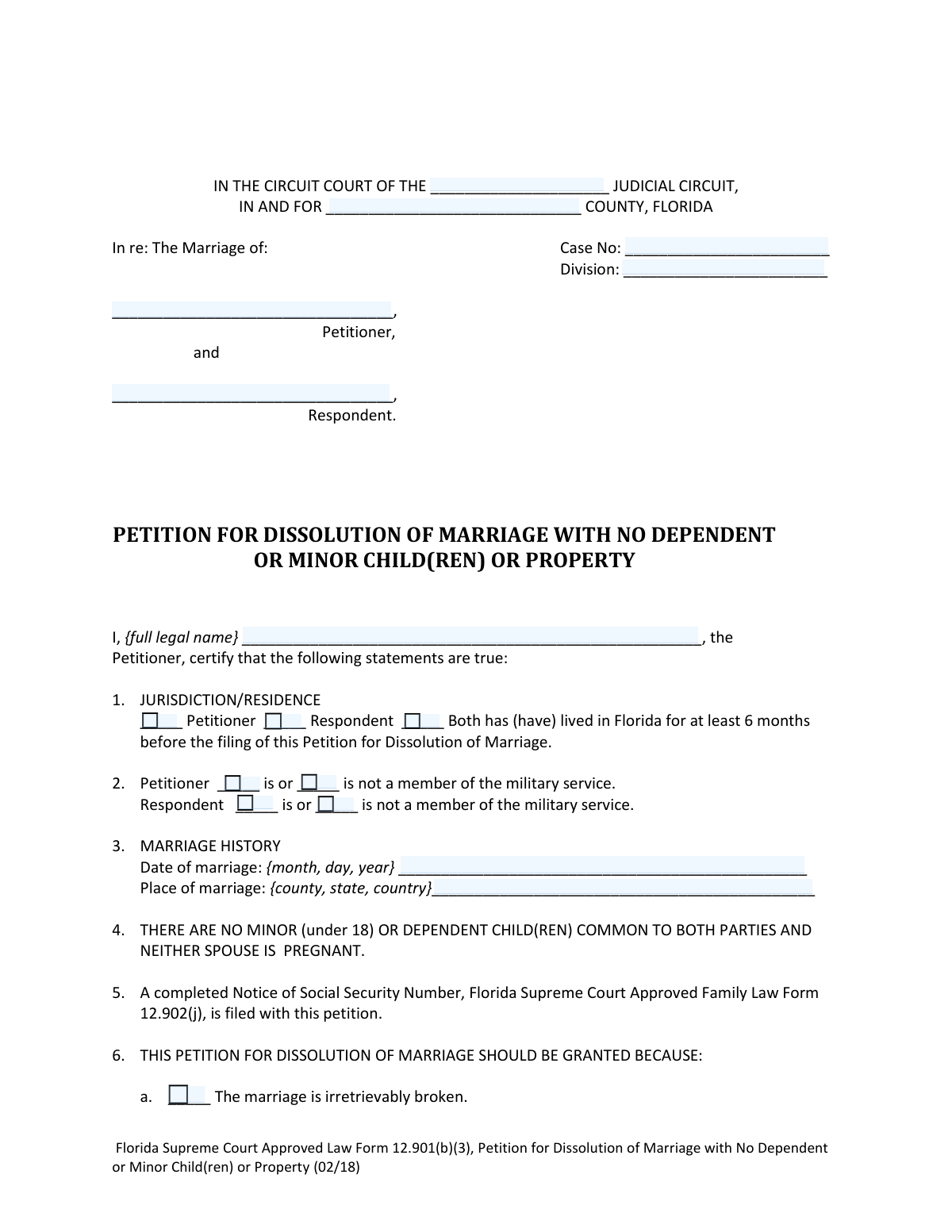
Yes! You can use AI to fill out Florida Supreme Court Approved Family Law Form 12.901(b)(3), Petition for Dissolution of Marriage with No Dependent or Minor Child(ren) or Property (02/18)
Florida Supreme Court Approved Family Law Form 12.901(b)(3) is the official petition used to open a Florida divorce case when the spouses have no minor/dependent children, no marital assets or liabilities, and no request for spousal support, and neither spouse is pregnant. The form establishes key eligibility facts such as Florida residency (at least 6 months), marriage details, and the legal basis for dissolution (typically that the marriage is irretrievably broken). It must be signed under oath before a notary or deputy clerk and filed with the clerk of the circuit court, and the other spouse must be properly served so the case can proceed to default, uncontested, or contested resolution.
Our AI automatically handles information lookup, data retrieval, formatting, and form filling.
It takes less than a minute to fill out Form 12.901(b)(3) using our AI form filling.
Securely upload your data. Information is encrypted in transit and deleted immediately after the form is filled out.
Form specifications
| Form name: | Florida Supreme Court Approved Family Law Form 12.901(b)(3), Petition for Dissolution of Marriage with No Dependent or Minor Child(ren) or Property (02/18) |
| Number of pages: | 7 |
| Filled form examples: | Form Form 12.901(b)(3) Examples |
| Language: | English |
| Categories: | court forms |
Instafill Demo: filling out a legal form in seconds
How to Fill Out Form 12.901(b)(3) Online for Free in 2026
Are you looking to fill out a FORM 12.901(B)(3) form online quickly and accurately? Instafill.ai offers the #1 AI-powered PDF filling software of 2026, allowing you to complete your FORM 12.901(B)(3) form in just 37 seconds or less.
Follow these steps to fill out your FORM 12.901(B)(3) form online using Instafill.ai:
- 1 Confirm eligibility: Florida residency for at least 6 months, no minor/dependent children, no pregnancy, no marital assets or debts, and no alimony request; gather marriage date/place and identification/residency proof.
- 2 Complete the case caption: judicial circuit, county, parties’ names (petitioner/respondent), and leave case number/division blank if not yet assigned by the clerk.
- 3 Fill out the petition statements: residency (who meets it), military service status for each spouse, marriage history, and select the reason for dissolution (irretrievably broken or mental incapacity with attachment).
- 4 Complete requests for relief: confirm no assets/liabilities and waiver of alimony, indicate whether you want a former name restored, and list any other requested relief (if applicable).
- 5 Add contact and e-service information: mailing address (or omit and file confidentiality request if eligible), phone/fax, and designated email address(es) if electing e-service.
- 6 Sign and notarize: sign the petition under oath in front of a notary public or deputy clerk; include nonlawyer assistance information if someone who is not an attorney helped prepare the form.
- 7 File and serve: file the petition with the circuit court clerk (e-file if you choose/are required), submit required accompanying forms (e.g., Notice of Social Security Number, financial affidavit, corroborating witness/ID proof, mandatory disclosure compliance), and arrange proper service on the respondent to move the case toward a final hearing.
Our AI-powered system ensures each field is filled out correctly, reducing errors and saving you time.
Why Choose Instafill.ai for Your Fillable Form 12.901(b)(3) Form?
Speed
Complete your Form 12.901(b)(3) in as little as 37 seconds.
Up-to-Date
Always use the latest 2026 Form 12.901(b)(3) form version.
Cost-effective
No need to hire expensive lawyers.
Accuracy
Our AI performs 10 compliance checks to ensure your form is error-free.
Security
Your personal information is protected with bank-level encryption.
Frequently Asked Questions About Form Form 12.901(b)(3)
This form is a Petition for Dissolution of Marriage when there are no minor or dependent children, no marital property or debts to divide, no request for alimony, and neither spouse is pregnant.
You can file if you or your spouse has lived in Florida for at least 6 months before the petition is filed, and your situation meets the âno children, no property/debts, no alimony, not pregnantâ requirements.
If you and your spouse agree on all issues and can both attend the hearing, you may be able to use the Simplified Dissolution form (12.901(a)). You cannot use the simplified process if either spouse wants alimony, you want to do financial discovery, or you want to reserve rights to reconsider/appeal.
This form is only for cases with no marital assets and no marital liabilities. If you have anything to divide (bank accounts, vehicles, credit cards, loans, etc.), you likely need a different dissolution form.
This form is only barred by minor (under 18) or dependent children common to both parties. If there are no minor or dependent children, you may still qualify, but if there are dependent children, you should use a different form.
You should not use this form if either spouse is pregnant. You will likely need a different dissolution process because pregnancy can affect the courtâs required findings.
This petition requires the petitioner to forever give up any rights to spousal support (alimony) from the other spouse. If you may need alimony now or later, you should not use this form.
You must file a Notice of Social Security Number (12.902(j)) and either an Affidavit of Corroborating Witness (12.902(i)) or proof of Florida residency (a copy of a Florida driverâs license/ID/voter card issued at least 6 months before filing). You also must file a Family Law Financial Affidavit (12.902(b) or (c)) and a Certificate of Compliance with Mandatory Disclosure (12.932) within 45 days of service if not filed with the petition.
You can file an Affidavit of Corroborating Witness (12.902(i)) or provide a photocopy of a current Florida driverâs license, Florida ID, or voter registration card with an issue date at least six months before the case is filed.
Yes. After completing the petition, you must sign it in front of a notary public or deputy clerk because you are swearing under oath that the statements are true.
You file the original with the clerk of the circuit court in the county where you live and keep a copy for your records. E-filing is generally required for attorneys, but self-represented litigants may e-file and are not required to do so.
If you know where your spouse lives, you generally must use personal service (sheriff or certified process server). If you absolutely do not know where your spouse lives, you may be able to use constructive service, but it has strict requirements and limits what the court can order.
If personal service is used, your spouse has 20 days after being served to file an answer. After that, the case may proceed as default (no response), uncontested (agreement), or contested (disagreement).
You may file a Motion for Default (12.922(a)) with the clerk. If your paperwork is complete, you can then work with the clerk/family law intake/judicial assistant to set a final hearing and must provide your spouse notice of the hearing.
If you are a victim of sexual battery, aggravated child abuse, aggravated stalking, harassment, aggravated battery, or domestic violence, do not put your address/phone/fax on the form. Instead, file a Request for Confidential Filing of Address (12.980(h)).
You can ask the clerk for an Application for Determination of Civil Indigent Status. If you qualify, the clerk may defer filing fees.
Compliance Form 12.901(b)(3)
Validation Checks by Instafill.ai
1
Court Heading Completeness (Judicial Circuit, County, Case No., Division, Party Names)
Validates that the court heading fields are present and populated: judicial circuit, county, case number (if assigned), division (if required by the circuit), and the petitioner/respondent names. This is critical for correct docketing, routing to the proper division, and ensuring the filing is associated with the correct case. If any required heading element is missing or malformed, the submission should be flagged for correction or rejected to prevent misfiling.
2
Petitioner Full Legal Name Provided and Non-Placeholder
Ensures the petitionerâs full legal name field is completed and does not contain placeholders (e.g., blanks, âN/A,â or initials only). The petitionerâs legal name is required to identify the filing party and to match service, notary, and court records. If the name is incomplete or appears invalid, the form should fail validation and require the petitioner to provide the full legal name.
3
Florida Residency Selection and 6-Month Eligibility Confirmation
Checks that exactly one residency checkbox is selected (Petitioner, Respondent, or Both) and that the selection affirms at least one party has lived in Florida for at least 6 months before filing. This is a jurisdictional requirement for dissolution filings in Florida and affects whether the court can hear the case. If none or multiple boxes are selected, or if residency is not affirmed, the submission should be blocked and the filer prompted to correct the jurisdiction statement.
4
Military Service Status Checkboxes Completed for Both Parties
Validates that for both petitioner and respondent, exactly one option is selected: âisâ or âis notâ a member of the military service. Military status can trigger additional service requirements and protections (e.g., under the Servicemembers Civil Relief Act). If either partyâs status is missing or both options are selected, validation fails and the filer must correct the selections.
5
Marriage Date Format and Logical Validity
Ensures the date of marriage is provided in a valid month/day/year format and represents a real calendar date. The marriage date is essential to establish the marital relationship and is used in the final judgment and case record. If the date is missing, malformed, or impossible (e.g., 02/30), the form should be rejected until corrected.
6
Marriage Place Completeness (County/State/Country)
Checks that the place of marriage field is completed with sufficient detail (at minimum state/country, and county if applicable) and is not left blank. This information is commonly required for the court record and final judgment preparation. If the location is missing or clearly incomplete (e.g., only âUSAâ), the submission should be flagged for completion.
7
Grounds for Dissolution: Exactly One Option Selected and Attachment Required if Incapacity
Validates that exactly one ground is selected: (a) irretrievably broken or (b) mental incapacity for 3 years prior to filing. If mental incapacity is selected, the system must require an attached Judgment of Incapacity document. If both/neither grounds are selected or the required attachment is missing for incapacity, validation fails because the petition is legally incomplete.
8
No Minor/Dependent Children and No Pregnancy Affirmation Consistency
Confirms the petition includes the required statement that there are no minor or dependent children common to both parties and that neither spouse is pregnant, and that no other fields contradict this (e.g., any child-related addenda or pregnancy indicators if captured elsewhere in the intake). This form is only appropriate when these conditions are true, and contradictions can lead to improper case type filing. If inconsistency is detected, the submission should be stopped and redirected to the correct form type.
9
No Marital Assets or Liabilities Assertion and “Other Relief” Conflict Check
Validates that the petitionerâs assertion of no marital assets or liabilities is present and checks paragraph 10 (âOther reliefâ) for requests that imply property/debt division (e.g., âaward the house,â âallocate credit card debtâ). This form is intended only for cases with no marital property or liabilities, so conflicting requests indicate the wrong petition type. If a conflict is detected, validation should fail and instruct the filer to use the appropriate dissolution form.
10
Alimony Waiver Consistency and Prohibited Relief Check
Ensures the petition includes the statement that the petitioner forever gives up any rights to spousal support (alimony) and verifies that âOther reliefâ does not request alimony or support-like payments. This is a core eligibility condition for using this specific form. If alimony is requested anywhere or the waiver statement is missing, the submission should be rejected as inconsistent with the formâs requirements.
11
Former Name Restoration: Conditional Requirement and Request Alignment
If the petitioner checks the option requesting restoration of a former legal name (paragraph 9), validates that the former legal name field is completed and that the corresponding request box in the REQUEST section is also selected (or the system aligns them). Name restoration must be explicitly requested and clearly stated to be included in the final judgment. If the box is checked but the name is blank (or vice versa), validation fails and the filer must correct the mismatch.
12
Other Relief Field: Required When Selected and Content Safety/Clarity
If the petitioner selects âawarding other reliefâ in the REQUEST section, validates that paragraph 10 contains a non-empty, specific description and does not include prohibited or contradictory relief (e.g., property division, alimony, child-related relief). This prevents ambiguous judgments and ensures the court can understand what is being requested. If âother reliefâ is selected without details or includes disallowed requests, the submission should be flagged for correction.
13
Signature, Date, and Oath/Notary Block Completeness
Checks that the petitioner signature and dated line are completed and that the notary/deputy clerk section is properly filled (date sworn, name of signer, notary/deputy clerk signature, and identification method indicated). The petition must be sworn/affirmed to be valid, and missing notarization elements can invalidate the filing. If any required signature/notary elements are missing, the submission should be rejected or routed to a âneeds notarizationâ correction workflow.
14
Contact Information Format Validation (Address, Phone, Fax, Email)
Validates that the mailing address fields are complete (street, city, state, ZIP) unless the filer indicates confidential address handling, and checks phone/fax numbers for acceptable formats (e.g., 10-digit US numbers with optional separators). If an email address is provided as a designated email, it must be syntactically valid and should support multiple addresses separated in a consistent way if allowed. If formats are invalid or required address components are missing, validation fails to prevent service and notice delivery issues.
15
Required Accompanying Filings Presence (SSN Notice and Residency Proof/Corroborating Witness)
Ensures the submission includes (or is linked to) the Notice of Social Security Number (Form 12.902(j)) and either an Affidavit of Corroborating Witness (Form 12.902(i)) or acceptable residency proof (copy of Florida driverâs license/ID/voter registration with issue date at least 6 months before filing). These are explicitly required with this petition and support jurisdiction and identity requirements. If the required companion documents are missing or the residency proof issue date fails the 6-month rule, the system should block filing and list the missing/invalid items.
16
Nonlawyer Assistance Disclosure Block Conditional Completion
If the filer indicates a nonlawyer helped prepare the form (or if a preparer section is present/triggered), validates that the nonlawyerâs name, business (if any), address, city/state/ZIP, and telephone number are completed. Florida forms require preparer identification to protect consumers and ensure transparency about non-attorney assistance. If the nonlawyer section is partially filled or missing required details when applicable, validation should fail and require completion before acceptance.
Common Mistakes in Completing Form 12.901(b)(3)
People often choose this form because it seems simpler, but later realize they have marital debts, marital assets (even small ones like bank accounts or vehicles), a pregnancy, or a dependent/minor child. Filing the wrong petition can lead to delays, dismissal, or a final judgment that doesnât address important issues. Before filing, confirm there are truly no marital assets/liabilities, no minor/dependent children, neither spouse is pregnant, and no one wants alimony; if any item is not true, use the correct dissolution form or get legal advice.
A common error is checking the residency box without actually meeting the âlived in Florida for at least 6 monthsâ requirement or without having proof ready. This can cause the court to reject the case, require additional filings, or delay the final hearing. Avoid this by confirming at least one spouse has lived in Florida for 6 months immediately before filing and by filing the required proof (corroborating witness affidavit or qualifying ID with an issue date at least six months before filing).
Many filers forget to fill in the judicial circuit and county, or they guess the division, or they leave the case number blank after the clerk assigns it and never update copies. Incorrect caption information can cause filing errors, misrouting within the clerkâs office, and delays in scheduling hearings. Use the county where you are filing, confirm the correct judicial circuit for that county, and add the case number/division exactly as assigned by the clerk on all later documents.
This form relies heavily on checkboxes (residency, military status, grounds, name change request), and people often leave them blank or check multiple inconsistent options. Missing or conflicting selections can make the petition legally insufficient and trigger clerk rejections or court requests to amend. Go line-by-line and ensure exactly one option is selected where required (e.g., âisâ vs âis notâ), and that your selections match the facts and any attached documents.
Filers frequently enter an approximate marriage date, omit the county/state/country, or use nicknames instead of full legal names. Errors here can create inconsistencies with the marriage certificate and complicate the final judgment or recordkeeping. Copy the date and place exactly from the marriage certificate and use full legal names as they appear on government ID and the marriage record.
Some people check the âno minor or dependent childrenâ statement while they have a child over 18 who is still legally dependent, or they fail to disclose a current pregnancy. If this requirement is not true, the court may require a different petition and additional child-related forms, causing major delays. Confirm there are no children under 18, no dependent children (as legally defined), and that neither spouse is pregnant before using this form.
A very common mistake is filing only the petition and missing required documents like the Notice of Social Security Number (12.902(j)) and later-required items like the Family Law Financial Affidavit and Certificate of Compliance with Mandatory Disclosure. Missing documents can prevent the case from moving forward, delay default/uncontested final hearings, or result in court orders to file them by a deadline. Use a checklist and file the SSN Notice with the petition, then calendar the 45-day deadlines for the financial affidavit and mandatory disclosure (unless properly waived by agreement).
People often attach an ID copy that is too recent, expired, or not one of the accepted documents, or they forget to file the Affidavit of Corroborating Witness. Without proper residency proof, the court may not grant the dissolution at the final hearing. Avoid this by attaching either the corroborating witness affidavit or a copy of a Florida driverâs license/Florida ID/voter registration card with an issue date at least six months before the filing date.
Filers sometimes write requests in paragraph 10 for property division, debt allocation, discovery, or support-related relief even though the form is for cases with no property/liabilities and no alimony. Conflicting requests can cause the court to require an amended petition or to deny requested relief. Keep âother reliefâ limited and consistent with the form (e.g., administrative items), and if you need property/debt/support orders, use the appropriate dissolution petition instead.
A frequent error is writing a former name in paragraph 9 but forgetting to check the corresponding request box, or listing a name that was never a legal former name. This can result in the final judgment not restoring the name, requiring a later correction or separate name-change steps. Enter the exact former legal name you want restored and check both the paragraph 9 option and the request item for restoring the former name.
People often sign the petition at home without notarization, forget the notary block, or submit forms that are not typed/printed in black ink as instructed. An unnotarized petition can be rejected by the clerk or deemed defective, delaying service and the case timeline. Sign only in front of a notary public or deputy clerk, complete the notary section fully, and ensure the form is legible and in black ink.
Many filers assume filing the petition automatically notifies the spouse, or they try to email the petition instead of using proper service of process, or they elect e-service without following the strict formatting/rule requirements. Improper service can prevent the 20-day response clock from starting and can block defaults and final hearings. Use sheriff/certified process server for initial service (or follow constructive service rules only when truly applicable), and only elect e-service if you can comply with Rule 2.516 and file the Designation of Current Mailing and E-mail Address (12.915).
Saved over 80 hours a year
âI was never sure if my IRS forms like W-9 were filled correctly. Now, I can complete the forms accurately without any external help.â
Kevin Martin Green
Your data stays secure with advanced protection from Instafill and our subprocessors

Robust compliance program
Transparent business model
Youâre not the product. You always know where your data is and what it is processed for.
ISO 27001, HIPAA, and GDPR
Our subprocesses adhere to multiple compliance standards, including but not limited to ISO 27001, HIPAA, and GDPR.
Security & privacy by design
We consider security and privacy from the initial design phase of any new service or functionality. Itâs not an afterthought, itâs built-in, including support for two-factor authentication (2FA) to further protect your account.
Fill out Form 12.901(b)(3) with Instafill.ai
Worried about filling PDFs wrong? Instafill securely fills florida-supreme-court-approved-family-law-form-129 forms, ensuring each field is accurate.



