Fill out marriage dissolution forms
with AI.
Marriage dissolution forms are the foundational legal documents required to formally end a marriage or domestic partnership. These forms are essential because they initiate the legal process, establishing the grounds for divorce and outlining the specific requests of the parties involved. Whether a couple is seeking a simplified dissolution or a more complex proceeding involving shared assets, these documents ensure that the court has a clear record of the marriage's status and the intended path forward for both individuals.
By continuing, you acknowledge Instafill's Privacy Policy and agree to get occasional product update and promotional emails.
About marriage dissolution forms
Typically, these forms are needed by individuals or couples who have decided to separate and want to legally dissolve their union. The specific form required depends heavily on the circumstances of the marriage—such as whether there are minor children involved, the existence of shared property or debts, and if both parties are in agreement on the terms. For example, a couple without children or significant assets might use a Petition for Simplified Dissolution, while those with dependents would use forms like the Petition for Dissolution of Marriage with Minor Children to address support and custody arrangements.
Navigating family law can be emotionally and logistically challenging, and the paperwork often adds an extra layer of stress. Tools like Instafill.ai use AI to fill these forms in under 30 seconds, ensuring that data is handled accurately and securely while saving significant time during a difficult transition. By automating the technical details of the filing process, individuals can focus on the practical and personal aspects of their separation rather than the complexities of manual form entry.
Every form on this page can be completed without typing. Instafill is form filling software that reads a PDF and fills it for you — including flat and scanned documents that carry no fillable fields at all.
Forms in This Category
The forms in this category have a median Form Complexity Index of 57/100 (Moderate), measured across 13 forms by field count, input difficulty, length, conditional logic and structure. See how it is calculated.
- Enterprise-grade security & data encryption
- 99%+ accuracy powered by AI
- 1,000+ forms from all industries
- Complete forms in under 60 seconds
How to Choose the Right Form
Selecting the correct marriage dissolution form in Florida depends primarily on three factors: whether you have minor children, the complexity of your shared assets, and whether you and your spouse are filing jointly. Using the wrong petition can lead to delays or the dismissal of your case.
Simplified and Joint Filings
If you and your spouse are in complete agreement on the terms of your divorce and meet specific criteria, you may be eligible for the most streamlined process.
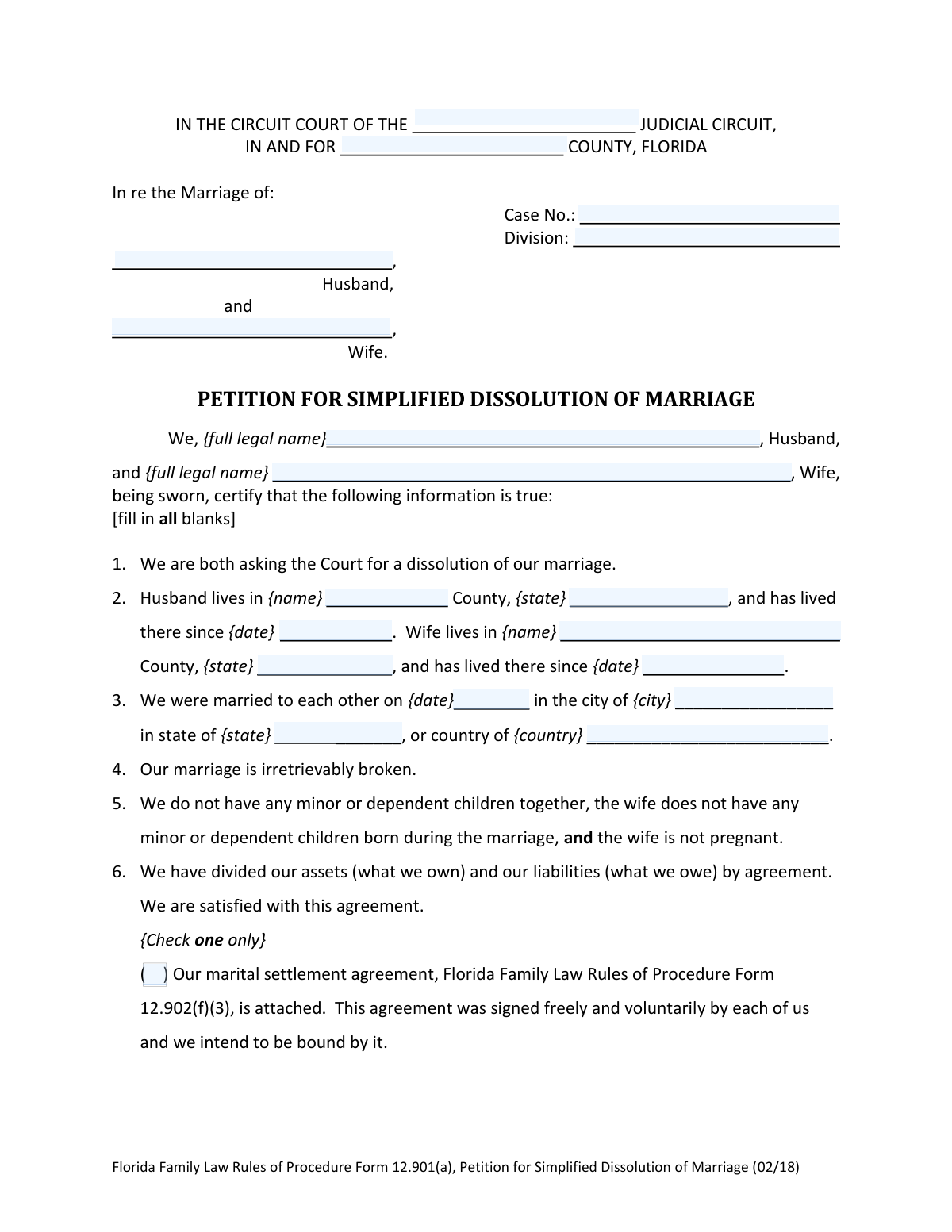
- Form 12.901(a), Petition for Simplified Dissolution of Marriage: Use this if you have no minor or dependent children, no one is seeking alimony, and you have both agreed on how to divide all assets and debts. Both spouses must sign this petition and attend the final hearing together.
Dissolutions Involving Children
When the marriage involves children, the court requires more detailed information regarding their welfare and support.
- Form 12.901(b)(1), Petition for Dissolution of Marriage: This is the mandatory form if you have dependent or minor children together, or if the wife is currently pregnant. It covers critical issues like child support, time-sharing schedules, and the division of parental responsibilities.
Dissolutions Without Children
If there are no minor children and you do not qualify for a "simplified" dissolution (for example, if only one spouse is filing), your choice depends on your financial situation:
- Form 12.901(b)(2), Petition for Dissolution of Marriage: Choose this form if you have shared property, real estate, or marital debts that the court needs to divide, but you do not have minor children.
- Form 12.901(b)(3), Petition for Dissolution of Marriage: This is for a "clean break." Use it only if you have no minor children, no marital assets, no marital debts, and neither spouse is seeking alimony.
Before filing, ensure at least one spouse has been a Florida resident for at least six months. All forms must be signed in the presence of a notary public or a deputy clerk before being submitted to the circuit court.
Form Comparison
| Form | Children Involved | Property & Debts | Ideal Situation |
|---|---|---|---|
| Form 12.901(a), Petition for Simplified Dissolution of Marriage | No minor or dependent children | Agreed division of all assets and liabilities | Couples who agree on all terms and meet residency requirements. |
| Form 12.901(b)(2), Petition for Dissolution of Marriage | No minor or dependent children | Shared assets or debts exist to be divided | Filing for divorce when property division is the primary legal concern. |
| Form 12.901(b)(1), Petition for Dissolution of Marriage | Includes minor/dependent children or pregnant spouse | Assets and liabilities to be divided | Families requiring court orders for child support and custody. |
| Form 12.901(b)(3), Petition for Dissolution of Marriage | No minor or dependent children | No marital assets, debts, or alimony requests | Couples with zero shared financial interests and no children. |
| Florida Supreme Court Approved Family Law Form 12.901(b)(3), Petition for Dissolution of Marriage with No Dependent or Minor Child(ren) or Property (02/18) | No minor or dependent children | No marital assets, debts, or alimony | Official filing for uncomplicated cases with no children or assets. |
Tips for marriage dissolution forms
Choosing the wrong form can lead to immediate rejection by the court. Carefully verify whether your situation requires a form for 'Dependent or Minor Children' versus 'No Property or Children' to ensure you are meeting the specific legal requirements for your household type.
Most jurisdictions require at least one spouse to have been a resident for a specific period, often six months, before a petition can be filed. Ensure you have proof of residency, such as a state-issued ID or a corroborating witness, to avoid having your case dismissed for lack of jurisdiction.
Managing multiple legal documents can be stressful, but AI-powered tools like Instafill.ai can complete these forms in under 30 seconds with high accuracy. This technology ensures your data stays secure during the process, providing a massive time-saving advantage when dealing with complex family law paperwork.
For petitions involving the division of assets or alimony, have your bank statements, property titles, and debt records ready. Accurate financial disclosure is mandatory, and having this information organized will prevent errors that could lead to lopsided settlements or future legal disputes.
Many marriage dissolution forms must be signed under oath to be valid. Do not sign your completed documents until you are in the presence of a notary public or a court clerk, as an unverified signature will usually require you to print and file the form all over again.
Filing the form with the clerk is only the beginning; you must legally notify your spouse through a process server or sheriff. Familiarize yourself with local rules for service to ensure the court has proof that the other party was properly notified, allowing your case to proceed.
While state-approved forms cover the basics, individual circuit courts often require additional local cover sheets or specific standing orders. Always double-check with your local county clerk’s website to see if there are extra documents that must be bundled with your primary petition.
Frequently Asked Questions
Selecting the right form depends primarily on whether you have minor children and the extent of your shared assets. For example, if you have children, you must use Form 12.901(b)(1), whereas couples with no children or property might use Form 12.901(b)(3) for a more streamlined process.
A simplified dissolution, such as Form 12.901(a), is designed for couples who agree on all terms, have no minor children, and meet specific residency requirements. Regular petitions in the 12.901(b) series are used when the couple has children, property to divide, or when they do not qualify for the simplified procedure.
If a spouse is pregnant, the court views this as a case involving a dependent child. In this situation, you should use Form 12.901(b)(1), which is specifically designed for dissolution of marriage with dependent or minor children.
Yes, Form 12.901(b)(3) is specifically intended for couples who have no minor or dependent children, no marital assets or liabilities, and are not seeking alimony. This form establishes that the marriage is irretrievably broken without requiring complex financial or parental disclosures.
Generally, at least one spouse must have been a resident of the state for at least six months before filing the petition. You will typically need to provide a valid state ID or an affidavit from a witness to prove this residency to the court.
Once completed and notarized, these forms must be filed with the Clerk of the Circuit Court in the county where you or your spouse lives. Many counties now offer electronic filing systems, though some may still require physical copies to be delivered to the courthouse.
Yes, most of these petitions must be signed under oath in the presence of a notary public or a deputy clerk at the courthouse. This step is necessary to verify your identity and confirm that the information provided in the document is true and accurate.
Yes, you can use AI tools like Instafill.ai to complete these forms accurately and efficiently. The AI can extract data from your personal documents and place it into the correct form fields in under 30 seconds, ensuring that all information is positioned correctly for court submission.
While manual entry can be time-consuming and prone to errors, using an AI-powered platform allows you to complete marriage dissolution forms in less than 30 seconds. The tool automates the data mapping process, which helps you move through the legal paperwork much faster.
After filing, the other spouse must typically be 'served' with the papers to provide them with legal notice, unless they sign a waiver of service. Depending on whether the case is contested or uncontested, the court will then schedule hearings or a final judgment to legally end the marriage.
This is a legal term indicating that the marriage has reached a point where it can no longer be saved and there is no hope for reconciliation. Most of these forms require you to state this as the legal basis for the dissolution, as it is the standard for 'no-fault' divorce in many jurisdictions.
Glossary
- Form Complexity Index
- Instafill’s 0–100 measure of how much effort a form takes to complete, calculated deterministically from the form’s own structure rather than estimated. It combines the number of fillable fields (the largest factor), how difficult those fields are to complete based on their type, the number of pages that contain fields, the amount of conditional “fill-only-if” logic, and how many sections the form is divided into, then adds modifiers for tables and repeating lists, bundled instruction pages, and dense page layouts. A higher score means the form is harder to fill out by hand. The forms in this category have a median Form Complexity Index of 57/100 (Moderate). See exactly how it is calculated.
- Dissolution of Marriage
- The legal term for divorce, which refers to the formal court process that ends a valid marriage and addresses the division of property and responsibilities.
- Petitioner
- The spouse who initiates the legal process by filing the initial petition for dissolution of marriage with the court.
- Respondent
- The spouse who did not file the initial petition and must respond to the legal action after being formally notified of the case.
- Alimony
- Financial support paid by one spouse to the other after a divorce, often based on the recipient's need and the other spouse's ability to pay.
- Marital Assets and Liabilities
- The property, debts, and financial obligations acquired by either spouse during the marriage that must be divided between the parties.
- Irretrievably Broken
- The legal ground for divorce in many states, including Florida, meaning the marriage is beyond repair and no reconciliation is possible.
- Simplified Dissolution
- A streamlined divorce process for couples who agree on all terms, have no minor children, and meet specific residency and financial requirements.
- Service of Process
- The formal procedure of delivering legal documents to the other spouse to ensure they are legally notified that a divorce case has been opened.