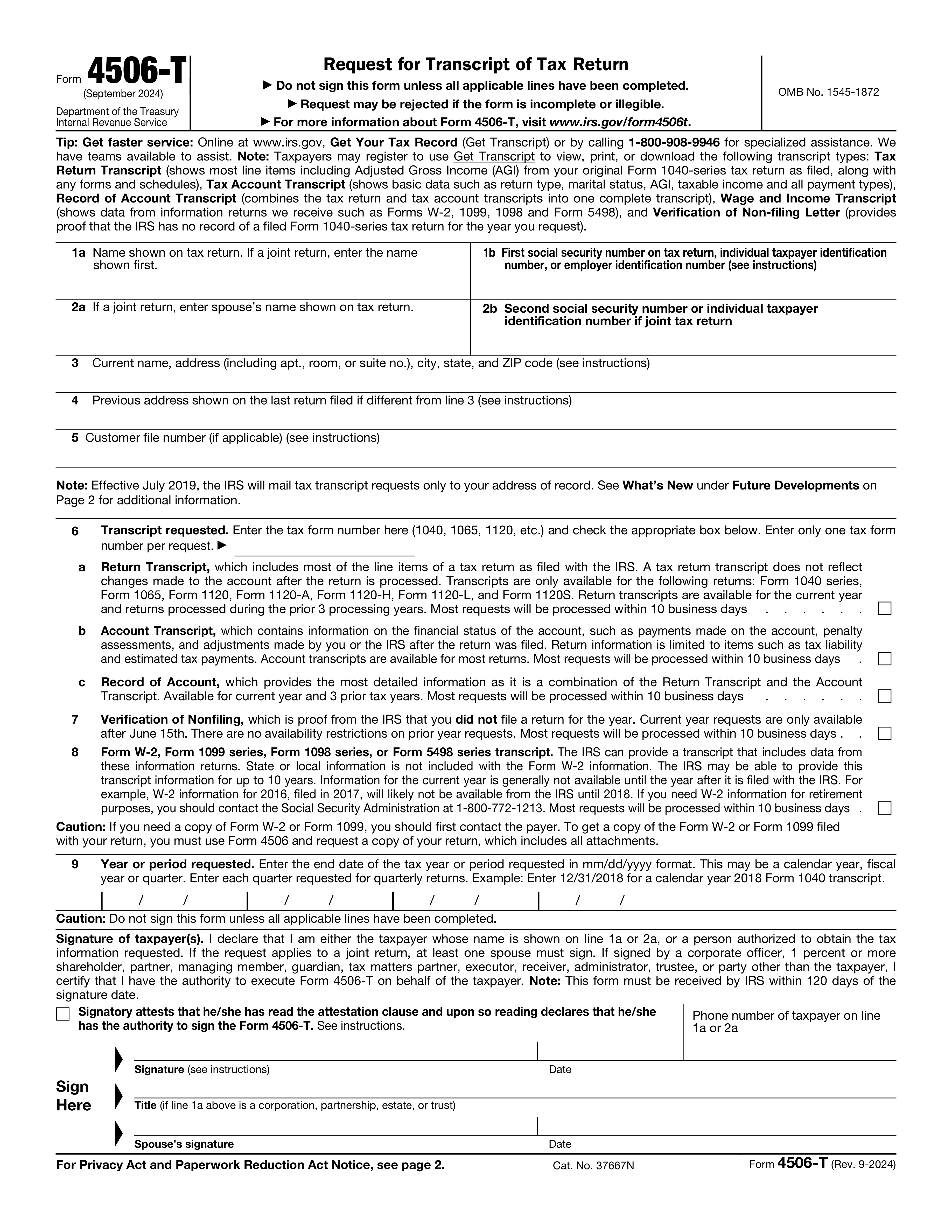
It is crucial to enter the name exactly as it appears on the tax return to avoid processing delays. The IRS uses the name to verify identity and match it to the correct tax account. To prevent this mistake, double-check past tax documents for the precise name used, including any middle initials or suffixes. If there has been a legal name change since the last filing, attach the appropriate documentation to support the change.
The Social Security Number (SSN), Individual Taxpayer Identification Number (ITIN), or Employer Identification Number (EIN) must be accurate to ensure the IRS can locate the correct tax records. An incorrect number can lead to a rejection of the request. Before submitting Form 4506-T, verify the number by comparing it with official documents such as Social Security cards or previous tax filings. If the number has changed for any reason, include documentation to reflect this change.
When requesting a transcript for a joint tax return, it is necessary to include the spouse's name as it appeared on the joint return. This helps the IRS to verify the identity of both parties and provide the correct information. To avoid this error, review the joint tax return to confirm the spouse's name and include it on the form. If the spouse's name has changed, provide legal documentation of the name change.
For joint returns, both the primary and secondary taxpayer's SSNs or ITINs must be provided. This information is used to authenticate the request and access the correct tax records. Ensure that both numbers are included on the form and that they are accurate. Cross-reference with previous joint tax returns or other official documents to verify the numbers before submission.
The current address, including the apartment number if applicable, must be complete and accurate to ensure the delivery of the tax transcript. An incomplete or incorrect address can result in the transcript being sent to the wrong location. To prevent this, confirm the current address against a recent utility bill or official correspondence. If you have moved since the last tax filing, update the address with the IRS before requesting the transcript.
Failing to provide a previous address when it differs from the one on the last tax return can lead to processing delays or the IRS being unable to fulfill the request. It is crucial to include any previous addresses that may have been associated with past tax filings to ensure the correct transcripts are retrieved. Taxpayers should double-check their records and ensure that the address provided on Form 4506-T matches the one used on their last tax return. If there has been a change of address since the last filing, it must be noted in the appropriate section of the form.
Inputting a Social Security Number (SSN) instead of a customer file number in line 5 is a common error. The customer file number field is optional and is intended for the requester's use to help them match the transcript to the taxpayer. An SSN should not be entered in this field. To avoid this mistake, requesters should leave line 5 blank unless they have a specific customer file number that they use to identify the document. If a customer file number is used, it should be a number that is meaningful to the requester, such as an account or file identification number.
Choosing the incorrect tax form number in line 6 can result in the IRS providing a transcript for the wrong tax document, which can be a significant setback. It is essential to verify the specific tax form number for which the transcript is needed before completing the form. Taxpayers should refer to their tax records or consult with a tax professional if they are uncertain about the correct form number to request. Careful attention to the list of available forms and selecting the appropriate one will ensure the correct information is provided.
Neglecting to check the appropriate box for the type of transcript needed is a mistake that can lead to receiving the wrong type of tax information. There are several types of transcripts available, each serving a different purpose. Taxpayers should carefully read the descriptions of each transcript type and select the one that best fits their needs. It is important to understand the difference between a tax return transcript, tax account transcript, record of account, and wage and income transcript to make the correct selection.
Omitting to check the box for requesting W-2, 1099, and other income document information can result in not receiving all necessary tax documentation. If these documents are required, the requester must check the box in line 8 on Form 4506-T. This information is often needed for loan applications and for accurate tax preparation. To avoid this oversight, requesters should review the form thoroughly before submission and ensure that all necessary boxes are checked to receive all relevant income information.
Line 9 of Form 4506-T requires the requester to specify the form number of the tax return transcript they need. It is crucial to use the MM/DD/YYYY date format when filling in this section. Using different date formats can lead to processing delays or even rejection of the request. To avoid this mistake, double-check that the date is entered correctly and corresponds to the required format before submitting the form.
The taxpayer's signature is mandatory on Form 4506-T to validate the request. An absent or incorrect signature will result in the form being returned without the requested transcript. Ensure that the taxpayer signs the form in the designated signature area and that the signature matches the one on file with the IRS. If the taxpayer cannot sign, a valid power of attorney may be required.
A taxpayer's phone number is a critical piece of information on Form 4506-T that is often overlooked. Without it, the IRS may be unable to contact the taxpayer for any clarifications or issues, potentially delaying the processing of the request. To prevent this, the taxpayer should provide a current phone number where they can be readily reached during business hours.
When an authorized individual is requesting a transcript on behalf of an entity, it is mandatory to enter their title in the appropriate field on Form 4506-T. Neglecting to provide this information can lead to the IRS questioning the legitimacy of the request. Authorized individuals should ensure their title is clearly printed on the form to confirm their authority to request the information.
For joint tax return transcripts, both spouses must sign Form 4506-T if they filed a joint tax return and are still married at the time of the request. A missing spouse's signature can invalidate the request. To avoid this issue, both spouses should review the form together and ensure both signatures are provided before submission.
Submitting Form 4506-T after 120 days from the signature date invalidates the request, as the IRS considers the signature to be outdated. To avoid this, ensure that you send the form within the 120-day window after signing it. It is advisable to review the form for accuracy and completeness as soon as possible after filling it out, and to promptly mail or fax it to the appropriate IRS address or fax number. Keeping track of the signature date and setting a reminder can help ensure timely submission.
Signing Form 4506-T before all applicable lines are completed can lead to processing delays or the rejection of the form. It is important to thoroughly review the form instructions and fill out all required information before signing. Double-check that all relevant sections are filled out accurately and completely. Sign the form only after you have verified that all the information is correct and that no required fields have been left blank.
Failing to check the appropriate authority box in the signature area of Form 4506-T can result in the IRS not recognizing the authority of the individual to request the information. It is crucial to read the instructions regarding who has the authority to sign the form and to check the appropriate box that corresponds to the signer's authority. If you are signing on behalf of a business, organization, or other entity, ensure that you have the legal authority to do so and that the correct box is checked to reflect this.
Using an incorrect address or fax number for submission based on the state can lead to the form being sent to the wrong IRS office, causing delays. To prevent this, consult the latest IRS instructions for Form 4506-T to determine the correct address or fax number for your state. The IRS periodically updates these addresses and fax numbers, so it is important to use the most current information available. Always verify the correct submission details before sending the form to ensure it reaches the correct destination.