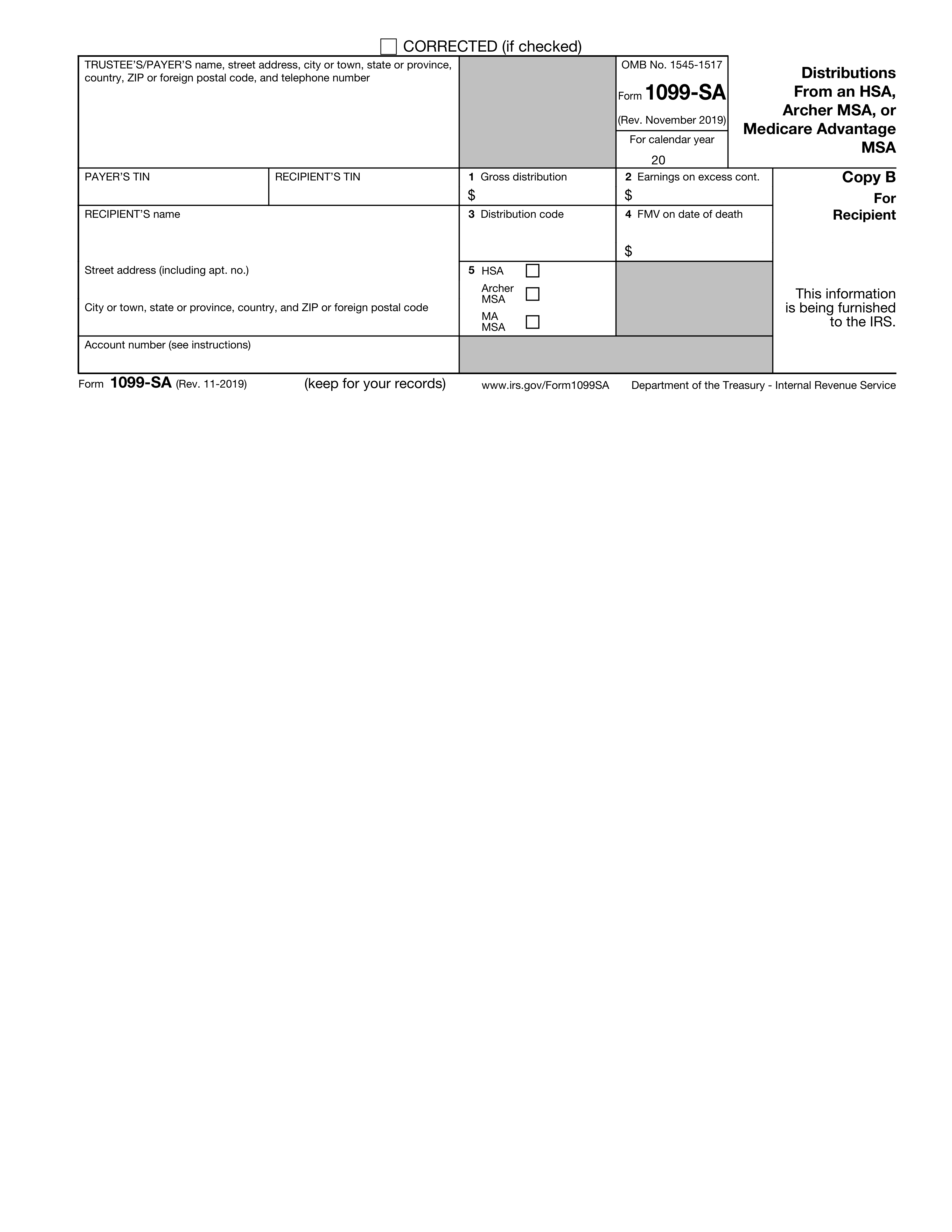
Filers sometimes forget to include Copy A of Form 1099-SA when submitting it along with Form 1096 to the IRS. It is crucial to remember that Copy A is the official IRS copy and must be included when filing. To avoid this mistake, filers should organize their documents carefully and double-check that all required copies are attached before mailing. Using a checklist can also help ensure that no document is overlooked during the filing process.
Entering the wrong calendar year for distributions on Form 1099-SA can lead to confusion and potential tax issues for the account holder. It is important to verify the distribution dates and ensure that they correspond to the correct tax year before completing the form. Filers should cross-reference their records with the distribution statements provided by the trustee or payer to confirm the accuracy of the tax year reported.
If a mistake is made on Form 1099-SA and a corrected form needs to be issued, it is essential to check the 'VOID' or 'CORRECTED' box at the top of the form. This indicates to the IRS that the form is either voided or a corrected version of a previously filed form. To prevent this oversight, filers should review the form thoroughly before submission and mark the appropriate box if the form is being voided or corrected. Keeping a record of all forms issued, including those that are voided or corrected, can also help maintain accurate filing.
The trustee or payer's full name and address are required fields on Form 1099-SA and must be completed accurately. Omitting this information can result in processing delays or misdirected correspondence. Filers should ensure that they have the correct and complete details of the trustee or payer before filling out the form. It is advisable to use pre-printed forms or labels if available, to minimize the risk of errors in entering this information.
The trustee or payer's telephone number is an important piece of information that should be included on Form 1099-SA. Neglecting to provide this number can hinder communication between the IRS and the trustee or payer if any issues arise. Filers should make sure to obtain the correct telephone number and include it on the form. It is a good practice to verify the number for accuracy and clarity before submitting the form to the IRS.
The payer's Taxpayer Identification Number (TIN) is a critical piece of information required on Form 1099-SA. Failure to include the TIN can lead to processing delays and potential penalties. To avoid this mistake, double-check the payer's TIN before submission and ensure it is accurately entered in the appropriate field. It is also advisable to verify the TIN against official documents or previous tax forms to confirm its correctness.
Omitting the recipient's Taxpayer Identification Number (TIN) on Form 1099-SA can result in incorrect tax reporting and issues for the recipient. To prevent this error, always request the recipient's TIN in advance and confirm its accuracy. Enter the TIN carefully in the designated area on the form. If the recipient's TIN is not available, follow the IRS guidelines for submitting forms without a TIN.
Providing incomplete recipient's name or address details can lead to misdirected or undeliverable tax documents. Ensure that the recipient's full legal name is used as it appears on their tax identification documents. Additionally, verify the address for completeness, including apartment or suite numbers if applicable. Review the information with the recipient if necessary to confirm its accuracy before filing the form.
Neglecting to include the recipient's city, state, and ZIP code is a common oversight that can hinder the delivery of tax-related correspondence. Always complete the address section in its entirety, including city, state, and ZIP code. Use the United States Postal Service's ZIP code lookup tool if you are unsure of the correct ZIP code. This ensures that all mailed documents reach the recipient without delay.
The account number is an essential identifier on Form 1099-SA, especially when the payer has multiple accounts for the recipient. Failing to enter the account number on Copy A can cause confusion and misallocation of distributions. To avoid this, always include the account number as it appears on the account statement or other related documents. Double-check the number for accuracy to ensure proper reporting and record-keeping.
Entering an incorrect gross distribution amount in box 1 can lead to discrepancies in tax calculations and reporting. To avoid this mistake, double-check the distribution statements provided by the financial institution managing the HSA or MSA. Ensure that the amount entered matches the total distributions received during the tax year. It is also advisable to cross-reference this amount with personal records and bank statements to confirm its accuracy before submitting the form.
Miscalculating earnings on excess contributions in box 2 can result in incorrect tax liability. To prevent this error, carefully review the IRS guidelines on how to calculate earnings on excess contributions. Use accurate interest rates and contribution data, and consider using tax software or consulting with a tax professional to ensure the calculation is correct. Keep detailed records of all contributions to the account to simplify this process.
Using the wrong distribution code in box 3 can lead to confusion about the nature of the distribution and potentially trigger an IRS inquiry. Familiarize yourself with the IRS distribution codes and their meanings as outlined in the instructions for Form 1099-SA. Verify the type of distribution taken and choose the code that accurately reflects the transaction. If uncertain about which code to use, seek clarification from the financial institution or a tax advisor.
Misreporting the fair market value on the date of death in box 4 can have significant tax implications for the estate or beneficiaries. To avoid this error, obtain an accurate valuation of the account as of the date of death, which may require the assistance of the financial institution holding the account. Ensure that this value is reported correctly on the form. If the account has multiple beneficiaries, it may also be necessary to allocate the fair market value proportionally.
Failing to check the correct account type box in box 5 can result in improper tax treatment of the distributions. Before completing the form, confirm whether the distribution is from a Health Savings Account (HSA) or a Medical Savings Account (MSA). Check the appropriate box that corresponds to the type of account from which the distribution was made. Reviewing account documentation or consulting with the financial institution can help ensure the correct box is checked.
Recipients often overlook the importance of reviewing the instructions for tax reporting provided with Form 1099-SA. This can lead to errors in reporting distributions from Health Savings Accounts (HSAs) or Medical Savings Accounts (MSAs) on their tax returns. To avoid this mistake, recipients should carefully read the instructions that accompany Form 1099-SA to understand how to report these distributions correctly. It is also advisable to consult with a tax professional if there is any confusion regarding the tax implications of these distributions.
Trustees or payers sometimes fail to refer to the general instructions for Form 1099-SA, which can result in incorrect or incomplete forms being issued. It is crucial for trustees and payers to familiarize themselves with the IRS's general instructions for this form to ensure accurate reporting of distributions. Regularly reviewing the latest instructions and updates from the IRS can help prevent errors. Additionally, using IRS-approved software for form preparation can assist in reducing mistakes.
Both recipients and trustees/payers may neglect to visit the IRS website for additional resources and guidance related to Form 1099-SA. The IRS website offers a wealth of information, including frequently asked questions, publications, and the latest updates on tax laws that can help in accurately completing and understanding the form. To avoid this oversight, it is recommended to regularly check the IRS website for any new information regarding HSA and MSA distributions and to utilize the available tools and resources for assistance in tax reporting.