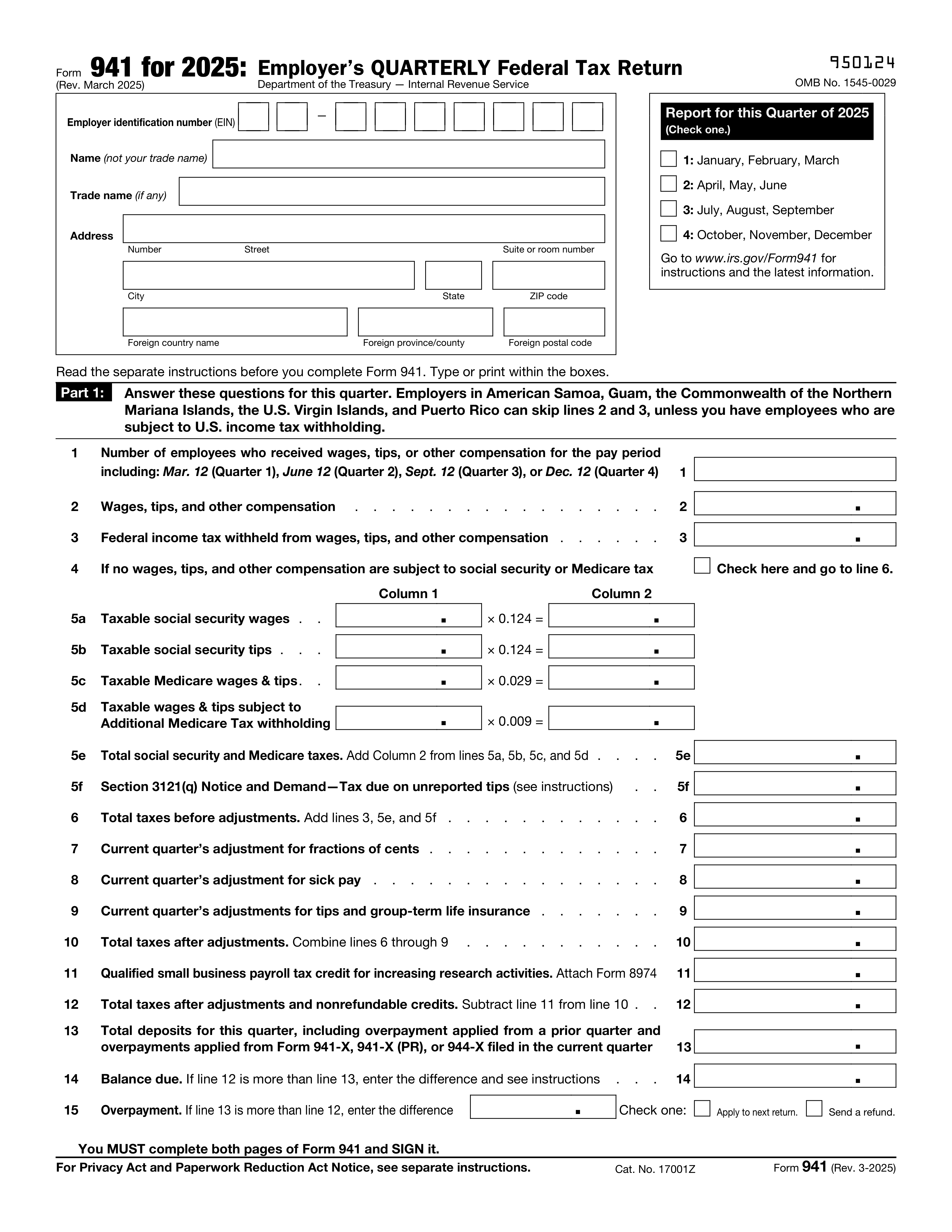
Compliance Form 941
Validation Checks by Instafill.ai
1
Verifies that the form is being filed by an employer who pays wages subject to federal income tax withholding or social security and Medicare taxes, ensuring compliance with filing requirements.
The AI software ensures that the entity filing Form 941 is indeed an employer obligated to pay wages subject to federal income tax withholding or social security and Medicare taxes. It verifies the employer's eligibility and compliance with the IRS's filing requirements, preventing non-compliant entities from filing. This check is crucial for maintaining the integrity of the tax system and ensuring that only eligible employers are submitting the form. It also helps in identifying any discrepancies in the employer's status that might affect the filing process.
2
Confirms that all necessary wage, tip, and other compensation information, along with federal income tax withheld and both employer and employee shares of social security and Medicare taxes, have been accurately gathered.
The software meticulously confirms the accuracy and completeness of all wage, tip, and other compensation data reported on Form 941. It ensures that the federal income tax withheld, as well as both the employer and employee shares of social security and Medicare taxes, are accurately calculated and reported. This validation is essential for the correct computation of tax liabilities and contributions. It also aids in preventing errors that could lead to penalties or interest charges for the employer.
3
Ensures that Part 1 of the form is correctly completed, including accurate reporting of the number of employees, wages, tips, and other compensation, and federal income tax withheld.
The AI software verifies the accurate completion of Part 1 of Form 941, focusing on the correct reporting of the number of employees, wages, tips, and other compensation. It ensures that the federal income tax withheld is accurately reported, which is vital for the correct assessment of tax liabilities. This step is crucial for maintaining the accuracy of the employer's tax records and ensuring compliance with IRS regulations. It also helps in identifying any discrepancies or omissions in the reported data.
4
Validates the accurate calculation of taxable social security and Medicare wages and tips, and the total taxes before adjustments.
The software performs a detailed validation of the calculations for taxable social security and Medicare wages and tips, as well as the total taxes before any adjustments. It ensures that these calculations are accurate and in line with IRS guidelines, which is essential for the correct determination of tax liabilities. This validation helps in preventing calculation errors that could affect the employer's tax obligations. It also ensures that the employer is not overpaying or underpaying their taxes.
5
Checks for the correct application of necessary adjustments for fractions of cents, sick pay, tips, and group-term life insurance.
The AI software checks for the correct application of adjustments related to fractions of cents, sick pay, tips, and group-term life insurance on Form 941. It ensures that these adjustments are accurately applied according to IRS regulations, which is crucial for the correct calculation of tax liabilities. This validation helps in identifying any errors in the application of adjustments, ensuring that the employer's tax obligations are accurately reported. It also aids in preventing potential issues during IRS audits by ensuring compliance with all applicable tax laws and regulations.
6
Confirms the accurate determination of total taxes after adjustments and the correct subtraction of any nonrefundable credits.
The AI software ensures that the total taxes after adjustments are accurately calculated, taking into account any applicable adjustments. It then verifies the correct subtraction of nonrefundable credits from the total taxes, ensuring the final amount reflects the true tax liability. This step is crucial for maintaining the integrity of the tax return and ensuring compliance with IRS regulations. The software cross-checks these calculations with the provided financial data to confirm accuracy.
7
Ensures that total deposits for the quarter, including any overpayment from a prior quarter, are accurately reported.
The software verifies that all deposits made during the quarter, including any overpayments carried over from previous quarters, are accurately reported on the form. It ensures that these figures are correctly entered to reflect the total deposits, which is essential for calculating the correct balance due or overpayment. This validation step helps in preventing discrepancies that could lead to penalties or interest charges. The AI cross-references these amounts with the employer's deposit records to ensure consistency and accuracy.
8
Validates the correct calculation of the balance due or overpayment, based on the comparison of total taxes after adjustments and nonrefundable credits with total deposits.
The AI software performs a detailed comparison between the total taxes after adjustments and nonrefundable credits against the total deposits for the quarter. It ensures that the balance due or overpayment is accurately calculated, reflecting the true financial obligation or credit of the employer. This step is critical for ensuring that the employer either pays the correct amount of taxes owed or receives the appropriate refund. The software meticulously checks these calculations to prevent any errors that could affect the employer's tax liabilities.
9
Confirms that Part 2 of the form is accurately completed, including the indication of the deposit schedule and tax liability for the quarter.
The software ensures that Part 2 of Form 941 is accurately completed, including the correct indication of the deposit schedule and the tax liability for the quarter. It verifies that the deposit schedule aligns with the employer's actual deposit activities and that the tax liability is accurately reported. This validation is essential for ensuring that the IRS has a clear understanding of the employer's tax obligations and deposit patterns. The AI cross-checks this information with the employer's financial records to ensure accuracy and compliance.
10
Ensures that Part 3 of the form is correctly filled out, providing necessary information about the business, including if it has closed or if it is a seasonal employer.
The AI software verifies that Part 3 of Form 941 is correctly filled out, ensuring that all necessary information about the business is accurately provided. This includes confirming whether the business has closed during the quarter or if it operates as a seasonal employer. The software checks that these details are correctly indicated, as they can significantly impact the employer's tax obligations and reporting requirements. This validation step ensures that the IRS has accurate and complete information about the employer's operational status.
11
Validates that the correct revision of Form 941 is used, specifically the March 2025 revision for the first quarter of 2025, to ensure compliance with current IRS requirements.
Ensures that the form being processed is the most current version as specified by the IRS, specifically the March 2025 revision for the first quarter of 2025. This validation is crucial for maintaining compliance with IRS regulations and avoiding potential penalties. It confirms that the form reflects the latest tax laws and reporting requirements. This step is essential for ensuring that the employer's quarterly federal tax return is accurately prepared and submitted.
12
Confirms that the form is signed and dated by an authorized person, ensuring the form's validity.
Verifies that the Form 941 has been properly signed and dated by an individual authorized to do so, such as the employer or a designated representative. This check is vital for the form's acceptance by the IRS, as it confirms the authenticity and authorization of the submission. It ensures that the form has been reviewed and approved by someone with the authority to represent the employer. This step is critical in preventing unauthorized submissions and ensuring the integrity of the tax reporting process.
13
Ensures that the form is submitted correctly, either electronically or by mail, to the appropriate IRS address based on the employer's location and whether a payment is included.
Confirms that Form 941 is submitted through the correct channel, whether electronically or via mail, and to the appropriate IRS address. This validation takes into account the employer's geographical location and whether the submission includes a payment, as these factors determine the correct submission method and address. It ensures that the form reaches the IRS in a timely manner and through the proper channels, reducing the risk of delays or misplacement. This step is crucial for the efficient processing of the employer's quarterly federal tax return.
14
Checks that all specific instructions for each part of the form have been followed to ensure accurate reporting and compliance with IRS requirements.
Verifies that all sections of Form 941 have been completed in accordance with the specific instructions provided by the IRS. This includes ensuring that all required fields are filled out accurately and that any applicable schedules or attachments are included. This validation is essential for accurate tax reporting and compliance, as it helps to identify and correct any errors or omissions before submission. It plays a key role in minimizing the risk of audits or penalties due to non-compliance or inaccuracies.
15
Verifies the optional authorization of a third-party designee to discuss the return with the IRS, if applicable.
Ensures that, if applicable, the optional authorization for a third-party designee to discuss the return with the IRS is correctly indicated on Form 941. This includes verifying that the designee's information is accurately provided and that the authorization is properly signed and dated. This step is important for employers who wish to designate a third party to communicate with the IRS on their behalf, ensuring that the authorization is valid and recognized by the IRS. It facilitates smoother communication between the IRS and the designated representative, if necessary.