Fill out quarterly tax forms
with AI.
Quarterly tax forms are IRS filings that businesses and employers must submit four times a year to report and pay certain federal taxes. Unlike annual returns, these forms keep the government updated on a rolling basis — covering everything from payroll taxes withheld from employee paychecks to federal excise taxes on specific goods and services. Staying on top of quarterly deadlines is essential, as late or inaccurate filings can result in significant IRS penalties.
By continuing, you acknowledge Instafill's Privacy Policy and agree to get occasional product update and promotional emails.
About quarterly tax forms
The most commonly filed forms in this category include Form 941, which most employers use to report withheld income taxes along with Social Security and Medicare contributions, and Form 720, used by businesses that sell or manufacture goods subject to federal excise taxes. If a past Form 941 contained errors, Form 941-X provides the official process for making corrections or claiming a refund. These forms are relevant to a wide range of filers — from small business owners with a handful of employees to larger companies managing complex payroll and tax obligations.
Because these forms recur every quarter and require precise figures, accuracy and efficiency matter. Tools like Instafill.ai use AI to fill out these forms in under 30 seconds, reducing the risk of data entry errors while keeping your information secure — a practical option for employers and tax professionals who file these returns regularly.
Every form on this page can be completed without typing. Instafill is form filling software that reads a PDF and fills it for you — including flat and scanned documents that carry no fillable fields at all.
Forms in This Category
The forms in this category have a median Form Complexity Index of 72/100 (Complex), measured across 6 forms by field count, input difficulty, length, conditional logic and structure. See how it is calculated.
| Form Name | Pages | FCI | |
|---|---|---|---|
| 1. | Form 720, Quarterly Federal Excise Tax Return | 8 | Very Complex 80 |
| 2. | Arizona Form A1-QRT, Arizona Quarterly Withholding Tax Return | 2 | Complex 66 |
| 3. | Form 941, Employer's QUARTERLY Federal Tax Return (Rev. March 2025) | 3 | Moderate 60 |
| 4. | Form 941-X, Adjusted Employer’s QUARTERLY Federal Tax Return or Claim for Refund | 6 | Complex 72 |
| 5. | Form 941-X (Rev. April 2023), Adjusted Employer’s QUARTERLY Federal Tax Return or Claim for Refund | 6 | Complex 76 |
| 6. | Form 941, Employer’s Quarterly Federal Tax Return | 3 | Moderate 62 |
- Enterprise-grade security & data encryption
- 99%+ accuracy powered by AI
- 1,000+ forms from all industries
- Complete forms in under 60 seconds
How to Choose the Right Form
Choosing the right quarterly tax form depends on whether you're an employer reporting payroll taxes, a business paying excise taxes, or correcting a previously filed return.
For Employers Reporting Payroll Taxes
Most employers will need one of the Form 941 variants:
- Form 941 (Rev. March 2025) — This is the current version most employers should use. File this four times a year to report employee wages, federal income tax withholding, and Social Security/Medicare (FICA) taxes. If you're filing for a recent quarter, use this version.
- Form 941 (Employer's Quarterly Federal Tax Return) — An earlier version of the same form. If you're completing a return for a prior period that aligns with this revision, this may apply — but when in doubt, use the most recent (March 2025) version.
For Businesses Paying Federal Excise Taxes
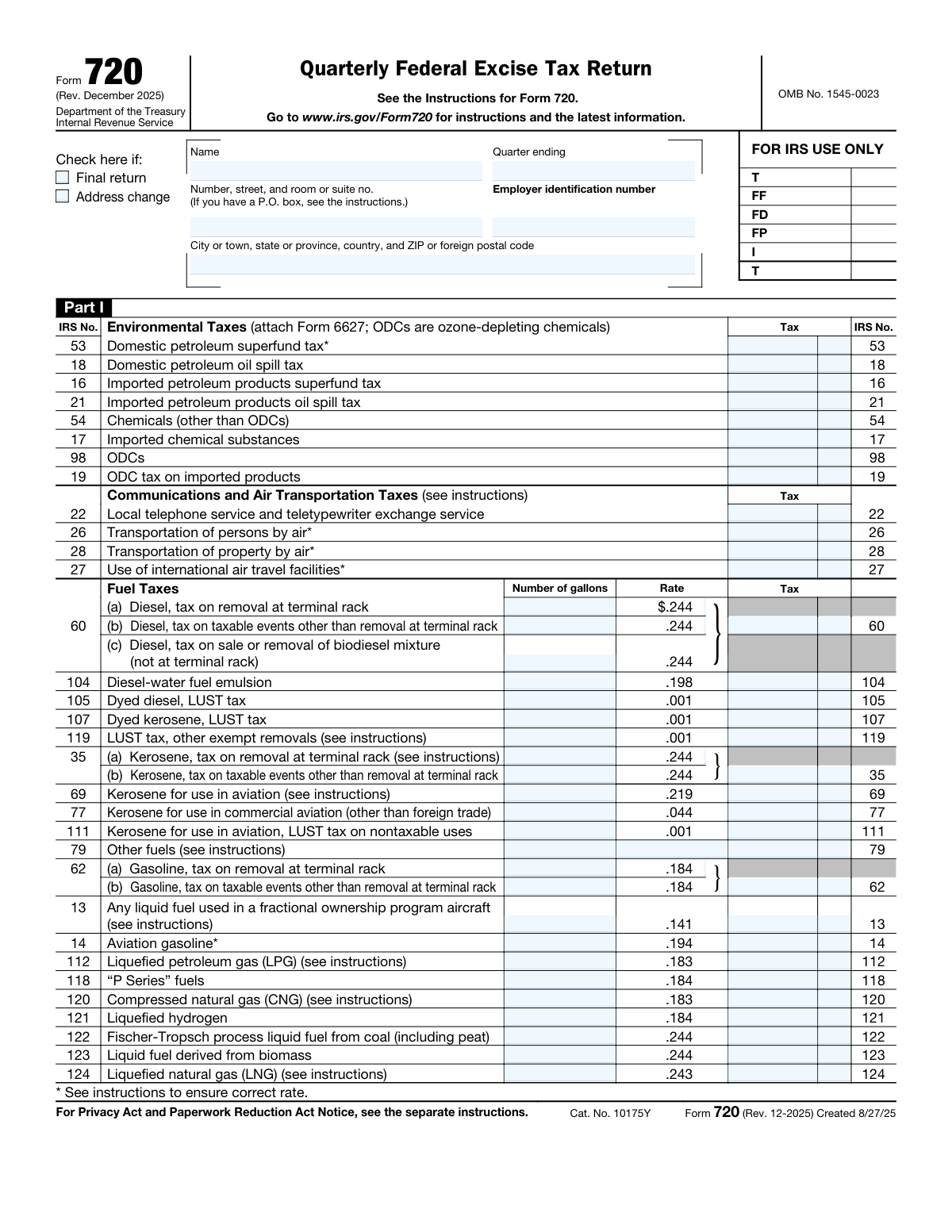
- Form 720 (Quarterly Federal Excise Tax Return) — Use this if your business sells or manufactures specific goods and services subject to federal excise taxes, such as fuel, tobacco, air transportation, or certain environmental products. This is not a payroll form — it's for product/service-based excise tax obligations.
For Correcting a Previously Filed Form 941
- Form 941-X (Rev. April 2023) — If you already filed a Form 941 and need to fix an error — such as incorrect wages, withholding amounts, or Social Security/Medicare taxes — file Form 941-X. You'll need to decide whether to submit it as an adjustment (credit applied to a future return) or a claim for refund, depending on your situation.
Quick Decision Summary
| Situation | Form to Use |
|---|---|
| Reporting current quarter payroll taxes | Form 941 (Rev. March 2025) |
| Reporting excise taxes on goods/services | Form 720 |
| Correcting a previously filed Form 941 | Form 941-X |
Form Comparison
| Form | Purpose | Who Files It | When to Use |
|---|---|---|---|
| Form 720, Quarterly Federal Excise Tax Return | Report and pay federal excise taxes on goods and services | Businesses selling excise-taxable goods or services | Quarterly, for each calendar quarter excise taxes apply |
| Form 941, Employer's Quarterly Federal Tax Return | Report withheld income, Social Security, and Medicare taxes | Employers who pay wages and withhold federal taxes | Quarterly, four times per year for each calendar quarter |
| Form 941-X (Rev. April 2023), Adjusted Employer's QUARTERLY Federal Tax Return or Claim for Refund | Correct errors on a previously filed Form 941 | Employers who made mistakes on a prior Form 941 | After discovering errors on a previously filed Form 941 |
| Form 941, Employer's QUARTERLY Federal Tax Return (Rev. March 2025) | Report wages, withheld taxes, and FICA taxes owed | Most employers paying wages subject to federal taxes | Quarterly starting with tax periods beginning in 2025 |
Tips for quarterly tax forms
Quarterly tax forms cover specific three-month periods, and marking the wrong quarter is a common and costly mistake. Double-check the quarter dates before you begin filling out any form, and make sure your payroll records match that exact period. Mismatched quarters can trigger IRS notices and require amended filings.
Form 941 requires you to reconcile the taxes you've already deposited against what you owe for the quarter. Discrepancies between your deposit records and the amounts reported on the form are a leading cause of IRS penalties. Pull your EFTPS deposit history before you start filling out the form to make this process smoother.
If you discover an error on a previously filed Form 941, resist the temptation to simply refile the original form. The IRS requires you to use Form 941-X to correct mistakes, and you must clearly explain how the correction was calculated. Filing a duplicate original instead of an amended return can create confusion and delay resolution.
When filing Form 941-X, you must choose between filing as an adjustment (which applies the correction to a future return) or as a claim for refund. The choice affects how and when you receive any money owed back to you, so review the instructions carefully before selecting your process. Choosing incorrectly can delay refunds or create additional compliance issues.
Form 720 covers a wide range of goods and services subject to federal excise taxes, and the applicable lines can vary significantly by industry. Maintain detailed records of taxable transactions throughout the quarter so you're not scrambling to reconstruct data at filing time. Organized records also make it easier to respond if the IRS has questions.
AI-powered tools like Instafill.ai can complete quarterly tax forms like Form 941 and Form 720 in under 30 seconds with high accuracy, saving significant time especially when filing every quarter. Your data stays secure throughout the process, making it a trustworthy option for handling sensitive payroll and tax information. For businesses managing multiple forms each quarter, this kind of automation can eliminate hours of manual data entry.
Failure-to-file penalties are typically steeper than failure-to-pay penalties for quarterly tax forms, so always submit your return by the deadline even if you can't pay the full amount owed. The IRS has payment options and installment agreements that can help you manage outstanding balances. Never skip filing just because the funds aren't available.
Your Employer Identification Number (EIN) must match exactly what the IRS has on file — even a single transposed digit can cause your return to be misapplied or rejected. Check your EIN against your IRS confirmation letter rather than relying on memory or copying from a prior return that may itself contain an error. This small step prevents significant processing delays.
Frequently Asked Questions
Quarterly tax forms are IRS documents that businesses and employers file four times a year to report and pay certain federal taxes. Depending on your situation, you may need to file payroll tax returns, excise tax returns, or amended returns. Employers who withhold income taxes or pay wages generally need to file Form 941, while businesses that sell specific goods or services subject to federal excise taxes typically file Form 720.
Form 720 is used by businesses to report and pay federal excise taxes on specific goods and services, such as fuel, tobacco, or air transportation. Form 941, on the other hand, is an employer payroll tax return used to report wages paid, federal income tax withheld, and Social Security and Medicare taxes. The two forms serve different tax obligations and are filed by different types of businesses.
As the name suggests, these forms are filed four times per year — once for each quarter of the calendar year. The quarters generally cover January–March, April–June, July–September, and October–December. Filing deadlines typically fall about a month after the end of each quarter, though you should verify exact due dates on the IRS website.
Form 941-X is an amended return used to correct errors made on a previously filed Form 941. If you discover mistakes in reported wages, withheld taxes, Social Security, Medicare amounts, or certain credits after you've already submitted a Form 941, you should file Form 941-X for that specific quarter. You cannot simply refile a corrected Form 941 — the IRS requires the dedicated amendment form.
Most quarterly federal tax forms are submitted directly to the IRS, either by mail or electronically through the IRS e-file system. The specific mailing address or e-file method can vary based on your business location and whether you are including a payment. The IRS website provides up-to-date submission instructions for each form.
Yes — AI-powered tools like Instafill.ai can fill out quarterly tax forms such as Form 941 and Form 720 in under 30 seconds by accurately extracting and placing data from your source documents. This significantly reduces manual data entry errors and speeds up the filing preparation process. Instafill.ai can also convert non-fillable PDF versions of these forms into interactive, fillable formats.
Manually completing a quarterly tax form can take anywhere from 30 minutes to several hours, depending on the complexity of your payroll or tax situation. Using AI tools like Instafill.ai, the data entry portion can be completed in under 30 seconds, with the AI accurately extracting and populating fields from your existing documents. You would still want to review the completed form before submitting it to the IRS.
To complete Form 941 or similar employer tax returns, you generally need records of total wages paid during the quarter, federal income tax withheld from employee paychecks, and the amounts of Social Security and Medicare taxes owed by both employees and the employer. You may also need information about any tax credits, adjustments, or deposit amounts already paid to the IRS during the quarter.
Yes, the IRS can assess penalties for late filing, late payment, or inaccurate reporting on quarterly tax forms. Penalty amounts can vary based on how late the filing is and the amount of tax owed. Filing amended returns like Form 941-X promptly when errors are discovered can help reduce potential penalties and interest.
Whether a small business or sole proprietor needs to file quarterly tax forms depends on whether they have employees and the nature of their business activities. Employers with employees generally must file Form 941 regardless of business size. Sole proprietors without employees typically do not file Form 941, but may have separate estimated tax obligations. Businesses dealing in excise-taxable goods or services may also need to file Form 720.
The IRS periodically revises Form 941, and you should always use the version that corresponds to the quarter you are filing for. For example, the March 2025 revision of Form 941 applies to reporting periods beginning in 2025. Using an outdated version of the form may result in processing delays or rejection by the IRS.
Yes, the IRS encourages and in some cases requires electronic filing of quarterly tax forms, particularly for larger employers. Many payroll software providers and tax preparation services support e-filing for Form 941 and Form 720. Electronic filing is generally faster, provides confirmation of receipt, and reduces the risk of errors compared to paper filing.
Glossary
- Form Complexity Index
- Instafill’s 0–100 measure of how much effort a form takes to complete, calculated deterministically from the form’s own structure rather than estimated. It combines the number of fillable fields (the largest factor), how difficult those fields are to complete based on their type, the number of pages that contain fields, the amount of conditional “fill-only-if” logic, and how many sections the form is divided into, then adds modifiers for tables and repeating lists, bundled instruction pages, and dense page layouts. A higher score means the form is harder to fill out by hand. The forms in this category have a median Form Complexity Index of 72/100 (Complex). See exactly how it is calculated.
- FICA Taxes
- Federal Insurance Contributions Act taxes, which include both Social Security and Medicare taxes. Both employers and employees each pay a share, and employers report and remit these amounts quarterly on Form 941.
- Withholding
- The portion of an employee's wages that an employer deducts from each paycheck and sends directly to the IRS on the employee's behalf to cover federal income tax and FICA obligations.
- Excise Tax
- A federal tax imposed on the sale or use of specific goods and services, such as fuel, tobacco, alcohol, and air transportation. Businesses that deal in these goods or services report and pay excise taxes quarterly using Form 720.
- Deposit Schedule
- The IRS-assigned timetable (monthly or semi-weekly) that determines how often an employer must deposit withheld payroll taxes. The schedule is based on the total tax liability reported in a prior lookback period.
- Lookback Period
- A 12-month period (July 1 through June 30 of the prior year) the IRS uses to determine an employer's payroll tax deposit schedule for the current year.
- Tax Liability
- The total amount of federal taxes an employer owes for a given quarter, including withheld income taxes and both the employer's and employees' shares of Social Security and Medicare taxes.
- Adjustment vs. Claim (Form 941-X)
- Two distinct processes for correcting a previously filed Form 941. An adjustment applies the correction as a credit toward a future tax period, while a claim requests a direct refund or abatement of the overcollected or overpaid amount.
- EIN (Employer Identification Number)
- A unique nine-digit number assigned by the IRS to identify a business entity for tax reporting purposes. It is required on all quarterly tax forms, including Form 941 and Form 720.
- Trust Fund Taxes
- Taxes withheld from employees' paychecks—specifically federal income tax and the employee share of FICA—that employers hold 'in trust' and are legally required to remit to the IRS. Failure to do so can result in personal liability for responsible parties.