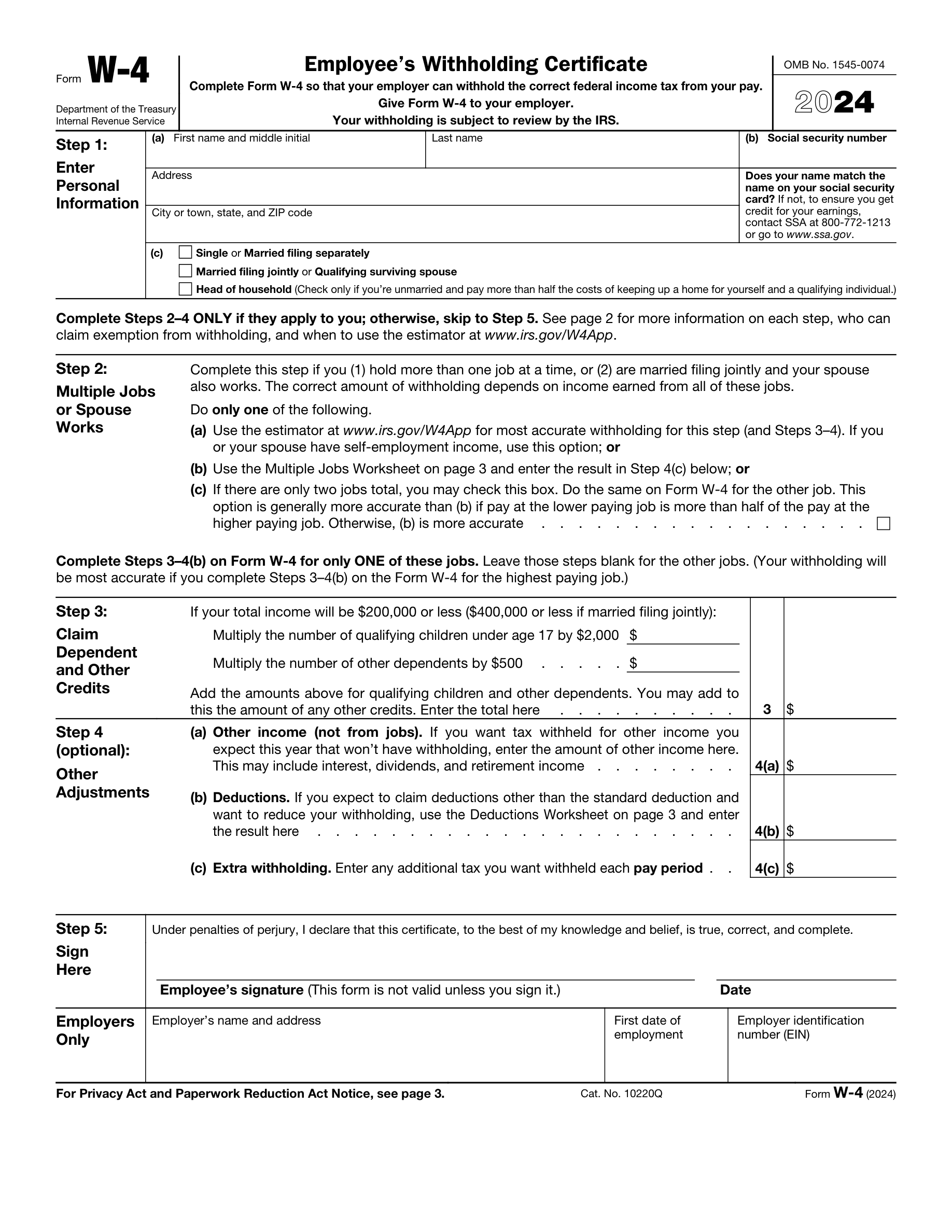
It is crucial to use the exact name as it appears on your social security card when filling out the Employee's Withholding Certificate. Mismatched names can lead to processing delays and potential issues with your tax records. To avoid this mistake, double-check your social security card before completing the form. Ensure that every detail, including middle initials and suffixes, if applicable, is accurately reflected.
Entering an incorrect social security number (SSN) on the Employee's Withholding Certificate can result in significant problems, such as incorrect earnings records and issues with your tax return. To prevent this error, carefully enter your SSN and verify it against your social security card. If you have recently changed your name, for example, due to marriage or divorce, make sure your social security record is updated before filling out the form.
Selecting the incorrect filing status on the Employee's Withholding Certificate can affect the amount of tax withheld from your wages, potentially leading to underpayment or overpayment of taxes. Review the definitions of each filing status provided in the form's instructions to ensure you make the correct choice. If you are unsure about your filing status, consult with a tax professional or use the IRS Tax Withholding Estimator for guidance.
If you hold more than one job at the same time or are married filing jointly and your spouse also works, it's important to complete Step 2 on the Employee's Withholding Certificate. This step ensures that the correct amount of tax is withheld based on the total income from all jobs. To avoid underwithholding, use the IRS's online Tax Withholding Estimator or the Multiple Jobs Worksheet provided with the form to calculate the correct withholding amount.
Using the Multiple Jobs Worksheet incorrectly can lead to inaccurate withholding amounts. This mistake often occurs when the instructions are not followed carefully or when the information from the highest paying job is not used in the calculations. To avoid this, read the instructions for the Multiple Jobs Worksheet thoroughly and use the figures from your highest paying job when completing the worksheet. If you are unsure about how to fill it out, consider seeking assistance from a tax professional.
Incorrectly claiming dependents in Step 3 can lead to inaccurate withholding, affecting the employee's tax liability. It is crucial to understand the eligibility criteria for claiming dependents as outlined by the IRS. Taxpayers should review the requirements for dependents, such as relationship, age, and residency tests, before completing this section. To avoid this mistake, double-check the IRS guidelines for dependents and ensure that all information matches the criteria before claiming them on the form.
Miscalculating the credits for dependents can result in either overpaying or underpaying taxes. It is important to accurately calculate the credit amount for each qualifying dependent as per the current tax year's guidelines. Taxpayers should use the Child Tax Credit and Credit for Other Dependents Worksheet provided by the IRS to determine the correct amounts. To prevent errors, carefully follow the instructions on the worksheet and verify all calculations before entering the amounts on the form.
Failing to include other income in Step 4(a) can lead to underreporting of income and potential penalties. This step is designed for reporting income that is not subject to withholding, such as interest, dividends, and retirement income. Employees should gather all sources of income and accurately report them in this section. To ensure accuracy, maintain records of all income received throughout the year and consult with a tax professional if there is uncertainty about what constitutes other income.
Neglecting to use the Deductions Worksheet for additional deductions can result in a missed opportunity to reduce taxable income. This worksheet helps employees calculate itemized deductions or other adjustments to income. Before completing this step, review the instructions for the Deductions Worksheet and determine if itemized deductions are more beneficial than the standard deduction. To avoid this mistake, carefully itemize and calculate deductions according to the worksheet's guidelines and include them on the form if they exceed the standard deduction.
Entering an incorrect amount of additional tax to withhold in Step 4(c) can cause discrepancies in the employee's tax withholding. This step allows employees to specify an additional withholding amount per pay period. To avoid errors, consider using the IRS Tax Withholding Estimator or consult with a tax professional to determine the appropriate additional withholding amount. Ensure that the specified amount aligns with your tax liability goals, such as avoiding a large tax bill or receiving a smaller refund.
The Employee's Withholding Certificate requires a signature and date to be considered valid. A missing signature or date can lead to the form being rejected or not processed, which may result in incorrect tax withholding. To avoid this mistake, double-check the form before submission to ensure that all required fields, including the signature and date, are completed. It is also advisable to review the form for accuracy and completeness as a final step.
Each section of the Employee's Withholding Certificate provides important information for accurate tax withholding. Failing to complete all relevant sections can lead to incorrect withholding amounts and potential tax liabilities. To prevent this, carefully read the instructions for each step and provide all necessary information. If unsure about how to fill out a section, seek guidance from a tax professional or the IRS resources available online.
To claim exemption from withholding, the word 'Exempt' must be written below Step 4(c) on the Employee's Withholding Certificate. Omitting this step can result in the exemption not being recognized and taxes being withheld. Employees who qualify for exemption should ensure they follow the instructions precisely and verify that 'Exempt' is clearly written on the form. It is also important to remember that claiming exemption applies only if the employee meets certain conditions, which should be reviewed annually.
Tax laws and forms are subject to change, and using an outdated Employee's Withholding Certificate, especially when claiming exemption, can lead to processing delays or errors. To avoid this, always use the most current form available from the IRS website. Check the form's revision date, usually located in the top left corner, to ensure it is the latest version. Additionally, exemptions must be claimed each year by February 15, so timely submission of the updated form is crucial.
The Employee's Withholding Certificate requires accurate personal information that matches the records of the Social Security Administration (SSA). Discrepancies between the form and SSA data can cause issues with tax records and potential mismatches. To prevent this, employees should update their personal information with the SSA, such as name changes due to marriage or divorce, before completing the form. Regularly checking and updating personal information with the SSA ensures smooth processing of tax-related documents.
Providing an incorrect address, city, or ZIP code on the Employee's Withholding Certificate can lead to significant issues, such as delayed or misdirected correspondence and tax documents. To avoid this mistake, double-check the accuracy of your address information against a recent utility bill or bank statement before submitting the form. Ensure that all details are current and correctly spelled. If you have recently moved, update your records with the USPS and other relevant institutions to ensure consistency across all documents.
Failing to check the correct box for multiple jobs in Step 2(c) can result in inaccurate withholding, potentially leading to an unexpected tax bill or a smaller refund. To prevent this error, carefully read the instructions for Step 2(c) if you hold more than one job at the same time or are married filing jointly with a working spouse. Use the IRS's Tax Withholding Estimator or the Multiple Jobs Worksheet provided with the form to determine the appropriate box to check. Regularly review your withholding whenever there is a change in employment to ensure it remains accurate.
If you claim exemption from withholding on the Employee's Withholding Certificate, you must submit a new Form W-4 by February 15, 2025, to maintain your exempt status. Neglecting to do so may result in tax being withheld from your paycheck when it is not necessary. To avoid this oversight, set a reminder at the start of each year to review your withholding status and submit a new Form W-4 if your exemption will continue. Keep a record of when you claim exemption and be proactive in understanding the IRS guidelines regarding exemption qualifications.