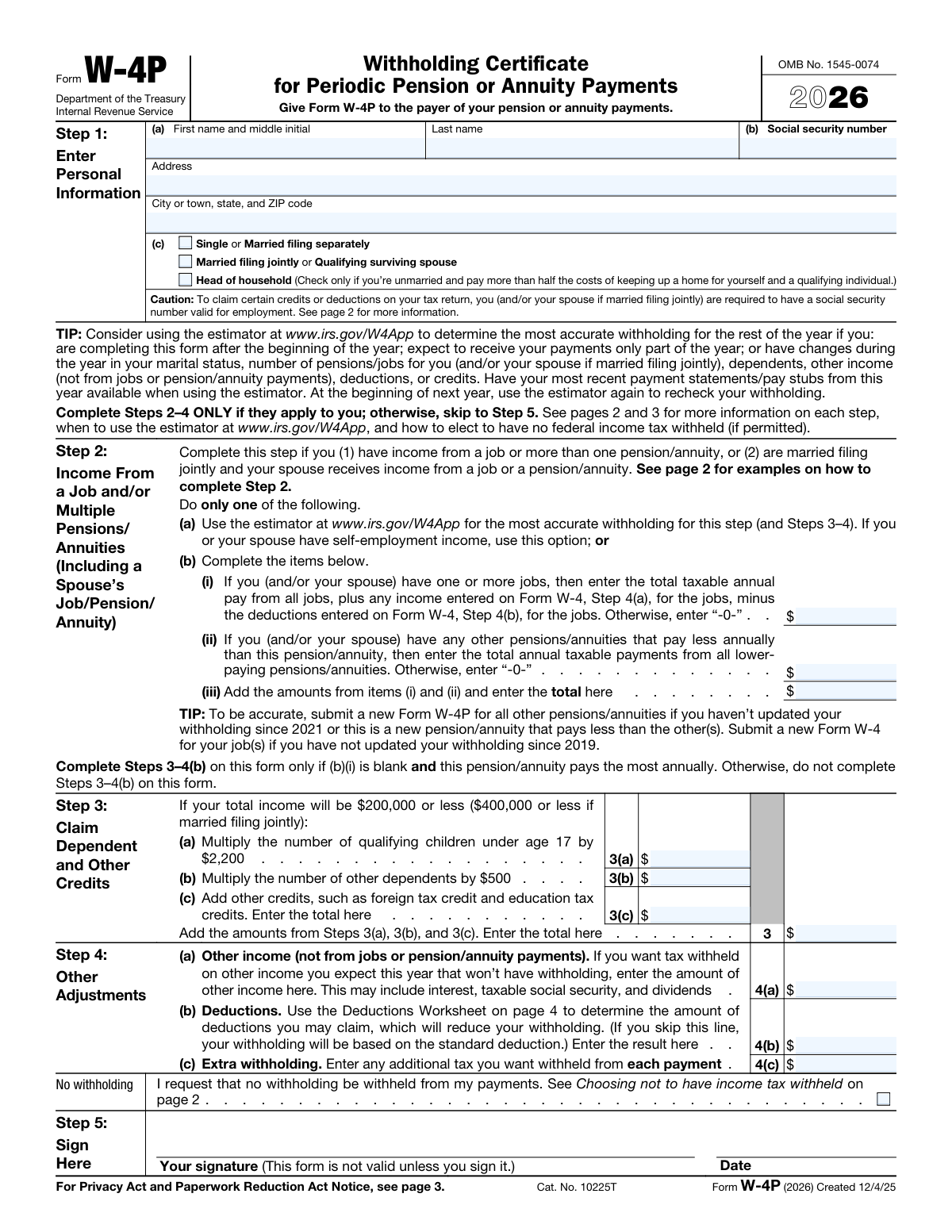
Yes! You can use AI to fill out Form W-4P, Withholding Certificate

Form W-4P, officially titled 'Withholding Certificate for Periodic Pension or Annuity Payments', is used by recipients of pensions, annuities, and other similar payments to specify the correct amount of federal income tax to be withheld from their distributions. It is important to fill out to ensure the correct tax is withheld and to avoid owing tax when filing a return.
Our AI automatically handles information lookup, data retrieval, formatting, and form filling.
It takes less than a minute to fill out W-4P using our AI form filling.
Securely upload your data. Information is encrypted in transit and deleted immediately after the form is filled out.

Form specifications

Form name: Form W-4P, Withholding Certificate
Form issued by: Internal Revenue Service
Number of fields: 24
Number of pages: 3
Version: 2025
Official download URL: https://www.irs.gov/pub/irs-pdf/fw4p.pdf
Language: English
main-image

Instafill Demo: filling out a legal form in seconds

How to Fill Out W-4P Online for Free in 2025

Are you looking to fill out a W-4P form online quickly and accurately? Instafill.ai offers the #1 AI-powered PDF filling software of 2025, allowing you to complete your W-4P form in just 37 seconds or less.
Follow these steps to fill out your W-4P form online using Instafill.ai:
  1. 1 Visit instafill.ai site and select W-4P
  2. 2 Enter personal information
  3. 3 Specify income from jobs or pensions
  4. 4 Claim dependents and other credits
  5. 5 Adjust for other income, deductions
  6. 6 Choose extra withholding if desired
  7. 7 Sign and date the form electronically
  8. 8 Check for accuracy and submit form

Our AI-powered system ensures each field is filled out correctly, reducing errors and saving you time.

Why Choose Instafill.ai for Your Fillable W-4P Form?

Speed

Complete your W-4P in as little as 37 seconds.

Up-to-Date

Always use the latest 2025 W-4P form version.

Cost-effective

No need to hire expensive lawyers.

Accuracy

Our AI performs 10 compliance checks to ensure your form is error-free.

Security

Your personal information is protected with bank-level encryption.

Frequently Asked Questions About Form W-4P

Form W-4P, officially titled 'Withholding Certificate for Pension or Annuity Payments,' is used by recipients of pensions, annuities, and certain other deferred compensation to tell payers the correct amount of federal income tax to withhold from their payments. The form is similar to Form W-4, which is used by employees to set withholding levels for wage income. Form W-4P is specifically designed for non-wage income that comes from retirement benefits.

Form W-4P needs to be completed by recipients of pensions, annuities, and certain other deferred compensation plans who want to adjust their federal income tax withholding. This includes individuals who receive payments from private or public pension plans, profit-sharing plans, annuities, and certain other deferred compensation plans. It is not required for Social Security and railroad retirement payments, as the withholding for these payments is handled using a different form, Form W-4V.

In Step 1 of Form W-4P, the recipient is required to provide personal information. This includes their full name, Social Security Number (SSN), address, and filing status (such as single, married filing jointly, married filing separately, head of household, or qualifying widow(er)). This step is crucial as it identifies the taxpayer and their basic tax filing situation to the payer for accurate withholding.

To determine the most accurate withholding for pension or annuity payments, you can use the IRS's Tax Withholding Estimator tool available online, which helps you estimate your taxes and determine the appropriate withholding. Additionally, you can refer to the instructions provided with Form W-4P and the accompanying tax tables to calculate the amount of federal income tax to withhold. It's important to consider all sources of income, deductions, and credits to ensure the correct amount is withheld, thereby avoiding underpayment penalties or a large tax bill at the end of the year.

If you have income from a job or multiple pensions/annuities, you should account for all sources of income when determining your withholding. You can allocate your withholding among the different sources of income in a way that suits your tax situation. It may be helpful to use the IRS's Tax Withholding Estimator or consult with a tax professional to determine the appropriate withholding amounts for each source of income. You will need to submit a separate Form W-4P to each payer of your pension or annuity payments and adjust your withholding on Form W-4 with your employer if you also have wage income.

Yes, you can choose not to have federal income tax withheld from your pension or annuity payments by submitting Form W-4P and selecting the appropriate option. However, if you choose not to withhold taxes, you may be responsible for paying estimated taxes, and you could incur penalties if the correct amount of tax is not paid throughout the year.

You might owe a penalty for underwithholding if the total amount of federal income tax withheld from your pension, annuity, and other income is not sufficient to cover the taxes you owe. Penalties can occur if you do not pay enough tax throughout the year, either through withholding or by making estimated tax payments. Generally, you may avoid a penalty if you pay at least 90% of the tax for the current year or 100% of the tax shown on your return for the prior year, whichever is smaller.

You should use the IRS Tax Withholding Estimator mentioned in Form W-4P if you want to ensure that the amount of federal income tax withheld from your pension or annuity is accurate. This is particularly useful if you have multiple sources of income, complex tax situations, or if you have had a significant life change that affects your tax liability. The estimator will help you determine the correct amount of withholding to avoid underpayment or overpayment of taxes.

If you have self-employment income in addition to your pension or annuity, you may need to adjust the amount of federal income tax withheld from your payments. Self-employment income can increase your overall tax liability, and you may need to account for additional taxes such as self-employment tax. You can use the IRS Tax Withholding Estimator or consult with a tax professional to determine the appropriate withholding amount to cover your total tax liability.

Nonresident aliens and foreign estates should not use Form W-4P. Instead, they are subject to different withholding rules and should use Form W-8BEN, Certificate of Foreign Status of Beneficial Owner for United States Tax Withholding and Reporting (Individuals), or Form W-8BEN-E, Certificate of Status of Beneficial Owner for United States Tax Withholding and Reporting (Entities), to provide the payer with the appropriate information for withholding on payments that are not effectively connected with a U.S. trade or business. They may also need to comply with treaty provisions if a tax treaty exists between the United States and their country of residence.

The IRS provides tax relief for victims of terrorist attacks under the Victims of Terrorism Tax Relief Act of 2001. This act provides several forms of relief, such as excluding from income certain death benefits paid to survivors, payments from the Victims of Terrorism Relief Fund, and disability payments for injuries incurred as a direct result of a terrorist attack. Additionally, the deadline for filing tax returns and paying taxes may be extended for those affected by terrorist attacks. It's important to consult the IRS directly or a tax professional for the specific provisions and eligibility as they may change or require detailed personal information.

If you receive multiple pensions or annuities, you must submit a separate Form W-4P to each payer. You can choose the amount of federal income tax to be withheld from each payment by specifying the number of allowances and any additional amount you want withheld on each form. It's important to consider the total amount of your income from all sources when determining your withholding amounts to avoid underpayment of taxes.

The eligibility requirements for the child tax credit include having a qualifying child under the age of 17 who has a valid Social Security number, and you must provide at least half of their support and claim them as a dependent on your tax return. The credit for other dependents applies to dependents who do not qualify for the child tax credit, such as older children or qualifying relatives. Income thresholds and phase-outs apply to these credits, so it's important to review the current tax year's IRS guidelines or consult with a tax professional for specific eligibility criteria.

In Step 4(a) of Form W-4P, you should include any additional income you expect to receive that is not subject to withholding, such as interest, dividends, and retirement income. This step helps you to account for the additional income in your withholding calculations so that you can pay the correct amount of tax throughout the year and avoid owing a large balance or incurring penalties at tax time.

To calculate deductions to reduce your withholding on Form W-4P, you should estimate the total amount of deductions that exceed the standard deduction for the year. These may include itemized deductions such as mortgage interest, state and local taxes, charitable contributions, and medical expenses. You would enter this information in Step 4(b) of Form W-4P. By accounting for these deductions, you can reduce the amount of income subject to withholding, which in turn reduces the amount of tax withheld from your pension or annuity payments.

Yes, you can specify an additional amount to be withheld from each pension payment on Form W-4P. On the form, there is a section where you can indicate the extra amount you want to be withheld from each payment. This allows you to tailor your withholding to better match your expected tax liability.

If you do not give Form W-4P to your payer, or if you provide incorrect information, the payer may withhold tax at the default rate as if you are married and claiming three withholding allowances. This may result in either too much or too little tax being withheld from your payments, potentially leading to a tax bill or penalty at the end of the year.

The purpose of the Deductions Worksheet on Form W-4P is to help you estimate the amount of deductions you expect to claim for the year, other than the standard deduction. This worksheet assists you in determining the correct amount of tax withholding to avoid underpayment or overpayment of tax.

Failing to provide information on Form W-4P can result in your payer withholding tax at an incorrect rate. This could lead to underwithholding, which may result in owing additional tax and possibly incurring penalties at the end of the tax year. Conversely, overwithholding could occur, which would give you a larger refund but reduce your disposable income throughout the year.

More information about estimated tax payments can be found in IRS Publication 505, 'Tax Withholding and Estimated Tax.' This publication provides detailed instructions on how to calculate and make estimated tax payments if you prefer not to have tax withheld from your pension or if you have other income that requires you to pay estimated taxes.

Compliance W-4P
Validation Checks by Instafill.ai

1
Ensures that the first name, middle initial, and last name are properly entered in Step 1(a).
The AI ensures that the first name, middle initial, and last name fields are populated with accurate information in Step 1(a) of Form W-4P. It checks for any typographical errors, ensures that the names match the associated social security number, and verifies that the format adheres to the IRS's requirements. The AI also confirms that no illegal characters are present in the name fields.
2
Confirms that the address, city or town, state, and ZIP code are correctly filled in Step 1(a).
The AI confirms that the address details, including the street address, city or town, state, and ZIP code, are correctly entered in Step 1(a) of Form W-4P. It validates the format of the address, checks for consistency with postal records, and ensures that the state and ZIP code are in agreement. The AI also verifies that the address is a valid and deliverable location.
3
Verifies that the social security number is accurately entered in Step 1(b).
The AI verifies the accuracy of the social security number (SSN) entered in Step 1(b) of Form W-4P. It checks the SSN against the official Social Security Administration format, ensures that it consists of nine digits, confirms that it is not a sequence of repeating or consecutive numbers, and validates that it has not been issued to another individual.
4
Checks that the appropriate filing status box is selected in Step 1(c).
The AI checks that the correct filing status box is selected in Step 1(c) of Form W-4P. It ensures that only one status is selected, that the chosen status is appropriate based on the individual's circumstances, and that it is consistent with the information provided in other sections of the form. The AI also alerts the user if no filing status is selected.
5
Validates the use of the IRS estimator for accurate withholding in Step 2(a).
The AI validates the use of the IRS Tax Withholding Estimator for accurate withholding in Step 2(a) of Form W-4P. It ensures that the taxpayer has used the tool correctly, that the results are entered accurately on the form, and that the withholding amount is consistent with the taxpayer's expected annual income. The AI also checks for any discrepancies between the estimated withholding and the taxpayer's entries on the form.
6
Calculates the total taxable annual pay from all jobs and income in Step 2(b)(i).
Ensures that the total taxable annual pay from all jobs and income sources is accurately calculated in Step 2(b)(i) of Form W-4P. This involves aggregating the income from various sources, such as wages, salaries, and other forms of compensation that the individual expects to receive during the year. The calculation must reflect the current tax year's rates and thresholds. The AI verifies that all income streams are considered and that the total is correctly entered into the form.
7
Summarizes the total annual taxable payments from all lower-paying pensions/annuities in Step 2(b)(ii).
Confirms that the total annual taxable payments from all lower-paying pensions and annuities are summarized in Step 2(b)(ii) of Form W-4P. The AI checks that each pension or annuity is listed and that the annual amounts are accurately reported. It ensures that the summation reflects the correct total of these payments for the year. This step is crucial for determining the appropriate withholding amount for the individual's situation.
8
Computes the combined total of amounts from Step 2(b)(i) and (ii) in Step 2(b)(iii).
Verifies that the combined total of amounts from Step 2(b)(i) and Step 2(b)(ii) is correctly computed in Step 2(b)(iii) of Form W-4P. The AI ensures that the sum of the total taxable annual pay from all jobs and income, along with the total annual taxable payments from lower-paying pensions and annuities, is accurately reflected. This combined total is essential for determining the correct withholding amount for the year.
9
Multiplies the number of qualifying children under age 17 by $2,000 in Step 3(a).
Calculates the total credit for qualifying children under age 17 by multiplying the number of such children by $2,000, as specified in Step 3(a) of Form W-4P. The AI checks the accuracy of the number of qualifying children reported and applies the correct multiplier. This calculation contributes to the determination of the taxpayer's total credits, which will affect the withholding amount.
10
Multiplies the number of other dependents by $500 in Step 3(b).
Determines the total credit for other dependents by multiplying the number of dependents (other than qualifying children under age 17) by $500, as outlined in Step 3(b) of Form W-4P. The AI ensures that the number of dependents is correctly reported and that the appropriate multiplier is used. This figure is used to calculate the total credits, which are important for the accurate calculation of the withholding amount.
11
Adds any other credits, such as foreign tax credit and education tax credits, in Step 3(c).
Ensures that any applicable credits, including foreign tax credits and education tax credits, are accurately added in Step 3(c) of Form W-4P. Verifies that the information provided aligns with the taxpayer's eligibility for such credits and that the amounts are correctly calculated. Confirms that the total sum of these credits is reflected in the form to adjust the withholding amount appropriately. Validates that no eligible credits are omitted, ensuring the taxpayer's withholding is as accurate as possible.
12
Aggregates the amounts for qualifying children, other dependents, and other credits in Step 3(d).
Calculates the total amount by aggregating the tax credits for qualifying children, other dependents, and any additional credits in Step 3(d) of Form W-4P. Ensures that each credit is properly accounted for and that the aggregation accurately reflects the sum of these amounts. Checks for the correct application of the Child Tax Credit and Credit for Other Dependents as applicable. Confirms that the aggregated amount is used to determine the correct withholding amount for the taxpayer.
13
Inputs the amount of other income not from jobs or pension/annuity payments in Step 4(a).
Inputs and verifies the amount of other income that is not derived from jobs or pension/annuity payments in Step 4(a) of Form W-4P. Ensures that this income is accurately reported and includes any interest, dividends, or other taxable income that the taxpayer expects to receive. Confirms that this additional income is considered when calculating the withholding amount. Validates that the inputted amount is correct to prevent underwithholding or overwithholding of taxes.
14
Enters the result from the Deductions Worksheet in Step 4(b) if itemizing deductions.
Enters the result from the Deductions Worksheet into Step 4(b) of Form W-4P when the taxpayer is itemizing deductions. Ensures that the deductions are accurately calculated and that the worksheet result is correctly transferred to the form. Verifies that the taxpayer's itemized deductions are properly accounted for in the withholding calculation. Confirms that the correct amount is used to adjust the withholding, reflecting the taxpayer's expected deductions for the year.
15
Confirms that any additional tax the taxpayer wants withheld from each payment is entered in Step 4(c).
Confirms that any additional amount of tax the taxpayer wishes to have withheld from each pension or annuity payment is entered in Step 4(c) of Form W-4P. Verifies that the additional withholding amount is clearly specified and correctly recorded on the form. Ensures that this additional tax is taken into account when determining the total withholding for each payment. Validates that the taxpayer's request for additional withholding is accurately reflected to meet their tax liability or preferences.
16
Ensures that the form is signed and dated in Step 5(a) to validate it
The AI software ensures that the Withholding Certificate, Form W-4P, is properly signed and dated by the payee in Step 5(a), as this is a critical requirement for the form's validity. It verifies that the signature field is not left blank and that an authentic signature, whether digital or handwritten, is present. Additionally, the software confirms that the date next to the signature is current and correctly formatted, typically in a month/day/year format. The system also checks that the date of signature aligns with the date of form completion to prevent any post-dated or pre-dated submissions.

Common Mistakes in Completing W-4P

Not signing and dating the form in Step 5

The completion of Form W-4P requires a signature and date in Step 5 to validate the document. An unsigned or undated form may not be processed, leading to potential withholding issues. To avoid this mistake, individuals should double-check that they have signed and dated the form before submission. It is also advisable to review all steps for completeness as a final check before signing.

Failing to enter personal information in Step 1

Entering personal information in Step 1 is crucial for the identification of the taxpayer. Neglecting to provide this information can result in processing delays or incorrect withholding. Taxpayers should ensure that all required fields in Step 1, including name, address, and other pertinent details, are filled out accurately. A careful review of personal details for accuracy can prevent issues with tax withholding.

Omitting social security number in Step 1(b)

The social security number (SSN) is a critical identifier on Form W-4P and must be provided in Step 1(b). Failure to include the SSN can lead to improper processing of the form. Taxpayers should take special care to enter their SSN correctly and verify that it is legible. It is recommended to cross-reference the SSN with an official document to ensure accuracy before submitting the form.

Incorrect filing status in Step 1(c)

Selecting the correct filing status in Step 1(c) is essential for accurate tax withholding. An incorrect filing status can affect the amount of tax withheld from pension or annuity payments. Taxpayers should review their current tax situation to determine the appropriate filing status. If there is any uncertainty, consulting with a tax professional or referring to IRS guidelines can help in making the correct selection.

Not using the IRS estimator for multiple pensions

For individuals with multiple pensions, it is recommended to use the IRS Tax Withholding Estimator to accurately determine the amount to be withheld. Not using this tool can result in under- or over-withholding of taxes. To avoid this mistake, individuals should access the IRS Estimator online, input all necessary information regarding their pensions, and follow the guidance provided. Keeping records of the estimator's results can assist in future tax planning and verification.

Miscalculating total taxable annual pay in Step 2(b)(i)

This mistake occurs when individuals inaccurately calculate their total taxable annual pay, which can lead to incorrect withholding amounts. To avoid this error, carefully review all sources of income and use the appropriate IRS worksheet or calculator to determine the correct total. Ensure that all income is accounted for, including wages, interest, dividends, and any other taxable income. Double-check your calculations and consider consulting with a tax professional if you are unsure about the correct amounts to include.

Incorrectly reporting lower-paying pensions in Step 2(b)(ii)

Failing to accurately report lower-paying pensions can result in improper withholding. It is important to list all pensions, regardless of the amount, to ensure the correct withholding rate is applied. Review the instructions for Step 2(b)(ii) carefully and include all pensions, even those that may seem insignificant. Verify the amounts with your pension statements and update the form if there are any changes to your pension income during the year. If you have multiple pensions, consider using the IRS's multiple pensions/more-than-one-income worksheet.

Not adding incomes correctly in Step 2(b)(iii)

When completing Step 2(b)(iii), it is crucial to add all sources of income accurately to determine the correct withholding. To prevent this mistake, list each source of income separately and then sum them up. Use a calculator to ensure that the addition is correct, and cross-reference your totals with your financial statements or pay stubs. If you have a complex income situation, you may want to use tax software or consult with a tax advisor to help you with the calculations.

Incorrectly multiplying qualifying children in Step 3(a)

This error occurs when the number of qualifying children is multiplied incorrectly, affecting the withholding calculations. To avoid this, confirm the number of qualifying children you have according to IRS guidelines. Use the worksheet provided with Form W-4P to calculate the correct multiplier for your qualifying children. Double-check your math and ensure that you are using the current year's tax credit amounts. If you are uncertain about your eligibility or the calculation, seek guidance from the IRS or a tax professional.

Incorrectly multiplying other dependents in Step 3(b)

Incorrectly multiplying the credit for other dependents can lead to inaccurate withholding. Make sure to understand the criteria for other dependents as defined by the IRS. Use the worksheet provided to calculate the correct amount for other dependents. Verify that you are using the correct tax year's credit amounts and that you have included all eligible dependents. If the number of dependents changes, remember to update this information on your Form W-4P to reflect the correct withholding amount.

Forgetting to add other credits in Step 3(c)

Taxpayers often overlook the inclusion of other credits in Step 3(c) of Form W-4P, which can lead to inaccurate withholding and potential underpayment of taxes. To avoid this mistake, carefully review your eligibility for credits such as education credits, the foreign tax credit, or the child and dependent care credit. Ensure that you consult the instructions for Form W-4P or seek guidance from a tax professional to accurately determine and include all applicable credits in this step.

Not entering the total of credits correctly in Step 3(d)

Incorrectly entering the total of credits in Step 3(d) can result in the wrong amount of tax being withheld from your pension or annuity payments. Double-check your calculations and ensure that you accurately add up all the credits from Step 3(c) to report the correct total in Step 3(d). It may be helpful to use a calculator or tax software to assist with the arithmetic, and always cross-verify with the instructions provided in the form.

Not reporting other income in Step 4(a)

Failing to report other income in Step 4(a) can lead to underwithholding, which might result in owing taxes when you file your return. Remember to include income from sources such as dividends, interest, and retirement accounts that do not have withholding. Accurately reporting all sources of income will help ensure the correct amount of tax is withheld. Keep records of all income sources and consult with a tax advisor if you are unsure about what constitutes other income.

Not using the Deductions Worksheet for Step 4(b)

Many taxpayers do not utilize the Deductions Worksheet for Step 4(b), which can result in a less accurate withholding amount. If you plan to itemize deductions or claim adjustments to income on your tax return, use the Deductions Worksheet to determine the correct withholding amount. This step is crucial for those with significant deductions that exceed the standard deduction amount. Review the instructions for Form W-4P and take the time to complete the worksheet accurately.

Failing to enter additional tax to withhold in Step 4(c)

Some individuals neglect to enter the additional tax they want withheld in Step 4(c). This oversight can lead to insufficient tax withholding and a possible tax bill at the end of the year. To prevent this, consider any additional tax you may owe and specify the amount you want withheld on your Form W-4P. Regularly review your tax situation, especially if you have multiple sources of income or complex tax scenarios, and adjust your withholding as necessary.

Writing 'No Withholding' without completing required steps

Taxpayers may incorrectly write 'No Withholding' on Form W-4P without fulfilling the necessary conditions to qualify for exemption from withholding. To avoid this mistake, individuals should carefully review the eligibility criteria for claiming exemption as outlined in the form's instructions. If unsure, consulting with a tax professional can provide clarity. It is essential to complete all the required steps and accurately determine withholding status to prevent underpayment penalties.

Using Form W-4P for nonresident aliens or foreign estates

Form W-4P is not intended for use by nonresident aliens or foreign estates, and doing so can lead to improper withholding and reporting of taxes. Nonresident aliens and foreign estates should use the appropriate forms and procedures specific to their tax status. It is recommended to review IRS guidelines or seek advice from a tax expert to ensure the correct forms are used. This will help maintain compliance with tax laws and avoid potential issues with the IRS.

Not completing Steps 3-4(b) for the highest paying source

Failing to complete Steps 3-4(b) on Form W-4P for the highest paying source of income can result in inaccurate withholding. It is crucial to determine which source of income is the highest and complete these steps accordingly to ensure the correct amount of tax is withheld. Taxpayers should review all sources of income, compare them, and then fill out the form for the highest one. Regularly updating this information is also important, especially when there are changes in income levels.

Providing fraudulent information on the form

Deliberately providing false or misleading information on Form W-4P is illegal and constitutes tax fraud. Taxpayers should ensure that all information provided on the form is accurate and truthful. In case of errors or uncertainties, it is advisable to seek guidance from a tax professional or the IRS. Honest and accurate reporting will prevent legal consequences and potential penalties associated with fraudulent activity.

Not updating the form when tax situations change

Taxpayers often neglect to update Form W-4P when their tax situations change, such as after marriage, divorce, or a change in income. It is important to review and revise the form whenever there are significant life or financial changes to ensure the correct amount of tax is withheld. Staying proactive and regularly assessing tax status will help avoid unexpected tax bills or penalties at the end of the year. Taxpayers should mark their calendars as a reminder to review their withholding each year or after major life events.
Saved over 80 hours a year

“I was never sure if my IRS forms like W-9 were filled correctly. Now, I can complete the forms accurately without any external help.”

Kevin Martin Green

Your data stays secure with advanced protection from Instafill and our subprocessors

Robust compliance program

Transparent business model

You’re not the product. You always know where your data is and what it is processed for.

ISO 27001, HIPAA, and GDPR

Our subprocesses adhere to multiple compliance standards, including but not limited to ISO 27001, HIPAA, and GDPR.

Security & privacy by design

We consider security and privacy from the initial design phase of any new service or functionality. It’s not an afterthought, it’s built-in, including support for two-factor authentication (2FA) to further protect your account.

Fill out W-4P with Instafill.ai

Worried about filling PDFs wrong? Instafill securely fills fw4p forms, ensuring each field is accurate.