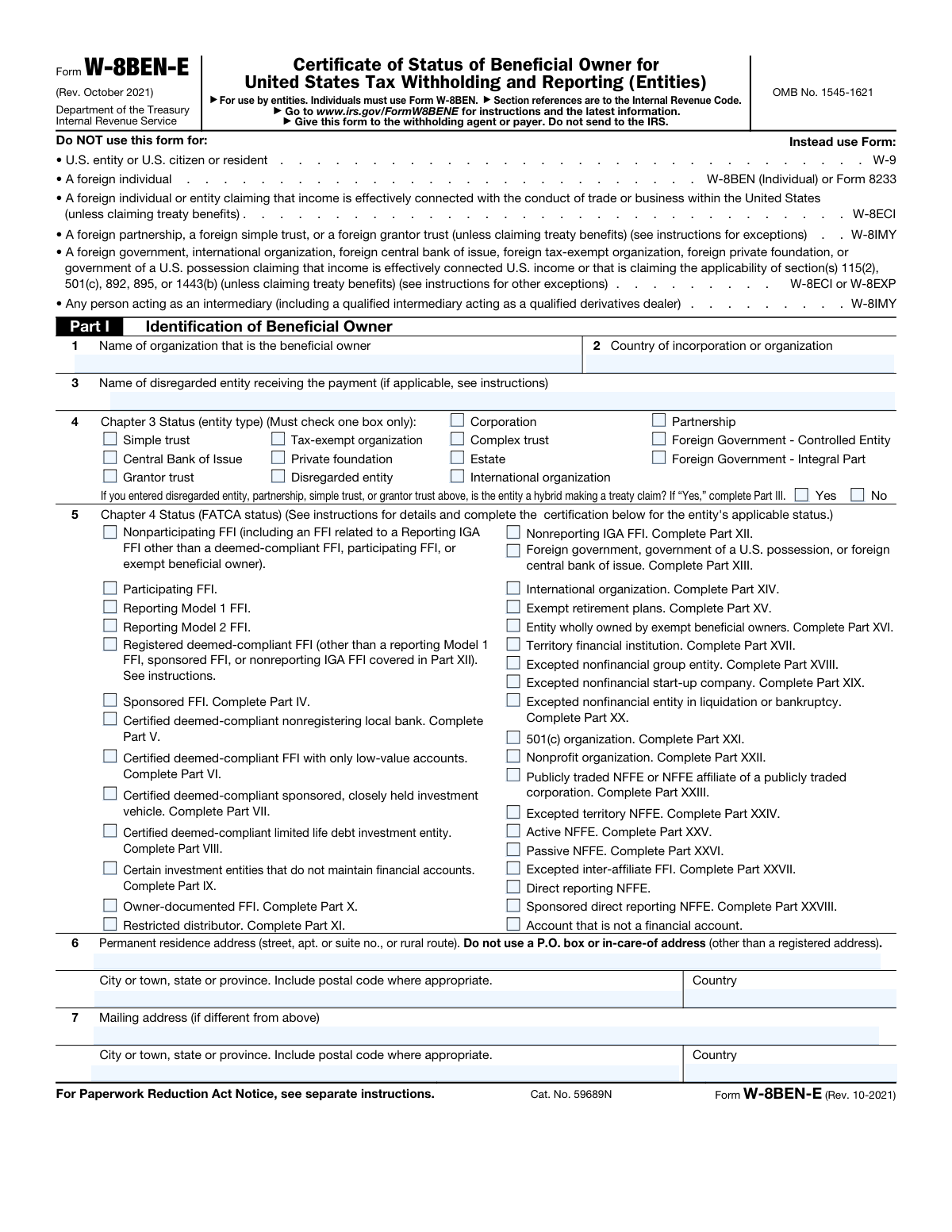
Yes! You can use AI to fill out Form W-8BEN-E, Certificate of Status of Beneficial Owner for United States Tax Withholding and Reporting (Entities)
Form W-8BEN-E is an IRS certificate used exclusively by foreign entities—such as corporations, partnerships, trusts, and other organizations—to establish their identity, country of incorporation, Chapter 3 entity type, and FATCA (Chapter 4) status for U.S. tax withholding and reporting purposes. It is provided to withholding agents or payers to claim reduced rates of withholding or exemptions under applicable tax treaties and to comply with FATCA requirements. The form is critical for foreign entities receiving U.S.-sourced income, as failure to provide it correctly can result in the maximum withholding tax rate being applied. Today, this form can be filled out quickly and accurately using AI-powered services like Instafill.ai, which can also convert non-fillable PDF versions into interactive fillable forms.
Our AI automatically handles information lookup, data retrieval, formatting, and form filling.
It takes less than a minute to fill out W-8BEN-E using our AI form filling.
Securely upload your data. Information is encrypted in transit and deleted immediately after the form is filled out.
Form specifications
| Form name: | Form W-8BEN-E, Certificate of Status of Beneficial Owner for United States Tax Withholding and Reporting (Entities) |
| Number of pages: | 1 |
| Language: | English |
| Categories: | IRS forms |
Instafill Demo: filling out a legal form in seconds
How to Fill Out W-8BEN-E Online for Free in 2026
Are you looking to fill out a W-8BEN-E form online quickly and accurately? Instafill.ai offers the #1 AI-powered PDF filling software of 2026, allowing you to complete your W-8BEN-E form in just 37 seconds or less.
Follow these steps to fill out your W-8BEN-E form online using Instafill.ai:
- 1 Navigate to Instafill.ai and upload or select Form W-8BEN-E from the available form library to begin the guided filling process.
- 2 Complete Part I (Identification of Beneficial Owner) by entering the organization's legal name, country of incorporation or organization, and the name of any disregarded entity receiving the payment, if applicable.
- 3 Select the appropriate Chapter 3 Status (entity type) by checking exactly one box that describes the organization's legal structure, and if a disregarded entity, partnership, simple trust, or grantor trust is selected, indicate whether the entity is a hybrid making a treaty claim.
- 4 Select the appropriate Chapter 4 Status (FATCA status) by checking the single box that best describes the entity's FATCA classification, and note which additional Parts of the form must be completed based on the selected status.
- 5 Enter the entity's permanent residence address (street, city/town, state/province, postal code, and country), and provide a separate mailing address if it differs from the permanent residence address.
- 6 Complete any additional Parts of the form required by the selected Chapter 3 or Chapter 4 status (e.g., treaty claims in Part III, sponsored FFI details in Part IV, or Active/Passive NFFE certifications in Parts XXV–XXVI).
- 7 Review all entries for accuracy and completeness, then have an authorized representative sign and date the certification before submitting the completed form to the withholding agent or payer—do not send it to the IRS.
Our AI-powered system ensures each field is filled out correctly, reducing errors and saving you time.
Why Choose Instafill.ai for Your Fillable W-8BEN-E Form?
Speed
Complete your W-8BEN-E in as little as 37 seconds.
Up-to-Date
Always use the latest 2026 W-8BEN-E form version.
Cost-effective
No need to hire expensive lawyers.
Accuracy
Our AI performs 10 compliance checks to ensure your form is error-free.
Security
Your personal information is protected with bank-level encryption.
Frequently Asked Questions About Form W-8BEN-E
Form W-8BEN-E is a Certificate of Status of Beneficial Owner for United States Tax Withholding and Reporting, specifically designed for entities (not individuals). It is used by foreign entities to certify their status to a U.S. withholding agent or payer in order to claim a reduced rate of, or exemption from, U.S. tax withholding under Chapter 3 or FATCA (Chapter 4) rules.
Form W-8BEN-E should be used by foreign entities — such as corporations, partnerships, trusts, and other organizations — that are the beneficial owners of payments subject to U.S. tax withholding. Individuals must use Form W-8BEN instead, and U.S. entities or U.S. citizens/residents should use Form W-9.
You should give the completed Form W-8BEN-E to the withholding agent or payer who is requesting it — do NOT send it directly to the IRS. The withholding agent will use it to determine the appropriate tax withholding rate on payments made to your entity.
Part I requires the legal name of the organization that is the beneficial owner, the country of incorporation or organization, the name of any disregarded entity receiving the payment (if applicable), the entity's Chapter 3 status (entity type), its Chapter 4 FATCA status, and the permanent residence address. A mailing address is also required if it differs from the permanent residence address.
Chapter 3 Status refers to the entity type classification under the Internal Revenue Code for withholding purposes. You must check exactly one box that best describes your organization, such as Corporation, Partnership, Simple Trust, Complex Trust, Grantor Trust, Tax-Exempt Organization, Private Foundation, Estate, Disregarded Entity, Foreign Government, Central Bank of Issue, or International Organization.
Chapter 4 Status refers to your entity's classification under FATCA (Foreign Account Tax Compliance Act), which requires foreign financial institutions and certain non-financial foreign entities to report information about U.S. account holders. Selecting the correct FATCA status determines your entity's compliance obligations and may require completing additional parts of the form (e.g., Part IV through Part XXVIII).
A hybrid entity is one that is treated differently for tax purposes in different countries. You only need to answer the hybrid entity question if you selected Disregarded Entity, Partnership, Simple Trust, or Grantor Trust as your Chapter 3 Status. If your entity is a hybrid making a treaty claim, you must answer 'Yes' and complete Part III of the form.
No, you cannot use a P.O. box or an in-care-of address for the permanent residence address (unless it is a registered address). You must provide the actual street address, apartment or suite number, city, state or province, postal code, and country of the entity's permanent residence.
You should complete the mailing address section (Line 7) only if your mailing address is different from your permanent residence address. If both addresses are the same, you can leave the mailing address section blank.
An FFI (Foreign Financial Institution) is a foreign entity that accepts deposits, holds financial assets for others, or is primarily engaged in investing or trading financial instruments. An NFFE (Non-Financial Foreign Entity) is any foreign entity that is not an FFI. Your entity's classification as an FFI or NFFE determines which Chapter 4 FATCA status box you check and which supplemental parts of the form you must complete.
Generally, a Form W-8BEN-E remains valid for three calendar years after the year in which it is signed, unless a change in circumstances makes any information on the form incorrect. For example, a form signed in 2024 would remain valid through December 31, 2027, unless your entity's status changes before then.
Yes, AI-powered services like Instafill.ai can help you accurately auto-fill Form W-8BEN-E by guiding you through each field and reducing the risk of errors. These tools save time, especially given the form's complexity with its many entity type and FATCA status options.
To fill out Form W-8BEN-E online, visit Instafill.ai, upload or select the form, and the AI will guide you through each section — from entering your organization's name and country of incorporation to selecting the correct Chapter 3 and Chapter 4 statuses. Once completed, you can download and provide the filled form to your withholding agent or payer.
If your PDF version of Form W-8BEN-E is not interactive or fillable, Instafill.ai can convert the flat PDF into an interactive fillable form, allowing you to type directly into the fields digitally. This eliminates the need to print and handwrite the form, making the process faster and more accurate.
If your foreign entity is claiming that income is effectively connected with the conduct of a trade or business within the United States (and is not claiming treaty benefits), you should use Form W-8ECI instead of Form W-8BEN-E. Form W-8BEN-E is not appropriate for that situation unless a treaty benefit is being claimed.
Compliance W-8BEN-E
Validation Checks by Instafill.ai
1
Beneficial Owner Organization Name is Present and Represents a Legal Entity Name
Validates that the Beneficial Owner Organization Name field (Line 1) is not blank and contains a full legal entity name rather than an abbreviated, informal, or individual person's name. This field is critical because the W-8BEN-E is exclusively for entities, and the name must match the entity's official registration documents. If this field is empty or contains an individual's name, the form is invalid and the withholding agent cannot properly identify the beneficial owner for tax withholding and reporting purposes.
2
Country of Incorporation or Organization is a Valid Non-U.S. Country
Validates that the Country of Incorporation or Organization field (Line 2) is populated with a recognized, non-U.S. country name or standard country code. Since the W-8BEN-E is specifically for foreign entities, a U.S. entry in this field would indicate the submitter should instead be using Form W-9. If a U.S. territory or the United States itself is entered, the form must be flagged as incorrect and the submitter redirected to the appropriate form.
3
Exactly One Chapter 3 Status (Entity Type) Box is Selected
Validates that one and only one checkbox is selected among all Chapter 3 Status options in Line 4, as the form explicitly instructs 'Must check one box only.' Selecting multiple entity types creates an ambiguous legal classification that could result in incorrect withholding rates being applied. If no box is checked or more than one box is checked, the form is incomplete or contradictory and must be returned to the submitter for correction.
4
Exactly One Chapter 4 FATCA Status Box is Selected
Validates that one and only one checkbox is selected among all Chapter 4 FATCA Status options in Line 5. The FATCA status determines the entity's compliance obligations and the applicable withholding treatment under Chapter 4 of the Internal Revenue Code. Selecting multiple statuses or leaving this field blank renders the form non-compliant with FATCA requirements, potentially subjecting payments to the default 30% FATCA withholding rate.
5
Hybrid Entity Treaty Claim Answer is Required When Applicable Chapter 3 Status is Selected
Validates that either 'Yes' or 'No' is selected for the hybrid entity treaty claim question whenever the Chapter 3 Status is Partnership, Simple Trust, Grantor Trust, or Disregarded Entity. This question is conditionally required because these entity types may qualify as hybrid entities under a tax treaty, which triggers additional certification requirements in Part III. If one of these entity types is selected but neither Yes nor No is answered, the form is incomplete and the withholding agent cannot determine whether Part III must also be completed.
6
Hybrid Entity Treaty Claim Answer is Not Provided for Non-Applicable Entity Types
Validates that the hybrid entity treaty claim question (Yes/No) is left blank when the selected Chapter 3 Status is not Partnership, Simple Trust, Grantor Trust, or Disregarded Entity. Answering this question for entity types such as Corporation, Estate, or International Organization is not applicable per the form instructions and could create confusion or inconsistency in the form's legal certifications. If an inapplicable entity type is selected alongside a hybrid treaty claim answer, the form should be flagged for review.
7
Hybrid Entity 'Yes' Selection Requires Part III Completion Indicator
Validates that when 'Yes' is selected for the hybrid entity treaty claim question, there is an indication or expectation that Part III of the form will be completed. Selecting 'Yes' without completing Part III means the treaty claim is unsubstantiated, which would invalidate any reduced withholding rate the entity is attempting to claim. This check ensures the form is internally consistent and that the withholding agent is alerted to verify Part III is present and complete.
8
Chapter 4 FATCA Status Requiring Supplemental Part Completion is Flagged
Validates that when a Chapter 4 FATCA status is selected that explicitly requires completion of a specific supplemental Part (e.g., Sponsored FFI requires Part IV, Nonreporting IGA FFI requires Part XII, Passive NFFE requires Part XXVI), the corresponding part is expected to be present and completed. Many FATCA statuses are only valid when accompanied by the required certifications in the designated supplemental part. Selecting such a status without completing the required part renders the FATCA certification incomplete and may result in the entity being treated as a nonparticipating FFI subject to 30% withholding.
9
Permanent Residence Address Street Field Does Not Contain a P.O. Box
Validates that the Permanent Residence Address street field does not contain a P.O. Box entry, as the form explicitly prohibits the use of a P.O. box or in-care-of address (other than a registered address) for the permanent residence address. The permanent residence address must reflect the entity's actual physical location for proper tax jurisdiction determination. If a P.O. Box is detected in this field, the form must be rejected and the submitter instructed to provide a valid street address.
10
Permanent Residence Address Country is a Valid Non-U.S. Country
Validates that the country entered in the Permanent Residence Address section is a recognized foreign country and not the United States. Because the W-8BEN-E is for foreign entities, a U.S. permanent residence address would be inconsistent with the form's purpose and would suggest the entity should be filing Form W-9 instead. If a U.S. address is detected, the form should be flagged and the submitter redirected to the appropriate IRS form.
11
Permanent Residence Address City/State/Province/Postal Code Field is Populated
Validates that the city or town, state or province, and postal code field for the permanent residence address is not left blank. This field provides essential geographic detail needed to confirm the entity's country of residence and to support proper tax treaty analysis and withholding determinations. An incomplete address without city and regional information may prevent the withholding agent from verifying the entity's claimed country of residence.
12
Mailing Address is Only Provided When It Differs from Permanent Residence Address
Validates that the mailing address fields (Line 7) are only completed when the mailing address is genuinely different from the permanent residence address provided in Line 6. If the mailing address fields are populated with an address identical to the permanent residence address, this is redundant and may indicate a data entry error. Conversely, if a mailing address is partially filled (e.g., street provided but country omitted), the incomplete mailing address must be flagged as it could cause correspondence to be misdirected.
13
Mailing Address is Complete When Provided
Validates that when a mailing address is entered in Line 7, all three components are present: the street address line, the city/state/province/postal code line, and the country. A partial mailing address is insufficient for the withholding agent to use for correspondence and may indicate an incomplete form submission. If any one of the three mailing address components is filled while others are blank, the form should be flagged for correction.
14
Disregarded Entity Name is Only Provided When Applicable Chapter 3 Status is Selected
Validates that the Disregarded Entity Name field (Line 3) is only populated when the Chapter 3 Status of 'Disregarded Entity' is selected, or when the payment is being received by a disregarded entity as described in the form instructions. Entering a disregarded entity name while selecting an incompatible entity type such as Corporation or Estate creates a logical inconsistency in the form. If a disregarded entity name is provided but the Chapter 3 Status does not support it, the form should be flagged for review.
15
Chapter 3 Status and Chapter 4 FATCA Status are Logically Consistent
Validates that the selected Chapter 3 entity type and the selected Chapter 4 FATCA status are not mutually contradictory based on IRS definitions. For example, an entity selecting 'International Organization' as its Chapter 3 Status should also select 'International Organization' as its Chapter 4 FATCA status, and an entity selecting 'Corporation' as its Chapter 3 Status should not select a FATCA status that is only available to trusts or governments. Inconsistent combinations between Chapter 3 and Chapter 4 statuses may indicate a misclassification that could lead to incorrect withholding treatment.
16
Form is Not Used by a U.S. Entity, U.S. Citizen, or Foreign Individual
Validates that the form submission does not exhibit characteristics indicating it was submitted by a U.S. entity, U.S. citizen, or a foreign individual, all of whom are explicitly prohibited from using Form W-8BEN-E. Indicators of incorrect form usage include a U.S. country of incorporation, a U.S. permanent residence address, or an individual person's name in the organization name field. If any of these indicators are present, the form must be rejected and the submitter directed to the appropriate form, such as Form W-9 for U.S. entities or Form W-8BEN for foreign individuals.
Common Mistakes in Completing W-8BEN-E
A very common mistake is when foreign individuals attempt to use Form W-8BEN-E instead of the correct Form W-8BEN (for individuals) or Form 8233. This happens because the forms have similar names and people may not read the instructions carefully. Using the wrong form results in rejection by the withholding agent and potential incorrect tax withholding. Always verify that the filer is a foreign entity (corporation, partnership, trust, etc.) before using this form — individuals must use Form W-8BEN instead.
In Line 1, filers often enter a trade name, brand name, or 'doing business as' (DBA) name rather than the full legal name of the beneficial owner organization as it appears in official incorporation or registration documents. This creates a mismatch with IRS records and can cause withholding issues or form rejection. Always use the exact legal name of the entity as registered with the relevant government authority. AI-powered tools like Instafill.ai can help validate that the name entered matches official records.
The form explicitly states that a P.O. box or in-care-of address (other than a registered address) must not be used for the permanent residence address in Line 6. Many filers mistakenly enter a P.O. box because it is the address they use for correspondence. This can cause the form to be rejected or result in incorrect tax treatment. The permanent residence address must be the actual physical street address of the entity's principal place of business or registered office.
Line 4 requires that only one box be checked for Chapter 3 Status (entity type), but filers sometimes check multiple boxes, for example checking both 'Corporation' and 'Tax-exempt organization.' The form clearly states 'Must check one box only,' and selecting multiple boxes invalidates the form. Carefully determine the single entity classification that best describes the beneficial owner under U.S. tax law before completing this section. Tools like Instafill.ai can enforce single-selection validation to prevent this error.
Many Chapter 4 FATCA status options (Line 5) require the filer to also complete a specific supplemental Part of the form (e.g., selecting 'Sponsored FFI' requires completing Part IV, 'Passive NFFE' requires Part XXVI, etc.). Filers frequently check the appropriate FATCA status box but neglect to complete the corresponding Part, rendering the form incomplete and potentially causing withholding at the maximum rate. Always cross-reference the selected FATCA status with its required Part and ensure that Part is fully completed.
The Chapter 4 FATCA status options are numerous and technically complex, and filers often select an incorrect category — for example, confusing 'Active NFFE' with 'Passive NFFE,' or misidentifying an entity as a 'Participating FFI' when it should be a 'Reporting Model 1 FFI.' Selecting the wrong FATCA status can lead to incorrect withholding, IRS penalties, and compliance issues. Entities should consult their tax advisors or legal counsel to confirm their correct FATCA classification before completing this section.
When a filer selects 'Disregarded entity,' 'Partnership,' 'Simple trust,' or 'Grantor trust' as the Chapter 3 Status in Line 4, they are required to answer the hybrid entity treaty claim question (Yes or No) and, if 'Yes,' complete Part III. Many filers overlook this conditional question entirely, leaving it blank, which makes the form incomplete. Failing to answer this question can result in the form being rejected or treaty benefits being denied. Always check whether this question applies based on the selected entity type.
Since Form W-8BEN-E is exclusively for foreign entities, the permanent residence address in Line 6 must be outside the United States. Filers sometimes enter a U.S. office address or U.S. registered agent address, which signals to the withholding agent that the entity may be a U.S. person, potentially invalidating the form and triggering backup withholding. The address provided must reflect the entity's actual foreign country of residence or principal place of business.
Line 2 requires the country where the entity is legally incorporated or organized, but filers sometimes leave it blank, enter the country where the entity operates rather than where it is incorporated, or use a non-standard country name. This information is critical for determining treaty eligibility and FATCA status. The country entered should match the entity's official incorporation documents and should use the full country name or the standard IRS-recognized country name to avoid processing errors.
Line 3 asks for the name of a disregarded entity receiving the payment, which applies only in specific circumstances where a disregarded entity (not the beneficial owner itself) is the direct recipient of the payment. Filers often either leave this blank when it should be completed, or incorrectly enter the beneficial owner's name again. Misuse of this field can cause confusion about who is actually receiving the payment and may affect withholding obligations. Consult the form instructions carefully to determine whether a disregarded entity is involved in the payment chain.
Similar to the Chapter 3 status error, filers sometimes check more than one Chapter 4 FATCA status box in Line 5, for example checking both 'Active NFFE' and 'Passive NFFE.' Only one FATCA status should apply to the entity, and selecting multiple boxes creates an inconsistency that can cause the form to be rejected by the withholding agent. Carefully review the FATCA status definitions in the IRS instructions to identify the single correct classification. AI-powered form tools like Instafill.ai can help enforce single-selection rules and flag conflicting entries.
Form W-8BEN-E is generally valid for three years from the date of signing, but many entities fail to update the form when there is a change in circumstances that makes the information on the form incorrect — such as a change in entity type, FATCA status, country of incorporation, or treaty eligibility. Submitting an outdated or inaccurate form can result in incorrect withholding and potential penalties. Entities should establish an internal review process to ensure the form is updated promptly whenever relevant circumstances change and re-submitted to withholding agents.
Saved over 80 hours a year
“I was never sure if my IRS forms like W-9 were filled correctly. Now, I can complete the forms accurately without any external help.”
Kevin Martin Green
Your data stays secure with advanced protection from Instafill and our subprocessors
Robust compliance program
Transparent business model
You’re not the product. You always know where your data is and what it is processed for.
ISO 27001, HIPAA, and GDPR
Our subprocesses adhere to multiple compliance standards, including but not limited to ISO 27001, HIPAA, and GDPR.
Security & privacy by design
We consider security and privacy from the initial design phase of any new service or functionality. It’s not an afterthought, it’s built-in, including support for two-factor authentication (2FA) to further protect your account.
Fill out W-8BEN-E with Instafill.ai
Worried about filling PDFs wrong? Instafill securely fills form-w-8ben-e-certificate-of-status-of-beneficial-owner-for-united-states-tax-withholding-and-reporting-entities forms, ensuring each field is accurate.