Yes! You can use AI to fill out The Principal Pension Plan Summary Plan Description: Cash Balance Formula for Employees and Individual Field
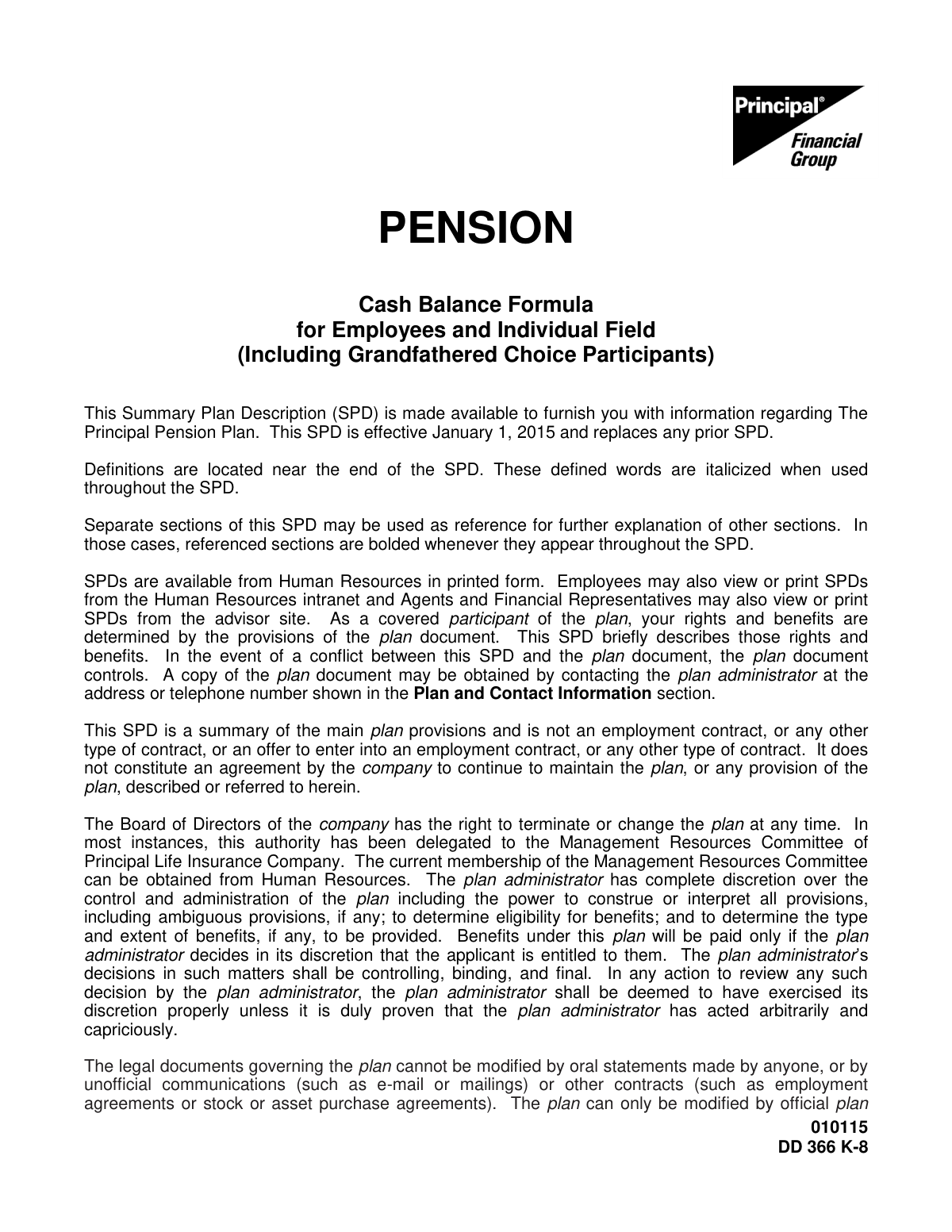
Form DD 366 K-8 is a Summary Plan Description (SPD) for The Principal Pension Plan, explaining the cash balance formula for retirement benefits. It details how pay credits and interest credits are calculated, vesting requirements, and various payment options available to participants. This document is crucial for employees and agents to understand their rights and the value of their pension benefits. Today, this form can be filled out quickly and accurately using AI-powered services like Instafill.ai, which can also convert non-fillable PDF versions into interactive fillable forms.
DD 366 K-8 is part of the
employee forms, pension forms, Principal forms and pension plan forms categories on Instafill.
Rather not fill this in by hand? Instafill is an online form filler that completes PDF forms automatically — upload the blank form, answer a few questions, and the AI fills every field.
Form specifications
| Form name: | The Principal Pension Plan Summary Plan Description: Cash Balance Formula for Employees and Individual Field |
| Number of pages: | 1 |
| Language: | English |
Our AI automatically handles information lookup, data retrieval, formatting, and form filling.
It takes less than a minute to fill out DD 366 K-8 using our AI form filling.
Securely upload your data. Information is encrypted in transit and deleted immediately after the form is filled out.
Instafill Demo: How to fill out PDF forms in seconds with AI
How to Fill Out DD 366 K-8 Online for Free in 2026
Are you looking to fill out a DD 366 K-8 form online quickly and accurately? Instafill.ai offers the #1 AI-powered PDF filling software of 2026, allowing you to complete your DD 366 K-8 form in just 37 seconds or less.
Follow these steps to fill out your DD 366 K-8 form online using Instafill.ai:
- 1 Navigate to Instafill.ai and upload or select the Principal Pension Plan Summary Plan Description document.
- 2 Allow the AI to process the document, identifying key sections like 'Participation,' 'Vesting,' and 'Payment Options' for easy navigation.
- 3 Use the AI-powered interface to review the detailed explanations of the cash balance formula, including pay credits and interest credits.
- 4 Input personal information, such as age and years of service, into the AI tool to estimate potential benefits based on the examples provided in the document.
- 5 Review the sections on 'Death Benefits' and 'Payment Options' to understand the choices available for you and your beneficiaries.
- 6 Add annotations or notes for discussion with a financial advisor or HR representative.
- 7 Securely download, save, or share the completed or annotated document for your personal records.
Our AI-powered system ensures each field is filled out correctly, reducing errors and saving you time.
Why Choose Instafill.ai for Your Fillable DD 366 K-8 Form?
Speed
Complete your DD 366 K-8 in as little as 37 seconds.
Up-to-Date
Always use the latest 2026 DD 366 K-8 form version.
Cost-effective
No need to hire expensive lawyers.
Accuracy
Our AI performs 10 compliance checks to ensure your form is error-free.
Security
Your personal information is protected with bank-level encryption.
Frequently Asked Questions About DD 366 K-8
This document is a Summary Plan Description (SPD) for The Principal Pension Plan. It is for your information only and does not need to be filled out or submitted.
Generally, all eligible employees and agents of Principal Financial Group who are at least 21 years old can participate in the plan. Specific eligibility requirements, such as hours of service for hourly employees, are detailed in the 'Participation' section.
The Cash Balance Formula is used to determine your pension benefit by tracking a hypothetical account. Your account grows through annual 'pay credits' based on your age and service, and 'interest credits' based on a set index.
Being vested means you have earned a non-forfeitable right to your pension benefit, even if you leave the company before retirement. You become vested after completing three years of vesting service or reaching age 65.
If you are vested when you leave, you are entitled to your accrued benefit. Your account will stop receiving pay credits but will continue to earn interest credits until the benefit is paid out, typically starting at age 65 unless you elect otherwise.
The plan offers several payment options, including a single sum payment, a life annuity (payments for your lifetime), and survivorship annuities (payments that continue to a beneficiary after your death).
To initiate a rollover, you should call the Participant Contact Center at (800) 547-7754. If your vested benefit is between $1,000 and $5,000 when you leave the company, it may be automatically rolled into a Principal IRA unless you choose another option.
A Qualified Domestic Relations Order (QDRO) is a legal order that allows a portion of your pension benefit to be paid to an alternate payee, such as a former spouse. The plan has specific procedures and requirements for a domestic relations order to be considered a QDRO.
After you submit your claim, a decision will typically be made within 90 days. If your claim is denied, you have 60 days to file a written appeal.
You can request a copy of the full plan document from the plan administrator or view it at their office. For questions, you can call the Participant Contact Center at (800) 547-7754 or the Human Resources Service Center.
Yes, AI-powered services like Instafill.ai can help you accurately auto-fill fields on related forms, such as benefit claim or rollover applications, saving you time and reducing errors.
You can upload the relevant form, like a claim or rollover application, to the Instafill.ai platform. The AI will identify the fields and help you fill them out quickly and accurately online.
Services like Instafill.ai can convert flat, non-fillable PDFs into interactive, fillable forms. You can then easily type your information directly into the fields before printing or submitting the document.
If you are vested and married for at least one year, your spouse will be entitled to a death benefit, which can be taken as an annuity or a lump sum. If you are single or have a non-spouse beneficiary, they will receive a single lump-sum death benefit equal to your cash balance account.
Compliance DD 366 K-8
Validation Checks by Instafill.ai
1
Validate Social Security Number Format and Requirement
Checks that the Social Security Number (SSN) is provided and follows a valid format (e.g., XXX-XX-XXXX or XXXXXXXXX). This is crucial for uniquely identifying participants, processing benefits, and tax reporting. If the format is invalid or the field is empty, the form submission should be rejected with an error message prompting the user to correct the entry.
2
Verify Participant Age Eligibility for Enrollment
Confirms that the participant is at least 21 years old based on the provided Date of Birth and hire date. The plan specifies age 21 as a minimum requirement for participation. Submissions for individuals under 21 should be flagged for review or automatically rejected to prevent ineligible individuals from being enrolled in the plan.
3
Enforce Chronological Date Integrity
Validates that all key dates are in a logical sequence: Date of Birth must be before the Hire Date, and the Hire Date must be before any Termination or Retirement Date. This check prevents data entry errors that would make service and benefit calculations impossible or incorrect. A failure would require the user to correct the date fields before the form can be processed.
4
Mandate Spousal Consent for Specific Elections
This check ensures that if a married participant selects a payment option other than the '50% survivorship annuity' or names a non-spouse contingent annuitant, a valid spousal consent signature is provided. This is a federal requirement under ERISA to protect spousal rights to pension benefits. Forms lacking the required consent must be returned as incomplete, preventing legal and compliance violations.
5
Require Contingent Annuitant for Survivorship Option
Verifies that if a participant chooses any Survivorship Annuity option (50%, 75%, etc.), they must provide the full details for a contingent annuitant. This is essential because the core feature of this option is the continuation of payments to another person after the participant's death. Failure to provide a contingent annuitant would make the election invalid, and the form should be rejected until the information is supplied.
6
Validate Beneficiary for Life with Certain Period Annuity
Ensures that if a participant elects the 'Life with Certain Period Annuity,' at least one beneficiary is designated. This is necessary to fulfill the 'certain period' guarantee, as payments must continue to a beneficiary if the participant dies before the period ends. A form with this election but no beneficiary would be considered incomplete and require correction.
7
Confirm Minimum Vesting Service for Benefits
Calculates the participant's years of service between their hire date and termination date to confirm they have met the 3-year vesting requirement. This check is fundamental to determining if a terminated participant is entitled to any retirement benefit at all. If the participant is not vested, the system should indicate that their benefit is forfeited, preventing incorrect benefit claims.
8
Apply One-Year Marriage Rule for Spousal Death Benefit
When processing a spousal death benefit claim, this validation confirms the participant was married to the surviving spouse for at least one year prior to death. This rule, as stated in the plan, determines eligibility for specific spousal survivor benefits. Claims not meeting this criterion would be processed under the rules for a non-spouse beneficiary or rejected if no other benefit is due.
9
Trigger Automatic Rollover for Small Balances
This check identifies terminated participants whose vested benefit value is between $1,000 and $5,000. If the participant does not make an affirmative distribution election, the system must flag the account for an automatic rollover into a Principal Bank Safe Harbor IRA. This is a compliance check to adhere to Department of Labor regulations and preserve retirement savings.
10
Verify QDRO Alternate Payee Relationship
When processing a Qualified Domestic Relations Order (QDRO), this validation ensures the designated alternate payee's relationship to the participant is 'spouse,' 'former spouse,' 'child,' or 'other dependent.' The plan can only pay benefits to these specified relations under a QDRO. An order naming an invalid alternate payee cannot be qualified and must be rejected or sent back for legal correction.
11
Flag Compensation Exceeding Annual Limit
This check compares the participant's entered annual compensation against the IRS legal limit for the given year (e.g., $265,000 for 2015). Pay credits are calculated based on compensation, and using a value above the legal limit is prohibited. The system should issue a warning or cap the compensation used for calculations to ensure compliance and prevent over-crediting of benefits.
12
Check Retirement Date Against Normal Retirement Age
Verifies that if a participant is applying for normal retirement, their selected retirement date is on or after they reach age 65. The plan defines the normal retirement date specifically, and this check prevents participants from incorrectly applying for a normal retirement benefit before they are eligible. Applications with a premature retirement date should be flagged for review to determine if an early retirement or termination process is more appropriate.
13
Ensure Logical Disability Date
Validates that a provided date of disability occurs after the participant's hire date and before their termination date. This ensures the disability claim is relevant to the period of employment covered by the plan. An illogical date could indicate a data entry error and must be corrected to properly assess eligibility for disability-related provisions in the pension plan.
14
Validate Payment Option Choice Window
Confirms that the participant's payment option choice is made within the 180-day period prior to their selected retirement date. The plan specifies this window for making an election. Submissions outside this timeframe should be rejected, and the participant should be instructed to resubmit their choice within the valid period.
Common Mistakes in Completing DD 366 K-8
Participants often assume they can designate any beneficiary without consulting their spouse. However, federal law requires a spouse's written, notarized consent to name a non-spouse beneficiary for death benefits. Submitting a form without this consent will render the designation invalid, and the benefit will likely default to the spouse, overriding the participant's stated wishes and causing significant delays.
A standard divorce decree often lacks the specific language required by the plan to be a Qualified Domestic Relations Order (QDRO). The plan document lists explicit requirements, such as full names, addresses, plan name, and the exact method for calculating the benefit split. Submitting a non-compliant order will result in its rejection by the plan administrator, halting the division of assets and requiring costly and time-consuming legal revisions.
Participants must choose a payment option (e.g., lump sum, life annuity) within 180 days of their retirement date. Many people miss this deadline due to procrastination or confusion, causing their pension to be paid out under a default option, which is often a 50% survivorship annuity for married individuals. This choice is irreversible once payments begin and may not align with the retiree's financial goals.
When designating beneficiaries, people may use ambiguous terms like 'my children' or fail to provide full legal names, Social Security numbers, and dates of birth. This lack of specific information can create confusion and legal challenges for the plan administrator when distributing benefits after the participant's death. To prevent disputes and delays, always provide complete and precise details for each primary and contingent beneficiary.
Mistakes on rollover forms, such as entering the wrong receiving account number or confusing a direct vs. indirect rollover, are common. An error can cause the distribution to be treated as a taxable event, triggering mandatory tax withholding and potential penalties. To avoid this, double-check all account details and clearly elect a 'direct rollover' to have funds sent from trustee to trustee. AI-powered tools like Instafill.ai can help validate data formats to prevent such errors.
If a married participant elects any payment option other than the '50% survivorship annuity,' they must obtain their spouse's signed and witnessed consent. Forgetting this step or failing to have the signature properly notarized or witnessed by a plan representative will invalidate the election. The plan will reject the form, delaying the start of retirement payments until the paperwork is corrected and resubmitted.
Claim forms for retirement or disability benefits require complete information and often supporting documents like a birth certificate or proof of disability. Applicants frequently overlook required fields or forget to attach necessary documentation. This results in an immediate delay, as the plan administrator will deny the claim pending receipt of the missing information, restarting the 90-day review period and postponing benefit payments.
The plan automatically rolls over balances between $1,000 and $5,000 into a default IRA unless the terminating employee elects otherwise. Many people overlook the form to make a choice, missing their chance to take a cash payout or roll the funds to an IRA of their own choosing. This results in their money being moved to an account they did not select, which may have undesirable fees or investment options.
Many financial institutions still provide critical forms as non-fillable PDFs, forcing individuals to print and complete them by hand. Poor handwriting can easily lead to data entry errors by the plan administrator, causing incorrect Social Security numbers, misspelled names, or misdirected funds. This can be avoided by using AI tools like Instafill.ai, which can convert flat PDFs into digitally fillable forms, ensuring all information is perfectly clear and accurate.
Saved over 80 hours a year
“I was never sure if my IRS forms like W-9 were filled correctly. Now, I can complete the forms accurately without any external help.”
Kevin Martin Green
Your data stays secure with advanced protection from Instafill and our subprocessors




Robust compliance program
Transparent business model
You’re not the product. You always know where your data is and what it is processed for.
ISO 27001, HIPAA, and GDPR
Our subprocesses adhere to multiple compliance standards, including but not limited to ISO 27001, HIPAA, and GDPR.
Security & privacy by design
We consider security and privacy from the initial design phase of any new service or functionality. It’s not an afterthought, it’s built-in, including support for two-factor authentication (2FA) to further protect your account.
Fill out DD 366 K-8 with Instafill.ai
Worried about filling PDFs wrong? Instafill securely fills the-principal-pension-plan-summary-plan-description-cash-balance-formula-for-employees-and-individual-field forms, ensuring each field is accurate.
