
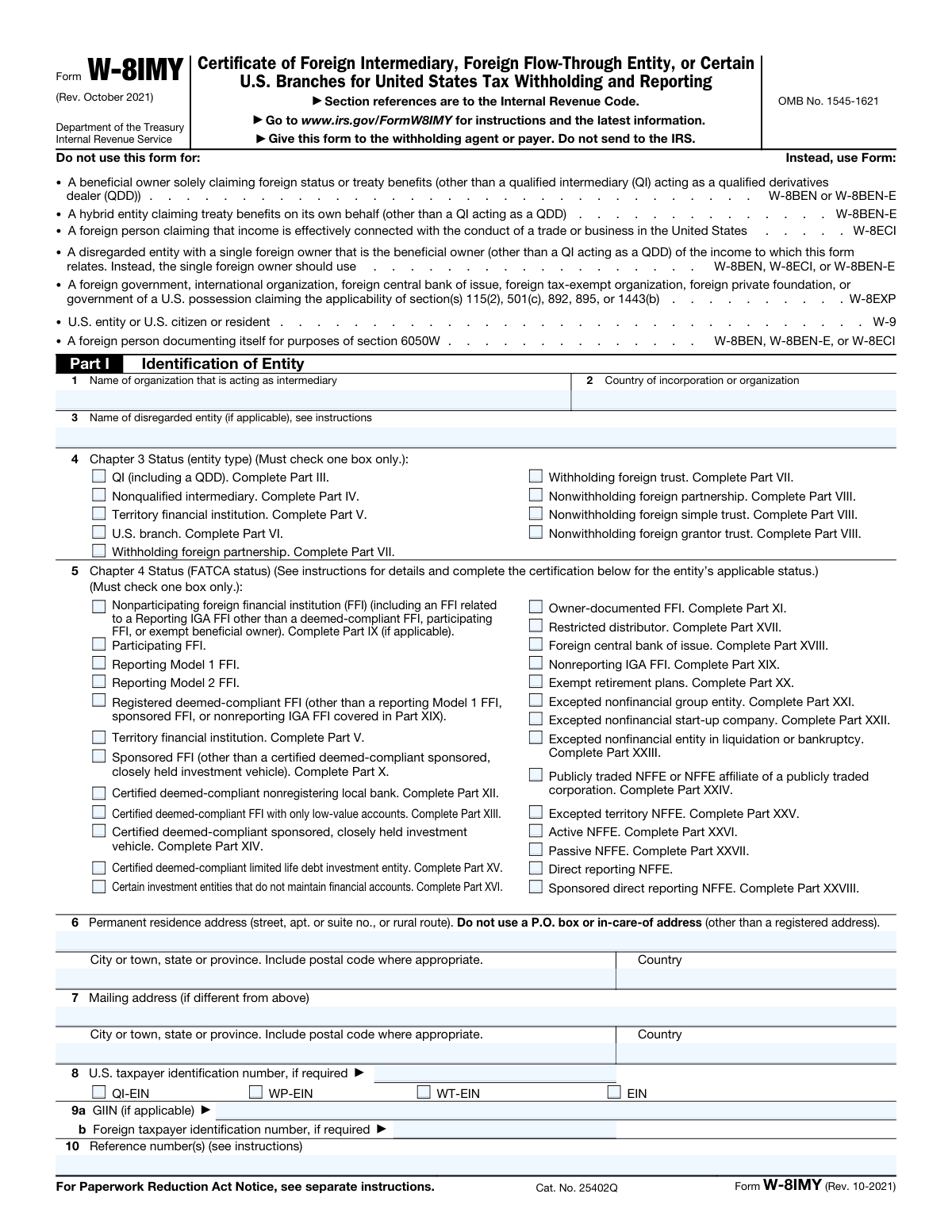
Yes! You can use AI to fill out Form W-8IMY (Rev. October 2021), Certificate of Foreign Intermediary, Foreign Flow-Through Entity, or Certain U.S. Branches for United States Tax Withholding and Reporting
Don't type 148 fields by hand. Tell our AI about yourself, or upload a document you already have, and it fills every field in seconds. You check it, then download, print or sign.
The AI does the filling. You just check it.
No typing into boxes, nothing to install.
What this form asks for
The AI fills all of it, from your answers or your documents.
The AI checks your answers before you download
16 checks built for this form, so a wrong date or a missing answer is caught before anyone else sees it.
Validate that line 1 (name of organization acting as intermediary) is present, not blank, and not a placeholder value (e.g., “N/A,” “same,” or asterisks). This is essential because the withholding agent must be able to identify the legal entity making the certifications. If missing or invalid, the submission should be rejected and routed for correction before it can be relied upon.
Ensure line 2 contains a valid country name or ISO-recognized jurisdiction and is not a U.S. state/territory unless the entity is actually organized there (which may indicate the wrong form is being used). Country is required to determine foreign status and FATCA/Chapter 4 treatment. If the country is missing or invalid, flag the form as incomplete and prevent downstream tax classification.
Verify that exactly one Chapter 3 status checkbox is selected on line 4 (e.g., QI, NQI, U.S. branch, WP/WT, nonwithholding partnership/trust). Also validate that the corresponding certification part is completed (e.g., QI requires Part III; NQI requires Part IV; U.S. branch requires Part VI). If multiple or none are selected, or the required part is not completed, the form should fail validation because the withholding agent cannot determine the correct withholding and reporting regime.
Confirm that exactly one FATCA status checkbox is selected on line 5 and that any required associated part is completed (e.g., Sponsored FFI requires Part X with sponsoring entity name; Owner-documented FFI requires Part XI certifications). FATCA status drives GIIN requirements and withholding under chapter 4. If the selection is missing/ambiguous or the required part is incomplete, the form should be rejected or treated as undocumented for FATCA purposes.
Validate that line 6 includes street address, city, and country, and that it does not contain a P.O. box or “in care of” address except where explicitly allowed as a registered address. A valid permanent residence address is a core documentary requirement for foreign status and reasonableness checks. If a P.O. box is provided or key components are missing, the form should be flagged for cure and may be treated as invalid documentation.
If line 7 is provided, ensure it is complete (street/city/country) and is meaningfully different from line 6; if it is identical, the system should either auto-clear it or flag as redundant based on business rules. This prevents inconsistent address records and reduces downstream mailing/notice failures. If line 7 is partially filled or inconsistent, fail validation and request correction.
And 10 more checks
- U.S. TIN (Line 8) Format and Conditional Requirement Based on Status
- GIIN (Line 9a) Format Validation and Required When Applicable
- Foreign TIN (Line 9b) Presence When Required and Basic Character Rules
- QI-EIN / WP-EIN / WT-EIN / EIN Fields Conditional Requirement and EIN Format
- Part II Completion Trigger and Internal Consistency (Disregarded Entity/Branch)
- Sponsored FFI / Sponsored Direct Reporting NFFE Sponsoring Entity Name Required
- Nonreporting IGA FFI (Part XIX) IGA Model and Jurisdiction Must Be Provided
- Publicly Traded NFFE / Affiliate (Part XXIV) Market and Entity Name Requirements
- Signature, Printed Name, and Date (Part XXIX) Presence and Date Format
- Reference Number(s) (Line 10) Character/Length Validation and Optionality Rules
Let AI fill out your W-8IMY
No typing. Every field filled in seconds, checked, ready to sign.
How to Fill Out W-8IMY Online for Free in 2026
What the AI walks you through.
- Confirm W-8IMY is the correct form for your role (intermediary, flow-through entity, or certain U.S. branch) and identify whether you must also provide a withholding statement and underlying payee documentation.
- Complete Part I (Identification of Entity): enter the entity’s legal name, country of incorporation/organization, any disregarded entity name (if applicable), permanent and mailing addresses, and required tax identifiers (U.S. TIN if required, GIIN if applicable, foreign TIN, and any QI-EIN/WP-EIN/WT-EIN/EIN as relevant).
- Select your Chapter 3 status in line 4 (check exactly one) and then complete the corresponding certification part (e.g., Part III for QI/QDD, Part IV for nonqualified intermediary, Part V for territory financial institution, Part VI for certain U.S. branches, Part VII for WP/WT, or Part VIII for nonwithholding partnership/trust).
- Select your Chapter 4 (FATCA) status in line 5 (check exactly one) and complete the applicable FATCA certification section(s) (e.g., Sponsored FFI, Owner-Documented FFI, Nonreporting IGA FFI, Active/Passive NFFE, etc.), including any required sponsor/trustee details and GIINs.
- If applicable, complete Part II for a disregarded entity or branch receiving payment (including the branch/disregarded entity FATCA status, address, and GIIN) when the payment is received through a branch in a different country or a disregarded entity with a GIIN.
- Review all checked boxes and statements for consistency with your withholding statement, reference numbers (line 10), and any attached documentation, ensuring the form aligns with how payments should be allocated and reported.
- Sign and date Part XXIX (Certification) as an authorized official, then deliver the completed form (and any required withholding statement/attachments) to the withholding agent or payer and track renewal/updates if any information changes.
Common Mistakes in Completing W-8IMY
The ones the AI is built to catch.
Using Form W-8IMY when a different W-8/W-9 is required
Checking multiple boxes or the wrong box for Chapter 3 status (Line 4)
Checking multiple boxes or the wrong box for Chapter 4 (FATCA) status (Line 5)
Leaving required follow-on parts incomplete after selecting a status
Providing a P.O. box or “in care of” address for permanent residence (Line 6)
Mismatch between entity name, disregarded entity name, and country of organization (Lines 1–3 and Line 2)
Missing or incorrect TINs (U.S. TIN, foreign TIN, QI-EIN/WP-EIN/WT-EIN) on Lines 8 and 9b
Entering an invalid or inconsistent GIIN (Line 9a and Part II Line 13)
Completing Part II when it does not apply (or failing to complete it when it does)
Omitting the required withholding statement and attachments referenced throughout the form
Signature, authority, or date errors in the certification (Part XXIX)
Frequently Asked Questions About W-8IMY
Is it really free for 7 days?
Can I fill other forms too?
How do I cancel?
How does the AI fill out W-8IMY?
What happens to my information?
How complex is W-8IMY to fill out?
What is Form W-8IMY used for?
Who should complete Form W-8IMY?
Who should NOT use Form W-8IMY, and what form should they use instead?
Do I send Form W-8IMY to the IRS?
What information is required in Part I (Identification of Entity)?
What is the difference between Chapter 3 status and Chapter 4 (FATCA) status on the form?
How do I choose the correct box on line 4 (Chapter 3 Status)?
How do I choose the correct box on line 5 (FATCA status)?
When do I need to complete Part II (Disregarded Entity or Branch Receiving Payment)?
What is a GIIN and when is it required on Form W-8IMY?
Do I need to provide a U.S. TIN on line 8?
What is a withholding statement, and when do I need to attach one?
What is the “reference number(s)” on line 10 used for?
What do I need to do in the certification section (Part XXIX)?
How long does it take to process Form W-8IMY, and when should I submit it?
Get your W-8IMY filled out by AI
$0 today. Cancel before Nov 1 and you pay nothing.
Other forms like this one
tax forms: W-9, Request for Taxpayer Identification Number and Certification, Form W-2, Wage and Tax Statement, Form 1040-X, Amended U.S. Individual Income Tax Return, Form 130, Taxpayer's Notice to Initiate an Appeal, Form 1040-C, U.S. Departing Alien Income Tax Return, Form 940, Employer’s Annual FUTA Tax Return, Form 720, Quarterly Federal Excise Tax Return, Form 982, Reduction of Tax Attributes, Form 4137, Social Security and Medicare Tax on Unreported Tip Income, Form 911, Request for Taxpayer Advocate Service Assistance, Form 8960, Net Investment Income Tax, Form 8959, Additional Medicare Tax, Form 8919, Uncollected Social Security and Medicare Tax, Form 8801, Credit for Prior Year Minimum Tax, Form 990-T, Exempt Org Business Income Tax Return, Form 945, Annual Return of Withheld Federal Income Tax, Form 5330, Return of Excise Taxes, Form FTB 3514, California Earned Income Tax Credit, Form 100, CA Corp Tax Return, Form 8288, U.S. Withholding Tax Return
state tax forms: Form W-2, Wage and Tax Statement, Form W-2, Wage and Tax Statement (2025), Dealer’s Heavy Equipment Inventory Tax Statement (Form 50-266), Form W-8BEN-E, Certificate of Status of Beneficial Owner for United States Tax Withholding and Reporting (Entities), Colorado Form DR 0026, Tax Statement for Leased Motor Vehicle, Form W-2, Wage and Tax Statement, Form 706-NA, United States Estate (and Generation-Skipping Transfer) Tax Return Estate of Nonresident Not a Citizen of the United States, Form W-2, Wage and Tax Statement, Form 1310, Statement of Person Claiming Refund Due a Deceased Taxpayer, Form ST-120, New York State and Local Sales and Use Tax Resale Certificate, Form 1120-REIT, U.S. Income Tax Return for Real Estate Investment Trusts, State of Michigan, Form MC 52, Request and Writ for Garnishment (Income Tax Refund/Credit), Tax Court of New Jersey, State Tax Complaint, State Tax Case Information Statement (CIS-State), Form CN 10328, State Tax Complaint Packet, Tax Court of New Jersey Case Information Statement - Correction of Error in Assessment, Form 1041, U.S. Income Tax Return for Estates and Trusts (2023), Form 1041, U.S. Income Tax Return for Estates and Trusts (2025), Form 3911, Taxpayer Statement Regarding Refund (Rev. 10-2022), Form 3911, Taxpayer Statement Regarding Refund (Rev. 1-2018)
PA state forms: Form 1095-A, Health Insurance Marketplace Statement, Form W-2, Wage and Tax Statement, Form 593, Real Estate Withholding, Form 8938, Statement of Specified Foreign Financial Assets, Form CMS-2567, Statement of Deficiencies, Form 1098, Mortgage Interest Statement, Form 1098-T, Tuition Statement, Form 1099-S, Proceeds From Real Estate Transactions, Form 1098-E, Student Loan Interest Statement, Form DS-3053, Statement of Consent, Form DS-86, Statement of Non-Receipt of a U.S. Passport, Form DS-86, Statement of Non-Receipt of a U.S. Passport, Form 108, Statement of Intention, Form 107, Statement of Financial Affairs, Form 121, Statement About Your SSNs, Form 122A-1, Chapter 7 Statement of Current Monthly Income, Center for Infertility & Reproductive Surgery – New Patient Questionnaire and Patient/Guarantor Statement (Brigham and Women’s Hospital, Department of Obstetrics and Gynecology), Adult Travel Document Application for Stateless and Protected Persons in Canada (16 years of age or over) (PPTC 190), Form W-2, Wage and Tax Statement (2025), State of New Mexico Workers’ Compensation Administration — Workers' Compensation Complaint (Rev. 8/22) (11.4.4.9 NMAC)
tax withholding forms: Form W-8BEN-E, Certificate of Status of Beneficial Owner for United States Tax Withholding and Reporting (Entities), Form 8288, U.S. Withholding Tax Return, Form W-4P (2026), Withholding Certificate for Periodic Pension or Annuity Payments, Form 8288, U.S. Withholding Tax Return for Certain Dispositions by Foreign Persons, Arizona Form A1-QRT, Arizona Quarterly Withholding Tax Return, Form SS-8, Determination of Worker Status, Form W-8BEN-E, Certificate of Status of Beneficial Owner, Form 4506-W, Request for Copy of Withholding Tax Forms
entity tax forms: Form SSA-1694, Entity Registration and Taxpayer Information
withholding forms: Excess Withdrawal Request and Form W-4R, Withholding Certificate for Nonperiodic Payments and Eligible Rollover Distributions, Form W-4, Employee's Withholding Certificate, Form 593, Real Estate Withholding, Form 8288, U.S. Withholding Tax Return, Form I-589, Application for Asylum and for Withholding of Removal, Form W-4P, Withholding Certificate, Form W-8BEN-E, Certificate of Status of Beneficial Owner for United States Tax Withholding and Reporting (Entities), Form W-4P (2026), Withholding Certificate for Periodic Pension or Annuity Payments, Form 8288, U.S. Withholding Tax Return for Certain Dispositions by Foreign Persons, Form W-4V, Voluntary Withholding Request, Arizona Form A1-QRT, Arizona Quarterly Withholding Tax Return, Form DE 4, Employee's Withholding Allowance Certificate, Form DE 4, Employee’s Withholding Allowance Certificate (Rev. 53), Form DE 4, Employee’s Withholding Allowance Certificate (Rev. 56), Form SS-8, Determination of Worker Status, Form W-8BEN-E, Certificate of Status of Beneficial Owner
NJ state forms: Form 1095-A, Health Insurance Marketplace Statement, Form W-2, Wage and Tax Statement, Form 593, Real Estate Withholding, Form 8938, Statement of Specified Foreign Financial Assets, Form CMS-2567, Statement of Deficiencies, Form 1098, Mortgage Interest Statement, Form 1098-T, Tuition Statement, Form 1099-S, Proceeds From Real Estate Transactions, Form 1098-E, Student Loan Interest Statement, Form DS-3053, Statement of Consent, Form DS-86, Statement of Non-Receipt of a U.S. Passport, Form DS-86, Statement of Non-Receipt of a U.S. Passport, Form 108, Statement of Intention, Form 107, Statement of Financial Affairs, Form 121, Statement About Your SSNs, Form 122A-1, Chapter 7 Statement of Current Monthly Income, Center for Infertility & Reproductive Surgery – New Patient Questionnaire and Patient/Guarantor Statement (Brigham and Women’s Hospital, Department of Obstetrics and Gynecology), Adult Travel Document Application for Stateless and Protected Persons in Canada (16 years of age or over) (PPTC 190), Form W-2, Wage and Tax Statement (2025), State of New Mexico Workers’ Compensation Administration — Workers' Compensation Complaint (Rev. 8/22) (11.4.4.9 NMAC)
state ID forms: Application for Renewal or Duplicate of Alabama Driver License or ID card, Form 1095-A, Health Insurance Marketplace Statement, Form W-2, Wage and Tax Statement, Form 593, Real Estate Withholding, Form 8938, Statement of Specified Foreign Financial Assets, Form CMS-2567, Statement of Deficiencies, Form 1098, Mortgage Interest Statement, Form 1098-T, Tuition Statement, Form 1099-S, Proceeds From Real Estate Transactions, Form 1098-E, Student Loan Interest Statement, Form DS-3053, Statement of Consent, Form DS-86, Statement of Non-Receipt of a U.S. Passport, Form 108, Statement of Intention, Form 107, Statement of Financial Affairs, Form 121, Statement About Your SSNs, Form 122A-1, Chapter 7 Statement of Current Monthly Income, Center for Infertility & Reproductive Surgery – New Patient Questionnaire and Patient/Guarantor Statement (Brigham and Women’s Hospital, Department of Obstetrics and Gynecology), Adult Travel Document Application for Stateless and Protected Persons in Canada (16 years of age or over) (PPTC 190), Form W-2, Wage and Tax Statement (2025), State of New Mexico Workers’ Compensation Administration — Workers' Compensation Complaint (Rev. 8/22) (11.4.4.9 NMAC)
reporting forms: Central Registry Reporting Form, Form W-8BEN-E, Certificate of Status of Beneficial Owner for United States Tax Withholding and Reporting (Entities), Fidelity NetBenefits Auditor's Guide: An Overview of Fidelity's 2024 Plan Year Reporting Package, Selbstauskunft für Unternehmen und Organisationen U.S. Foreign Account Tax Compliance Act (FATCA) und Common Reporting Standard (CRS) der OECD, DHCS 7107, Provider Preventable Conditions (PPC) Reporting Form, Toronto Hydro Data Request Form: Reporting Energy Consumption, Form W-8BEN-E, Certificate of Status of Beneficial Owner
ERM forms: REQUEST FOR OWNERSHIP INFORMATION—ERM-14 FORM, Form I-90, Application to Replace Permanent Resident Card, Form I-485, Application to Register Permanent Residence, Form SS-8, Determination of Worker Status, Form CMS-1763, Request for Termination of Medicare Coverage, Form I-212, Application for Permission to Reapply, Form I-192, Application for Advance Permission to Enter as a Nonimmigrant, County of Louisa Department of Community Development – New Non-Residential Building Permit Package, Application Schedule 1: Designer Information (City of Toronto Building Permit Application), HR-Pol-Rec&Res-04 Employment Application Form (Recruitment of Permanent Employees), Fauquier County Department of Community Development – Building Trades Permit or Amendment to Existing Permit Application (Residential or Commercial), Belastingdienst VPB 075 – Verzoek fiscale eenheid Vennootschapsbelasting (Deel A – Gegevens moedermaatschappij), ROTC Cadet Academic Plan / Degree and Credit Hour Worksheet (Student Identification, Term-by-Term Courses, GPA Summary, and Completion Certification), Health Assessment – Ontario Health atHome (Fixing Long-Term Care Act, 2021) (Form 4768-69E), Health Assessment - Ontario Health atHome (Fixing Long-Term Care Act, 2021) — Form 4768-69E, Washington Single-Family Property Term Lease & Security Deposit Receipt (WA Single-Family Lease) | Revised 10/08/2025, Application for Mechanical Permit, Pennsylvania Department of State — Certificate of Termination (Domestic Limited Liability Company) (15 Pa.C.S. § 8872(f)) (DSCB:15-8872(f)), Document Checklist for a Study Permit (IMM 5483), City of Raleigh Residential Permit Application (Revision 08-20-2025)
Let AI fill out your W-8IMY
Your trial starts once a card is added. You pay nothing before Nov 1.
Our AI already knows this form, all 148 fields of it. Skip the typing: tell it about yourself, or upload what you have, and it fills the whole form in seconds.
- AI fills every field on all 8 pages, checkboxes included
- No typing into boxes: answer a few questions, or upload a document you already have, an old copy of this form, a photo of a document
- The AI checks the answers; you review and change anything before you download
- Download the finished PDF, print it, or sign it online
- Encrypted, and never used to train AI
Cancel before Nov 1 and you pay nothing.
A card is needed to start the trial. Cancel in two clicks from your account.
Terms · Privacy