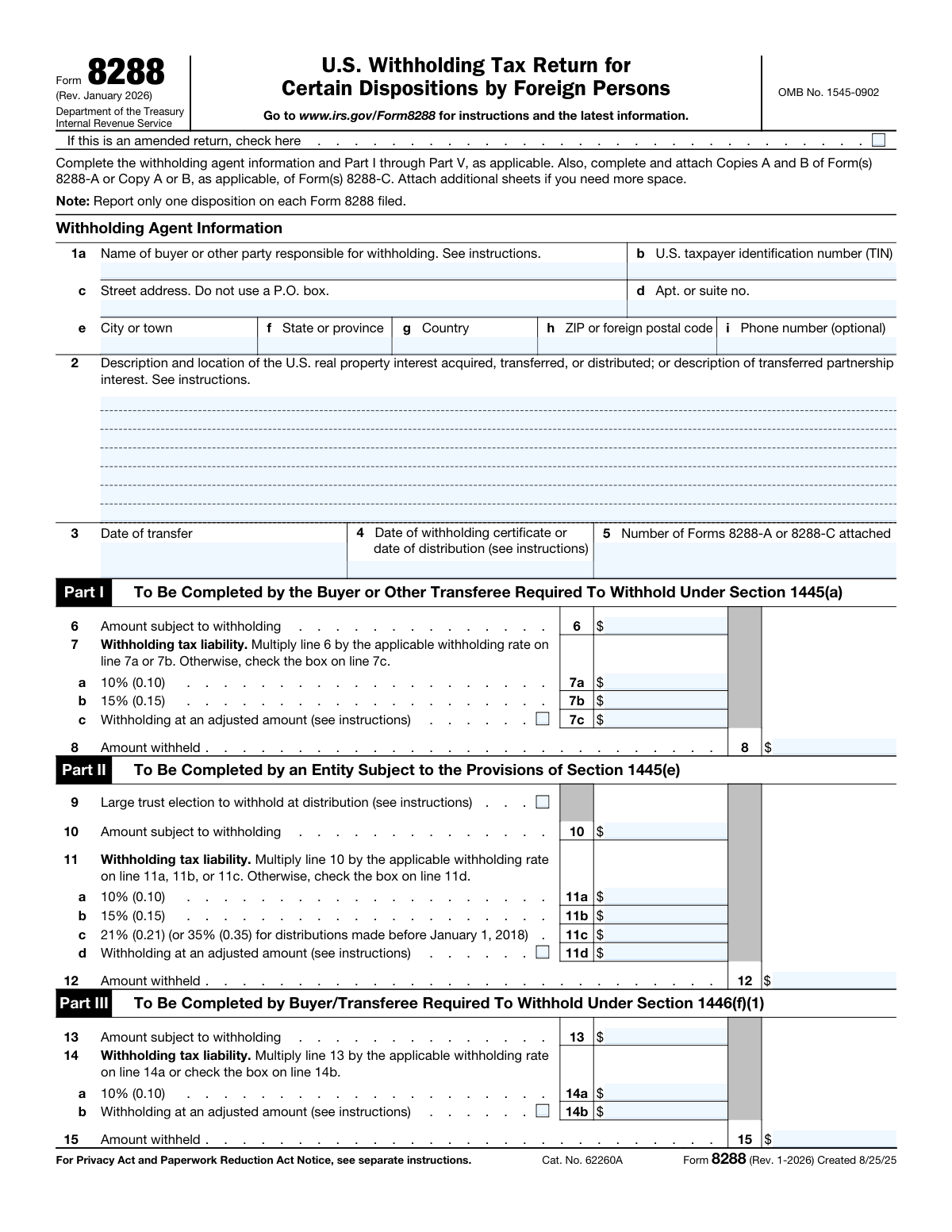
Yes! You can use AI to fill out Form 8288, U.S. Withholding Tax Return for Certain Dispositions by Foreign Persons

Form 8288, U.S. Withholding Tax Return for Certain Dispositions by Foreign Persons, is an IRS form used by the buyer or other withholding agent to report and pay the tax withheld on the sale of U.S. real property interests by foreign individuals or entities. This process, governed by the Foreign Investment in Real Property Tax Act (FIRPTA), ensures that the U.S. government collects taxes on capital gains from these transactions. Today, this form can be filled out quickly and accurately using AI-powered services like Instafill.ai, which can also convert non-fillable PDF versions into interactive fillable forms.
Our AI automatically handles information lookup, data retrieval, formatting, and form filling.
It takes less than a minute to fill out Form 8288 using our AI form filling.
Securely upload your data. Information is encrypted in transit and deleted immediately after the form is filled out.

Form specifications

Form name: Form 8288, U.S. Withholding Tax Return for Certain Dispositions by Foreign Persons
Number of pages: 2
Language: English
Categories: tax forms, tax withholding forms, withholding forms
main-image

Instafill Demo: How to fill out PDF forms in seconds with AI

How to Fill Out Form 8288 Online for Free in 2026

Are you looking to fill out a FORM 8288 form online quickly and accurately? Instafill.ai offers the #1 AI-powered PDF filling software of 2026, allowing you to complete your FORM 8288 form in just 37 seconds or less.
Follow these steps to fill out your FORM 8288 form online using Instafill.ai:
  1. 1 Navigate to Instafill.ai and upload your Form 8288, or select it from their library of templates.
  2. 2 Provide the withholding agent's information in the designated section, including name, address, and U.S. Taxpayer Identification Number (TIN).
  3. 3 Enter the details of the property transaction, such as the description and location of the property, date of transfer, and amount subject to withholding.
  4. 4 Complete the relevant part of the form (Part I, II, III, IV, or V) based on your role in the transaction, calculating the withholding tax liability using the applicable rates.
  5. 5 Attach the required copies of Form 8288-A or 8288-C as indicated, ensuring the number of attached forms is correctly stated.
  6. 6 Review all entered information for accuracy with the help of AI-powered validation, then electronically sign the form in the 'Sign Here' section.
  7. 7 Download the completed Form 8288 for your records and for submission to the IRS along with the withheld amount.

Our AI-powered system ensures each field is filled out correctly, reducing errors and saving you time.

Why Choose Instafill.ai for Your Fillable Form 8288 Form?

Speed

Complete your Form 8288 in as little as 37 seconds.

Up-to-Date

Always use the latest 2026 Form 8288 form version.

Cost-effective

No need to hire expensive lawyers.

Accuracy

Our AI performs 10 compliance checks to ensure your form is error-free.

Security

Your personal information is protected with bank-level encryption.

Frequently Asked Questions About Form Form 8288

Form 8288 is used by the buyer or other withholding agent to report and pay tax withheld on the sale or other disposition of U.S. real property interests by foreign persons.

The buyer or other transferee (the withholding agent) who acquires a U.S. real property interest from a foreign person is required to file this form. In certain cases, partnerships, fiduciaries of trusts, or executors of estates must also file.

You must attach Copies A and B of Form 8288-A for each foreign seller, or Form 8288-C for distributions by publicly traded partnerships, to report the withholding for each person.

Complete Part I if you are the buyer in a standard transaction. Parts II, III, and IV are for specific situations involving entities like trusts, estates, and partnerships, while Part V is for claiming a specific type of refund.

The withholding rates vary, with common rates being 10% and 15% for dispositions of real property, and 21% for certain entity distributions. The form also allows for an adjusted withholding amount if you have an IRS withholding certificate.

You must file Form 8288 and pay the withheld tax by the 20th day after the date of the transfer. Always refer to the official IRS instructions for the most current deadlines and mailing address.

You must provide the full name, U.S. Taxpayer Identification Number (TIN), and complete mailing address of the person or entity responsible for withholding the tax.

Yes, you should report only one disposition on each Form 8288. However, you must attach a separate Form 8288-A for each foreign seller involved in that single transaction.

Part V is used by a buyer or transferee to request a refund of tax that was over-withheld by a partnership under section 1446(f)(4). This is a specific refund claim related to partnership interest transfers.

To amend a return, you must file a new Form 8288 with the corrected information and check the 'amended return' box at the top of the form.

Yes, services like Instafill.ai use AI to auto-fill form fields accurately and save time. This can help reduce errors by populating required information from your records.

Simply upload the Form 8288 PDF to Instafill.ai. The platform will make it an interactive, fillable form, allowing you to type your information directly into the fields and then download the completed document.

You can use a service like Instafill.ai to solve this problem. It can convert flat, non-fillable PDFs into interactive forms that you can easily complete and save on your computer.

Compliance Form 8288
Validation Checks by Instafill.ai

1
Withholding Agent TIN Format
This check validates that the U.S. taxpayer identification number (TIN) in field 1b is in a valid format, such as a 9-digit Social Security Number (SSN), Employer Identification Number (EIN), or Individual Taxpayer Identification Number (ITIN). Proper TIN formatting is crucial for the IRS to correctly identify the withholding agent and process the return. An invalid format will lead to processing delays or rejection of the form.
2
Prohibits P.O. Box in Street Address
This validation ensures that the street address provided in field 1c does not contain 'P.O. Box' or similar variations. The form explicitly requires a physical street address for the withholding agent. Using a P.O. box can result in non-compliance and may cause the form to be returned for correction.
3
Valid Date of Transfer
This check verifies that the 'Date of transfer' in field 3 is a valid calendar date and is not a future date. The date of transfer is a critical piece of information that establishes the timing of the tax event. An invalid or future date would make the filing nonsensical and would be rejected.
4
Attached Forms Count Validation
This validation ensures that the value entered in field 5, 'Number of Forms 8288-A or 8288-C attached', is a non-negative integer. This number must correspond to the actual number of physical or electronically attached supplemental forms. An incorrect count can lead to processing errors and mismatches when the IRS reconciles the associated documents.
5
Part I Withholding Calculation (15%)
This check verifies that if the 15% rate is used, the amount in field 7b is correctly calculated as 15% of the 'Amount subject to withholding' from line 6. This ensures mathematical accuracy for the most common withholding rates. A miscalculation could lead to an incorrect tax liability assessment, resulting in penalties or notices from the IRS.
6
Part I Withholding Method Exclusivity
This validation ensures that a value is entered in only one of the fields for line 7: either 7a (10%), 7b (15%), or 7c (adjusted amount). These fields represent mutually exclusive methods for calculating the withholding tax liability. Populating more than one would create ambiguity and cause the form to be flagged for manual review or rejection.
7
Part I Withheld Amount Consistency
This check confirms that the 'Amount withheld' on line 8 is equal to the single value entered for the 'Withholding tax liability' on line 7 (either 7a, 7b, or 7c). This ensures consistency between the calculated liability and the amount reported as withheld. A discrepancy would indicate a calculation error or an incorrect entry, requiring correction.
8
Part II Withholding Calculation (21%)
This validation verifies that if the 21% rate is used, the amount in field 11c is correctly calculated as 21% of the 'Amount subject to withholding' from line 10. This ensures the specific tax rate for certain entity distributions is applied correctly. Failure to calculate this accurately will result in an incorrect tax liability and potential compliance issues.
9
Part V Refund Calculation
This check validates that the 'Amount of refund requested' on line 22a equals the 'Amount withheld' on line 20 minus the 'Withholding tax liability' on line 21 (either 21a or 21b). This ensures the requested refund amount is arithmetically correct based on the figures provided. An incorrect refund calculation will cause processing delays and require correction before any refund can be issued.
10
Conditional Requirement for Bank Information
This validation ensures that the bank account details (routing number, account type, and account number in fields 22b-d) are provided if, and only if, an amount greater than zero is entered for 'Amount of refund requested' on line 22a. This prevents unnecessary data collection and ensures that a direct deposit can be processed when a refund is due. Failure to provide this information when a refund is requested will result in a paper check being mailed, delaying the refund.
11
Bank Routing Number Format
This check verifies that the bank routing number entered in field 22b is exactly nine digits long and contains only numeric characters. This is a standard requirement for all U.S. financial institutions for electronic funds transfers. An invalid routing number will cause the direct deposit to fail, requiring the IRS to issue a paper check instead.
12
Account Type Selection for Refund
This validation ensures that if bank information is provided for a refund, either the 'Checking' or 'Savings' box is checked, but not both. A clear selection is required to direct the funds to the correct account type. Missing or ambiguous selection will cause the direct deposit to fail.
13
Preparer PTIN Format Validation
This check ensures the Preparer Tax Identification Number (PTIN) entered in the 'Paid Preparer Use Only' section follows the required IRS format (a 'P' followed by eight digits). A valid PTIN is required for all paid preparers to identify them to the IRS. An invalid PTIN can lead to penalties for the preparer and processing issues for the return.
14
Firm EIN Format Validation
This validation confirms that the Firm's EIN in the 'Paid Preparer Use Only' section is in the correct nine-digit format (e.g., XX-XXXXXXX). The EIN is used to identify the preparer's business entity. An incorrectly formatted EIN will cause data mismatches in IRS systems and may delay return processing.

Common Mistakes in Completing Form 8288

Reporting Multiple Dispositions on a Single Form

Filers sometimes attempt to report several property dispositions on one Form 8288 to save time, despite explicit instructions to the contrary. The form is designed to track the withholding for a single, specific transaction. Submitting a form with multiple dispositions will lead to its rejection and significant processing delays, requiring you to refile correctly and potentially incurring penalties. Always file a separate Form 8288 for each individual disposition of a U.S. real property interest.

Completing an Inapplicable Part of the Form

Form 8288 is divided into distinct parts for different filers (e.g., Part I for buyers, Part II for entities, Part IV for partnerships). A common error is filling out the wrong section, such as a buyer completing Part II. This happens due to not carefully reading the instructions for each part and leads to incorrect tax calculations and IRS inquiries. To avoid this, carefully identify your role in the transaction and only complete the corresponding part of the form.

Applying an Incorrect Withholding Rate

The form requires applying a specific withholding rate (e.g., 10%, 15%, 21%) which depends on factors like the property's sale price and the buyer's intent to use it as a residence. Filers often apply a default or incorrect rate, leading to under- or over-withholding of tax. This can result in penalties for underpayment or complex refund procedures for overpayment. Always consult the latest Form 8288 instructions to determine the precise rate applicable to your transaction.

Forgetting to Attach or Mismatching Forms 8288-A/8288-C

This filing requires attaching Copies A and B of Form 8288-A or copies of Form 8288-C for each foreign seller, and Line 5 must state the total number attached. Filers often forget the attachments or enter an incorrect count on Line 5 due to simple oversight. An incomplete submission will halt processing and trigger a notice from the IRS, delaying the credit of withholding to the foreign person's account. Before filing, verify that all required forms are attached and the count on Line 5 is accurate.

Entering an Incorrect or Mismatched TIN

A frequent mistake is entering an incorrect U.S. Taxpayer Identification Number (TIN) for the withholding agent on Line 1b, such as transposing digits or using a personal SSN for a business entity that has an EIN. An incorrect TIN prevents the IRS from properly crediting the payment and associating the return with the correct taxpayer account, causing processing failures and notices. To prevent this, use an AI-powered tool like Instafill.ai, which can help validate TIN formats and reduce data entry errors.

Providing a Vague Property Description on Line 2

Line 2 requires a description sufficient to uniquely identify the property, but filers often provide vague information like 'Building in New York'. This ambiguity makes it difficult for the IRS to link the withholding to the specific asset, which can delay the proper crediting of the tax paid on behalf of the foreign seller. Always provide the full street address, including city, state, and ZIP code, and if possible, the legal description or parcel number.

Inconsistent Withholding Liability and Amount Withheld

An error occurs when the calculated withholding tax liability (e.g., on Line 7 or 11) does not match the amount reported as actually withheld (e.g., on Line 8 or 12). This discrepancy, often from a calculation mistake or an incorrect payment, will flag the return for review and likely result in an IRS notice. To avoid this, double-check your math and ensure the liability, the amount withheld, and the amount remitted to the IRS are all identical. Using a tool like Instafill.ai can automate these calculations to ensure accuracy.

Omitting Bank Details for a Direct Deposit Refund

When requesting a refund in Part V, filers may forget to provide complete and accurate bank information on lines 22b-22d. Leaving out the routing number, account number, or failing to check the account type will prevent a direct deposit. This forces the IRS to issue a paper check, significantly delaying receipt of the refund. To avoid this, carefully fill in all required bank details if you are requesting a refund.

Failing to Sign and Date the Return

An unsigned or undated tax return is considered invalid by the IRS and will not be processed, which is a surprisingly common oversight. This is treated as a failure to file, potentially leading to late-filing penalties and interest charges on the amount due. Always perform a final review to ensure the form is physically signed by the appropriate person and dated before mailing. If the form is a non-fillable PDF, a tool like Instafill.ai can convert it into a fillable version to make completion and review easier.

Using a P.O. Box for the Physical Address

The instructions for the withholding agent's address on Line 1c explicitly state 'Do not use a P.O. box.' Filers may enter their P.O. Box out of habit, as it is their primary mailing address. This error can cause the form to be flagged or returned for correction, delaying the entire filing process. Always provide a physical street address where required on government forms.
Saved over 80 hours a year

“I was never sure if my IRS forms like W-9 were filled correctly. Now, I can complete the forms accurately without any external help.”

Kevin Martin Green

Your data stays secure with advanced protection from Instafill and our subprocessors

Robust compliance program

Transparent business model

You’re not the product. You always know where your data is and what it is processed for.

ISO 27001, HIPAA, and GDPR

Our subprocesses adhere to multiple compliance standards, including but not limited to ISO 27001, HIPAA, and GDPR.

Security & privacy by design

We consider security and privacy from the initial design phase of any new service or functionality. It’s not an afterthought, it’s built-in, including support for two-factor authentication (2FA) to further protect your account.

Fill out Form 8288 with Instafill.ai

Worried about filling PDFs wrong? Instafill securely fills form-8288-us-withholding-tax-return-for-certain-dispositions-by-foreign-persons forms, ensuring each field is accurate.