
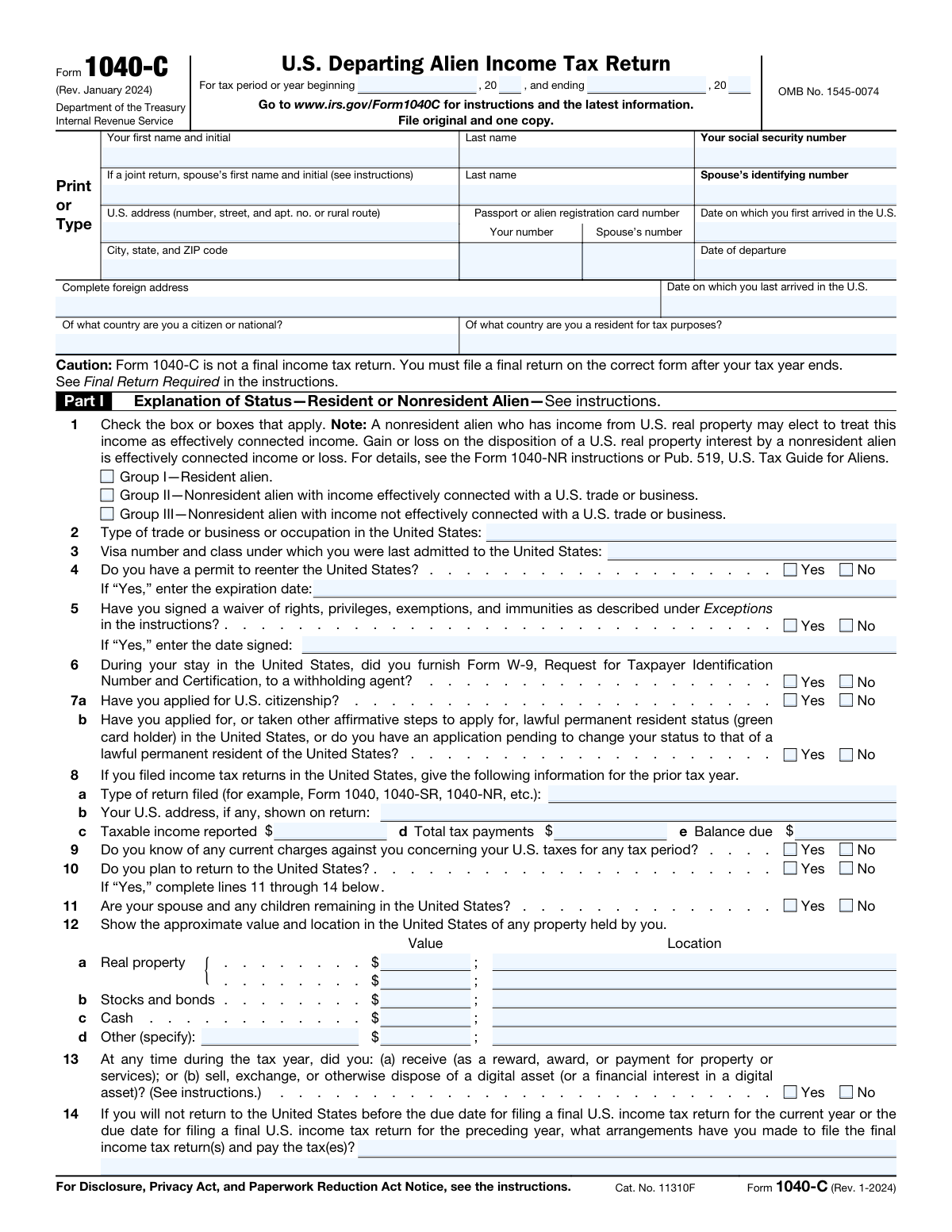
Yes! You can use AI to fill out Form 1040-C, U.S. Departing Alien Income Tax Return
Don't type 307 fields by hand. Tell our AI about yourself, or upload your W-2 or last year's return, and it fills every field in seconds. You check it, then download, print or sign.
The AI does the filling. You just check it.
No typing into boxes, nothing to install.
What this form asks for
The AI fills all of it, from your answers or your documents.
The AI checks your answers before you download
15 checks built for this form, so a wrong date or a missing answer is caught before anyone else sees it.
Ensures that all necessary documentation, including income statements, tax forms, and identification, is available before form completion. This check is crucial to prevent delays and ensure that the information provided on the U.S. Departing Alien Income Tax Return is accurate and complete. It also helps in verifying the identity of the taxpayer and the authenticity of the income reported.
Confirms that Form 1040-C is filed before the alien's departure from the United States. This validation is important to comply with the Internal Revenue Service (IRS) regulations, which require that certain departing aliens report their income and pay any taxes due before leaving the country. It also ensures that the taxpayer does not face any legal issues or penalties for non-compliance.
Verifies the correct use of Instructions for Form 1040-NR for nonresident aliens or Instructions for Forms 1040 for resident aliens to complete Form 1040-C. This check is essential for the accurate completion of the form, as it guides the taxpayer through the process and helps avoid common mistakes. It also ensures that the taxpayer takes advantage of all applicable tax benefits and deductions.
Checks for the filing of Form 8854 for former U.S. citizens or long-term residents who expatriated in 2024. This validation is significant for those who have renounced their U.S. citizenship or ended their long-term residency, as it is a requirement by the IRS to certify compliance with all tax obligations. It also helps in avoiding potential penalties associated with the expatriation process.
Validates that Form 843 is filed if social security or Medicare taxes were withheld in error. This check is important to ensure that taxpayers can claim a refund for any taxes incorrectly withheld from their income. It also confirms that the taxpayer's rights are protected and that they are not overpaying taxes due to administrative errors.
The system ensures that an Individual Taxpayer Identification Number (ITIN) renewal has been processed if the ITIN has not been included on a U.S. federal tax return in the last three consecutive years. This validation is crucial as an expired ITIN may lead to processing delays and possible disallowance of certain tax benefits until the number is renewed and updated in the tax records.
And 9 more checks
- Social Security Number for Child Tax Credit
- Form 1040-C Not a Final Return
- Tax Credit from Form 1040-C
- Filing Form 1040-C or Form 2063 for Certificate of Compliance
- Payment of Tax Due on Form 1040-C
- Scheduling Appointment with Local IRS Office
- Inclusion of All Income
- Filing Status for Resident and Nonresident Aliens
- Payment of Tax and Refund Claims
Let AI fill out your Form 1040-C
No typing. Every field filled in seconds, checked, ready to sign.
How to Fill Out Form 1040-C Online for Free in 2026
What the AI walks you through.
- Visit instafill.ai site and select Form 1040-C.
- Enter your personal information and tax details.
- Provide information about your income and deductions.
- Sign and date the form electronically.
- Check for accuracy and submit the form.
Common Mistakes in Completing Form 1040-C
The ones the AI is built to catch.
Neglecting to File Form 1040-C Before Leaving the United States
Failing to Report All Income Received and Expected During the Entire Year of Departure
Filing as a Nonresident Alien Without Obtaining the Correct Instructions (Form 1040-NR)
Filing as a Resident Alien Without Obtaining the Correct Instructions (Forms 1040)
Not Providing a Valid Social Security Number When Claiming the Child Tax Credit
Filing a joint return as a nonresident alien
Not scheduling an appointment with the local IRS office at least 2 weeks before planned departure
Not bringing all required documents to the appointment, including passport, tax returns, receipts, and proof of income
Failing to pay all tax shown as due on Form 1040-C at the time of filing
Not filing a final income tax return after the tax year ends
Failure to file Form 8854 if required for former U.S. citizens or long-term residents who expatriated in 2024
Not requesting a refund of social security or Medicare taxes withheld in error
Not renewing an ITIN if not included on a tax return in the last 3 consecutive years
Filing Form 1040-C or Form 2063 instead of a final income tax return after the tax year ends
Frequently Asked Questions About Form 1040-C
Is it really free for 7 days?
Can I fill other forms too?
How do I cancel?
How does the AI fill out Form 1040-C?
What happens to my information?
How complex is Form 1040-C to fill out?
What is the purpose of the U.S. Departing Alien Income Tax Return (Form 1040-C)?
Who is required to file Form 1040-C?
What information is required on Form 1040-C?
What is the difference between a resident alien and a nonresident alien for tax purposes?
What is effectively connected income?
What is income that is not effectively connected with a U.S. trade or business?
What is the deadline for filing Form 1040-C?
How is Form 1040-C filed?
What is the deadline for filing Form 1040-C?
What happens if a departing alien fails to file Form 1040-C?
Can a departing alien claim deductions on Form 1040-C?
What is the purpose of the waiver of rights, privileges, exemptions, and immunities question on Form 1040-C?
What is the purpose of the Form W-9 question on Form 1040-C?
Get your Form 1040-C filled out by AI
$0 today. Cancel before Nov 1 and you pay nothing.
Other forms like this one
tax forms: W-9, Request for Taxpayer Identification Number and Certification, Form W-2, Wage and Tax Statement, Form 1040-X, Amended U.S. Individual Income Tax Return, Form 130, Taxpayer's Notice to Initiate an Appeal, Form 940, Employer’s Annual FUTA Tax Return, Form 720, Quarterly Federal Excise Tax Return, Form 982, Reduction of Tax Attributes, Form 4137, Social Security and Medicare Tax on Unreported Tip Income, Form 911, Request for Taxpayer Advocate Service Assistance, Form 8960, Net Investment Income Tax, Form 8959, Additional Medicare Tax, Form 8919, Uncollected Social Security and Medicare Tax, Form 8801, Credit for Prior Year Minimum Tax, Form 990-T, Exempt Org Business Income Tax Return, Form 945, Annual Return of Withheld Federal Income Tax, Form 5330, Return of Excise Taxes, Form FTB 3514, California Earned Income Tax Credit, Form 100, CA Corp Tax Return, Form 8288, U.S. Withholding Tax Return, Form 540 2EZ, California Resident Tax Return
income forms: Form SSA-44, Medicare Income-Related Monthly Adjustment Amount - Life-Changing Event, Form 1040-X, Amended U.S. Individual Income Tax Return, Form 4137, Social Security and Medicare Tax on Unreported Tip Income, Form 8960, Net Investment Income Tax, Form 1042-S, Foreign Person’s U.S. Income, Form 990-T, Exempt Org Business Income Tax Return, Form 945, Annual Return of Withheld Federal Income Tax, Form 568, LLC Income Return, Form FTB 3514, California Earned Income Tax Credit, Form 1099-INT, Interest Income, Form 1120-S, U.S. Income Tax Return for an S Corporation, Form 1065, U.S. Return of Partnership Income, Form 1040, U.S. Individual Income Tax Return, Form FL-150, Income and Expense Declaration, Form 122A-1, Chapter 7 Statement of Current Monthly Income, Arizona Form 285-I, Individual Income Tax Disclosure/Representation Authorization Form, Form SSA-8000-BK, Application for Supplemental Security Income (SSI), Judicial Council of California Form FL-150, Income and Expense Declaration, Form 1120-S (2025), U.S. Income Tax Return for an S Corporation, California Form 568 (2024), Limited Liability Company Return of Income
income tax forms: Form 1040-X, Amended U.S. Individual Income Tax Return, Form 4137, Social Security and Medicare Tax on Unreported Tip Income, Form 8960, Net Investment Income Tax, Form 990-T, Exempt Org Business Income Tax Return, Form 945, Annual Return of Withheld Federal Income Tax, Form FTB 3514, California Earned Income Tax Credit, Form 1120-S, U.S. Income Tax Return for an S Corporation, Form 1040, U.S. Individual Income Tax Return, Arizona Form 285-I, Individual Income Tax Disclosure/Representation Authorization Form, Form 1120-S (2025), U.S. Income Tax Return for an S Corporation, Form 1120 (2025), U.S. Corporation Income Tax Return, 2023 Schedule IL-E/EIC, Illinois Exemption and Earned Income Tax Credit (Illinois Department of Revenue), 2023 Form IL-1040-X, Amended Individual Income Tax Return (Illinois Department of Revenue), Form APL-505, Taxpayer’s Earned Income Tax Credit Protest, Form 1120-H, U.S. Income Tax Return for Homeowners Associations, Form 1040, U.S. Individual Income Tax Return (2025), T2 Corporation Income Tax Return, Form 1040-X, Amended U.S. Individual Income Tax Return, Form TC-40, Utah Individual Income Tax Return, Form T101, Statement of Resource Expenses
Let AI fill out your Form 1040-C
Your trial starts once a card is added. You pay nothing before Nov 1.
Our AI already knows this form, all 307 fields of it. Skip the typing: tell it about yourself, or upload what you have, and it fills the whole form in seconds.
- AI fills every field on all 4 pages, checkboxes included
- No typing into boxes: answer a few questions, or upload your W-2 or last year's return, an old copy of this form, a photo of a document
- The AI checks the answers; you review and change anything before you download
- Download the finished PDF, print it, or sign it online
- Encrypted, and never used to train AI
Cancel before Nov 1 and you pay nothing.
A card is needed to start the trial. Cancel in two clicks from your account.
Terms · Privacy