Fill out beneficiary forms
with AI.
Beneficiary forms are essential legal documents designed to manage the transfer of assets and benefits following an individual's passing. These forms serve as a direct instruction to financial institutions, insurance companies, and government agencies, often superseding a traditional will or trust. By clearly naming primary and contingent beneficiaries, you ensure that retirement savings, life insurance payouts, and investment accounts are distributed according to your specific wishes, helping your loved ones avoid the lengthy and often expensive probate process.
By continuing, you acknowledge Instafill's Privacy Policy and agree to get occasional product update and promotional emails.
About beneficiary forms
This category covers a wide range of administrative needs, from designating heirs for a 401(k) or IRA to filing supplemental information for a spouse's green card application. You typically need these forms when starting a new job, opening a brokerage account with providers like Fidelity or Vanguard, or updating your estate plan after a major life event such as marriage or the birth of a child. Specialized documents, such as life insurance affidavits from The Hartford or retirement designations from TIAA, are also common requirements for maintaining clear financial records.
Navigating these legal requirements can be time-consuming, but tools like Instafill.ai use AI to fill these forms in under 30 seconds, ensuring your data is handled accurately and securely. Whether you are managing an inherited account or setting up your own legacy, having the right paperwork in order provides peace of mind and financial security for your family.
Every form on this page can be completed without typing. Instafill is form filling software that reads a PDF and fills it for you — including flat and scanned documents that carry no fillable fields at all.
Forms in This Category
The forms in this category have a median Form Complexity Index of 52/100 (Moderate), measured across 90 forms by field count, input difficulty, length, conditional logic and structure. See how it is calculated.
- Enterprise-grade security & data encryption
- 99%+ accuracy powered by AI
- 1,000+ forms from all industries
- Complete forms in under 60 seconds
How to Choose the Right Form
Beneficiary forms are essential legal tools that ensure your assets—ranging from life insurance payouts to retirement savings—are distributed according to your wishes, often bypassing the lengthy probate process. Because these designations typically override instructions in a will, choosing the specific form for your account provider is critical.
Retirement and Investment Accounts
Most forms in this category are provider-specific. You should select the form that matches where your assets are currently held:
- Fidelity: Use the Fidelity Investments 403(b) Beneficiary Designation or the Fidelity Advisor IRA Beneficiary Designation to name heirs. If you have inherited an account, use the Fidelity Investments® Beneficiary Distribution Form to claim assets.
- Vanguard: Choose the Vanguard Retirement Plan Beneficiary Designation for standard accounts or the IRA Distribution to Charitable Beneficiary if you are an organization claiming a gift.
- Charles Schwab: Use the Designated Beneficiary Plan Agreement for Schwab One brokerage accounts or the Beneficiary Designation Form For IRA and 403(b)(7) Accounts for retirement funds.
- TIAA & Empower: Select the TIAA Beneficiary Designation Form or the Empower Beneficiary Recordkeeping Form to update your primary and contingent beneficiaries.
Life Insurance and Annuities
To ensure your loved ones receive policy proceeds, use the form provided by your insurer:
- Principal & Transamerica: Use the Principal Life Insurance Company Beneficiary Designation/Change Form or the Transamerica Beneficiary Change Form to update your policy.
- The Hartford: If you are a survivor identifying next of kin for a claim, use the Affidavit and Representations Regarding Next of Kin (Preference Beneficiary Affidavit).
- Minors: If naming a minor as a beneficiary, use the UTMA Beneficiary Designation (Uniform Transfers to Minor Act) to appoint a custodian.
Immigration and Government Benefits
Not all beneficiary forms are for estate planning. Some are required for legal status or government payouts:
- Immigration: Form I-130A, Supplemental Info for Spouse Beneficiary is required by USCIS when sponsoring a spouse for a green card.
- Veterans Affairs: Use VA Form 21-0788, Information Regarding Apportionment of Beneficiary's Award to request that a portion of a veteran's benefits be paid to a dependent.
- Taxes: If you are receiving income from a trust or estate in California, you will need the California Schedule K-1 (541) for your tax filings.
Form Comparison
| Form | Purpose | Who Files It | When to Use |
|---|---|---|---|
| Form I-130A, Supplemental Info for Spouse Beneficiary | Provide additional info for spousal green card petition | Foreign spouse being sponsored for U.S. residency | Filed alongside Form I-130 immigration petition |
| Affidavit and Representations Regarding Next of Kin (Preference Beneficiary Affidavit) (The Hartford) – Form LC-7086-17 | Identify next of kin to receive life insurance proceeds | Surviving family member or estate representative | When no beneficiary was named on a Hartford policy |
| VA Form 21-0788, Information Regarding Apportionment of Beneficiary's Award | Request partial VA award payment to dependent or spouse | Veteran, surviving spouse, or dependent claimant | When seeking apportionment of VA disability benefits |
| California Schedule K-1 (541) (2025), Beneficiary's Share of Income, Deductions, Credits, etc. | Report beneficiary's share of estate or trust income | Fiduciary (estate or trust) prepares; beneficiary uses it | Annually when filing California state tax returns |
| Fidelity Investments® Beneficiary Distribution Form | Request distribution from inherited Fidelity retirement account | Beneficiary of a deceased Fidelity account holder | After account holder's death to claim inherited assets |
| Fidelity Investments 403(b) Beneficiary Designation | Designate beneficiaries for a Fidelity 403(b) plan | 403(b) retirement plan account owner | At enrollment or after major life changes |
| Fidelity Advisor IRA Beneficiary Designation | Name beneficiaries for Fidelity Advisor IRA accounts | IRA account owner (Traditional, Roth, SEP, SIMPLE) | At account opening or when updating beneficiaries |
| Fidelity Investments Qualified Plan Beneficiary Designation | Designate beneficiaries for qualified retirement plan assets | Qualified retirement plan participant (spousal consent required) | At enrollment or following qualifying life events |
| Fidelity Investments 403(b)/401(a) Beneficiary Designation | Name heirs for 403(b) or 401(a) retirement plan assets | 403(b) or 401(a) retirement plan participant | At enrollment or when updating existing designations |
| The Church of the Nazarene 403(b) Retirement Savings Plan Beneficiary Designation Form | Designate beneficiaries for Church of Nazarene 403(b) plan | Church of the Nazarene 403(b) plan participant | At enrollment or after major life events |
| IRA/HSA Beneficiary Designation | Designate beneficiaries for IRA or HSA accounts | IRA or HSA account holder at Fidelity | When opening account or updating beneficiary information |
| Fidelity IRA Beneficiary Distribution — Charity, Foundation, or a University | Transfer inherited IRA assets to charitable organization | Domestic charity, foundation, or university beneficiary | After account holder's death when charity is named beneficiary |
| Designated Beneficiary Plan Agreement | Set up TOD/POD beneficiary for Schwab brokerage accounts | Charles Schwab brokerage account holder | To name beneficiaries and avoid probate on brokerage assets |
| Beneficiary Designation Form For IRA and 403(b)(7) Accounts | Designate beneficiaries for Schwab IRA or 403(b)(7) | Charles Schwab IRA or 403(b)(7) account holder | At account opening or when updating beneficiary designations |
| IRA Beneficiary Designation Form | Officially name heirs for an Individual Retirement Account | IRA account owner | At account setup or after major life changes |
| Stock Power Form For transferring shares, changing names, or adding a beneficiary | Authorize transfer or change of ownership of securities | Current securities owner or authorized representative | When selling, gifting, or transferring stock ownership |
| Distribution Due to Death for Spouse Beneficiary - Elevator Constructors Union Local No. 1 Annuity and 401(k) Fund | Request distribution from deceased spouse's retirement account | Surviving spouse of deceased plan participant | After spouse's death to claim retirement account assets |
| IRA Distribution to Charitable Beneficiary | Claim IRA assets as a designated charitable beneficiary | Charitable organization named as IRA beneficiary | After account holder's death to receive IRA proceeds |
| Inherited Retirement Account Beneficiary Identification Form | Identify all beneficiaries under a general designation | Beneficiaries of a deceased retirement account holder | When designation uses broad terms like 'per stirpes' |
| Vanguard Retirement Plan Beneficiary Designation | Name primary and contingent beneficiaries for Vanguard plan | Vanguard retirement plan account owner | At enrollment or when updating beneficiary information |
| Vanguard Retirement Plan Beneficiary Designation - Phillips 66 Savings Plan | Designate beneficiaries for Phillips 66 Vanguard savings plan | Phillips 66 Savings Plan participant | At enrollment or after qualifying life events |
| Beneficiary Account Withdrawal Request Governmental 457(b) Plan | Request withdrawal from inherited governmental 457(b) plan | Beneficiary of deceased 457(b) plan participant | After account holder's death to access inherited funds |
| Empower Beneficiary Designation Governmental 457(b) Plan | Designate beneficiaries for Empower 457(b) retirement plan | Governmental 457(b) plan participant | At enrollment or when updating beneficiary designations |
| Beneficiary Designation 401(a) Plan | Name heirs for a 401(a) retirement plan account | 401(a) retirement plan participant | At enrollment or after major life events |
| Form RS115, Beneficiary Designation | Name beneficiaries for PERSI death benefits | Idaho PERSI public employee retirement system member | At enrollment or when updating beneficiary information |
| Empower Beneficiary Recordkeeping Form | Formally name beneficiaries for Empower retirement plan assets | Empower retirement plan participant | At enrollment or when updating beneficiary designations |
| Beneficiary Designation for Seafarers International Union AGLIW 401(k) Plan | Designate heirs for SIU 401(k) retirement plan assets | Seafarers International Union 401(k) plan participant | At enrollment or after major life changes |
| Beneficiary Designation 401(k) Plan | Name primary and contingent 401(k) beneficiaries | 401(k) plan participant; spousal consent may be required | At enrollment or following qualifying life events |
| Empower Beneficiary Designation Form for WoodmenLife 401(k) Plan | Designate beneficiaries for WoodmenLife 401(k) plan | WoodmenLife 401(k) plan participant via Empower | At enrollment or when updating existing designations |
| Empower SRIP II Beneficiary Designation Form | Name beneficiaries for Empower SRIP II retirement plan | SRIP II plan participant; spousal consent may apply | At enrollment or after qualifying life events |
| Beneficiary Designation/Change - Principal Life Insurance Company | Designate or change life and accident insurance beneficiaries | Employee covered under Principal group insurance plan | At enrollment or when updating beneficiary information |
| UTMA Beneficiary Designation (Uniform Transfers to Minor Act) | Transfer insurance or investment assets to minor via custodian | Policy or account owner naming a minor as beneficiary | When naming a minor as beneficiary without a formal trust |
| Principal Retirement Plan Beneficiary Designation | Designate beneficiaries for Principal retirement plan assets | Principal Life retirement plan participant | At enrollment or when updating beneficiary designations |
| Principal Financial Group Beneficiary Designation Form | Name heirs for life insurance or retirement account proceeds | Principal Financial Group policy or account holder | At account setup or after major life events |
| Form DD 638-28, Beneficiary Change | Change or designate beneficiary on a Principal life policy | Principal life insurance policy owner | When updating or adding beneficiaries to existing policy |
| Principal Life Insurance Company Beneficiary Designation/Change Form (GP34795-14) | Designate beneficiaries for group term life insurance policy | Employee covered by Principal group life insurance | At enrollment or when updating beneficiary information |
| Principal Beneficiary Designation Form (PT383B-06) | Name heirs for Principal retirement plan benefits | Principal retirement plan participant | At enrollment or after qualifying life events |
| Beneficiary Designation Form | Name beneficiaries for life, AD&D, and supplemental plans | Employee or policyholder of group insurance plan | At enrollment or when updating existing designations |
| Transamerica Life Insurance Company Beneficiary Designation Form (TOB 306M-0809) | Designate who receives Transamerica life insurance death benefit | Transamerica life insurance policy owner | At policy issuance or when updating beneficiaries |
| Transamerica Beneficiary Change Form | Change primary and contingent life insurance beneficiaries | Transamerica life insurance policyholder | When updating or replacing existing beneficiary designations |
| Transamerica Beneficiary Designation Form | Officially name beneficiaries for Transamerica life policy | Transamerica life insurance policy owner | At policy setup or after major life events |
| Form 2227, Beneficiary Designation | Designate beneficiaries for retirement or insurance plan | Retirement plan or insurance policy participant | At enrollment or when updating beneficiary information |
| Transamerica Beneficiary Designation Form - The Hopi Tribe | Designate beneficiaries for Hopi Tribe's Transamerica plan | Hopi Tribe Transamerica plan participant | At enrollment or when updating beneficiary designations |
| TIAA Beneficiary Designation Form | Name beneficiaries for TIAA employer-sponsored retirement plan | TIAA retirement plan account holder | At enrollment or when updating beneficiary information |
| TIAA Life Insurance Beneficiary Designation Form | Designate beneficiaries for TIAA life insurance death benefit | TIAA or TIAA-CREF life insurance policy owner | At policy issuance or when updating beneficiaries |
| TIAA-CREF Funds Beneficiary Designation Form (Retail Class Only) | Name heirs for TIAA-CREF IRA or individual fund accounts | TIAA-CREF IRA or individual/joint account holder | At account setup or when updating beneficiary designations |
| Beneficiary Designation Form for Plans Subject to QJSA (Form F11607) | Designate beneficiaries under ERISA QJSA spousal rules | TIAA-CREF account holder in ERISA-governed retirement plan | When spousal consent is required for beneficiary designation |
| Form F11015, TIAA Brokerage Designation of Beneficiary | Name beneficiaries for TIAA Brokerage IRA account | TIAA Brokerage IRA account holder | At account setup or when updating beneficiary designations |
| TIAA Non-Qualified Annuity Beneficiary Designation Form | Designate beneficiaries for TIAA non-qualified annuity contract | TIAA non-qualified annuity contract owner | At contract issuance or when updating beneficiaries |
| TIAA Trust, N.A. IRA Beneficiary Designation | Designate beneficiaries for TIAA Trust IRA account | TIAA Trust, N.A. IRA account owner | At account setup or when updating beneficiary information |
| Voya Beneficiary Designation Request Form | Name beneficiaries for Voya/ReliaStar life insurance policy | ReliaStar/Voya life insurance policyholder | At policy issuance or when updating beneficiary designations |
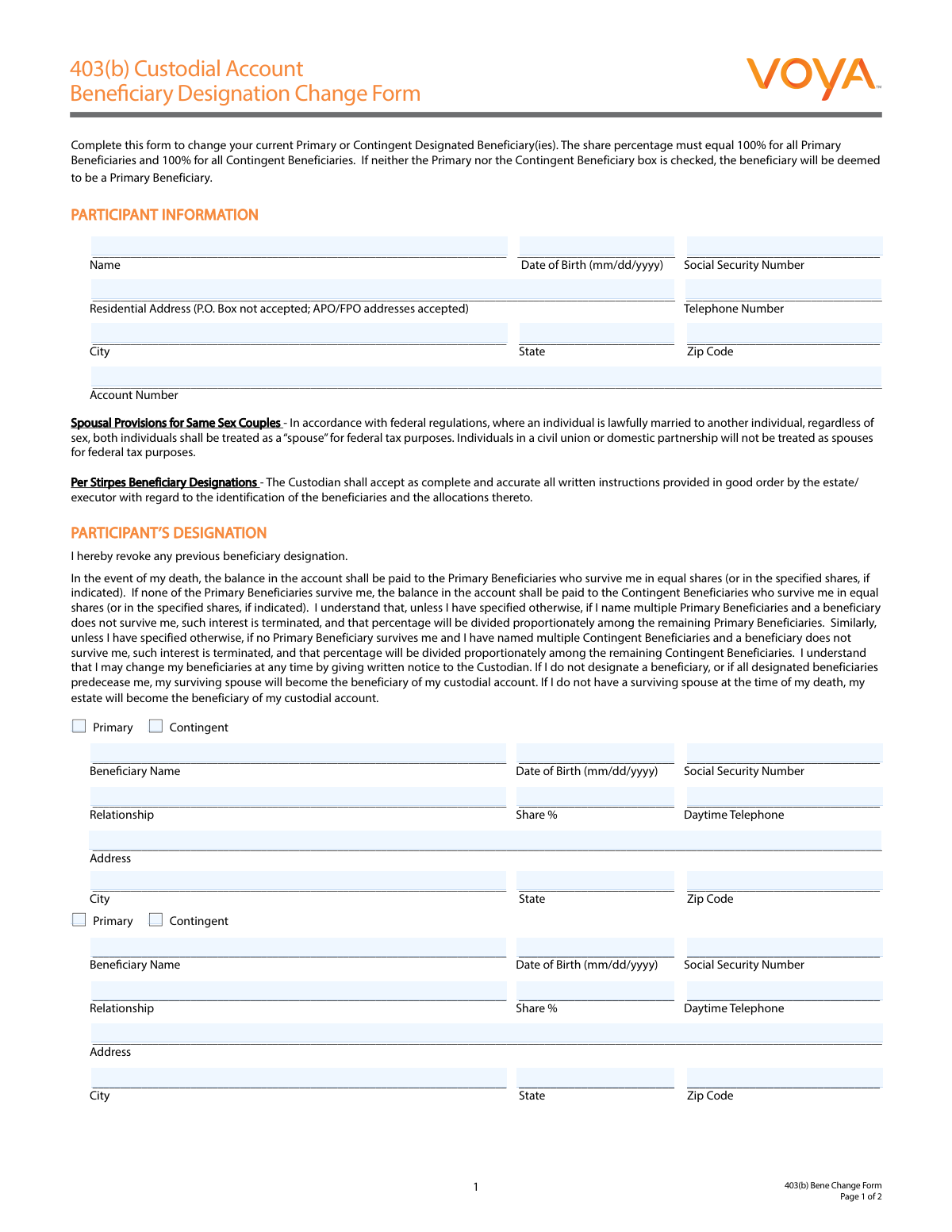
| 403(b) Custodial Account Beneficiary Designation Change Form | Change beneficiaries on a 403(b) custodial retirement account | 403(b) custodial account holder | When updating existing beneficiary designations |
| IRA/IRRA®/ROTH IRA/SEP/SRA Beneficiary Distribution Form | Request distribution from inherited Merrill Lynch retirement account | Beneficiary of deceased Merrill Lynch IRA or SRA holder | After account holder's death to claim inherited assets |
| Merrill Beneficiary Designation Form | Designate beneficiaries for Merrill investment and savings accounts | Merrill client with investment or savings accounts | At account setup or when replacing prior designations |
| Beneficiary Designation Form - Merrill Lynch | Name beneficiaries for Merrill Lynch IRA, HSA, or 403(b) | Merrill Lynch IRA, HSA, or 403(b) account holder | At account setup or when updating beneficiary information |
| Beneficiary Distribution Request | Request total distribution of inherited retirement account assets | Beneficiary of a deceased retirement or investment account holder | After account holder's death to distribute inherited funds |
| Designation of Customized Beneficiary | Create detailed custom beneficiary plan for Pershing IRA | Pershing LLC IRA account holder with complex estate needs | When standard beneficiary form is insufficient for estate plan |
| Pershing LLC IRA Designation of Beneficiary | Designate beneficiaries for Pershing LLC IRA account | Pershing LLC IRA account holder | At account setup or when updating beneficiary designations |
| Qualified Retirement Plan Designation of Beneficiary | Designate beneficiaries for qualified 401(k) or 403(b) plan | Qualified retirement plan participant | At enrollment or when updating beneficiary designations |
| New York State Comptroller Form RS 5127, Designation of Beneficiary with Contingent Beneficiaries | Name primary and contingent NYSLRS death benefit recipients | New York State and Local Retirement System member | At enrollment or when updating beneficiary information |
| Change of Beneficiary Form | Officially change who receives a life insurance policy benefit | Life insurance policy owner | When updating or replacing existing beneficiary designations |
| Beneficiary Designation Form, F11468 | Designate beneficiaries for TIAA employer-sponsored plan | TIAA employer-sponsored retirement plan holder | At enrollment or when spousal consent is required |
| Fidelity Investments Account Application/Enrollment Form and Beneficiary Designation | Open Fidelity workplace savings account and name beneficiaries | New Fidelity 401(k) or 403(b) plan participant | At initial enrollment in a Fidelity workplace savings plan |
| Fidelity Institutional 529 College Savings Plan Beneficiary Change | Change designated beneficiary on Fidelity Institutional 529 plan | 529 college savings plan account owner/participant | When redirecting education savings to a different beneficiary |
| 529 College Savings Plan Beneficiary Change Form | Change beneficiary and transfer balance on a 529 plan | 529 college savings plan account holder | When redirecting education savings to a new beneficiary |
| American Fidelity Change of Beneficiary Form | Change beneficiary on American Fidelity insurance policy | American Fidelity insurance policy owner | When updating beneficiaries after life changes |
| Fidelity Advisor 403(b) Beneficiary Distribution Request | Request distribution from inherited Fidelity Advisor 403(b) | Beneficiary of deceased Fidelity Advisor 403(b) holder | After account holder's death to claim inherited retirement assets |
| Vanguard Super Nominate or cancel a beneficiary | Nominate or cancel superannuation death benefit beneficiary | Vanguard Super fund member (Australian superannuation) | When designating or updating superannuation death benefit nominees |
| Bright Directions 529 Beneficiary Change Form | Change designated beneficiary on Bright Directions 529 account | Bright Directions 529 college savings account owner | When redirecting education savings to a different individual |
| CollegeAdvantage Direct 529 Savings Plan Beneficiary Change Form | Change beneficiary on Ohio CollegeAdvantage 529 savings plan | Ohio CollegeAdvantage Direct 529 account owner | When transferring education savings to a new eligible family member |
| Nest 529 Beneficiary Change Form | Change designated beneficiary on NEST 529 savings plan | NEST 529 college savings plan account owner | When redirecting education savings to a new beneficiary |
| TIAA-CREF Form F1387, Designation of Beneficiary | Designate beneficiaries for TIAA-CREF annuity death benefits | TIAA-CREF annuity contract holder | At contract setup or when updating beneficiary designations |
| TIAA Beneficiary Designation Form (F11468) | Name heirs for TIAA retirement plan account assets | TIAA retirement plan account holder | At enrollment or when updating beneficiary information |
Tips for beneficiary forms
Avoid using vague terms like 'my children' or 'my estate' when naming beneficiaries. To prevent legal disputes and ensure the provider can uniquely identify your heirs, always include full legal names, Social Security numbers, and current contact information.
For many employer-sponsored retirement plans, such as 401(k) or 403(b) accounts, federal law often requires your spouse to sign a notarized waiver if they are not named as the primary beneficiary. Failure to include this required signature can render your designation invalid.
Naming a backup or 'contingent' beneficiary is a critical safety net. If your primary beneficiary passes away before you, having a contingent listed ensures your assets transfer directly to your secondary choice rather than being tied up in a lengthy probate court process.
Beneficiary designations typically supersede instructions left in a will or trust. It is vital to review and update these forms immediately following life changes such as marriage, divorce, or the birth of a child to ensure your assets are distributed according to your current wishes.
Completing multiple forms for different accounts can be tedious and prone to error. AI-powered tools like Instafill.ai can complete these forms in under 30 seconds with high accuracy, ensuring your data stays secure while saving you significant time during the estate planning process.
When naming multiple primary beneficiaries, ensure the total percentage of assets allocated equals exactly 100%. Mathematical errors are a common reason for form rejection, which can lead to significant delays in processing your request.
Many institutions, including The Hartford and TIAA, require signatures to be witnessed by a notary public or a plan representative. Always check the 'Instructions' section of the specific form to see if notarization is required before you sign and submit the document.
Frequently Asked Questions
A beneficiary designation form is a legal document used to specify who will receive assets from an account or insurance policy upon the owner's death. These forms are standard for life insurance, retirement accounts like 401(k)s and IRAs, and certain brokerage accounts to ensure assets are transferred according to the owner's wishes.
In most jurisdictions, a beneficiary designation form takes legal precedence over a will or trust for that specific account. Because these forms create a direct transfer of ownership, the financial institution is generally required to pay the named beneficiary regardless of what is written in a general will.
A primary beneficiary is the first person or entity designated to receive the assets. A contingent beneficiary serves as a backup and only receives the distribution if all primary beneficiaries have passed away or are legally unable to accept the funds at the time of the account holder's death.
It is recommended to review and update your forms after significant life events such as marriage, divorce, the birth of a child, or the passing of a previously named beneficiary. Keeping these forms current ensures that your assets do not accidentally go to an ex-spouse or an estate, which could trigger a lengthy probate process.
While you can name a minor, they usually cannot manage the assets directly until they reach the age of majority. Many people use a Uniform Transfers to Minors Act (UTMA) designation or name a trust as the beneficiary to ensure a guardian or trustee manages the funds for the child's benefit.
Under federal laws like ERISA, a spouse often has a legal right to be the primary beneficiary of a retirement plan. If an account holder wishes to name someone else, the spouse must typically sign a waiver or consent section, which often requires notarization to be valid.
Yes, AI tools like Instafill.ai can be used to fill out these forms in under 30 seconds. The AI accurately extracts data from your source documents and places it into the correct fields on the PDF, reducing the risk of manual entry errors that could delay the processing of your designation.
While manual entry can take 10 to 15 minutes depending on the complexity of the form, using an AI-powered service like Instafill.ai allows you to complete the process in less than 30 seconds. This technology ensures that sensitive information like Social Security numbers and account details are placed precisely where they belong.
Completed forms should be submitted directly to the organization managing the account, such as the insurance company (The Hartford, Transamerica) or the investment firm (Fidelity, Vanguard, TIAA). Most companies offer an online portal for uploads, though some may still require the original document to be sent via mail.
If no beneficiary is named, the assets are typically paid to your estate. This often forces the funds to go through probate court, which can be a time-consuming and expensive process that delays your heirs' access to the money.
Yes, most forms allow you to designate a legal entity such as a 501(c)(3) non-profit, a church, or a living trust as a beneficiary. You will generally need to provide the entity's full legal name, their tax identification number (EIN), and their current mailing address.
Glossary
- Form Complexity Index
- Instafill’s 0–100 measure of how much effort a form takes to complete, calculated deterministically from the form’s own structure rather than estimated. It combines the number of fillable fields (the largest factor), how difficult those fields are to complete based on their type, the number of pages that contain fields, the amount of conditional “fill-only-if” logic, and how many sections the form is divided into, then adds modifiers for tables and repeating lists, bundled instruction pages, and dense page layouts. A higher score means the form is harder to fill out by hand. The forms in this category have a median Form Complexity Index of 52/100 (Moderate). See exactly how it is calculated.
- Primary Beneficiary
- The individual or entity first in line to receive the proceeds or assets from an insurance policy or retirement account upon the owner's death.
- Contingent Beneficiary
- Also known as a secondary beneficiary, this is the person or entity who inherits the assets only if all primary beneficiaries are deceased or unable to accept the distribution.
- Spousal Consent
- A legal requirement for many retirement plans where a spouse must provide a notarized signature to waive their right to the assets if they are not named as the sole primary beneficiary.
- Per Stirpes
- A legal term used in distribution which ensures that if a named beneficiary dies before the account owner, their share of the inheritance passes down to their own children or heirs.
- Probate
- The court-supervised legal process of validating a will and distributing a deceased person's estate; properly completed beneficiary forms allow assets to bypass this process entirely.
- UTMA (Uniform Transfers to Minors Act)
- A set of laws that allows a minor to receive assets, such as life insurance proceeds, which are managed by a designated custodian until the minor reaches the age of majority.
- TOD / POD (Transfer on Death / Payable on Death)
- Arrangements for brokerage or bank accounts that allow the assets to transfer directly to a named beneficiary upon the owner's death without the need for a will.
- QPSA (Qualified Preretirement Survivor Annuity)
- A mandatory death benefit provided by certain retirement plans to the surviving spouse of a participant who dies before they begin receiving their retirement benefits.
- Affiant
- The person who signs an affidavit and swears to the truth of the information provided, commonly required when identifying next of kin for insurance claims.