Yes! You can use AI to fill out Designated Beneficiary Plan Agreement
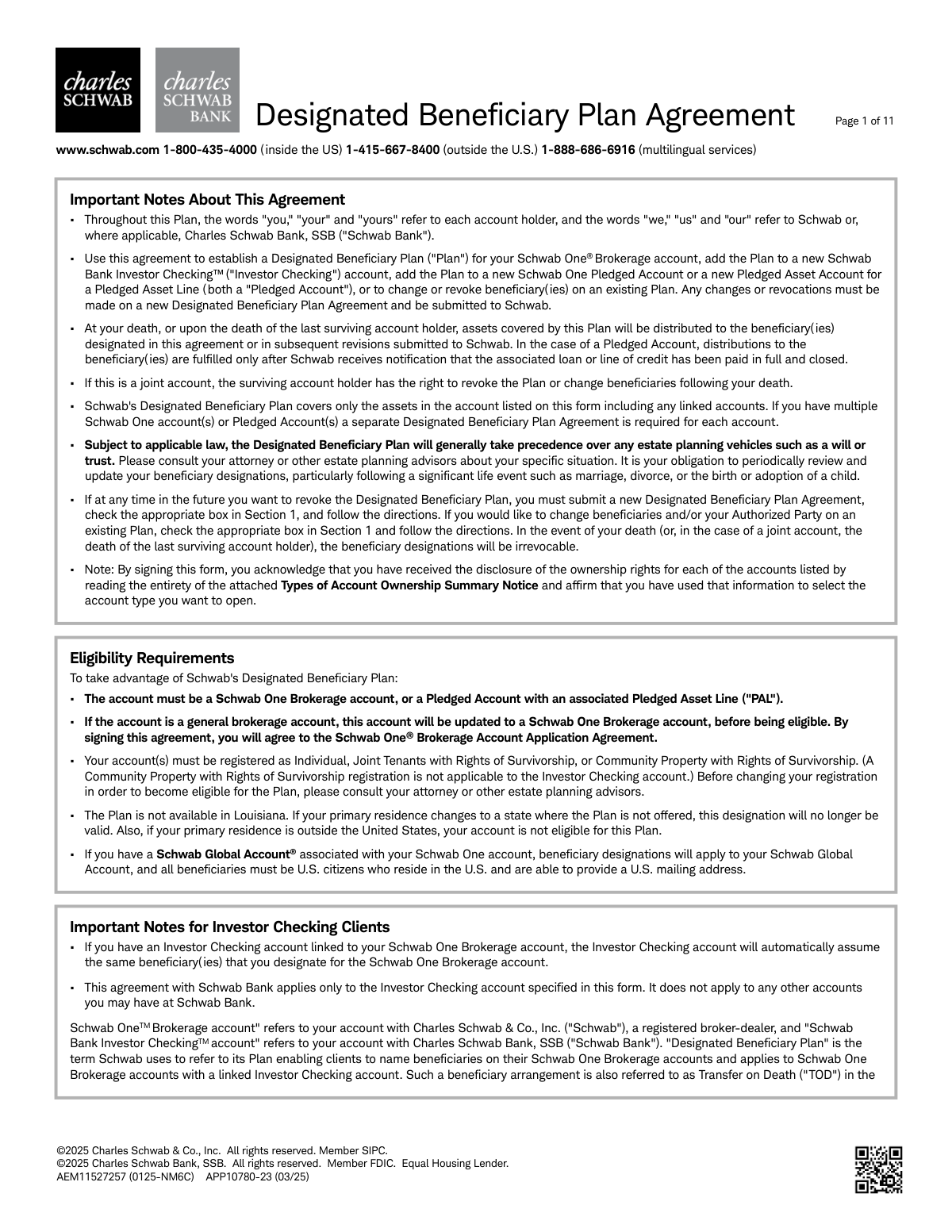
The Designated Beneficiary Plan Agreement is a crucial document for Charles Schwab clients to specify who will inherit the assets in their Schwab One Brokerage, Pledged, or linked Investor Checking accounts upon their death. This agreement, also known as a Transfer on Death (TOD) or Payable on Death (POD) arrangement, helps assets bypass the often lengthy probate process. Today, this form can be filled out quickly and accurately using AI-powered services like Instafill.ai, which can also convert non-fillable PDF versions into interactive fillable forms.
APP10780-23 is part of the
beneficiary forms category on Instafill.
Rather not fill this in by hand? Instafill is an online form filler that completes PDF forms automatically — upload the blank form, answer a few questions, and the AI fills every field.
Form specifications
| Form name: | Designated Beneficiary Plan Agreement |
| Number of pages: | 1 |
| Language: | English |
Our AI automatically handles information lookup, data retrieval, formatting, and form filling.
It takes less than a minute to fill out APP10780-23 using our AI form filling.
Securely upload your data. Information is encrypted in transit and deleted immediately after the form is filled out.
Instafill Demo: How to fill out PDF forms in seconds with AI
How to Fill Out APP10780-23 Online for Free in 2026
Are you looking to fill out a APP10780-23 form online quickly and accurately? Instafill.ai offers the #1 AI-powered PDF filling software of 2026, allowing you to complete your APP10780-23 form in just 37 seconds or less.
Follow these steps to fill out your APP10780-23 form online using Instafill.ai:
- 1 Navigate to Instafill.ai and upload or select the Charles Schwab Designated Beneficiary Plan Agreement form.
- 2 In Section 1, select the action you wish to take: add a new plan, change beneficiaries, or revoke an existing plan.
- 3 Complete Section 2 with your account information, including registration type, account number, and personal details.
- 4 In Section 5, carefully enter the full names, contact information, and percentage portions for your primary and contingent beneficiaries. You can also select a per stirpes or per capita distribution option.
- 5 Designate an Authorized Party in Section 6 to assist Schwab in identifying your beneficiaries after your death.
- 6 Specify instructions for any minor beneficiaries in Section 7 and provide custodian information if applicable.
- 7 Review all entered information for accuracy, then electronically sign and date the agreement in Section 8 to authorize your designations.
Our AI-powered system ensures each field is filled out correctly, reducing errors and saving you time.
Why Choose Instafill.ai for Your Fillable APP10780-23 Form?
Speed
Complete your APP10780-23 in as little as 37 seconds.
Up-to-Date
Always use the latest 2026 APP10780-23 form version.
Cost-effective
No need to hire expensive lawyers.
Accuracy
Our AI performs 10 compliance checks to ensure your form is error-free.
Security
Your personal information is protected with bank-level encryption.
Frequently Asked Questions About APP10780-23
This form allows you to name beneficiaries who will directly inherit the assets in your eligible Schwab account upon your death. This process, also known as Transfer on Death (TOD), typically avoids probate for the specified account.
You should fill out this form if you have an eligible Schwab One Brokerage, Pledged, or linked Investor Checking account and want to add, change, or remove beneficiaries. It is for account holders with Individual, Joint Tenants with Rights of Survivorship, or Community Property with Rights of Survivorship registrations.
You will need each beneficiary's full name, relationship to you, date of birth, Social Security or Tax ID number, and contact information. You must also specify the percentage of the account assets they should receive, ensuring the total for each beneficiary type (Primary/Contingent) adds up to 100%.
Primary beneficiaries are the first in line to inherit the account assets. Contingent beneficiaries will only inherit the assets if all of your designated primary beneficiaries have passed away before you.
An Authorized Party is a person you designate to help Schwab locate and identify your beneficiaries after your death. It is particularly important if you choose a 'per stirpes' or 'per capita' distribution, as Schwab will require this party to certify the identity of the heirs.
To change or revoke your beneficiaries, you must complete and submit a new Designated Beneficiary Plan Agreement form. In Section 1, check the box for 'Change beneficiaries' or 'Revoke an existing Plan' and follow the instructions.
Yes, a separate Designated Beneficiary Plan Agreement is required for each individual Schwab One or Pledged Account you wish to cover. However, a linked Investor Checking or Schwab Global account will automatically assume the same beneficiaries as the brokerage account.
In Section 7, you can designate a custodian to manage the assets in a custodial account (UTMA/UGMA) for the minor beneficiary. If you do not make this designation, a court-appointed guardian may be required to manage the minor's inheritance.
You can submit the form by uploading it via the secure Message Center on Schwab.com, faxing it to 1-888-526-7252, or bringing it to a local Schwab branch.
No, life events like marriage or divorce do not automatically change your beneficiary designations. You must submit a new form to officially remove or change a beneficiary.
These are two ways to distribute assets if a beneficiary dies before you. Per stirpes gives the deceased beneficiary's share to their children, while per capita distributes the assets equally among all living children of all deceased beneficiaries.
No, the Designated Beneficiary Plan is not available to residents of Louisiana or those whose primary residence is outside the United States. If you move to an ineligible location, the plan will become invalid.
Yes, services like Instafill.ai use AI to accurately auto-fill form fields with your information, which can save you time and help reduce errors.
Simply upload the Designated Beneficiary Plan Agreement PDF to the Instafill.ai platform. The AI will identify the fields, and you can use its browser extension to automatically populate your personal and beneficiary information from your saved profile.
You can use a service like Instafill.ai, which can convert flat, non-fillable PDFs into interactive, fillable forms. This allows you to easily type your information directly into the fields before printing and signing.
Compliance APP10780-23
Validation Checks by Instafill.ai
1
Ensures Exclusive Agreement Action Selection
This check verifies that exactly one option ('Add a new Plan', 'Change beneficiaries...', or 'Revoke an existing Plan') is selected in Section 1. Selecting more than one or none at all creates ambiguity in the account holder's intent. If this validation fails, the form cannot be processed as the primary action is unclear.
2
Validates Primary Residence Eligibility
This check confirms the account holder's primary residence is not in Louisiana or outside the United States, as stated in the eligibility requirements in Section 2. The Designated Beneficiary Plan is not legally valid in these jurisdictions. A submission from an ineligible residence will be rejected to prevent establishing an unenforceable plan.
3
Verifies Primary Beneficiary Portions Sum to 100%
This validation ensures that the sum of all percentage portions assigned to Primary Beneficiaries in Section 5 equals exactly 100%. This is critical for ensuring the complete and unambiguous distribution of account assets. If the total is not 100%, the form will be rejected to prevent disputes and legal complications during asset distribution.
4
Verifies Contingent Beneficiary Portions Sum to 100%
This validation ensures that the sum of all percentage portions assigned to Contingent Beneficiaries in Section 5 equals exactly 100%. Similar to primary beneficiaries, this is required for the clear and complete allocation of assets if no primary beneficiaries survive the account holder. Failure to sum to 100% will result in form rejection.
5
Ensures Mutually Exclusive Beneficiary Type
For each beneficiary entry in Section 5, this check verifies that information is provided for either an individual (First/Last Name) or an entity (Trust/Organization/Estate), but not both. This prevents data conflicts and ensures the legal identity of the beneficiary is clear. A record with both types of information filled in would be flagged as an error.
6
Prohibits Per Stirpes/Capita for Non-Individual Beneficiaries
This check validates that the 'Per Stirpes/Per Capita Distribution' option is not set to 'Yes' for any beneficiary designated as a Trust, Organization, or Estate. The form explicitly states these distribution methods are for individual beneficiaries only. Applying it to an entity is a logical error and would cause the submission to be rejected.
7
Validates SSN/Tax ID Number Format
This check ensures the 'Social Security/Tax ID Number' for each beneficiary in Section 5 conforms to the standard format for a U.S. SSN (9 digits) or Taxpayer Identification Number. Correct identification is legally required for tax reporting and asset distribution. An invalid format will halt processing until corrected.
8
Validates Date of Birth/Trust Date Format and Plausibility
This check verifies that the 'Date of Birth/Trust Date' in Section 5 is in the 'mm/dd/yyyy' format and represents a valid, past date. This is essential for identifying beneficiaries, determining if they are minors, and applying survivorship rules. An invalid or future date will cause a validation failure.
9
Requires Authorized Party for Per Stirpes/Capita Election
This validation confirms that if 'Per Stirpes' or 'Per Capita' is selected in Section 5, the 'Designate an Authorized Party' section (Section 6) is fully completed. The form states Schwab requires this party to help identify beneficiaries under these complex distribution scenarios. If this section is incomplete when required, the form will be rejected.
10
Cross-Validates Minor Beneficiary and Custodian Designation
This check creates a logical link between Section 5 and Section 7. If any beneficiary's date of birth indicates they are a minor, it verifies that option B in Section 7 is selected and a corresponding custodian is named for that minor. This ensures proper legal handling of assets for minors and prevents the need for court appointments later. A mismatch will result in an error.
11
Verifies All Signatures for Joint Accounts
This check confirms that if the 'Type of Registration' in Section 2 is 'Joint Tenants with Rights of Survivorship' or 'Community Property', all account holder signature fields in Section 8 are signed and dated. All owners of a joint account must consent to beneficiary changes. Missing signatures will render the agreement invalid and cause the submission to be rejected.
12
Validates Completeness for Revocation Action
If 'Revoke an existing Plan' is selected in Section 1, this check ensures that only Section 2 (Account Information) and Section 8 (Account Holder Authorization) are completed, as per the form's instructions. Filling out other sections, like beneficiary details, would be contradictory to the revocation action. The form would be returned for clarification if other sections are filled.
13
Prohibits P.O. Box for Legal Residence
This validation ensures that the 'Legal Residence Address' field in Section 2 does not contain 'P.O. Box'. A physical address is required for establishing legal residency, which is critical for determining eligibility for the plan. A P.O. Box is insufficient for this purpose and will cause the form to be flagged for correction.
14
Checks for Global Account Beneficiary Eligibility
Based on the form's notes, if the account is a Schwab Global Account, this check verifies that every designated beneficiary has their 'Country of Legal Residence' and 'Country(ies) of Citizenship' set to 'USA'. Non-U.S. beneficiaries are ineligible for this specific account type. A failure would require the account holder to change beneficiaries or be aware of account closure consequences.
Common Mistakes in Completing APP10780-23
A frequent error is assigning percentage portions to primary or contingent beneficiaries that do not add up to exactly 100%. This often happens due to simple miscalculation, especially when dividing assets among three or more people. An incorrect total will cause the form to be rejected, delaying the establishment of your beneficiary plan and leaving your account unprotected. To avoid this, double-check your math before submission; AI-powered tools like Instafill.ai can automatically validate these fields to ensure they sum correctly.
Applicants often leave critical beneficiary details blank, such as the Social Security Number (SSN), Tax ID Number (TIN), or a full date of birth. This information is vital for Schwab to correctly identify and locate beneficiaries upon the account holder's death. Missing data can lead to significant delays in asset distribution, require costly legal proceedings to verify identity, and in worst-case scenarios, result in assets being turned over to the state as unclaimed property. Always gather and enter all required information for each beneficiary.
When naming a minor as a beneficiary, many people forget to complete Section 7 to appoint a custodian under the Uniform Transfers to Minors Act (UTMA). They mistakenly assume naming the minor is sufficient. Without a designated custodian, the form states that a court-appointed guardian may be required to manage the assets, a process that is expensive, time-consuming, and subject to court supervision. To prevent this, always complete Section 7 and name a trusted adult as the custodian for any minor beneficiary.
For joint accounts, the form requires signatures from all account holders in Section 8 to add, change, or revoke a beneficiary plan. It's common for one account holder to fill out and sign the form, forgetting that their partner's signature is also mandatory. A form with a missing signature is invalid and will be rejected, meaning the intended beneficiary changes will not take effect. Ensure all parties listed on the account sign and date the form before submission.
Entering the Schwab One Brokerage or Pledged Account Number incorrectly in Section 2 is a simple but critical mistake. A single mistyped digit can result in the beneficiary plan being rejected or, worse, applied to the wrong account. This leaves your intended account without a valid transfer-on-death designation, potentially forcing it through probate. Carefully verify the account number against your account statement before writing it on the form. Using a tool like Instafill.ai can help by pre-filling this information accurately from your records.
The distinction between 'Per Stirpes' and 'Per Capita' in Section 4 is complex, and people often make a selection in Section 5 without fully understanding the consequences for their descendants. An incorrect choice can lead to assets being distributed in a way the account holder did not intend if a beneficiary predeceases them. The form defaults to 'Per Stirpes' if the selection is ambiguous, which may not be the desired outcome. It is crucial to review the examples and consult an estate planning advisor to make an informed decision.
The form explicitly states 'no P.O. boxes' for the legal residence address in Section 2, as this address is used to verify eligibility based on state law. Applicants sometimes enter a P.O. Box out of habit or for privacy reasons. This will lead to automatic rejection and processing delays, as a physical street address is required. Always provide your full physical primary residence address. Since this form is a non-fillable PDF, a service like Instafill.ai can convert it into an interactive version, making it easier to fill and validate such fields.
Many filers skip Section 6, 'Designate an Authorized Party,' viewing it as optional. However, this role is critical, especially if you've made a Per Stirpes or Per Capita election, as Schwab will rely on this person to help identify your beneficiaries' children. Failing to name an Authorized Party could force Schwab to wait for a court-appointed estate representative, causing major delays and legal costs for your heirs. To ensure a smooth transition, always designate a reliable Authorized Party and provide their complete contact information.
In Section 5, there are separate lines for an individual's name and for a 'Trust/Organization/Estate' name. A common error is to enter the full name of a trust in the 'First/Middle/Last' name fields, or an individual's name on the trust line. This ambiguity can create legal confusion about the intended beneficiary, potentially requiring Schwab to seek clarification from a court at the expense of the account. Ensure you use the correct field for the type of beneficiary you are designating.
The form has strict eligibility rules regarding residency that are often overlooked. For instance, the plan is invalid if the account holder's primary residence is in Louisiana or outside the U.S. (Section 2). Furthermore, if a linked Schwab Global Account exists, all beneficiaries must be U.S. citizens residing in the U.S. (Section 5). Naming an ineligible beneficiary can force the liquidation of foreign assets and cause significant complications. Always confirm your own eligibility and that of your beneficiaries before completing the form.
Saved over 80 hours a year
“I was never sure if my IRS forms like W-9 were filled correctly. Now, I can complete the forms accurately without any external help.”
Kevin Martin Green
Your data stays secure with advanced protection from Instafill and our subprocessors




Robust compliance program
Transparent business model
You’re not the product. You always know where your data is and what it is processed for.
ISO 27001, HIPAA, and GDPR
Our subprocesses adhere to multiple compliance standards, including but not limited to ISO 27001, HIPAA, and GDPR.
Security & privacy by design
We consider security and privacy from the initial design phase of any new service or functionality. It’s not an afterthought, it’s built-in, including support for two-factor authentication (2FA) to further protect your account.
Fill out APP10780-23 with Instafill.ai
Worried about filling PDFs wrong? Instafill securely fills designated-beneficiary-plan-agreement forms, ensuring each field is accurate.
