Yes! You can use AI to fill out TIAA Beneficiary Designation Form
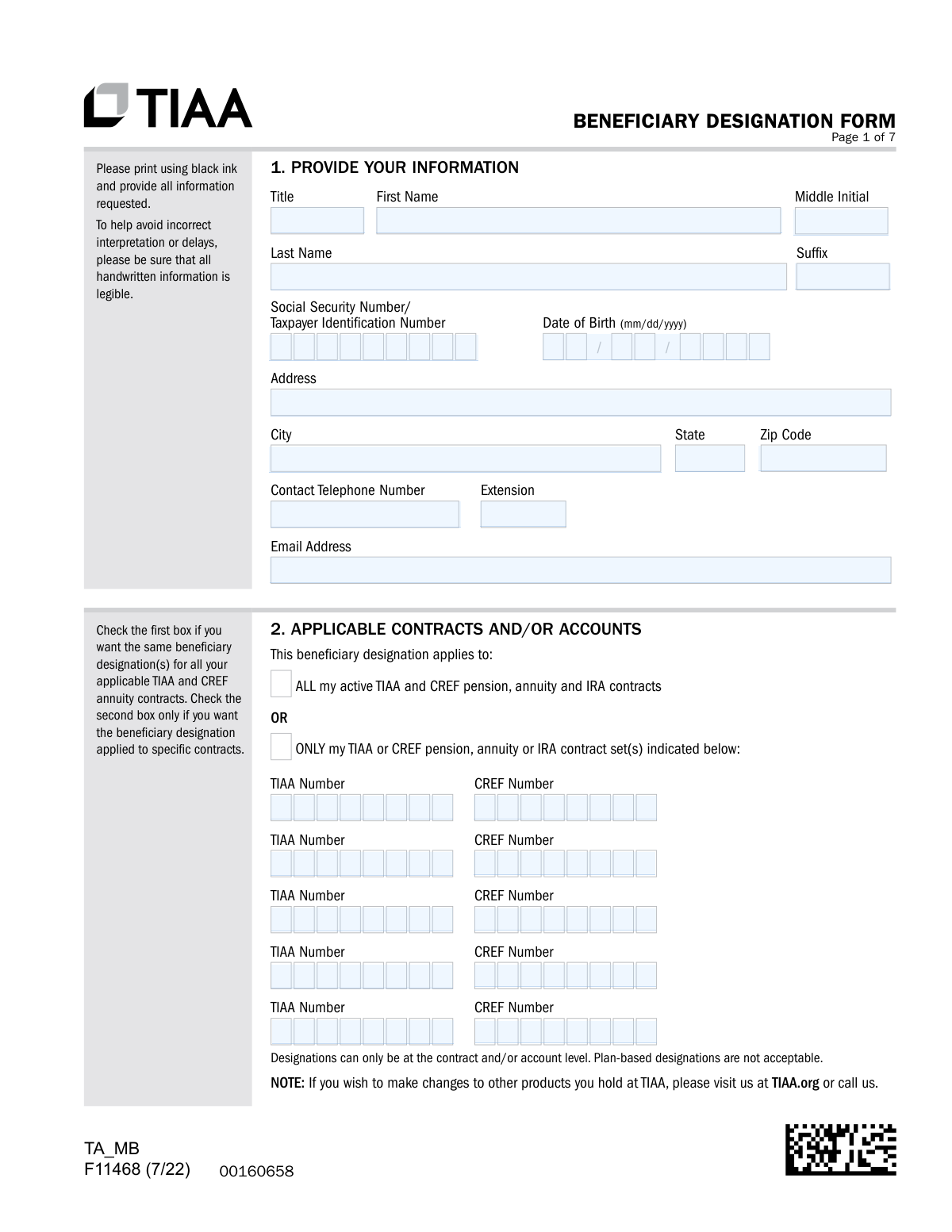
Form F11468 is a legal document provided by TIAA for retirement plan holders to name the individuals, trusts, or organizations who will receive their account assets upon their death. Properly completing this form is crucial to ensure your assets are distributed according to your wishes, avoiding potential legal complications for your heirs. Today, this form can be filled out quickly and accurately using AI-powered services like Instafill.ai, which can also convert non-fillable PDF versions into interactive fillable forms.
F11468 is part of the
beneficiary forms, beneficiary designation forms, TIAA forms, retirement account forms and financial planning forms categories on Instafill.
Rather not fill this in by hand? Instafill is an online form filler that completes PDF forms automatically — upload the blank form, answer a few questions, and the AI fills every field.
Form specifications
| Form name: | TIAA Beneficiary Designation Form |
| Number of pages: | 1 |
| Language: | English |
Our AI automatically handles information lookup, data retrieval, formatting, and form filling.
It takes less than a minute to fill out F11468 using our AI form filling.
Securely upload your data. Information is encrypted in transit and deleted immediately after the form is filled out.
Instafill Demo: How to fill out PDF forms in seconds with AI
How to Fill Out F11468 Online for Free in 2026
Are you looking to fill out a F11468 form online quickly and accurately? Instafill.ai offers the #1 AI-powered PDF filling software of 2026, allowing you to complete your F11468 form in just 37 seconds or less.
Follow these steps to fill out your F11468 form online using Instafill.ai:
- 1 Navigate to Instafill.ai and upload or select the TIAA Beneficiary Designation Form (F11468).
- 2 Use the AI assistant to accurately fill in your personal information in Section 1, including your name, Social Security Number, and contact details.
- 3 In Section 2, specify whether the designation applies to all your TIAA/CREF contracts or only specific ones by providing the contract numbers.
- 4 Complete Section 3 by providing the full name, contact information, SSN, date of birth, and percentage of benefits for each primary beneficiary.
- 5 Optionally, fill out Section 4 to name contingent beneficiaries who will inherit your assets if all primary beneficiaries are deceased.
- 6 Electronically sign and date the form in Section 5. If required, have your spouse complete the consent section (Section 6B), which may need notarization.
- 7 Review the entire form for accuracy, then download the completed document to submit to TIAA via their mobile app, website upload, fax, or mail.
Our AI-powered system ensures each field is filled out correctly, reducing errors and saving you time.
Why Choose Instafill.ai for Your Fillable F11468 Form?
Speed
Complete your F11468 in as little as 37 seconds.
Up-to-Date
Always use the latest 2026 F11468 form version.
Cost-effective
No need to hire expensive lawyers.
Accuracy
Our AI performs 10 compliance checks to ensure your form is error-free.
Security
Your personal information is protected with bank-level encryption.
Frequently Asked Questions About F11468
This form is used to designate new beneficiaries or update existing ones for your TIAA retirement plan, pension, annuity, and IRA contracts. It ensures your assets are distributed according to your wishes after your death.
A primary beneficiary is the first person or entity to receive your account assets upon your death. A contingent beneficiary only receives the assets if all of your primary beneficiaries have passed away before you.
You need to provide each beneficiary's full name, address, phone number, email, date of birth, Social Security Number (SSN) or Taxpayer ID, and their relationship to you. Complete information is crucial for TIAA to locate them without delay.
Federal law and some plans require your spouse to receive at least 50% of the death benefit. If you name someone other than your spouse as more than 50% primary beneficiary, your spouse must sign a consent waiver in Section 6B, which must be notarized.
Their share is typically divided among the other living beneficiaries in that class. However, you can check the 'Payments made to this deceased beneficiary’s children' box to have their share go directly to their children, if any.
The form has space for four primary and four contingent beneficiaries. If you need to add more, check the box at the end of Section 3 and attach a separate, signed letter with the additional names and required information.
Yes, you can name a trust as a beneficiary. For a testamentary trust (one created by a will), you must provide the date the will was created, as simply designating a 'Will' is not acceptable.
You can submit the form by uploading it via the TIAA mobile app or at tiaa.org/upload. You may also send it by fax or mail to the addresses listed on the form's checklist page.
Yes, in Section 2, you can check a box to apply the designation to all your active TIAA and CREF contracts. Alternatively, you can list specific contract numbers to apply the changes only to those accounts.
Your spouse must sign in the presence of a Notary Public or a Plan Representative. The form notes you can use an online service like Notarize.com/TIAA, visit a traditional notary, or go to a U.S. Embassy if abroad.
While you can use this form, TIAA recommends updating your beneficiary designation online at TIAA.org/profile for the fastest and most direct way to make changes.
Yes, services like Instafill.ai use AI to accurately auto-fill form fields with your information. This can save you time and help prevent common errors when completing the form.
Simply upload the TIAA Beneficiary Designation form to the Instafill.ai platform. The AI will identify the fields and help you fill them in with your personal and beneficiary details quickly and accurately.
You can use a service like Instafill.ai, which can convert flat, non-fillable PDFs into interactive forms you can complete on your computer. This makes it easy to type your information directly into the fields before printing.
Compliance F11468
Validation Checks by Instafill.ai
1
Primary Beneficiary Percentage Summation
This check verifies that the sum of percentages assigned to all listed primary beneficiaries equals exactly 100%. This is crucial to ensure the entire account balance is allocated as intended by the account holder. If the percentages do not total 100%, the form is considered incomplete and will be rejected, as it creates ambiguity in how the assets should be distributed upon death.
2
Contingent Beneficiary Percentage Summation
This validation ensures that if contingent beneficiaries are named, the percentages assigned to them also sum to exactly 100%. Contingent beneficiaries only receive assets if all primary beneficiaries are deceased, and their allocation must also be clearly defined. A failure to sum to 100% will cause the form to be rejected to prevent disputes and ensure the account holder's secondary wishes are fully accounted for.
3
Spousal Consent Requirement for Non-Spouse Primary Beneficiary
This is a critical logical check based on marital status and beneficiary designation. If the account holder is married and designates someone other than their spouse as a primary beneficiary for more than 50% of the assets, the spousal consent in Section 6B must be completed, signed, and witnessed. This is required by ERISA and community property laws to ensure the spouse knowingly waives their legal right to the death benefit, preventing legal challenges later.
4
Spousal Consent Signature Date Chronology
This check validates that the spouse's signature date in Section 6B is on the same day as or a later date than the account holder's signature date in Section 5. This is important to legally confirm that the spouse is consenting to a designation that has already been made by the account holder. A spouse's signature dated before the account holder's would invalidate the consent, as they could not have been aware of the final designation they were waiving their rights to.
5
Exclusive Contract Designation Selection
This check ensures that the user has made a clear choice in Section 2 regarding which contracts the designation applies to. The user must select either the 'ALL my active...contracts' checkbox OR provide specific contract numbers in the fields below, but not both. If the 'ONLY' option is chosen, at least one TIAA or CREF contract number must be provided, otherwise the designation has no target.
6
Account Holder SSN/TIN Format and Presence
This validation verifies that the Social Security Number or Taxpayer Identification Number in Section 1 is present and follows the correct format (e.g., XXX-XX-XXXX or XX-XXXXXXX). This number is the primary unique identifier for the account holder and is essential for tax reporting and legal verification. An invalid or missing SSN/TIN will prevent the form from being processed.
7
Account Holder Signature and Date Presence
This check confirms that the account holder has signed and dated the form in Section 5. The signature legally binds the account holder to the designations made on the form, and the date establishes when the designation was made. Missing either the signature or the date renders the entire document legally invalid and unenforceable.
8
Beneficiary Date of Birth/Trust Date Validity
This validation checks that any date entered in the 'Date of Birth/Date of Trust/Issue Date of Will' field for a beneficiary is in a valid mm/dd/yyyy format and is not a future date. This date is critical for identifying the beneficiary, especially for individuals, or for verifying the existence of a trust. An invalid or future date would make it impossible to properly identify the beneficiary or legal entity.
9
Marital Status Declaration Completeness
This check ensures that the user has completed the marital status section by either checking the 'I am not married' box in Section 6A or by providing spousal information in Section 6B. This declaration is mandatory because it determines whether spousal consent rules apply to the beneficiary designations. Failure to declare marital status leaves a critical legal requirement unaddressed and will halt processing.
10
Spousal Consent Witness Verification
This validation confirms that if the spousal consent in Section 6B is signed, it is also properly witnessed by either a Notary Public (Option 1) or a Plan Representative (Option 2). The witness signature and details are required to attest that the spouse signed the document willingly and to verify their identity. An unwitnessed spousal signature is legally insufficient and will cause the waiver to be rejected.
11
Beneficiary Information Completeness
For each primary or contingent beneficiary listed, this check verifies that at a minimum, the First Name, Last Name, and Percentage fields are completed. While the form encourages providing full details, these fields are the absolute minimum required to create a valid designation. Without a name and an allocation percentage, the entry is meaningless and cannot be processed.
12
Trust Designation Date Requirement
This check is triggered if a beneficiary's 'Relationship' is listed as 'Trust' or similar. It verifies that the 'Date of Birth/Date of Trust/Issue Date of Will' field is populated with the trust's creation date or the will's issue date for a testamentary trust. The form explicitly states a 'Will' is not a valid designation but a testamentary trust is, and this date is required to validate the existence of the specified legal instrument.
Common Mistakes in Completing F11468
People often leave fields like the beneficiary's Social Security Number, date of birth, or full address blank, especially if they don't have the information readily available. This can significantly delay or complicate the process of locating the beneficiary and distributing the assets after your death. To avoid this, gather all required information before filling out the form and double-check each entry for completeness.
When naming multiple primary or contingent beneficiaries, the percentages assigned to each group must add up to exactly 100%. Filers frequently make simple math errors or forget to assign a percentage if they want an equal split, causing the form to be rejected. This delays the update, leaving the old designation in effect, which may not reflect your current wishes. Always verify that the percentages for your primary beneficiaries total 100%, and do the same for your contingent beneficiaries.
If you are married and designate someone other than your spouse as the primary beneficiary for 50% or more of the benefit, your spouse must sign a consent waiver in Section 6B. This section is often missed or completed incorrectly, which can invalidate your non-spousal designation, forcing the benefit to be paid to your spouse against your wishes. Ensure your spouse signs and dates the form correctly in the presence of a Notary Public or Plan Representative.
The spousal consent section requires the spouse's signature date to be on or after the account holder's signature date, and it must be witnessed by a Notary or Plan Representative. Common errors include the spouse signing before the account holder or the notary's information being incomplete. An invalid notarization will cause the entire beneficiary designation to be rejected, requiring you to restart the process.
In Section 2, filers must choose whether the designation applies to ALL contracts or ONLY specific ones. People may check 'ONLY' but fail to list all intended contract numbers, or they may check 'ALL' without realizing it overrides previous, specific designations. This can lead to your assets being distributed in a way you did not intend. Carefully review your accounts and decide if a universal or specific designation is appropriate, ensuring you list all relevant contract numbers if needed.
Filers often focus on primary beneficiaries and neglect to complete Section 4 for contingent beneficiaries. If all your primary beneficiaries predecease you and no contingent beneficiaries are named, the benefits will be paid to your estate by default. This can result in a lengthy and costly probate process for your heirs. Always name at least one contingent beneficiary to ensure a smoother transfer of assets if your primary choices are unable to inherit.
The form includes a checkbox to pass a deceased beneficiary's share to their children (a per stirpes designation). Many people either overlook this option or misunderstand its function, assuming it happens automatically. Failing to check this box means the deceased beneficiary's share will be divided among the other living primary beneficiaries, potentially disinheriting your grandchildren. Carefully consider for each beneficiary whether you want their share to go to their children if they pass away before you.
The form explicitly states that a 'Will' cannot be accepted as a beneficiary designation, yet people sometimes write 'Per my will' in the beneficiary field. This will invalidate the designation, as the form requires specific individuals, trusts, or organizations to be named. If you wish for the assets to be distributed according to your will, you must name your Estate as the beneficiary, though the form advises consulting an attorney as this may have negative consequences.
Since this is a paper form that is often handwritten, information can be illegible, or fields like middle initial, suffix, or full address can be left incomplete. This can cause processing delays or errors in identifying you and your beneficiaries. To prevent this, print clearly in black ink as instructed. AI-powered tools like Instafill.ai can convert the non-fillable PDF into a fillable version, ensuring all data is entered legibly and in the correct format.
A simple but critical error is forgetting to sign and date the form in Section 5. An unsigned form is invalid and will not be processed, leaving your previous beneficiary designation in place. Similarly, entering a date that conflicts with the spousal consent date can also cause rejection. Always perform a final review to ensure you have signed and correctly dated the form before submitting it.
Saved over 80 hours a year
“I was never sure if my IRS forms like W-9 were filled correctly. Now, I can complete the forms accurately without any external help.”
Kevin Martin Green
Your data stays secure with advanced protection from Instafill and our subprocessors




Robust compliance program
Transparent business model
You’re not the product. You always know where your data is and what it is processed for.
ISO 27001, HIPAA, and GDPR
Our subprocesses adhere to multiple compliance standards, including but not limited to ISO 27001, HIPAA, and GDPR.
Security & privacy by design
We consider security and privacy from the initial design phase of any new service or functionality. It’s not an afterthought, it’s built-in, including support for two-factor authentication (2FA) to further protect your account.
Fill out F11468 with Instafill.ai
Worried about filling PDFs wrong? Instafill securely fills tiaa-beneficiary-designation-form forms, ensuring each field is accurate.
