Fill out TIAA forms
with AI.
TIAA forms are essential documents for managing retirement accounts, brokerage portfolios, and insurance policies within the TIAA ecosystem. These forms facilitate critical financial actions, such as consolidating retirement savings through rollovers, initiating asset transfers from external institutions, and managing distributions for retirement income. Properly completing these documents ensures that your long-term investments are handled according to federal regulations and your personal financial goals while maintaining the tax-advantaged status of your accounts.
By continuing, you acknowledge Instafill's Privacy Policy and agree to get occasional product update and promotional emails.
About TIAA forms
These forms are typically required by educators, healthcare workers, and non-profit employees who utilize TIAA for their employer-sponsored retirement plans. You may need to access this category when transitioning between jobs, planning for estate distribution, or authorizing a third party to manage your accounts. For example, the Beneficiary Designation Form and the IRA Transfer or Rollover Authorization are frequently used to ensure assets are protected and moved efficiently. Tools like Instafill.ai use AI to fill these forms in under 30 seconds, handling data accurately and securely to save you time.
Whether you are requesting a distribution from a brokerage account or setting up a power of attorney, accuracy is paramount to avoid processing delays or tax complications. Navigating complex paperwork like the Brokerage IRA Distribution Request or hardship withdrawal applications can be time-consuming, but having the right tools makes the process manageable. By streamlining the documentation process, individuals can focus more on their financial future and less on the administrative burden of manual data entry.
Every form on this page can be completed without typing. Instafill is form filling software that reads a PDF and fills it for you — including flat and scanned documents that carry no fillable fields at all.
Forms in This Category
The forms in this category have a median Form Complexity Index of 59/100 (Moderate), measured across 33 forms by field count, input difficulty, length, conditional logic and structure. See how it is calculated.
- Enterprise-grade security & data encryption
- 99%+ accuracy powered by AI
- 1,000+ forms from all industries
- Complete forms in under 60 seconds
How to Choose the Right Form
Moving Funds into TIAA
If you are consolidating your retirement assets or transferring investments from another institution, your choice depends on the destination account:
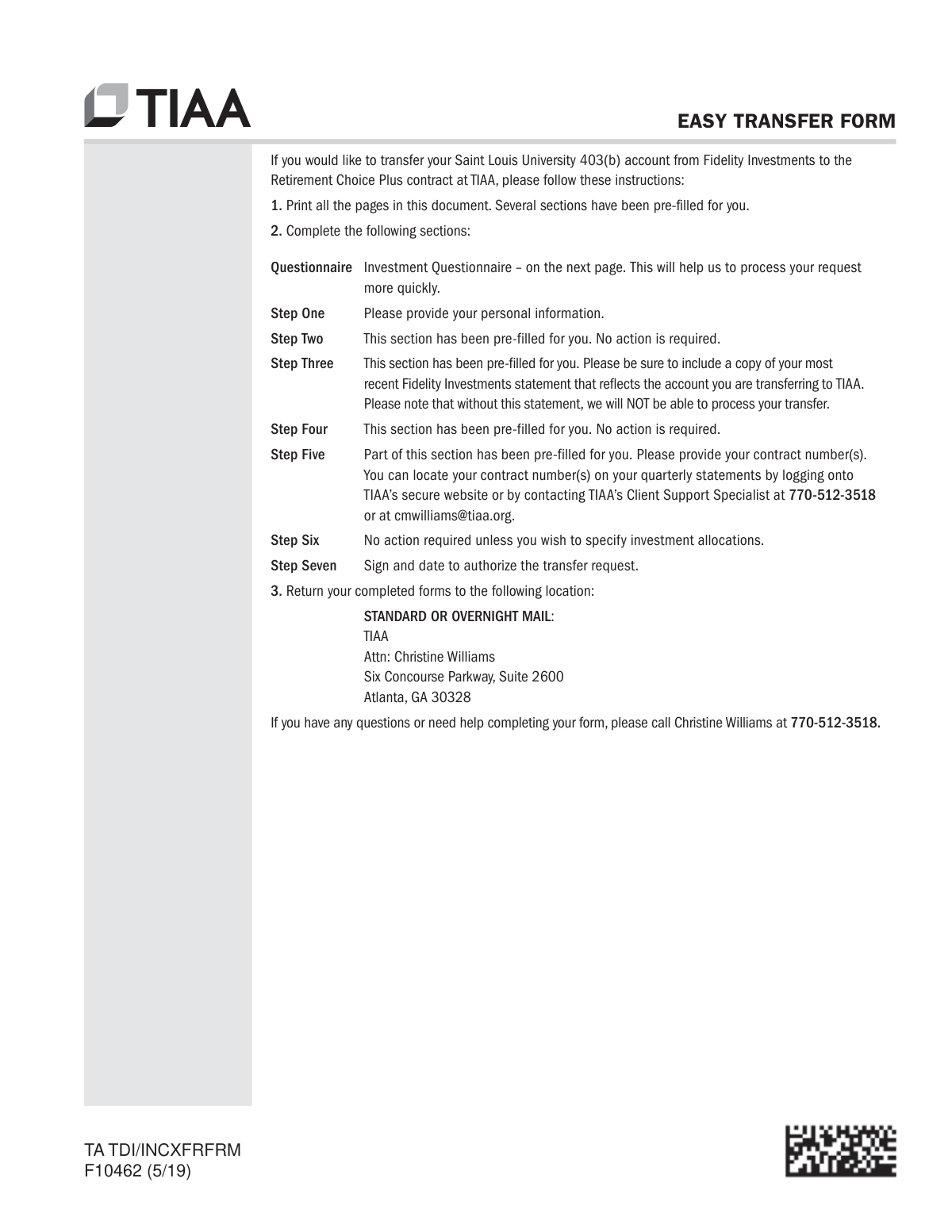
- Employer-Sponsored Plans: Use Form F10462 (Easy Transfer Form) to move funds from a previous employer or financial carrier into your current TIAA 403(b) or 401(k).
- Brokerage Accounts: Use the TIAA Brokerage Incoming Account Transfer Form (F11043) to transfer stocks, mutual funds, or other securities.
- IRAs: For direct transfers into a TIAA IRA, use Form F10463. If you have already received a check from another provider and need to deposit it within the 60-day window, use Form F11260 (IRA 60-Day Rollover Request).
Taking Distributions or Withdrawals
When you need to access your money, the correct form is determined by the specific product you hold:
- Standard Distributions: Use Form F11025 for TIAA Brokerage IRA distributions or Form A11752 for Retail Class TIAA-CREF Funds.
- Financial Emergencies: If you need an early withdrawal due to IRS-qualified financial stress, use the Request for Hardship Withdrawal (Form F11270).
- Annuity Exchanges: To move TIAA Traditional balances to another company via a tax-free 1035 exchange, use Form F10926.
Designating Beneficiaries
Updating your beneficiaries is essential for estate planning. TIAA uses different forms for different account types:
- Retirement & Annuity Accounts: Use Form F11468 or Form F1387 for most employer-sponsored and TIAA-CREF accounts.
- Brokerage IRAs: Use Form F11015 specifically for brokerage-based retirement assets.
- Life Insurance: Use the TIAA Life Insurance Beneficiary Designation Form to ensure death benefits are paid correctly.
Account Access and Legal Authorization
To grant others access to your accounts, use Form F10352 (Authorization to Access TIAA Accounts) for simple information sharing. For legal authority to trade or manage assets, use the TIAA Brokerage Power of Attorney (Form F11014), often accompanied by the Durable Power of Attorney Affidavit (Form F11424).
Form Comparison
| Form | Primary Action | Account Type | Key Benefit |
|---|---|---|---|
| TIAA Brokerage Incoming Account Transfer Form | Transfer external assets | TIAA Brokerage | Consolidates stocks and mutual funds into one managed account |
| Easy Transfer Form: Moving Funds to an Employer-Sponsored Retirement Plan at TIAA | Consolidate retirement funds | Employer-Sponsored Plan | Moves 403(b) or 401(k) assets into a TIAA plan |
| TIAA IRA Transfer or Rollover Authorization | Direct transfer of assets | TIAA IRA | Permits tax-free movement of funds from other IRA providers |
| Form F11260, TIAA IRA 60-Day Rollover Request | Indirect rollover deposit | TIAA IRA | Allows depositing funds previously distributed to the account holder |
| TIAA Brokerage IRA Distribution Request (Form F11025) | Withdraw funds | Brokerage IRA | Facilitates one-time, recurring, or Required Minimum Distributions (RMDs) |
| TIAA Form F11270, Request for Hardship Withdrawal | Emergency withdrawal | Retirement Plan | Provides access to funds for immediate, heavy financial needs |
| Form F10352, Authorization to Access TIAA Accounts | Grant viewing access | All TIAA Accounts | Allows financial advisors or family members to see account details |
| Form F11014, TIAA Brokerage Power of Attorney (POA) Form | Appoint legal agent | TIAA Brokerage | Delegates trading or disbursement authority to a trusted person |
| TIAA Beneficiary Designation Form | Name heirs | Retirement Plans | Ensures assets are distributed according to owner wishes after death |
| TIAA Brokerage Authorization To Gift Securities | Transfer ownership | Taxable Brokerage | Formally gifts stocks or bonds to another person or organization |
| TIAA 1035 Exchange Authorization to Alternate Investment Company | Tax-free annuity transfer | Annuity Contracts | Moves Traditional account balances to alternate companies without tax penalties |
| TIAA Brokerage Durable Power Of Attorney Affidavit Of Full Force And Effect | Validate legal authority | TIAA Brokerage | Attests that an existing Power of Attorney remains valid and active |
Tips for TIAA forms
Ensure your primary and contingent beneficiaries are updated across all TIAA accounts to prevent assets from entering probate. Review these forms after major life events like marriage, divorce, or the birth of a child to ensure your estate plan remains accurate.
When performing a manual rollover using forms like F11260, you must deposit the funds into your TIAA account within 60 days of receipt. Missing this window can result in the distribution being treated as taxable income and may trigger early withdrawal penalties.
AI-powered tools like Instafill.ai can complete these complex financial forms in under 30 seconds with high accuracy. Your sensitive financial data stays secure during the process, providing a reliable way to manage multiple retirement and brokerage documents efficiently.
Many TIAA retirement plan forms require a spouse’s signature to authorize distributions or changes to beneficiary designations. Check the signature section carefully, as some forms may also require the signature to be witnessed by a notary public or a plan representative.
When filling out incoming transfer forms, double-check the account numbers and delivery instructions for the delivering financial institution. Even a minor clerical error in an account number can cause significant delays in the asset consolidation process.
For distribution requests, you must specify your federal and state tax withholding preferences. Failing to select an option or choosing an incorrect percentage can lead to unexpected tax liabilities when you file your annual return.
Frequently Asked Questions
The TIAA forms library includes documents for a wide range of actions, including transferring funds from external accounts, rolling over existing IRAs, designating beneficiaries, and requesting distributions. You will also find forms for specialized needs like hardship withdrawals, Power of Attorney authorizations, and gifting securities from brokerage accounts.
Selecting the right form depends on the source of your funds and the type of TIAA account you are using. Use the 'Easy Transfer' or 'Employer-Sponsored' forms for moving assets into a workplace plan, while the 'IRA Transfer or Rollover' forms are designed for consolidating personal retirement accounts into a TIAA IRA.
Yes, AI tools like Instafill.ai can fill these forms in under 30 seconds by accurately extracting and placing data from your source documents. This technology helps ensure that sensitive financial information is transferred precisely into the correct fields, reducing the risk of processing delays.
A direct transfer moves funds directly between financial institutions, which is generally simpler and avoids tax withholding. A 60-day rollover occurs when you receive a check personally and must deposit those funds into a TIAA account within 60 days to avoid taxes and potential penalties, requiring specific forms like the F11260.
Naming primary and contingent beneficiaries ensures that your retirement or brokerage assets are distributed according to your wishes upon your death. Without these forms on file, your assets may be subject to probate, which can be a lengthy and expensive legal process for your heirs.
Using traditional manual entry can take quite a while, but AI-powered services like Instafill.ai can complete these forms in under 30 seconds. The AI automatically identifies the required fields and populates them with data from your existing financial records or identity documents.
You can use an 'Authorization to Access' form to allow a third party, such as a financial advisor, to view your account details. If you need someone to actively manage or trade within your account, you will typically need to complete a Power of Attorney (POA) form and, in some cases, a Durable Power of Attorney Affidavit.
If you are facing an immediate and heavy financial need as defined by the IRS, you may need to submit a Request for Hardship Withdrawal. This process usually requires you to certify the nature of the hardship and provide supporting documentation to prove the financial necessity.
Yes, TIAA generally requires separate forms for different types of products. For example, life insurance policies, brokerage accounts, and standard retirement annuities each have their own specific beneficiary designation forms to ensure the distribution matches the legal requirements of that specific asset type.
Most forms provide specific submission instructions on the final page, which may include a mailing address, a secure fax number, or an option for digital upload through the TIAA website. Always ensure you have signed and dated the form, as missing signatures are a common cause for forms being returned or rejected.
Glossary
- Form Complexity Index
- Instafill’s 0–100 measure of how much effort a form takes to complete, calculated deterministically from the form’s own structure rather than estimated. It combines the number of fillable fields (the largest factor), how difficult those fields are to complete based on their type, the number of pages that contain fields, the amount of conditional “fill-only-if” logic, and how many sections the form is divided into, then adds modifiers for tables and repeating lists, bundled instruction pages, and dense page layouts. A higher score means the form is harder to fill out by hand. The forms in this category have a median Form Complexity Index of 59/100 (Moderate). See exactly how it is calculated.
- Rollover
- The process of moving retirement savings from one qualified account, like a 401(k), into another retirement plan or an IRA while maintaining tax-deferred status.
- Direct Transfer
- A method of moving assets directly between financial institutions where the account holder never receives the funds, ensuring no taxes or penalties are triggered.
- Beneficiary Designation
- A formal instruction identifying the person, trust, or organization that will receive your account assets or death benefits upon your passing.
- Required Minimum Distribution (RMD)
- The minimum amount the IRS mandates you withdraw from your retirement accounts each year once you reach a certain age, currently 73 for most individuals.
- 403(b) Plan
- A tax-advantaged retirement savings plan available for employees of public schools, certain non-profits, and cooperative hospital service organizations.
- 1035 Exchange
- An IRS-approved tax-free exchange of an existing annuity or life insurance contract for a new one, often used when moving funds between insurance providers.
- ERISA
- The Employee Retirement Income Security Act, a federal law that sets minimum standards for retirement plans in private industry to protect individuals.
- Hardship Withdrawal
- An early distribution from a retirement plan taken to meet an immediate and heavy financial need, such as medical expenses or preventing eviction.