Yes! You can use AI to fill out TIAA IRA Transfer or Rollover Authorization
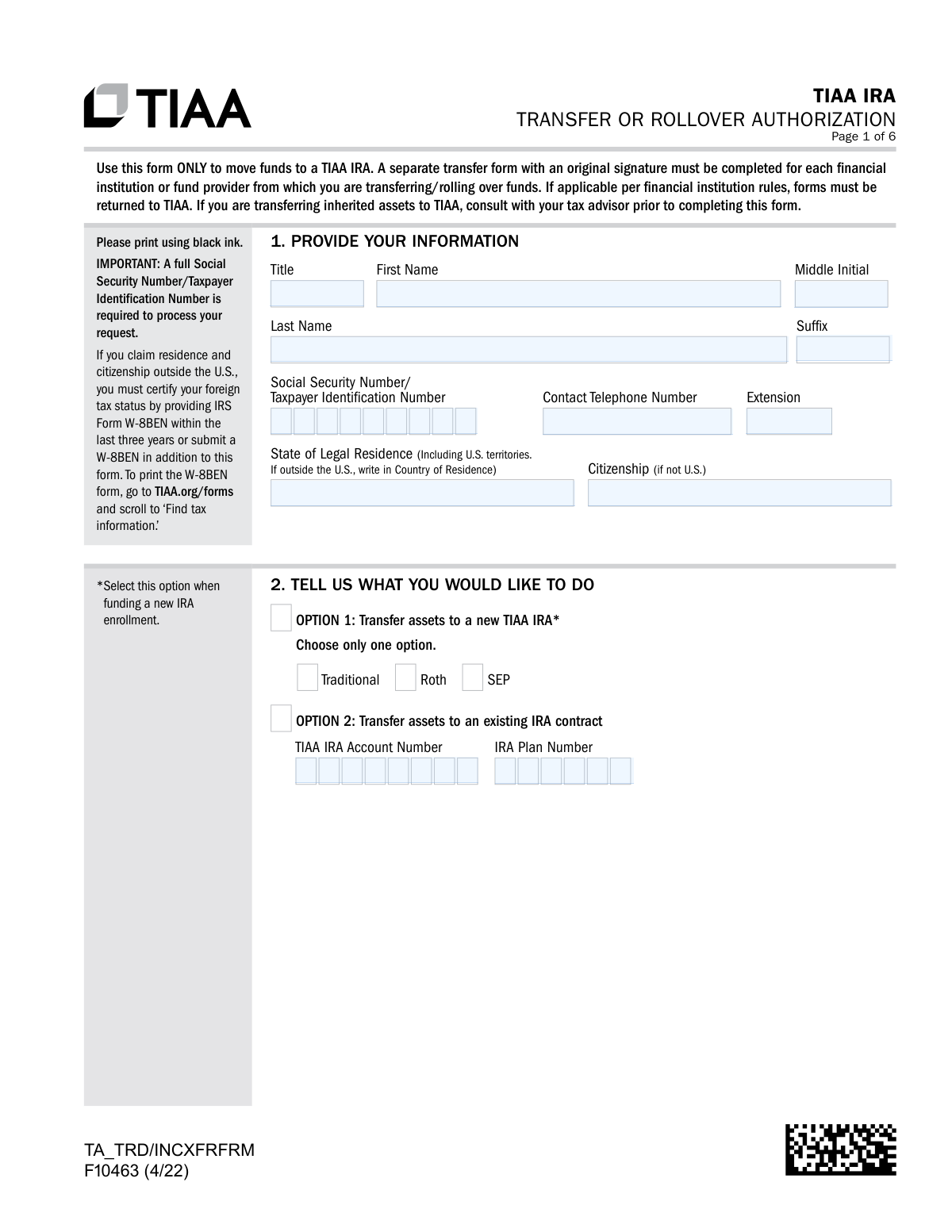
Form F10463 is a legal document that grants TIAA permission to initiate a direct transfer or rollover of retirement assets from another provider into a TIAA IRA. It is essential for individuals looking to consolidate their retirement savings, such as 401(k)s, 403(b)s, or other IRAs, into a single TIAA account. Today, this form can be filled out quickly and accurately using AI-powered services like Instafill.ai, which can also convert non-fillable PDF versions into interactive fillable forms.
F10463 is part of the
IRA forms, TIAA forms, IRA rollover forms and IRA transfer forms categories on Instafill.
Rather not fill this in by hand? Instafill is an online form filler that completes PDF forms automatically — upload the blank form, answer a few questions, and the AI fills every field.
Form specifications
| Form name: | TIAA IRA Transfer or Rollover Authorization |
| Number of pages: | 1 |
| Language: | English |
Our AI automatically handles information lookup, data retrieval, formatting, and form filling.
It takes less than a minute to fill out F10463 using our AI form filling.
Securely upload your data. Information is encrypted in transit and deleted immediately after the form is filled out.
Instafill Demo: How to fill out PDF forms in seconds with AI
How to Fill Out F10463 Online for Free in 2026
Are you looking to fill out a F10463 form online quickly and accurately? Instafill.ai offers the #1 AI-powered PDF filling software of 2026, allowing you to complete your F10463 form in just 37 seconds or less.
Follow these steps to fill out your F10463 form online using Instafill.ai:
- 1 Navigate to Instafill.ai and upload the TIAA IRA Transfer or Rollover Authorization form or select it from their template library.
- 2 Provide your personal information in Section 1, including your full name, Social Security Number, and contact details.
- 3 In Section 3, enter the details of the financial institution where the funds are currently held, using a recent account statement for accuracy.
- 4 Specify the type of account you are rolling over (Section 5) and provide clear liquidation instructions for the assets (Section 6).
- 5 Choose how the transferred funds will be allocated within your TIAA IRA in Section 7.
- 6 Carefully review all the information populated by the AI for accuracy, then provide your digital signature in Section 8 to authorize the transaction.
- 7 Submit the completed form along with a copy of your most recent account statement from the other institution as instructed on the form.
Our AI-powered system ensures each field is filled out correctly, reducing errors and saving you time.
Why Choose Instafill.ai for Your Fillable F10463 Form?
Speed
Complete your F10463 in as little as 37 seconds.
Up-to-Date
Always use the latest 2026 F10463 form version.
Cost-effective
No need to hire expensive lawyers.
Accuracy
Our AI performs 10 compliance checks to ensure your form is error-free.
Security
Your personal information is protected with bank-level encryption.
Frequently Asked Questions About F10463
This form is used to authorize the movement of funds from another financial institution or an employer-sponsored retirement plan directly into a new or existing TIAA Individual Retirement Account (IRA).
You must include a complete copy of a recent account statement, dated within the last 12 months, from the financial institution you are transferring funds from. A separate form is required for each institution.
The entire process can take up to six weeks. The timeline largely depends on how quickly your other financial institution responds to TIAA's transfer request.
It is a special signature verification stamp that may be required by your current financial institution to release the funds. You must confirm with them if it's needed; if so, TIAA can help provide this service.
No, you must complete a separate transfer form with an original signature for each financial institution or fund provider from which you are moving funds.
No, you cannot directly roll over a non-Roth account into a TIAA Roth IRA. You must first transfer the funds into a TIAA Traditional IRA and then perform a separate Roth conversion.
You can choose to liquidate your entire account, or you can specify a portion by dollar amount, percentage, or number of shares. For Certificates of Deposit (CDs), you can choose to liquidate immediately or at maturity.
In Section 7, you can either use the current allocation on file for your TIAA account or have the funds placed into your IRA’s default cash vehicle. If your selection is invalid, the funds will go to the default option.
You can submit the form digitally, upload it via the TIAA mobile app or website, or send it by fax or mail. The specific addresses and fax numbers are provided in the form's checklist.
Yes, a SIMPLE IRA must be established for at least two years before you can transfer it to a non-SIMPLE IRA. Transferring it earlier may result in a taxable distribution and an increased early withdrawal penalty.
Yes, services like Instafill.ai use AI to accurately auto-fill form fields. This can help you complete the form faster and with fewer errors.
You can use a service like Instafill.ai to upload the PDF and fill it out on your computer. This allows you to type directly into the fields and then download the completed form for submission.
If you have a non-fillable or 'flat' PDF, you can use a tool like Instafill.ai. It can convert the document into an interactive, fillable form that you can complete online.
Compliance F10463
Validation Checks by Instafill.ai
1
SSN/TIN Format and Completeness
This check verifies that the Social Security Number/Taxpayer Identification Number field in Section 1 is not empty and is formatted correctly as a 9-digit number. A valid SSN/TIN is legally required for tax reporting purposes and to uniquely identify the client. If the number is missing or invalid, the form cannot be processed, and the transfer request will be rejected pending correction.
2
Exclusive Destination Account Selection
Validates that in Section 2, the user has selected either 'OPTION 1: Transfer assets to a new TIAA IRA' or 'OPTION 2: Transfer assets to an existing IRA contract', but not both. This ensures there is a single, unambiguous destination for the incoming funds. A failure in this check would create processing ambiguity and requires the form to be returned to the client for clarification.
3
Existing TIAA Account Number Presence
If 'OPTION 2: Transfer assets to an existing IRA contract' is selected in Section 2, this check ensures that the 'TIAA IRA Account Number' field is filled out. This number is essential for routing the transferred funds to the correct existing account. If the number is missing, the transfer cannot be completed and will be delayed until the information is provided.
4
Source Institution Information Completeness
This check confirms that the name and full mailing address (including city, state, and zip code) of the financial institution in Section 3 are provided. This information is critical for TIAA to contact the other institution and formally request the transfer of assets. Incomplete information will halt the process, as TIAA will be unable to initiate the transfer request.
5
Required Financial Statement Attachment
Verifies that the submission includes a copy of the client's most recent statement (dated within the last 12 months) from the financial institution listed in Section 3. The form explicitly states this is required to process the request, as it helps verify account details and ownership. Failure to include the statement is a common cause for delay and will result in the application being placed on hold.
6
Roth to Roth Rollover Consistency
This is a logical check to ensure that if the destination account selected in Section 2 is a 'Roth' IRA, the source account type selected in Section 5 is also a Roth-designated account (e.g., 'ROTH IRA', 'ROTH 401(k)'). IRS rules generally restrict non-Roth funds from being directly rolled into a Roth account without a conversion step. A mismatch will cause the transaction to be rejected for non-compliance with tax regulations.
7
Prohibited Traditional IRA to Roth IRA Direct Rollover
This validation specifically enforces the rule stated on the form that a 'Traditional IRA' from an external institution cannot be directly rolled over to a 'TIAA Roth IRA'. It checks if the source account in Section 5 is 'TRADITIONAL IRA' and the destination in Section 2 is 'Roth'. If this condition is met, the transaction is invalid and must be rejected, as it violates the specified process which requires an intermediate step through a TIAA Traditional IRA.
8
Exclusive Liquidation Method Selection
Ensures that in Section 6, the user has chosen either Liquidation Instructions 'A' (for investments) or 'B' (for CDs), but not both. The form is designed to handle one account type per submission. Selecting both creates ambiguity and indicates a potential misunderstanding by the user, requiring clarification before proceeding.
9
Partial Liquidation Specificity
If the user selects 'Option 2: Liquidate only a portion of my account' in Section 6A, this check validates that for each investment row filled, only one of the three amount types ('Number of Shares', 'Percent', or 'Dollar Amount') is provided. Providing multiple amount types for a single investment creates conflicting instructions. The system should flag this as an error to prevent incorrect liquidation.
10
CD Maturity Date Requirement
This check is triggered if the user selects 'Option 2: Liquidate (cash out) my CD at MATURITY' in Section 6B. It verifies that the 'Maturity Date' field is filled with a valid date in mm/dd/yyyy format. Without a valid maturity date, TIAA cannot know when to initiate the transfer, making the instruction impossible to execute.
11
Signature and Date Completeness
Validates that the client has provided a signature and a 'Today’s Date' in Section 8. The signature is a legal authorization for TIAA to act on the client's behalf, and the date establishes when the authorization was given. A missing signature or date renders the entire form legally invalid and will cause an immediate rejection of the request.
12
Foreign Resident W-8BEN Requirement
Checks if the client has indicated a non-U.S. 'State of Legal Residence' or non-U.S. 'Citizenship' in Section 1. If so, it validates that an IRS Form W-8BEN is either on file or has been submitted with this form, as stated in the instructions. This is crucial for correct tax withholding and reporting for non-U.S. persons, and failure to provide it will prevent processing.
13
SIMPLE IRA Two-Year Rule Flag
This check identifies if 'SIMPLE IRA' is selected as the source account type in Section 5. If it is, the submission is flagged for manual review to verify the account has been established for at least two years, as per the warning on the form. An early transfer can result in significant tax penalties for the client, so this check serves as a crucial safeguard.
14
Allocation Instruction Selection
Verifies that the user has selected one of the two options in Section 7, 'Allocate Your Funds'. This instruction tells TIAA whether to use the existing allocation on file or to place the funds in a default vehicle. Without this selection, TIAA would not know how to invest the incoming funds, causing a processing delay until the client provides clarification.
Common Mistakes in Completing F10463
Applicants often enter a version of their name (e.g., a nickname or omitting a middle initial) that does not exactly match the name on their account at the other financial institution. This mismatch will cause the sending institution to reject the transfer request, as they cannot verify the account holder's identity. To avoid this, carefully copy your full legal name exactly as it appears on the account statement you are required to submit with the form.
The form explicitly requires a copy of a recent statement (dated within the last 12 months) from the financial institution you are transferring funds from. People often forget to include this document, which is essential for TIAA to verify account details like the account number, owner's name, and address of the other institution. Forgetting the statement will halt the entire process until it is provided, causing significant delays.
Many financial institutions require a Medallion Signature Guarantee to authorize the release of assets, but applicants often overlook this step. They assume a standard signature is sufficient, only to have the transfer rejected by their old institution weeks later. You must proactively contact your current institution to ask if this guarantee is needed; if so, TIAA can help provide it, but the need must be identified upfront to prevent rejection.
In Section 3, applicants may enter a generic name like 'Fidelity' or a local branch address instead of the specific legal entity name and designated transfer processing address. This can cause the transfer request to be lost or sent to the wrong department, leading to weeks of delays. Always use the full company name and mailing address listed on your official account statement for transfer requests.
Applicants frequently guess the type of account they are rolling over (e.g., confusing a 401(k) with a 403(b) or a Traditional IRA with a SEP IRA) in Section 5. This is a critical error with significant tax implications that can lead to the request being rejected or processed incorrectly. If you are unsure, you must contact your current provider or check your account documents to confirm the exact plan type before filling out the form.
The form clearly states that a Traditional IRA from an external institution cannot be directly rolled over into a TIAA Roth IRA. However, users often miss this fine print and select this invalid combination, leading to an automatic rejection of their application. It is crucial to read all notes and understand the permissible transfer paths, such as transferring from a Traditional IRA to a TIAA Traditional IRA first, before attempting a Roth conversion.
When choosing to transfer only a portion of an account in Section 6, people create confusion by providing conflicting instructions, such as entering both a number of shares and a dollar amount for the same investment. This ambiguity forces the sending institution to halt the transaction and seek clarification, delaying the transfer. You must choose only one method per investment—either shares, percentage, or dollar amount—to ensure clear, actionable instructions.
Section 6 requires the account number from the *other* financial institution to identify which account to liquidate. Applicants sometimes leave this blank, assuming the information in Section 3 is sufficient, or mistakenly enter their TIAA account number. This omission makes it impossible for the sending institution to process the request, which will be returned as incomplete.
A missing signature or date in Section 8 is one of the most common and easily avoidable mistakes. An unsigned form is legally invalid and cannot be used to authorize the transfer of funds, causing the entire application to be rejected immediately. Always double-check that you have provided a full, legally valid signature and the current date before submitting the form. AI-powered tools like Instafill.ai can flag missing signature fields to prevent this error.
In Section 2, an applicant might select 'Transfer assets to a new TIAA IRA' when they already have an existing one, or vice-versa. This creates administrative confusion, potentially resulting in the creation of a duplicate account or the funds being misdirected. It's important to verify if you have an existing TIAA IRA and provide the correct account number if you do.
Non-U.S. citizens or residents often overlook the requirement to have a valid IRS Form W-8BEN on file. The form states this is necessary for non-resident non-citizens, but it's easily missed, leading to processing holds and an inability to take distributions in the future. If this applies to you, you must ensure a W-8BEN has been submitted within the last three years or include a new one with this application.
The instructions state to return all numbered pages of the form, even those that were not filled out. Applicants sometimes only send the pages with their information, but processing departments often require the complete document packet for compliance and context. Submitting an incomplete set of pages can cause the paperwork to be flagged as incomplete and returned. Since this form is a non-fillable PDF, a tool like Instafill.ai can convert it into an interactive, fillable version, making it easier to manage and ensure all pages are included in the final submission.
Saved over 80 hours a year
“I was never sure if my IRS forms like W-9 were filled correctly. Now, I can complete the forms accurately without any external help.”
Kevin Martin Green
Your data stays secure with advanced protection from Instafill and our subprocessors




Robust compliance program
Transparent business model
You’re not the product. You always know where your data is and what it is processed for.
ISO 27001, HIPAA, and GDPR
Our subprocesses adhere to multiple compliance standards, including but not limited to ISO 27001, HIPAA, and GDPR.
Security & privacy by design
We consider security and privacy from the initial design phase of any new service or functionality. It’s not an afterthought, it’s built-in, including support for two-factor authentication (2FA) to further protect your account.
Fill out F10463 with Instafill.ai
Worried about filling PDFs wrong? Instafill securely fills tiaa-ira-transfer-or-rollover-authorization forms, ensuring each field is accurate.
