Yes! You can use AI to fill out TIAA Brokerage Joint Transfer on Death Account Agreement
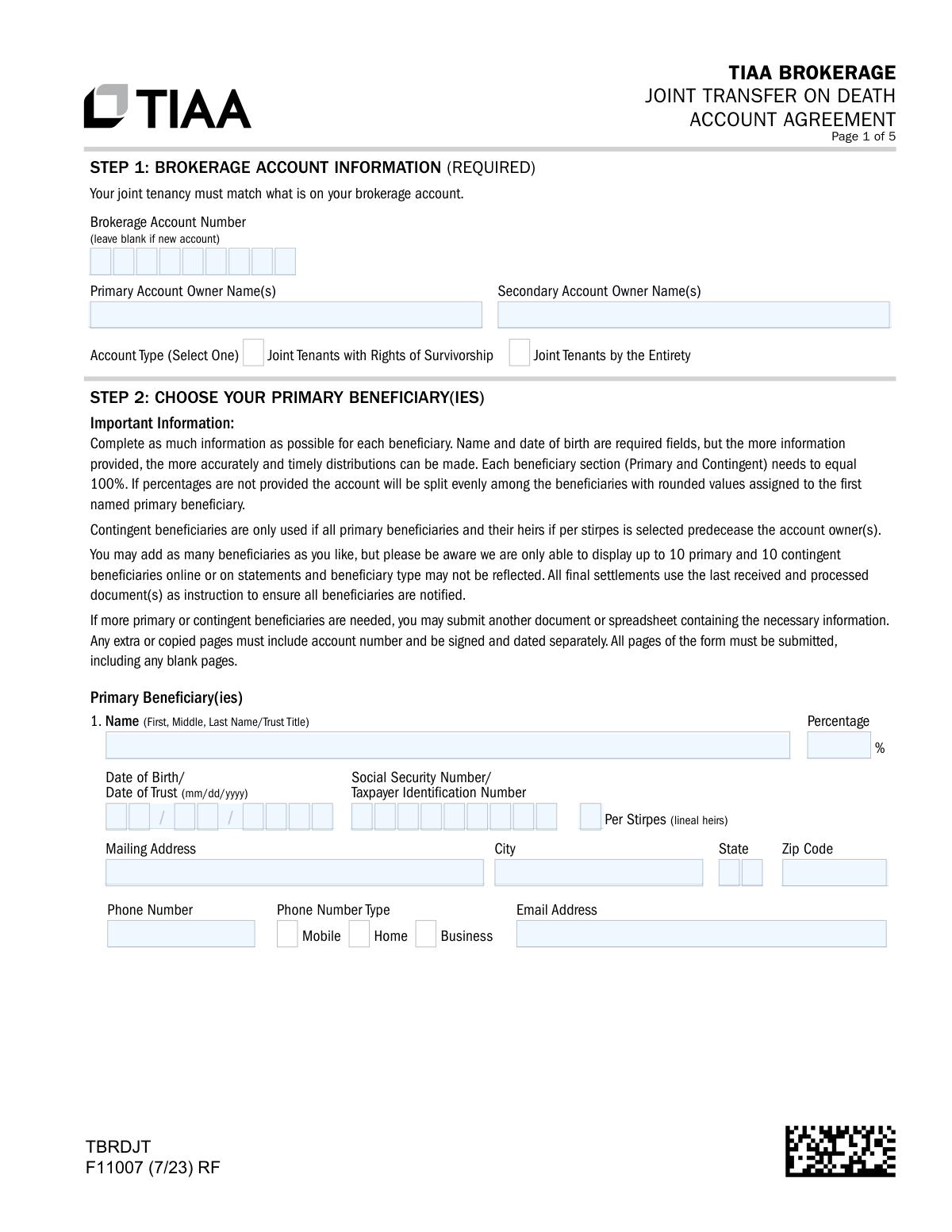
This form is a legal agreement for owners of a TIAA joint brokerage account to designate primary and contingent beneficiaries. It allows the account's assets to be transferred directly to the named beneficiaries upon the death of the last surviving account owner, avoiding the probate process. This is a crucial step for estate planning to ensure a smooth transition of assets. Today, this form can be filled out quickly and accurately using AI-powered services like Instafill.ai, which can also convert non-fillable PDF versions into interactive fillable forms.
TBRDJT / F11007 is part of the
brokerage forms, TIAA forms, account transfer forms, broker forms, brokerage account forms, brokerage transfer forms, transfer on death forms and joint account forms categories on Instafill.
Rather not fill this in by hand? Instafill is an online form filler that completes PDF forms automatically — upload the blank form, answer a few questions, and the AI fills every field.
Form specifications
| Form name: | TIAA Brokerage Joint Transfer on Death Account Agreement |
| Number of pages: | 1 |
| Language: | English |
Our AI automatically handles information lookup, data retrieval, formatting, and form filling.
It takes less than a minute to fill out TBRDJT / F11007 using our AI form filling.
Securely upload your data. Information is encrypted in transit and deleted immediately after the form is filled out.
Instafill Demo: How to fill out PDF forms in seconds with AI
How to Fill Out TBRDJT / F11007 Online for Free in 2026
Are you looking to fill out a TBRDJT / F11007 form online quickly and accurately? Instafill.ai offers the #1 AI-powered PDF filling software of 2026, allowing you to complete your TBRDJT / F11007 form in just 37 seconds or less.
Follow these steps to fill out your TBRDJT / F11007 form online using Instafill.ai:
- 1 Navigate to Instafill.ai and upload the TIAA Brokerage Joint Transfer on Death Account Agreement or select it from their template library.
- 2 Provide your joint brokerage account information in Step 1, including the account number and the names of both account owners.
- 3 In Step 2, enter the full details for each primary beneficiary, such as name, date of birth, SSN, and the percentage of assets they will receive. Ensure the total percentage equals 100%.
- 4 Optionally, complete Step 3 to designate contingent beneficiaries who will inherit the assets if all primary beneficiaries predecease you.
- 5 Address the spousal consent requirements in Step 4 if you live in a community property state and your joint account owner is not your spouse.
- 6 In Step 5, carefully review the entire agreement, then have both primary and secondary account owners provide their electronic signatures and the date.
- 7 Securely submit the completed and signed form directly through the platform to TIAA for processing.
Our AI-powered system ensures each field is filled out correctly, reducing errors and saving you time.
Why Choose Instafill.ai for Your Fillable TBRDJT / F11007 Form?
Speed
Complete your TBRDJT / F11007 in as little as 37 seconds.
Up-to-Date
Always use the latest 2026 TBRDJT / F11007 form version.
Cost-effective
No need to hire expensive lawyers.
Accuracy
Our AI performs 10 compliance checks to ensure your form is error-free.
Security
Your personal information is protected with bank-level encryption.
Frequently Asked Questions About TBRDJT / F11007
This form allows you to designate beneficiaries to inherit the assets in your taxable joint brokerage account upon the death of both account owners. This process helps your assets bypass probate, but it should not be used for retirement accounts.
This form is for joint owners of a TIAA taxable brokerage account who want to add or update who will inherit the account. Both account owners must sign the completed form for it to be valid.
Primary beneficiaries are the first in line to inherit the account's assets. Contingent beneficiaries will only inherit the assets if all of the primary beneficiaries have passed away before the last surviving account owner.
If you list multiple beneficiaries but do not assign specific percentages, the account assets will be divided equally among them. The total for primary beneficiaries must be 100%, and the total for contingent beneficiaries must also be 100%.
Choosing 'per stirpes' for a beneficiary means that if they predecease you, their share of the account will automatically pass to their direct descendants (e.g., their children). If not selected, the share is divided among the other surviving beneficiaries.
Spousal consent is required if you live in a community property state (AZ, CA, ID, LA, NV, NM, TX, WA, or WI) and the other joint account owner is not your spouse. This signature waives their community property rights to the account assets.
No, the form explicitly states that it must be signed by the account owners themselves. Signatures from a Power of Attorney are not accepted for this agreement.
You can attach a separate sheet with the additional beneficiary information, making sure to label them as primary or contingent. Each additional page must include your account number and be signed and dated by both account owners.
You can submit all pages of the form via the TIAA mobile app, online at tiaa.org/upload, by fax, or by mail. Be sure to return all pages of the form, including any that were left blank.
After the first owner's death, the account passes to the surviving joint owner. The beneficiaries you designated on this form will remain the same unless the surviving owner submits a new TOD agreement to make changes.
Yes, services like Instafill.ai use AI to help you accurately auto-fill form fields, which can save time and reduce errors. This is a great option for quickly completing your paperwork.
To fill out this form online, you can use a service like Instafill.ai. Simply upload the PDF to their platform, and their AI will help you fill in the required fields before you download the completed document for submission.
If your PDF is not interactive, you can use a tool like Instafill.ai to convert it into a fillable format. This allows you to easily type your information into the fields directly on your computer.
Compliance TBRDJT / F11007
Validation Checks by Instafill.ai
1
Account Owner Signature Completeness
This check verifies that both the Primary and Secondary Account Owners have signed the form in Step 5. A joint agreement requires the consent and signature of all parties to be legally binding. If either signature is missing, the form is considered incomplete and cannot be processed, as it would represent an invalid agreement.
2
Primary Beneficiary Percentage Sum
This validation calculates the sum of all percentage values assigned to the primary beneficiaries in Step 2. The total must equal exactly 100%. This is critical to ensure the entire account is allocated without ambiguity, preventing legal disputes during asset distribution. Forms with totals not equal to 100% will be rejected for correction.
3
Contingent Beneficiary Percentage Sum
This validation calculates the sum of all percentage values assigned to the contingent beneficiaries in Step 3. If any contingent beneficiaries are listed, their percentages must total exactly 100%. This ensures clear instructions for asset distribution if all primary beneficiaries are deceased. A failure to total 100% will result in the form being returned to the user for correction.
4
Required Beneficiary Information Present
This check ensures that for every listed beneficiary (Primary and Contingent), the 'Name' and 'Date of Birth/Date of Trust' fields are completed, as stated in the form instructions. This information is the minimum required to accurately identify the beneficiary and process the transfer. A submission missing this data for any beneficiary is incomplete and will be rejected.
5
At Least One Primary Beneficiary Designated
This validation confirms that at least one primary beneficiary has been designated in Step 2. The fundamental purpose of a Transfer on Death (TOD) agreement is to name a beneficiary to receive the account assets. A form submitted without any primary beneficiaries fails to fulfill its purpose and will be considered invalid.
6
Spousal Consent Logic and Signature
This check enforces the rules in Step 4 for residents of community property states. If an account owner indicates they are married but the joint owner is not their spouse, the system must verify that the spouse's signature, printed name, and date are provided. This is a legal requirement to waive community property rights, and its absence will prevent the form from being processed.
7
Valid SSN/TIN Format
This check validates that any entered Social Security Number or Taxpayer Identification Number for beneficiaries follows the standard 9-digit format (XXX-XX-XXXX or XX-XXXXXXX). Correctly formatted identification numbers are crucial for tax reporting and setting up new accounts for beneficiaries. An invalid format would trigger an error, requiring correction to ensure compliance and a smooth transfer process.
8
Consistent Date Format (mm/dd/yyyy)
This validation ensures that all date fields, including beneficiary dates of birth, trust dates, and signature dates, are entered in the specified 'mm/dd/yyyy' format. Enforcing a standard format prevents data interpretation errors and ensures all dates are recorded accurately in the system. Submissions with improperly formatted dates will be flagged for correction.
9
Account Type Selection
This check verifies that one of the two account type options ('Joint Tenants with Rights of Survivorship' or 'Joint Tenants by the Entirety') has been selected in Step 1. This selection is critical as it defines the legal terms of ownership and survivorship rights. A form without this selection is ambiguous and must be returned for completion.
10
Beneficiary Is Not an Account Owner
This validation compares the names of the designated beneficiaries against the names of the Primary and Secondary Account Owners. An account owner cannot be designated as a beneficiary on their own TOD account, as the transfer is contingent upon their death. A match would indicate a logical error and the form would be flagged for review and correction.
11
Plausible Signature Date
This check ensures the signature dates in Step 5 are logical and valid. The dates must not be in the future and should be on or after the form's revision date (7/23). This confirms the account owners are agreeing to the current version of the terms and provides a valid timestamp for the agreement. An invalid or future date would render the signature invalid.
12
No Power of Attorney (POA) Signature
This validation confirms that the signatures in Step 5 are from the account owners themselves, not a Power of Attorney (POA). The form explicitly forbids POA signatures for this agreement. A submission signed by a POA would be rejected as it violates the form's terms, requiring it to be re-signed by the actual account owners to be valid.
13
Joint Account Owner Name Completeness
This check verifies that both the 'Primary Account Owner Name' and 'Secondary Account Owner Name' fields are filled in Step 1. Since this is a joint account agreement, identifying both owners is fundamental to the contract's validity. An omission of either name makes the form incomplete and it cannot be processed.
14
Valid Beneficiary Zip Code Format
This check validates that the Zip Code provided for each beneficiary address is in a valid 5-digit or 9-digit (ZIP+4) format. A correct zip code is essential for the accurate and timely delivery of legal notices, statements, or other important correspondence. An invalid format could lead to communication failures and should be flagged for correction.
Common Mistakes in Completing TBRDJT / F11007
This mistake occurs when the percentages assigned to beneficiaries do not total exactly 100% for each section (Primary and Contingent). People often miscalculate or assume the total can be something other than 100. An incorrect total can lead to the form being rejected or the firm defaulting to an equal distribution, which may not align with the account owner's wishes. To avoid this, double-check that the sum for all primary beneficiaries is 100% and the sum for all contingent beneficiaries is also 100%.
Step 4 is frequently filled out incorrectly due to its conditional logic based on state residency and marital status. Account owners in community property states (AZ, CA, ID, LA, NV, NM, TX, WA, WI) who are married to someone other than their joint account holder must have their spouse sign. Failure to secure this signature can invalidate the beneficiary designations and lead to legal challenges from the spouse upon the account owner's death. Carefully read the instructions for both the primary and secondary account owner to determine if a spousal signature is required.
As this is a joint account agreement, the form is invalid unless signed by both the Primary and Secondary account owners in Step 5. Often, one owner completes the form but forgets to obtain the other's signature before submitting it. This will cause immediate rejection of the form, delaying the establishment of the Transfer on Death instructions. Always ensure both parties have signed and dated the document before submission.
The form explicitly states it is for taxable Brokerage accounts and not for retirement accounts (like an IRA). People may overlook this instruction in a hurry, assuming one beneficiary form works for all account types. Submitting this form for a retirement account will result in it being rejected, leaving the retirement account's beneficiaries unchanged and potentially outdated. Always confirm you are using the correct form for your specific account type.
While the form only requires a name and date of birth, failing to provide additional details like a Social Security Number and current address is a common oversight. This lack of information can significantly delay the distribution process, as the firm will have difficulty locating and verifying the beneficiary's identity. To ensure a smooth transfer of assets, provide as much complete and accurate information for each beneficiary as possible. AI-powered tools like Instafill.ai can help by flagging missing required or recommended fields.
Many people are unfamiliar with the legal term 'Per Stirpes' and either ignore the checkbox or check it without understanding its meaning. Checking this box means that if a beneficiary predeceases you, their share will automatically pass to their children or other descendants. Not selecting it when intended, or selecting it by mistake, can lead to assets being distributed in a way the account owner did not want. It is crucial to understand this option or consult an advisor before making a selection.
The submission instructions on the final page state to 'return all numbered pages, including any pages you didn’t need to complete.' It's a common mistake to only send back the pages that were filled out, like the signature and beneficiary pages. This can cause the submission to be considered incomplete, as the full agreement terms are missing, leading to processing delays or rejection. Always submit the entire multi-page document as a single package.
Step 5 explicitly states that the form 'cannot be signed by a Power of Attorney (POA).' An individual holding a POA for an account owner might assume they can sign on the owner's behalf, especially if the owner is incapacitated. Signing as a POA will render the beneficiary designation invalid and cause the form to be rejected. The account owners themselves must personally sign the document.
Account holders sometimes misunderstand the hierarchy, believing a contingent beneficiary is linked to a specific primary beneficiary. The form clearly states contingent beneficiaries only inherit if ALL primary beneficiaries are deceased. This misunderstanding can lead to unintended consequences where a person listed as contingent receives nothing if even one primary beneficiary is alive. To avoid this, ensure you understand that the contingent pool is a backup for the entire primary pool, not for individuals within it.
When more beneficiaries are needed than space allows, the form requires attaching extra pages with specific information. A common error is to attach a simple list of names without including the account number, a separate signature, and date on each additional page as required. This omission can invalidate the designations on the extra pages, leaving those intended beneficiaries out of the distribution plan. Follow the instructions precisely for any supplemental documents.
In Step 1, the names of the account owners must exactly match the names on the existing brokerage account. People may inadvertently use a nickname, a shortened name, or omit a middle initial or suffix that is part of the official account title. This discrepancy requires manual verification, delaying the processing of the form until the identity of the owners can be confirmed. Using a tool like Instafill.ai can help prevent this by pre-filling information exactly as it appears on your account profile.
Saved over 80 hours a year
“I was never sure if my IRS forms like W-9 were filled correctly. Now, I can complete the forms accurately without any external help.”
Kevin Martin Green
Your data stays secure with advanced protection from Instafill and our subprocessors




Robust compliance program
Transparent business model
You’re not the product. You always know where your data is and what it is processed for.
ISO 27001, HIPAA, and GDPR
Our subprocesses adhere to multiple compliance standards, including but not limited to ISO 27001, HIPAA, and GDPR.
Security & privacy by design
We consider security and privacy from the initial design phase of any new service or functionality. It’s not an afterthought, it’s built-in, including support for two-factor authentication (2FA) to further protect your account.
Fill out TBRDJT / F11007 with Instafill.ai
Worried about filling PDFs wrong? Instafill securely fills tiaa-brokerage-joint-transfer-on-death-account-agreement forms, ensuring each field is accurate.
