Fill out account transfer forms
with AI.
Account transfer forms are the official documents required to move financial assets — such as stocks, mutual funds, retirement savings, or health savings account funds — from one financial institution or account to another. Whether you're consolidating brokerage accounts, rolling over a 401(k), switching custodians, or transferring assets to a new provider like Schwab, Fidelity, or Vanguard, these forms are the necessary first step. Getting them right matters: errors in account registration details or missing signatures can delay transfers by weeks or result in rejected requests.
By continuing, you acknowledge Instafill's Privacy Policy and agree to get occasional product update and promotional emails.
About account transfer forms
People who typically need these forms include investors consolidating portfolios under a single brokerage, individuals rolling over retirement accounts after a job change, families transferring custodial accounts when a minor reaches adulthood, and those doing estate planning through Transfer on Death (TOD) agreements. HSA holders switching investment platforms, 529 plan owners changing providers, and anyone moving assets between existing accounts at the same institution also rely on forms in this category regularly.
The 32 forms listed on this page cover a wide range of institutions and account types, from the Fidelity Funds Account Transfer of Assets Form to the J.P. Morgan Securities Account Transfer Request. Because these forms often involve precise financial and legal details, tools like Instafill.ai use AI to fill them out accurately in under 30 seconds — a practical time-saver when you're managing an important financial transition.
Every form on this page can be completed without typing. Instafill is form filling software that reads a PDF and fills it for you — including flat and scanned documents that carry no fillable fields at all.
Forms in This Category
The forms in this category have a median Form Complexity Index of 50/100 (Moderate), measured across 33 forms by field count, input difficulty, length, conditional logic and structure. See how it is calculated.
- Enterprise-grade security & data encryption
- 99%+ accuracy powered by AI
- 1,000+ forms from all industries
- Complete forms in under 60 seconds
How to Choose the Right Form
Not all account transfer forms work the same way — the right one depends on where your money is now, where it's going, and what type of account is involved. Here's how to narrow it down quickly.
Moving Assets INTO a New Brokerage
If you're bringing outside investments into a new firm, look for that firm's incoming transfer form:
- Fidelity: Use the Fidelity Funds Account Transfer of Assets Form for external-to-Fidelity transfers, or the TIAA Brokerage Incoming Account Transfer Form (F11043) / Incoming Managed Account Transfer Form (F11319) for TIAA accounts.
- Schwab: Use Form APP13017-29 (Transfer Your Account to Schwab) or the Charles Schwab & Co., Inc. Account Transfer Form.
- Merrill Lynch: Use the Client Account Transfer Form to Merrill Lynch.
- Others: The TD Ameritrade Institutional Account Transfer Form, U.S. Bancorp Investments Account Transfer Form, J.P. Morgan Securities LLC Account Transfer Request, or Pershing LLC Account Transfer Form cover their respective platforms.
- For a general ACATS transfer between any brokers, use the Account Transfer Authorization (ACATS) Form.
Transferring Between Accounts at the Same Institution
If both accounts are already at the same firm:
- Fidelity users: Use Transfer Between Existing Fidelity Accounts (or the variant Transfer Between Existing Fidelity Accounts Form) for internal moves.
- Vanguard users: Use Retirement Transfer Between Existing Vanguard Accounts for retirement fund moves.
Specialty Account Types
- HSA accounts: Choose the Group Transfer Form Fidelity HSA, HSA Bank Investment Account Transfer Form, Schwab HSBA to HSA Invest Choice Transfer Form, or the HSA Transfer Request (Voya) based on your provider.
- ABLE accounts: Use the Fidelity ABLE Account Rollover/Transfer Request Form or one of the two Rollover/Transfer Request — ABLE Account forms for Fidelity ABLE.
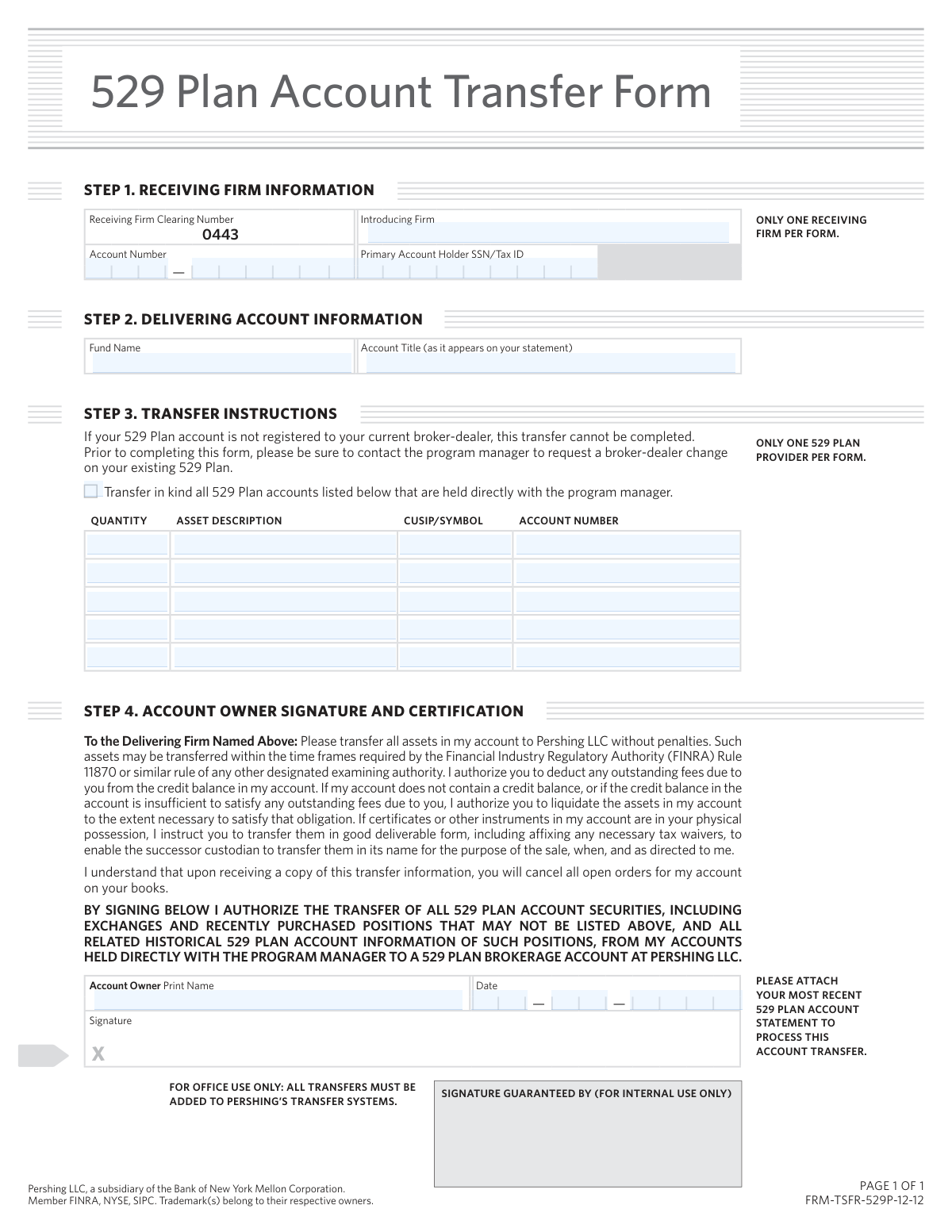
- 529 plans: The 529 Plan Account Transfer Form (Pershing) or the Vanguard 529 Transfer Due to Death of Account Owner Form covers college savings transfers.
- Custodial accounts: Use the Custodial Account – Transfer of Ownership Form when a minor reaches the age of majority.
Estate Planning (Transfer on Death)
To designate beneficiaries and bypass probate:
- TIAA: Form F11004 (Individual Transfer on Death) or TIAA Brokerage Joint Transfer on Death Account Agreement.
- Pershing: Individual Transfer on Death Account Agreement (available in two versions for individual and joint accounts).
Employer Plan Transitions
If your 401(k) is moving between recordkeepers, review the AbbVie Savings Plan 401(k) Account Transfer Notice for guidance on blackout periods and investment mapping.
Quick tip: Always match the form to the *receiving* institution — most firms require their own proprietary form to initiate an incoming transfer.
Form Comparison
| Form | Purpose | Who Files It | When to Use |
|---|---|---|---|
| Fidelity Funds Account Transfer of Assets Form | Transfer external assets into a Fidelity Funds account | Individual investors consolidating holdings | Moving mutual funds, CDs, or securities to Fidelity |
| Transfer Between Existing Fidelity Accounts Form | Move assets between two existing Fidelity accounts | Fidelity account holders doing internal transfers | Consolidating or reallocating assets within Fidelity |
| Fidelity ABLE Account Rollover/Transfer Request Form | Roll over or transfer assets into a Fidelity ABLE account | Individuals with disabilities or their representatives | Moving funds from non-Fidelity ABLE or 529 accounts |
| Group Transfer Form Fidelity Health Savings Account (HSA) | Transfer HSA assets from prior custodian to Fidelity HSA | Employees or groups switching HSA custodians | Consolidating health savings into Fidelity HSA |
| Form APP13017-29, Transfer Your Account to Schwab | Transfer external investments into a Schwab account | Investors consolidating assets at Charles Schwab | Switching brokers or centralizing portfolio at Schwab |
| Transfer of Assets Out - Partial Account or Charitable Gift Transfers | Transfer specific Schwab assets to another institution or charity | Schwab account holders making partial or charitable transfers | Gifting securities or moving partial assets out of Schwab |
| Charles Schwab & Co., Inc. Account Transfer Form | Transfer assets from external firm into Schwab account | Investors moving full or partial accounts to Schwab | Consolidating brokerage, bank, or insurance assets at Schwab |
| HSA Bank Investment Account Transfer Form | Transfer HSA investment assets to Schwab HSBA via HSA Bank | HSA account holders switching investment platforms | Moving HSA investments from existing account to Schwab HSBA |
| Rollover/Transfer Request — ABLE Account | Initiate rollover or transfer into a Fidelity ABLE account | Individuals with disabilities consolidating savings | Moving ABLE or 529 plan assets into Fidelity ABLE |
| Schwab Health Savings Brokerage Account (HSBA) to HSA Invest Choice Account Transfer Form | Transfer Schwab HSBA fully to HSA Invest Choice account | HSA Bank account holders switching investment providers | Full transfer from Schwab HSBA to DriveWealth platform |
| Retirement Transfer Between Existing Vanguard Accounts | Transfer retirement assets between existing Vanguard accounts | Vanguard retirement account holders | Performing rollovers or distributions between Vanguard IRAs |
| The Vanguard 529 College Savings Plan Transfer Due to Death of Account Owner Form | Transfer 529 account ownership after account owner's death | Successor owners or estate representatives | Claiming or inheriting a deceased owner's Vanguard 529 plan |
| Vanguard Brokerage Account CREST Transfer Form | Transfer foreign certificated securities into Vanguard via CREST | Investors holding foreign securities in certificated form | Converting certificated foreign holdings to electronic Vanguard account |
| Account Transfer Authorization (ACATS) Form | Authorize asset transfer between financial institutions via ACATS | Investors changing brokers or consolidating accounts | Transferring stocks, bonds, or mutual funds to a new firm |
| AbbVie Savings Plan 401(k) Account Transfer Notice | Notify participants of 401(k) plan transfer from Fidelity to Empower | AbbVie plan participants affected by provider change | During mandatory plan migration with blackout period |
| Transfer Between Existing Fidelity Accounts | Move assets internally between Fidelity accounts | Fidelity clients consolidating or reallocating assets | Funding IRA, consolidating accounts, or moving securities |
| Rollover/Transfer Request — ABLE Account | Transfer or rollover funds into a Fidelity ABLE account | Individuals with disabilities or authorized representatives | Moving ABLE or 529 assets from another institution to Fidelity |
| TIAA Brokerage Incoming Account Transfer Form | Transfer external assets into a TIAA Brokerage account | Individuals consolidating investments under TIAA | Moving stocks, mutual funds, or retirement assets to TIAA |
| TIAA Brokerage Joint Transfer on Death Account Agreement | Designate beneficiaries for a TIAA joint brokerage account | Joint TIAA brokerage account owners for estate planning | Setting up TOD to bypass probate for joint accounts |
| TIAA Brokerage Incoming Managed Account Transfer Form (F11319) | Transfer external assets into a TIAA Brokerage managed account | Clients moving investments to TIAA managed account | Consolidating portfolio from external firm into TIAA management |
| Health Savings Account (HSA) Transfer Request | Transfer HSA, MSA, or IRA assets to a Voya Financial HSA | Individuals consolidating health savings at Voya | Switching HSA custodians or merging health savings accounts |
| Client Account Transfer Form to Merrill Lynch, Pierce, Fenner & Smith Incorporated | Transfer assets from another firm to a Merrill Lynch account | Investors consolidating assets at Merrill Lynch | Moving stocks, bonds, or mutual funds to Merrill Lynch |
| Authorization to transfer funds from a bank retirement account | Transfer Bank of America IRA assets to a Merrill IRA | Bank of America IRA holders moving to Merrill platform | Consolidating retirement accounts from BofA to Merrill |
| Pershing LLC Account Transfer Form | Authorize asset transfer to a Pershing LLC receiving account | Investors or broker-dealer clients transferring assets | Moving stocks, bonds, or mutual funds to a Pershing account |
| 529 Plan Account Transfer Form | Transfer 529 plan assets to a new Pershing LLC brokerage account | 529 plan holders switching investment management | Consolidating educational savings at Pershing LLC |
| Individual Transfer on Death Account Agreement | Designate beneficiaries for individual Pershing LLC account | Individual account owners for estate planning | Setting up TOD arrangement to bypass probate at Pershing |
| U.S. Bancorp Investments Account Transfer Form | Transfer assets from external firm to U.S. Bancorp Investments | Investors consolidating assets at U.S. Bancorp | Moving stocks, mutual funds, or cash to U.S. Bancorp account |
| Form F11004, TIAA Brokerage Individual Transfer on Death Account Agreement | Designate beneficiaries for individual TIAA brokerage account | Individual TIAA brokerage account owners | Estate planning to transfer taxable brokerage assets at death |
| Individual Transfer on Death Account Agreement | Specify beneficiaries to inherit account assets upon death | Individual account owners for estate planning purposes | Establishing TOD to avoid probate for inherited assets |
| Custodial Account – Transfer of Ownership Form | Transfer custodial account assets to former minor at majority | Custodians transferring UTMA/UGMA or minor IRA accounts | When minor reaches age of majority and assumes account ownership |
| TD Ameritrade Institutional Account Transfer Form | Transfer assets from external firm to TD Ameritrade Institutional | Investors consolidating assets at TD Ameritrade Institutional | Moving stocks, bonds, or mutual funds to TD Ameritrade |
| J.P. Morgan Securities LLC Account Transfer Request | Transfer assets from another institution to a JPMS account | Investors consolidating portfolio at J.P. Morgan Securities | Moving cash, securities, or mutual funds to JPMS account |
Tips for account transfer forms
One of the most common reasons account transfers get rejected or delayed is a mismatch between the account registration at the delivering firm and the receiving firm. Make sure the name, tax identification number, and account type listed on the transfer form match exactly what's on file at both institutions before submitting.
Account transfers come in several forms — full transfers, partial transfers, in-kind transfers, and rollovers — and each has different rules and implications. For example, a trustee-to-trustee HSA transfer is non-reportable to the IRS, while a 60-day rollover has strict deadlines. Identify the correct transfer type before filling out any form to avoid unintended tax consequences.
Most account transfer forms require specific information about the delivering institution, including the firm's name, address, your account number there, and the type of assets being moved. Having your most recent statement from the delivering firm on hand before you start will save you from stopping midway to hunt down details.
Certain transfers — particularly those involving large asset amounts, different account owners, or specific account types like ABLE accounts — may require a Medallion Signature Guarantee rather than a standard notarization. Check the form's signature section carefully, as submitting without the correct authentication will result in rejection and delays.
If you're consolidating accounts across multiple institutions, filling out each transfer form manually can be tedious and error-prone. AI-powered tools like Instafill.ai can complete these forms in under 30 seconds with high accuracy, and your data stays secure throughout the process — a real time-saver when you're dealing with a stack of transfer paperwork.
Some transfers — especially employer-sponsored plan transfers like 401(k) moves — involve a blackout period during which you cannot access or trade your assets. Check with both the delivering and receiving institutions for estimated timelines, which can range from a few days to several weeks, and avoid making investment decisions that depend on those funds being available.
Not all assets can be transferred in-kind; some proprietary mutual funds, certain annuities, or non-transferable securities must be liquidated first. Review the receiving firm's accepted asset list before initiating the transfer, as failing to do so can cause partial rejections and leave assets stranded at the delivering firm.
Once you submit an account transfer form, keep a copy along with any confirmation numbers or correspondence for your records. If a transfer is delayed or disputed, having documentation of exactly what you submitted — including the date — will help you resolve the issue with either institution much faster.
Frequently Asked Questions
Account transfer forms are official documents used to authorize the movement of financial assets — such as stocks, bonds, mutual funds, cash, or retirement savings — from one financial institution or account to another. They are commonly used when consolidating investments, changing brokers, rolling over retirement accounts, or transferring assets as part of estate planning.
The right form depends on the institutions involved and the type of account being transferred. For example, if you're moving assets into a Fidelity, Schwab, Vanguard, TIAA, Merrill Lynch, or J.P. Morgan account, each institution has its own specific transfer form. This category includes 32 forms covering brokerage accounts, IRAs, HSAs, 529 plans, ABLE accounts, and more — browse the list to find the one that matches your situation.
This category covers a wide range of account types, including individual brokerage accounts, IRA and retirement accounts (401k rollovers, direct rollovers), Health Savings Accounts (HSAs), 529 college savings plans, ABLE accounts for individuals with disabilities, custodial accounts (UTMA/UGMA), and Transfer on Death (TOD) accounts. Each form is specific to the account type and institution involved.
Processing times vary by institution and transfer type. Standard brokerage-to-brokerage transfers through the ACATS system typically take 5–7 business days, while mutual fund or non-ACATS transfers can take 3–5 weeks. Retirement account rollovers and HSA transfers may also have their own timelines depending on the delivering institution's procedures.
In most cases, yes — the receiving institution typically requires an open account before it can accept incoming assets. For example, if you're transferring assets to Schwab, Fidelity, or J.P. Morgan, you'll generally need an existing account at that firm. Some forms allow you to open an account simultaneously, but it's best to confirm with the receiving institution before submitting.
It depends on the transfer type. Trustee-to-trustee transfers and direct rollovers between retirement accounts are generally non-taxable events and are not reported as distributions by the IRS. However, indirect rollovers (where funds are paid to you first) must typically be completed within 60 days to avoid taxes and penalties. HSA trustee-to-trustee transfers are also non-reportable. Always consult a tax advisor for guidance specific to your situation.
Most account transfer forms require information about both the delivering and receiving accounts, including account numbers, account holder names, institution names and addresses, the type and amount of assets being transferred (full or partial), and your signature. Some forms — particularly for retirement or large transfers — may also require a Medallion Signature Guarantee or notarization.
Many account transfer forms support both full and partial transfers. For example, Fidelity, Schwab, and Merrill Lynch forms allow you to specify whether you want to transfer the entire account or only selected assets. If you choose a partial transfer, you'll typically need to list the specific securities or dollar amounts you want moved.
Yes — AI-powered tools like Instafill.ai can fill out account transfer forms in under 30 seconds by accurately extracting and placing your data from source documents. This significantly reduces the risk of errors that can delay or reject a transfer. Instafill.ai can also convert non-fillable PDF versions of these forms into interactive, fillable formats.
Manually filling out an account transfer form can take 15–30 minutes, especially when gathering account numbers, institution details, and asset information. Using an AI tool like Instafill.ai, the same form can be completed in under 30 seconds, with data accurately extracted and placed from your existing documents.
Completed forms are typically submitted to the receiving financial institution — the firm where you want your assets to end up. Submission methods vary: some institutions accept forms by mail, fax, or secure upload through their online portal. Check the specific instructions provided by your receiving institution, as submitting to the wrong party can delay the transfer.
A Transfer on Death (TOD) account agreement allows you to designate beneficiaries who will automatically inherit your brokerage account assets upon your death, bypassing the probate process. These forms are important for estate planning and are available from institutions like TIAA, Pershing LLC, and others in this category. Anyone who wants to ensure a smooth, direct transfer of their investment assets to heirs should consider completing a TOD agreement.
Glossary
- Form Complexity Index
- Instafill’s 0–100 measure of how much effort a form takes to complete, calculated deterministically from the form’s own structure rather than estimated. It combines the number of fillable fields (the largest factor), how difficult those fields are to complete based on their type, the number of pages that contain fields, the amount of conditional “fill-only-if” logic, and how many sections the form is divided into, then adds modifiers for tables and repeating lists, bundled instruction pages, and dense page layouts. A higher score means the form is harder to fill out by hand. The forms in this category have a median Form Complexity Index of 50/100 (Moderate). See exactly how it is calculated.
- ACATS (Automated Customer Account Transfer Service)
- A standardized electronic system operated by FINRA that facilitates the transfer of securities accounts between brokerage firms. Most brokerage-to-brokerage transfers are processed through ACATS, typically completing within 5–7 business days.
- In-Kind Transfer
- The movement of assets—such as stocks, bonds, or mutual funds—from one account to another without first selling them and converting to cash. This avoids triggering a taxable event that a sale would otherwise create.
- Transfer on Death (TOD)
- A legal designation on a brokerage account that allows assets to pass directly to named beneficiaries upon the account owner's death, bypassing the probate process. Beneficiaries have no rights to the account while the owner is alive.
- Trustee-to-Trustee Transfer
- A direct movement of retirement or HSA funds from one financial institution to another, where the account holder never receives the money personally. This method is non-reportable to the IRS and avoids withholding taxes or rollover penalties.
- 60-Day Rollover
- A type of retirement or ABLE account transfer where the account holder receives a distribution and must deposit it into a new qualifying account within 60 days to avoid taxes and penalties. Unlike a trustee-to-trustee transfer, the IRS limits this to once per 12-month period for IRAs.
- Medallion Signature Guarantee
- A special certification stamp provided by an authorized financial institution (such as a bank or broker) that verifies the authenticity of a signature on documents authorizing the transfer of securities. It is more secure than a notarization and is commonly required for large or sensitive account transfers.
- Delivering Firm
- The financial institution that currently holds the assets being transferred out. On transfer forms, you must provide the delivering firm's name, account number, and contact details so they can authorize and send the assets.
- Blackout Period
- A temporary window during a plan-to-plan transfer (common in 401(k) transitions) when account holders cannot access, trade, or make changes to their retirement account. This period allows the administrator to move assets accurately between platforms.
- ABLE Account (Achieving a Better Life Experience)
- A tax-advantaged savings account available to eligible individuals with disabilities, established under the ABLE Act. Funds can be used for qualified disability-related expenses, and assets in the account do not disqualify the holder from certain federal benefits.
- UTMA/UGMA (Uniform Transfers/Gifts to Minors Act)
- Legal frameworks that allow adults to transfer assets to a minor through a custodial account managed by a designated custodian. When the minor reaches the age of majority (typically 18–21 depending on the state), control of the account transfers to them and the custodianship ends.