Yes! You can use AI to fill out TIAA Trust Rollover From Your Retirement Plan (ERISA)
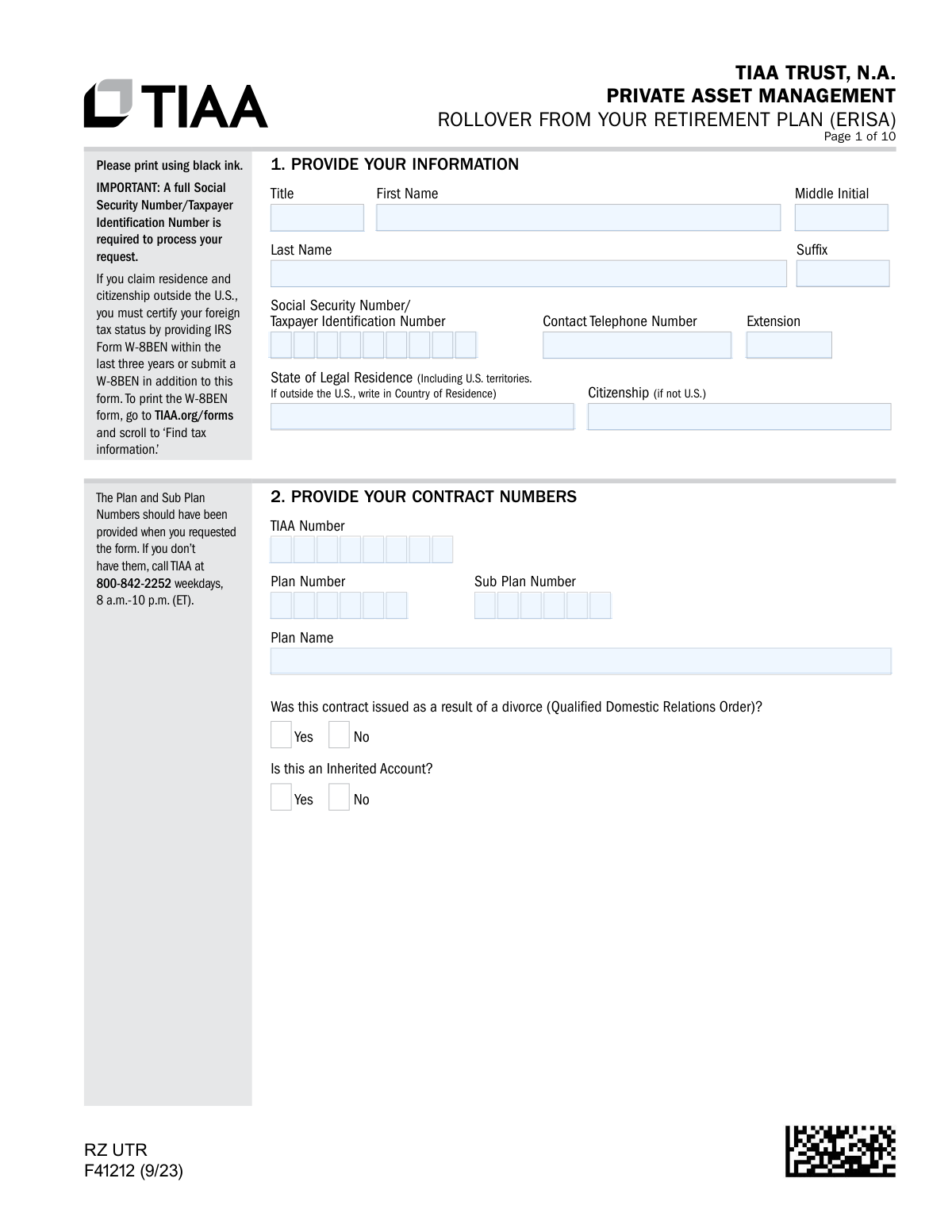
Form F41212 is a document provided by TIAA Trust for participants wishing to move their funds from an employer-sponsored retirement plan governed by ERISA to another eligible retirement account, such as a Traditional or Roth IRA. It guides the user through providing personal information, specifying rollover amounts, making tax withholding elections for Required Minimum Distributions (RMDs), and obtaining necessary spousal or plan representative consent. Today, this form can be filled out quickly and accurately using AI-powered services like Instafill.ai, which can also convert non-fillable PDF versions into interactive fillable forms.
F41212 is part of the
trust forms, retirement plan forms, TIAA forms and ERISA forms categories on Instafill.
Rather not fill this in by hand? Instafill is an online form filler that completes PDF forms automatically — upload the blank form, answer a few questions, and the AI fills every field.
Form specifications
| Form name: | TIAA Trust Rollover From Your Retirement Plan (ERISA) |
| Number of pages: | 1 |
| Language: | English |
Our AI automatically handles information lookup, data retrieval, formatting, and form filling.
It takes less than a minute to fill out F41212 using our AI form filling.
Securely upload your data. Information is encrypted in transit and deleted immediately after the form is filled out.
Instafill Demo: How to fill out PDF forms in seconds with AI
How to Fill Out F41212 Online for Free in 2026
Are you looking to fill out a F41212 form online quickly and accurately? Instafill.ai offers the #1 AI-powered PDF filling software of 2026, allowing you to complete your F41212 form in just 37 seconds or less.
Follow these steps to fill out your F41212 form online using Instafill.ai:
- 1 Navigate to Instafill.ai and upload or select the TIAA Rollover From Your Retirement Plan (ERISA) form.
- 2 Provide your personal information in Section 1, including your name, Social Security Number, and contact details.
- 3 Enter your TIAA contract and plan numbers in Section 2.
- 4 Complete the sections regarding Required Minimum Distributions (RMDs) and tax withholding elections (Sections 4 & 5).
- 5 Specify the amount to roll over in Section 6, choosing between the entire amount, a specific dollar amount, or amounts from particular investments.
- 6 Indicate the destination account for the rollover, such as a TIAA Trust IRA, in Section 7.
- 7 Review all information, provide your authorization signature, and obtain any necessary spousal waivers or plan representative certifications.
Our AI-powered system ensures each field is filled out correctly, reducing errors and saving you time.
Why Choose Instafill.ai for Your Fillable F41212 Form?
Speed
Complete your F41212 in as little as 37 seconds.
Up-to-Date
Always use the latest 2026 F41212 form version.
Cost-effective
No need to hire expensive lawyers.
Accuracy
Our AI performs 10 compliance checks to ensure your form is error-free.
Security
Your personal information is protected with bank-level encryption.
Frequently Asked Questions About F41212
This form is used to request a direct rollover of funds from your TIAA-managed employer retirement plan, such as a 401(k) or 403(b), to another eligible retirement account like an IRA.
You should complete this form if you are a participant in a TIAA-managed ERISA retirement plan and want to move your funds to a different retirement account, either after leaving your employer or as an in-service distribution if your plan allows it.
You will need your personal details including your full Social Security Number, your TIAA contract number, and your employer's Plan and Sub Plan numbers. If you don't have your plan numbers, you can call TIAA at 800-842-2252 to obtain them.
If you have reached your RMD applicable age, the IRS requires you to withdraw a minimum amount from your account each year. You must satisfy this year's RMD before processing a rollover, and TIAA will automatically pay it out from the funds if you haven't already taken it.
If you are married, federal law requires your spouse's consent to roll over funds because they are waiving their right to a survivor benefit from that money. Your spouse must sign the 'Spouse's Waiver' in Section 11, and their signature must be notarized or witnessed by a Plan Representative.
If you are not married, you do not need a spousal waiver. Instead, you must complete and sign the 'Unmarried Verification' in Section 10 to certify your marital status.
Not always, as different plan rules may apply and separate forms might be required for a TIAA Traditional Account rollover. It is best to call TIAA to confirm you have the correct form before proceeding.
Yes, you can roll over Roth funds, but they must go into another Roth 401(k)/403(b) plan or a Roth IRA to maintain their tax-advantaged status. Be sure to complete Section 3 to specify your instructions for your Roth accumulations.
TIAA will send a check directly to the financial institution you designate on the form; electronic transfers are not available for direct rollovers. TIAA will notify you of the final rollover amount after your completed forms are received and processed.
A Plan Representative's signature may be required to approve your request, especially for in-service withdrawals or to confirm your separation from service date. You should contact TIAA or your benefits office to determine if this approval is necessary for your situation.
You can upload the completed form via the TIAA mobile app or the TIAA.org website. Alternatively, you can fax or mail the form using the contact information provided in the checklist section.
Yes, services like Instafill.ai use AI to accurately auto-fill form fields, which can save you time and help prevent common errors. This is especially helpful for complex, multi-page forms like this one.
You can use a service like Instafill.ai to easily complete this form online. Simply upload the PDF, and the tool will make it interactive so you can type your information directly into the fields before printing or saving.
If you have a non-fillable or 'flat' PDF, you can use a tool like Instafill.ai to instantly convert it into an interactive, fillable form. This allows you to easily type your answers instead of having to print the form and fill it out by hand.
Compliance F41212
Validation Checks by Instafill.ai
1
SSN/TIN Format and Completeness
Verifies that the Social Security Number/Taxpayer Identification Number field in Section 1 is not empty and conforms to a valid 9-digit format (e.g., XXX-XX-XXXX or XXXXXXXXX). This number is essential for identity verification and mandatory tax reporting to the IRS. If the SSN/TIN is missing or invalid, the form cannot be processed, and the request will be rejected.
2
Citizenship and Foreign Status Certification
Checks if the 'Citizenship' field in Section 1 is a value other than 'U.S.'. If the participant is not a U.S. citizen, the system must verify that a valid IRS Form W-8BEN is on file or submitted with this request. This is a critical regulatory requirement for tax withholding for non-U.S. persons, and failure to provide it will halt the distribution process.
3
Roth Accumulation Selection Logic
Ensures logical consistency in Section 3. If the user answers 'Yes' to having Roth accumulations, they must select exactly one of the three subsequent options specifying how to roll them over. If they answer 'No', none of the subsequent options should be selected. This prevents contradictory or incomplete instructions that would make it impossible to determine how to allocate the rollover funds.
4
RMD Tax Withholding Rate Validation
Validates the tax withholding rate for RMDs in Section 5. If the user elects to specify a custom rate, the 'Line 2' percentage field must contain a whole number between 0 and 100. This ensures the provided rate is a valid input for the tax calculation system. An invalid entry would cause the system to either reject the form or apply a default rate, which may not match the user's intent.
5
Rollover Amount Option Exclusivity
Confirms that only one of the four primary options in Section 6 ('Roll over entire amount', 'entire amount except TIAA Traditional', 'specific dollar amount', or 'portion of account balance') is selected. Selecting multiple options creates ambiguity and makes the request impossible to process accurately. The form must be rejected if more than one option is chosen.
6
Partial Rollover Specification Logic
If 'Option 4' in Section 6 is selected, this check verifies that for each investment listed, either a dollar amount or a percentage is entered, but not both. It also ensures that any percentage values are whole numbers. This prevents conflicting instructions for a single fund and ensures the data is in the correct format for processing the partial rollover.
7
Future Processing Date Validity
Checks the 'FUTURE DATE' field in Section 6, if filled. The validation ensures the date is in a valid format (mm/dd/yyyy) and is a date in the future, not in the past. A past date is an impossible instruction, and an invalid format would cause a processing error, so the form would be returned for correction.
8
Roth IRA Rollover and Tax Section Consistency
Verifies that if 'Roll over to a Roth IRA at TIAA Trust' is selected in Section 7, then the user has made an election in Section 8 ('Tax Withholding for Your Roth IRA Rollover'). Conversely, if a non-Roth IRA is selected, Section 8 should be blank. This ensures tax withholding elections are captured only for the specific transaction type that may be taxable.
9
Participant Signature and Date Requirement
Confirms that the participant's signature and the 'Today’s Date' field in Section 9 are both present. A signature and date are legally required to authorize the transaction and certify the tax information. A missing signature or date renders the entire form invalid and will result in immediate rejection of the request.
10
Marital Status Verification Exclusivity
Ensures that either Section 10 (Unmarried Verification) or Section 11 (Spouse's Waiver) is completed, but not both. These sections are mutually exclusive based on marital status and are critical for satisfying ERISA spousal consent regulations. Completing neither or both sections will cause the form to be rejected for being incomplete or contradictory.
11
Spousal Consent Date Chronology
Validates that the spouse's signature date in Section 11 is on or after the participant's signature date in Section 9. This is a strict legal requirement to ensure the spouse is consenting to a specific, already-signed request, not pre-authorizing a future action. A spouse's signature dated before the participant's invalidates the waiver.
12
Spouse's Waiver Witness Validation
If Section 11 (Spouse's Waiver) is completed, this check confirms that either the Notary Public Certification (Option 1) or the Plan Representative Certification (Option 2) is also fully completed. The spouse's signature must be witnessed to be legally valid. Failure to obtain a proper witness signature will invalidate the spousal waiver and halt the rollover.
13
Separation from Service and Date Consistency
In Section 12, if the participant answers 'Yes' to 'Have you separated from service from your employer?', this check verifies that the 'Separation of Service Date' is provided in the Plan Representative Approval section. This date is a key data point for determining distribution eligibility under many retirement plans, and its absence can delay or prevent processing.
14
Vesting Percentage Completeness
Verifies that a vesting percentage is selected in question 6 of Section 12. This information is critical for calculating the portion of the account balance that is available to the participant for rollover. Without this information, TIAA cannot determine the correct rollover amount and the request cannot be fulfilled.
Common Mistakes in Completing F41212
Applicants often do not know their 'RMD Applicable Age' or are unsure if they have satisfied their RMD for the calendar year. This mistake can cause TIAA to automatically pay out the RMD amount before processing the rollover, resulting in an unexpected taxable distribution and a smaller rollover amount than intended. To avoid this, carefully review the RMD rules in Section 4 and confirm your RMD status for the year before submitting the form.
This is a frequent source of delays. Married applicants may forget to have their spouse sign Section 11, the spouse may sign on the wrong date (it must be on or after the applicant's signature date), or the signature may lack the required notarization. Conversely, unmarried applicants may forget to complete the Unmarried Verification in Section 10. These errors will cause the form to be rejected, so ensure you complete only the section applicable to your marital status and that all signatures and witnessing are done correctly.
In Section 6, applicants may select multiple conflicting options, such as checking 'Roll over entire amount' (Option 1) while also specifying a dollar amount in Option 3. Others may fill out Option 4 with fund percentages that do not total 100%. This ambiguity forces the processor to halt the request and contact the applicant for clarification, significantly delaying the rollover. To prevent this, choose only one option in Section 6 and provide clear, unambiguous figures.
Applicants often leave Section 2 incomplete because they do not have their Plan and Sub Plan numbers readily available. Submitting the form without these unique identifiers makes it impossible for TIAA to locate the correct account, leading to immediate rejection and processing delays. Before filling out the form, locate these numbers from a previous statement or call TIAA as instructed to ensure you have the correct information.
The form has separate, complex tax withholding sections for RMDs (Section 5) and Roth rollovers (Section 8) with different default rules. Applicants often skip these sections, resulting in a default 10% withholding on their RMD, or they may apply the wrong logic, leading to incorrect tax amounts being withheld. This can cause significant tax complications, so carefully read each section and make an explicit election, consulting a tax advisor if you are unsure what rate to choose.
A simple but very common error is forgetting to sign and date the form in Section 9. Beyond the applicant's own signature, the form may require a spouse's signature (Section 11) and/or a Plan Representative's signature (Sections 10, 11, or 12). Missing any required signature or date will render the form 'not in good order' and stop the process entirely. Double-check all sections to ensure every required signature field is completed and dated correctly.
Section 12 may require a signature from the employer's Plan Representative to approve the withdrawal, especially for active employees or to confirm vesting status. Applicants often overlook this or are unsure if it applies, so they submit the form without the signature. This results in the form being sent back, causing significant delays. The form advises calling TIAA to determine if this approval is needed, which is a critical step to avoid this mistake.
This form is a long, non-fillable PDF, which often leads to submissions with illegible handwriting, especially in the detailed tables of Section 6. Using the wrong color ink or making messy corrections can also cause the form to be rejected. To avoid this, it is best to use a tool like Instafill.ai, which can convert a flat PDF into a fillable version, ensuring all entries are typed, clear, and legible, preventing rejections due to poor handwriting.
Applicants sometimes miss a digit in their Social Security Number (SSN) or leave it blank, which is an automatic rejection. Furthermore, non-U.S. residents often fail to note their status and neglect to submit the required IRS Form W-8BEN, as mentioned in Section 1. This leads to processing holds and potential backup withholding issues. AI-powered form filling tools like Instafill.ai can help prevent these errors by automatically validating data formats like SSNs to ensure accuracy before submission.
In Section 3, applicants are asked about Roth (after-tax) accumulations and what they wish to roll over. People are often unsure if their plan contains Roth funds and may select 'Yes' to having them but then select 'requesting ONLY non-Roth accumulations,' creating confusion. This requires follow-up from TIAA to clarify intent. Before completing this section, verify from your account statements or online portal whether you have Roth contributions in your plan.
Saved over 80 hours a year
“I was never sure if my IRS forms like W-9 were filled correctly. Now, I can complete the forms accurately without any external help.”
Kevin Martin Green
Your data stays secure with advanced protection from Instafill and our subprocessors




Robust compliance program
Transparent business model
You’re not the product. You always know where your data is and what it is processed for.
ISO 27001, HIPAA, and GDPR
Our subprocesses adhere to multiple compliance standards, including but not limited to ISO 27001, HIPAA, and GDPR.
Security & privacy by design
We consider security and privacy from the initial design phase of any new service or functionality. It’s not an afterthought, it’s built-in, including support for two-factor authentication (2FA) to further protect your account.
Fill out F41212 with Instafill.ai
Worried about filling PDFs wrong? Instafill securely fills tiaa-trust-rollover-from-your-retirement-plan-erisa forms, ensuring each field is accurate.
