Fill out ERISA forms
with AI.
ERISA forms are essential documents governed by the Employee Retirement Income Security Act, a federal law designed to protect the interests of participants in private-sector employee benefit plans. These forms ensure transparency, accountability, and legal compliance for a wide range of retirement plans, including 401(k) and 403(b) accounts. Because these documents often involve significant financial assets, tax elections, and legal disclosures, completing them correctly is vital for maintaining the tax-advantaged status of your investments and ensuring timely access to your funds.
By continuing, you acknowledge Instafill's Privacy Policy and agree to get occasional product update and promotional emails.
About ERISA forms
Most often, these forms are required by employees who are navigating major life transitions, such as retiring, changing employers, or managing inherited accounts. For example, you may need to complete a distribution request for a Vanguard 403(b)(7) plan or facilitate a rollover from a TIAA retirement account to a traditional IRA. Whether you are setting up recurring Required Minimum Distributions (RMDs) or requesting a corporate 401(k) withdrawal, these documents serve as the official record for your financial instructions and spousal consents.
Managing this level of paperwork manually can be prone to errors, but tools like Instafill.ai use AI to fill these forms in under 30 seconds while handling your data accurately and securely. This streamlined approach helps you move through the administrative requirements of retirement planning with greater ease and precision.
Every form on this page can be completed without typing. Instafill is form filling software that reads a PDF and fills it for you — including flat and scanned documents that carry no fillable fields at all.
Forms in This Category
The forms in this category have a median Form Complexity Index of 59/100 (Moderate), measured across 6 forms by field count, input difficulty, length, conditional logic and structure. See how it is calculated.
- Enterprise-grade security & data encryption
- 99%+ accuracy powered by AI
- 1,000+ forms from all industries
- Complete forms in under 60 seconds
How to Choose the Right Form
Navigating ERISA (Employee Retirement Income Security Act) regulations requires using the specific documentation provided by your plan administrator. To choose the right form, first identify your financial institution (Vanguard, TIAA, or Voya) and your specific goal, such as withdrawing funds, rolling over an account, or managing mandatory distributions.
Taking a Distribution or Withdrawal
If you are leaving your employer, retiring, or facing a financial hardship, you will need a distribution request form specific to your provider:
- Vanguard Participants: Use the Vanguard 403(b)(7) ERISA Retirement Plan Distribution Request if you need to withdraw funds due to retirement, disability, or severance from employment. This form allows you to choose between lump sums or partial payments.
- Voya Participants: Select Voya Form 83516 (Withdrawal Request 401 Corporate ERISA) for withdrawals from corporate 401(k) plans. This is the standard document for handling hardship withdrawals or plan distributions after termination.
Moving Funds (Rollovers)
If you are not spending your retirement savings but want to move them to a different tax-advantaged account to avoid immediate taxes:
- Choose the TIAA Trust Rollover From Your Retirement Plan (ERISA) (Form F41212). This document is designed for moving ERISA-governed funds into a Traditional or Roth IRA, ensuring you meet tax withholding requirements and obtain necessary spousal consents.
Managing Income and Required Minimum Distributions (RMDs)
For those reaching retirement age or looking for specific income streams without drawing down their principal balance:
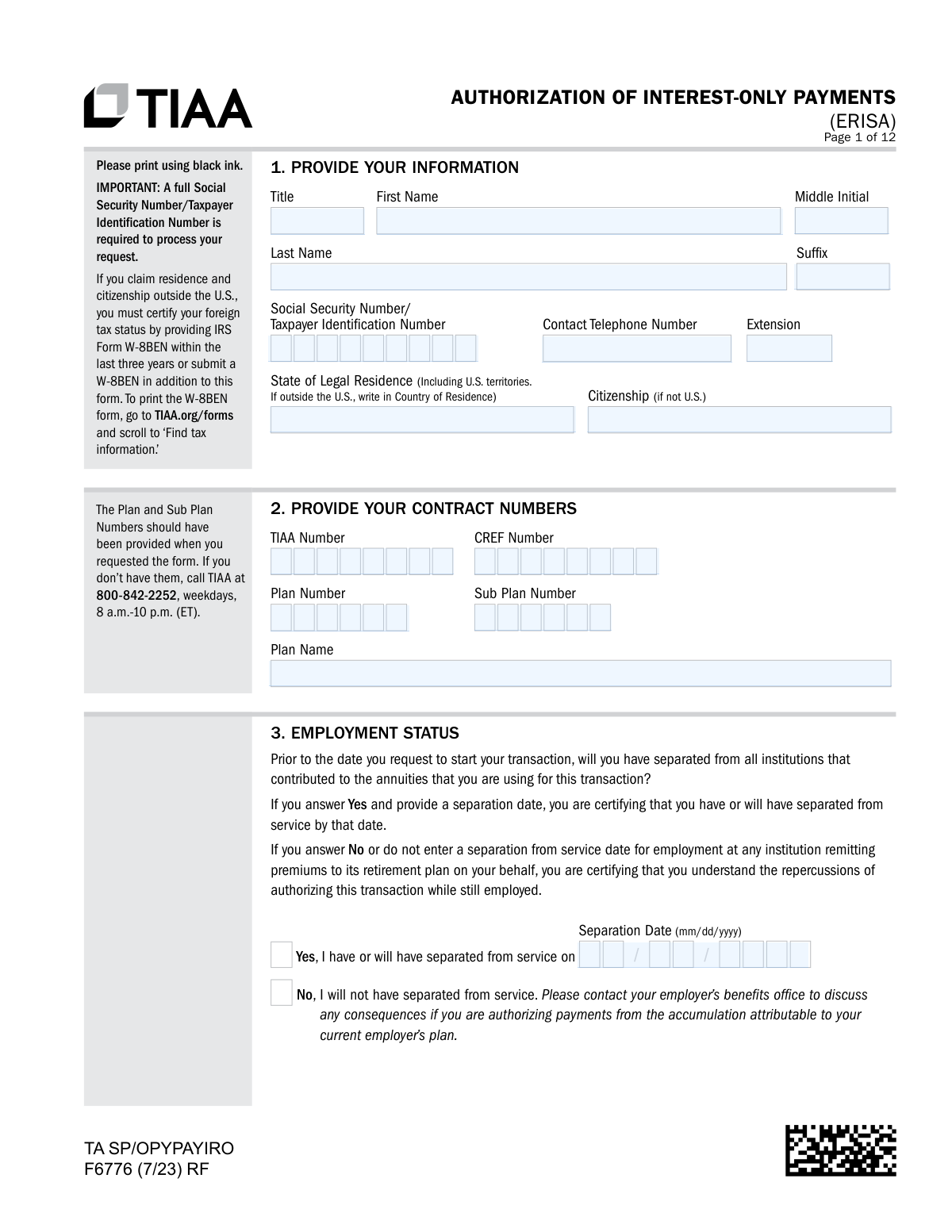
- For Interest Income: Use TIAA Form F6776 (Authorization of Interest-Only Payments) if you want to receive only the interest earned on your TIAA Traditional accumulation. This is an effective strategy for participants between age 55 and their RMD age.
- For Automatic RMDs: If your plan is classified as *Non-ERISA*, use the Request for Recurring Required Minimum Distributions From Your Retirement Investments (TIAA Form F11489). This allows TIAA to calculate and automate your annual IRS-mandated payouts to avoid penalties.
Form Comparison
| Form | Primary Purpose | Plan Type | Trigger Event |
|---|---|---|---|
| Vanguard 403(b)(7) ERISA Retirement Plan Distribution Request (Retirement / Severance from Employment / Disability) | Request full or partial distribution from a 403(b)(7) retirement account. | ERISA-governed 403(b)(7) plans. | Retirement, severance from employment, or qualifying disability. |
| TIAA Trust Rollover From Your Retirement Plan (ERISA) | Transfer retirement funds to an IRA or another eligible retirement account. | ERISA-governed employer retirement plans. | Moving assets to a personal IRA or a new employer's plan. |
| Request for Recurring Required Minimum Distributions From Your Retirement Investments (Non-ERISA) | Authorize automatic calculation and recurring payment of mandatory annual distributions. | Non-ERISA retirement investments. | Reaching the IRS mandatory age for required minimum distributions. |
| Form F6776, Authorization of Interest-Only Payments (ERISA) | Receive interest earnings only while preserving the principal balance. | ERISA-governed TIAA Traditional accumulation plans. | Generating income between age 55 and the required distribution age. |
| Voya Form 83516, Withdrawal Request 401 Corporate ERISA | Request withdrawal or rollover of assets from a corporate plan. | 401 Corporate ERISA retirement plans. | Termination of employment, retirement, financial hardship, or rollover. |
Tips for ERISA forms
Many ERISA-governed retirement plans require a spouse's notarized signature to authorize distributions or rollovers. Failing to have this section properly witnessed by a notary or plan representative is a leading cause for form rejection. Always check the specific requirements of your plan before submitting to avoid processing delays.
Managing complex retirement paperwork can be overwhelming, but AI-powered tools like Instafill.ai can complete these forms in under 30 seconds with high accuracy. Your sensitive financial data stays secure during the process, making it a reliable time-saver for those dealing with multiple distribution or rollover documents.
When filling out rollover forms, ensure you specify a 'Direct Rollover' to avoid mandatory 20% federal income tax withholding. If you choose an indirect rollover, the plan administrator is legally required to withhold taxes, and you will need to replace that amount from your own funds to avoid penalties. Double-check that the payee instructions list the new financial institution directly.
Unlike non-ERISA forms, these documents often require an authorized signature from your employer’s plan administrator to certify your eligibility. Sending the form directly to the financial provider without this internal approval can stall your request for weeks. Contact your HR department to see if they need to sign the document before it is mailed.
Discrepancies in your name, social security number, or address between the form and the provider's records can trigger security holds. If you have recently moved or changed your name, update your profile with the plan provider before submitting a distribution request. This prevents 'identity mismatch' flags that often delay the release of retirement funds.
Before requesting a full distribution, check your most recent plan statement to confirm your vested balance versus your total balance. ERISA forms allow you to request a total withdrawal, but you are only entitled to the portion you own based on your years of service. Knowing your vesting status helps you accurately calculate the actual payout you should expect.
Frequently Asked Questions
ERISA stands for the Employee Retirement Income Security Act of 1974, which is a federal law that sets minimum standards for most retirement and health plans in private industry. These forms are designed to ensure that plan administrators provide participants with important information and that benefit distributions follow strict legal protections.
The requirement depends on the type of employer that sponsored your plan. Most private-sector employer plans are governed by ERISA, while government and certain church plans are often non-ERISA, which may result in different documentation requirements for distributions or rollovers.
Yes, AI tools like Instafill.ai can fill out complex ERISA forms in under 30 seconds. The AI accurately extracts data from your source documents and places it into the correct fields, ensuring that complicated retirement and rollover documents are completed with high precision.
Most participants file these forms due to retirement, severance from employment, or a qualifying disability. Some forms are also specifically used for hardship withdrawals or to initiate Required Minimum Distributions (RMDs) once the participant reaches the federally mandated age.
Under ERISA regulations, many retirement plans are required to provide benefits in the form of a Qualified Joint and Survivor Annuity. If a participant wishes to choose a different payout method or name a different beneficiary, federal law typically requires written consent from the spouse, which often must be witnessed by a notary or plan representative.
Completing these forms manually can be a long process because of the detailed financial and personal information required, but using AI-powered services can reduce the process to less than a minute. Platforms like Instafill.ai can also convert non-fillable PDF versions into interactive forms to streamline the completion process.
A direct rollover moves your retirement funds directly from your current plan to another eligible retirement account or IRA without you taking possession of the money, which typically avoids immediate taxes. A lump-sum distribution pays the funds directly to you, which usually triggers mandatory tax withholding and potential early withdrawal penalties.
Completed forms should generally be submitted directly to your plan administrator or the specific financial institution managing the assets, such as TIAA, Vanguard, or Voya. Many providers now allow for digital uploads through their secure portals, though forms requiring a physical notary seal may still need to be sent via mail.
You will typically need your Social Security number, your specific plan or account number, and the contact details for the receiving institution if you are doing a rollover. If you are requesting a distribution due to disability or hardship, you may also need to have supporting medical or financial documentation ready to attach.
While distributions are often triggered by leaving an employer at any age, certain payment options like Interest-Only payments or Required Minimum Distributions (RMDs) are tied to specific age milestones. For example, RMDs generally must begin after you reach age 73 to avoid significant IRS tax penalties.
Glossary
- Form Complexity Index
- Instafill’s 0–100 measure of how much effort a form takes to complete, calculated deterministically from the form’s own structure rather than estimated. It combines the number of fillable fields (the largest factor), how difficult those fields are to complete based on their type, the number of pages that contain fields, the amount of conditional “fill-only-if” logic, and how many sections the form is divided into, then adds modifiers for tables and repeating lists, bundled instruction pages, and dense page layouts. A higher score means the form is harder to fill out by hand. The forms in this category have a median Form Complexity Index of 59/100 (Moderate). See exactly how it is calculated.
- ERISA
- The Employee Retirement Income Security Act of 1974 is a federal law that sets minimum standards for retirement and health plans in private industry to protect individuals' benefits.
- RMD (Required Minimum Distribution)
- The minimum amount the IRS requires you to withdraw from your retirement account annually once you reach a certain age, typically 73.
- Rollover
- The process of moving retirement savings from one eligible account to another, such as from an employer-sponsored 401(k) to an Individual Retirement Account (IRA), often to maintain tax-deferred status.
- Spousal Consent
- A legal requirement under ERISA that requires a participant's spouse to sign a waiver before the participant can take certain distributions or name a non-spouse beneficiary.
- 403(b)(7)
- A specific type of tax-sheltered annuity plan for employees of public schools and non-profit organizations that allows retirement contributions to be invested in mutual funds.
- Hardship Withdrawal
- An emergency distribution from a retirement plan allowed by the IRS for an 'immediate and heavy financial need,' which may be subject to taxes and specific plan limitations.
- Plan Administrator
- The person or entity designated by a retirement plan to handle day-to-day operations, process forms, and ensure the plan stays in compliance with federal laws.
- Direct Rollover
- A transfer of retirement funds directly from one plan provider to another, which prevents the 20% mandatory federal income tax withholding that applies when funds are paid directly to the participant.