Fill out trust forms
with AI.
Trust forms represent a critical intersection of estate planning, tax compliance, and financial management. This category encompasses the various documents required to establish, maintain, and report on assets held within a trust or estate. Whether you are dealing with federal obligations like IRS Form 1041 for income tax returns or state-specific requirements such as California Judicial Council probate forms, these documents serve as the legal record for how assets are handled. They are vital for ensuring that fiduciaries remain in compliance with the law and that the intentions of the trust creator are accurately fulfilled.
By continuing, you acknowledge Instafill's Privacy Policy and agree to get occasional product update and promotional emails.
About trust forms
Typically, these forms are needed by trustees, executors, and financial professionals who are tasked with managing wealth for others. They are also essential for individuals undergoing major life changes, such as establishing a new trust for their family or updating account ownership at financial institutions like Fidelity or TIAA. From notifying interested parties of court hearings via Form DE-120 to authorizing trusted contacts for account security, these forms facilitate the smooth transfer and protection of assets. Tools like Instafill.ai use AI to fill these forms in under 30 seconds, providing a practical way to handle complex paperwork accurately and securely without the manual burden.
Every form on this page can be completed without typing. Instafill is form filling software that reads a PDF and fills it for you — including flat and scanned documents that carry no fillable fields at all.
Forms in This Category
The forms in this category have a median Form Complexity Index of 58/100 (Moderate), measured across 47 forms by field count, input difficulty, length, conditional logic and structure. See how it is calculated.
- Enterprise-grade security & data encryption
- 99%+ accuracy powered by AI
- 1,000+ forms from all industries
- Complete forms in under 60 seconds
How to Choose the Right Form
Navigating trust and estate documentation can be complex, as requirements vary significantly between tax reporting, court proceedings, and managing private financial accounts. To find the right document, identify whether your primary goal is compliance, litigation, or asset management.
Tax Compliance and Reporting
If you are a fiduciary managing the financial activities of a trust or estate, you likely need IRS-specific forms to report income or foreign assets:
- Form 1041 (U.S. Income Tax Return for Estates and Trusts): Use this to report annual income, deductions, and gains.
- Form 3520: Required for U.S. persons who have transactions with foreign trusts or receive large foreign gifts.
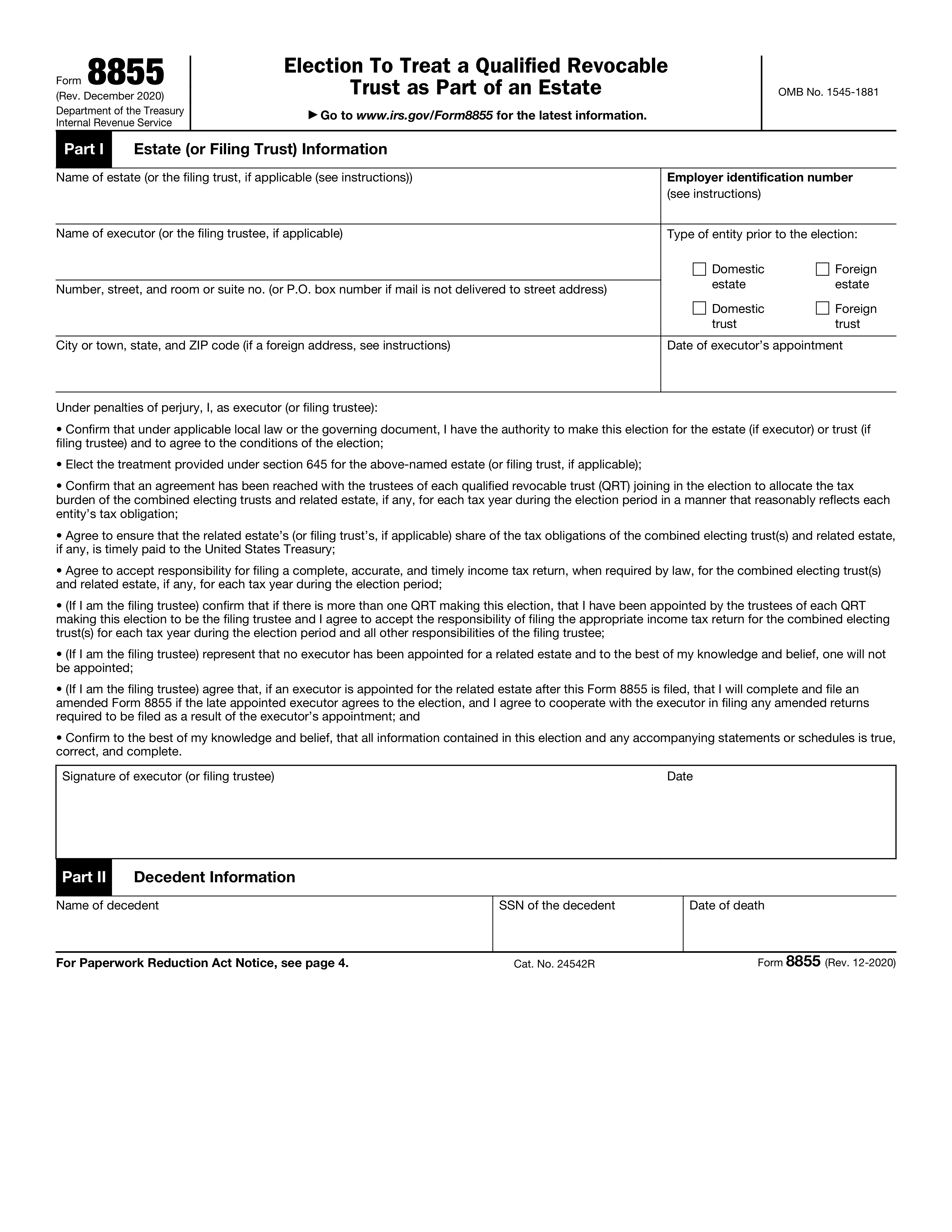
- Form 8855: Use this to elect to treat a qualified revocable trust as part of an estate for tax purposes.
California Probate and Court Actions
For those dealing with the California court system regarding a decedent's estate or a trust, specific Judicial Council forms are required to maintain legal standing:
- Form DE-120 (Notice of Hearing—Decedent's Estate or Trust): This is the mandatory form for notifying interested parties about scheduled court hearings.
- Trust Certification and Trustee Powers: Use this document to provide third parties (like banks or insurance companies) with proof that the trust exists and that you have the legal authority to act as trustee.
Managing Private Financial Accounts
Major financial institutions require specific paperwork to move assets into a trust or update account permissions:
- Fidelity Accounts: Use the Fidelity Ownership Change to Trust or Fidelity Change of Account Registration to move brokerage or mutual fund assets into a trust’s name. To add a protective layer to your account, use the Fidelity Trusted Contact Authorization Form.
- TIAA Accounts: For retirement assets, use the TIAA Trust, N.A. IRA Beneficiary Designation to control how assets pass after death, or the TIAA Trust Rollover From Your Retirement Plan (ERISA) to move funds between qualified accounts.
Retirement Plan and Pension Trusts
If you are a member of a specific union or agency plan, look for forms tailored to your organization, such as the Housing Agency Retirement Trust (HART) Transfer/Rollover Form or the I.B.E.W. & Electrical Industry Local 697 Direct Rollover Request Form. These are essential for maintaining the tax-deferred status of your retirement savings during a transfer.
Tips for trust forms
Ensure the name of the trust and the names of the trustees exactly match the original Trust Agreement or Declaration of Trust. Even minor discrepancies in spelling or formatting can cause financial institutions or court clerks to reject your filing.
Many trusts require a separate Employer Identification Number (EIN) from the IRS rather than the grantor's Social Security Number. Before filling out Form 1041 or ownership change forms, confirm the trust's tax status to avoid reporting errors or IRS audits.
AI-powered tools like Instafill.ai can complete these complex trust and probate forms in under 30 seconds with high accuracy. Your data stays secure during the process, providing a massive time-saver for fiduciaries and executors handling multiple filings.
When completing Judicial Council forms like the DE-120, double-check the hearing date, time, and department with the court's online portal. Providing incorrect notice information can lead to the court striking your petition, requiring you to restart the notification process.
If a trust has multiple co-trustees, most financial institutions require all parties to sign unless the trust document explicitly allows for independent action. Missing a single signature is a common reason for the rejection of transfer or rollover requests.
Forms like the Private Trust (Mod(PT).2005) or foreign trust reports often require attachments such as trust deeds or financial statements. Scan these documents into a dedicated folder so you can quickly reference or upload them while filling out your forms.
Before submitting rollover or withdrawal forms for trust-owned retirement accounts, consult the Summary Plan Description (SPD) or the Trust Agreement. Understanding specific vesting and withdrawal rules prevents accidental tax penalties and ensures fiduciary compliance.
Frequently Asked Questions
Trust forms are legal and financial documents used to establish, manage, or dissolve a trust. They cover a wide range of actions, including reporting trust income to the IRS, notifying parties of court hearings in probate matters, and transferring ownership of assets like brokerage accounts or retirement plans into a trust's name.
The fiduciary, which could be a trustee, executor, or personal representative, is responsible for filing Form 1041. This form is used to report the annual income, deductions, and distributions of an estate or trust to the IRS to ensure federal tax compliance.
You typically need these forms during probate proceedings or when a trust is under court supervision in California. For example, Form DE-120 is used to provide legally required notice to interested parties that a petition or report has been filed and a hearing has been scheduled.
Yes, financial institutions like Fidelity and TIAA provide specific ownership change forms for this purpose. These forms allow you to retitle mutual fund accounts, annuities, or brokerage accounts from your individual name to the name of your trust, which is a common step in estate planning.
A Trust Certification is a document that summarizes the key details of a trust without revealing confidential information like the names of beneficiaries. It is often required by banks and insurance companies to verify that the trustees have the legal authority to manage the account or policy.
If you are a U.S. person dealing with a foreign trust, you may need to file IRS Form 3520. This information return is used to report transactions with foreign trusts, ownership of foreign trust assets, or the receipt of large gifts from foreign sources to comply with international reporting rules.
Many employer-sponsored plans, such as those from HART or TIAA, have specific rollover request forms. These documents allow you to move funds from a retirement plan into a trust or another eligible account while maintaining the tax-deferred status of the assets.
Yes, you can use AI tools like Instafill.ai to complete complex trust and probate forms in under 30 seconds. The AI accurately extracts data from your source documents and places it into the correct fields, significantly reducing the risk of manual entry errors.
Filling out trust-related paperwork manually can take hours, but using an AI-powered platform can speed up the process significantly. Platforms like Instafill.ai allow users to generate accurately filled PDFs almost instantly, making it much easier to manage estate and trust administration.
A Trusted Contact Authorization form allows a financial institution to reach out to a designated person if they suspect financial exploitation or have concerns about the account owner's health. This contact can discuss the account with the institution but generally does not have the authority to make trades or withdrawals.
Submission locations depend on the form type: federal tax forms are sent to the IRS, Judicial Council forms are filed with the local Superior Court, and asset-specific forms are submitted directly to the financial institution managing the account.
While many people consult an attorney for estate planning, many trust forms are designed to be completed by the trustee or account owner. Using standardized forms and AI assistance can help ensure the paperwork is handled correctly, though legal advice is recommended for complex legal interpretations.
Glossary
- Form Complexity Index
- Instafill’s 0–100 measure of how much effort a form takes to complete, calculated deterministically from the form’s own structure rather than estimated. It combines the number of fillable fields (the largest factor), how difficult those fields are to complete based on their type, the number of pages that contain fields, the amount of conditional “fill-only-if” logic, and how many sections the form is divided into, then adds modifiers for tables and repeating lists, bundled instruction pages, and dense page layouts. A higher score means the form is harder to fill out by hand. The forms in this category have a median Form Complexity Index of 58/100 (Moderate). See exactly how it is calculated.
- Trustee
- The person or entity legally responsible for managing the assets held within a trust and ensuring they are distributed according to the trust's instructions.
- Beneficiary
- An individual or organization designated to receive income, property, or other assets from a trust or an estate.
- Fiduciary
- A person, such as a trustee or executor, who is legally and ethically obligated to act in the best interest of another party when managing their financial affairs.
- Grantor
- The individual who creates the trust and transfers their assets into it; this person may also be referred to as the settlor or trustor.
- Decedent
- The person who has passed away, whose estate or trust assets are currently being managed or distributed.
- Certification of Trust
- A shortened legal document that proves a trust exists and identifies the trustee's powers without revealing private details like specific assets or beneficiary names.
- Schedule K-1
- An IRS tax document issued with Form 1041 that reports a beneficiary's share of income, credits, and deductions from a trust or estate.
- Probate
- The court-supervised process of validating a deceased person's will and distributing their assets, which many trusts are specifically designed to avoid.