Yes! You can use AI to fill out Option Information — Corporate and Institutional Accounts; Sole Proprietorship Accounts; Merrill Lynch Trust Accounts
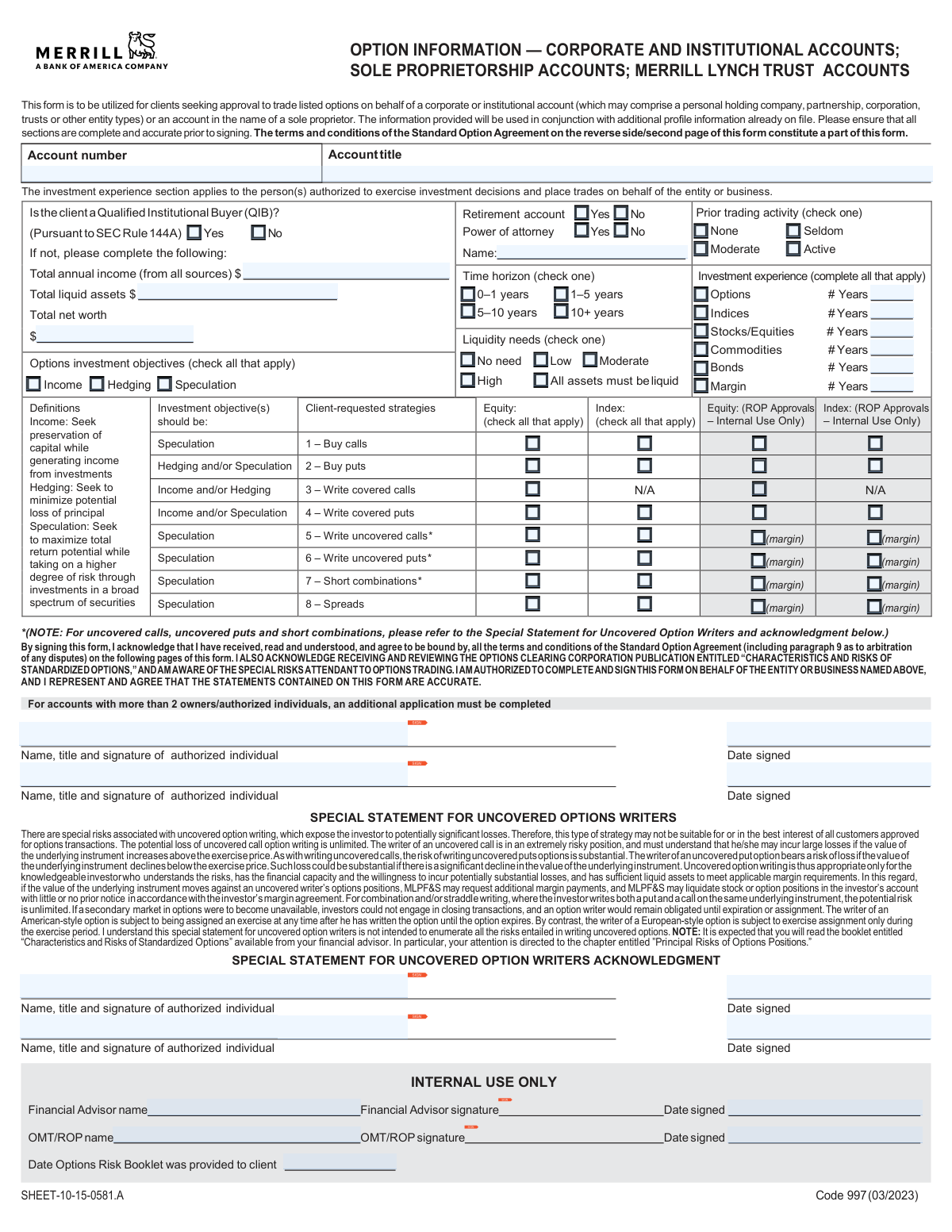
This form, titled 'Option Information — Corporate and Institutional Accounts', is a crucial document for entities like corporations, partnerships, or trusts seeking approval from Merrill Lynch to trade listed options. It collects detailed information on the account's financial standing, investment experience, risk tolerance, and objectives to ensure suitability for the high-risk nature of options trading. Today, this form can be filled out quickly and accurately using AI-powered services like Instafill.ai, which can also convert non-fillable PDF versions into interactive fillable forms.
Our AI automatically handles information lookup, data retrieval, formatting, and form filling.
It takes less than a minute to fill out Code 997 using our AI form filling.
Securely upload your data. Information is encrypted in transit and deleted immediately after the form is filled out.
Form specifications
| Form name: | Option Information — Corporate and Institutional Accounts; Sole Proprietorship Accounts; Merrill Lynch Trust Accounts |
| Number of pages: | 1 |
| Language: | English |
| Categories: | corporate forms, trust forms, sole proprietorship forms, institutional forms, Merrill forms |
Instafill Demo: How to fill out PDF forms in seconds with AI
How to Fill Out Code 997 Online for Free in 2026
Are you looking to fill out a CODE 997 form online quickly and accurately? Instafill.ai offers the #1 AI-powered PDF filling software of 2026, allowing you to complete your CODE 997 form in just 37 seconds or less.
Follow these steps to fill out your CODE 997 form online using Instafill.ai:
- 1 Navigate to Instafill.ai and upload or select the Option Information form.
- 2 Use the AI assistant to automatically populate basic account information, such as the account title and number.
- 3 Complete the financial information section, providing details on annual income, liquid assets, and total net worth.
- 4 Detail the investment experience, prior trading activity, and time horizon for the person(s) authorized to make investment decisions.
- 5 Select the appropriate options investment objectives (Income, Hedging, Speculation) and the specific strategies the client wishes to employ.
- 6 Carefully review the Standard Option Agreement and the Special Statement for Uncovered Option Writers to understand the terms and risks.
- 7 Have all authorized individuals provide their names, titles, and digital signatures to certify the accuracy of the information and agree to the terms.
Our AI-powered system ensures each field is filled out correctly, reducing errors and saving you time.
Why Choose Instafill.ai for Your Fillable Code 997 Form?
Speed
Complete your Code 997 in as little as 37 seconds.
Up-to-Date
Always use the latest 2026 Code 997 form version.
Cost-effective
No need to hire expensive lawyers.
Accuracy
Our AI performs 10 compliance checks to ensure your form is error-free.
Security
Your personal information is protected with bank-level encryption.
Frequently Asked Questions About Form Code 997
This form is used by corporate, institutional, sole proprietorship, or trust clients to request approval from Merrill Lynch for trading listed options. It gathers information about your financial standing, investment experience, and objectives to determine suitability.
An authorized individual of a corporate, institutional, sole proprietorship, or trust account who wishes to trade options must complete this form. The person signing must be authorized to make investment decisions and place trades on behalf of the entity.
You should provide the investment experience of the person or persons who are authorized to make investment decisions and place trades for the account, as stated on the form.
If your entity is a Qualified Institutional Buyer (QIB), you can check 'Yes' and you will not be required to complete the financial details section for annual income, liquid assets, and net worth.
According to the form's definitions, 'Income' focuses on preserving capital, 'Hedging' aims to minimize potential losses, and 'Speculation' seeks to maximize returns by taking on higher risk. You should check all objectives that apply to your entity's strategy.
Writing an uncovered option exposes an investor to potentially unlimited or substantial losses. The special acknowledgment ensures you understand these significant risks before being approved for such high-risk strategies.
Before signing, you must acknowledge that you have received and reviewed the Options Clearing Corporation (OCC) publication titled 'Characteristics and Risks of Standardized Options.' You must also agree to the terms of the Standard Option Agreement included with this form.
After submission, Merrill Lynch will review the information to determine your eligibility for options trading and the specific strategies you are approved for. This information is used in conjunction with the profile information already on file for your account.
By signing this agreement, you agree to resolve any future disputes with Merrill Lynch through binding arbitration rather than in court, which includes giving up the right to a jury trial. This is detailed in section 9 of the Standard Option Agreement.
For each investment type listed, such as Stocks, Bonds, and Options, you need to enter the number of years of trading experience the authorized individual has. This helps the firm assess your knowledge and suitability for options trading.
Yes, AI-powered services like Instafill.ai can help you accurately auto-fill form fields using your saved information, which can save time and reduce errors.
You can use a service like Instafill.ai to fill this form online. Simply upload the PDF, and the platform will make it an interactive, fillable form that you can complete, sign, and download from your device.
If you have a non-fillable or 'flat' PDF, you can upload it to a platform like Instafill.ai. It uses AI to recognize the fields and convert the document into an interactive, fillable form for you to complete easily.
Compliance Code 997
Validation Checks by Instafill.ai
1
Conditional Requirement for Financial Information based on QIB Status
This check verifies that if the client answers 'No' to being a Qualified Institutional Buyer (QIB), the fields for 'Total annual income', 'Total liquid assets', and 'Total net worth' are mandatory and completed. If the client is a QIB, this information is not required. This is crucial for assessing the financial suitability of non-institutional clients for high-risk options trading, and failure to provide this information when required will prevent form submission.
2
Logical Consistency of Financial Figures
This validation ensures that the value entered for 'Total net worth' is greater than or equal to the value entered for 'Total liquid assets'. It is logically impossible for liquid assets to exceed total net worth. This check prevents data entry errors and ensures the financial data provided is coherent, which is essential for accurate risk assessment. A failed validation would require the user to correct the figures before proceeding.
3
Mandatory Acknowledgment for Uncovered Options
This check confirms that if the client requests any uncovered option strategies (e.g., 'Write uncovered calls', 'Write uncovered puts'), the 'SPECIAL STATEMENT FOR UNCOVERED OPTION WRITERS ACKNOWLEDGMENT' section is signed and dated. These strategies carry a risk of unlimited loss, and this validation ensures the client has explicitly acknowledged these specific, heightened risks as required by regulations. Without this acknowledgment, approval for these strategies cannot be granted.
4
Alignment of Investment Objectives and Requested Strategies
This validation cross-references the client's stated 'Options investment objectives' (Income, Hedging, Speculation) with their 'Client-requested strategies'. For example, a client who only selects 'Income' should not be able to request strategies labeled 'Speculation'. This ensures the client's trading requests are consistent with their stated goals and risk tolerance, which is a key component of suitability rules. A mismatch would trigger an error, requiring the client to align their objectives and strategy requests.
5
Risk Booklet Disclosure Date Verification
This check ensures the 'Date Options Risk Booklet was provided to client' is a valid date that occurs on or before the date the client signs the main agreement. This is a critical compliance step to prove that the client received mandatory risk disclosures before committing to the agreement. A signature date that precedes the booklet provision date would invalidate the application, as it suggests the client agreed to terms without having received the required risk information.
6
Power of Attorney Name Requirement
This validation ensures that if the 'Power of attorney' box is checked 'Yes', the corresponding 'Name' field for the attorney-in-fact is filled out. This is necessary to properly identify the individual authorized to act on behalf of the account holder. Failure to provide the name when a POA is indicated would result in an incomplete and legally ambiguous authorization, halting the application process until the information is provided.
7
Completeness of Investment Profile Selections
This check verifies that the client has made a selection for each of the single-choice categories: 'Prior trading activity', 'Time horizon', and 'Liquidity needs'. This information is fundamental to building a complete investor profile and assessing suitability for options trading. An incomplete profile prevents the firm from meeting its regulatory obligations to understand its customer, so the form cannot be submitted until all these sections are completed.
8
Validity of Investment Experience Years
This validation ensures that all entries in the '# Years' column of the 'Investment experience' section are non-negative integers. This data is used to quantify the client's experience in various investment types, which is a key factor in determining the level of options trading they may be approved for. Submitting non-numeric or negative values would corrupt the client's profile, so the system will reject invalid entries.
9
Main Agreement Signature and Date Completion
This check confirms that at least one 'Name, title and signature of authorized individual' and 'Date signed' field is completed in the main signature block. The signature and date are required to make the Standard Option Agreement legally binding. Without a valid signature and date, the entire application is void and cannot be processed.
10
Suitability Check for Retirement Accounts
This validation flags applications where 'Retirement account' is marked 'Yes' and the client has also selected 'Speculation' as an objective or requested highly speculative strategies. Trading speculative options in a retirement account is often considered unsuitable and may be subject to stricter scrutiny or limitations. A failed check would trigger a warning or require manual review by a compliance officer to ensure the strategy is appropriate for the client's retirement goals.
11
Format Validation for Financial Inputs
This check ensures that the 'Total annual income', 'Total liquid assets', and 'Total net worth' fields contain only valid, positive numerical currency values. The system should reject any non-numeric characters (except for currency symbols or commas) or negative numbers. This maintains data integrity and ensures that financial calculations for risk assessment are based on accurate, properly formatted data.
12
Account Number Format and Presence
This validation verifies that the 'Account number' field is not empty and conforms to the financial institution's specific format (e.g., a certain number of digits, specific prefixes). A correct account number is essential for linking this options agreement to the client's primary account and for all subsequent processing and trading. An invalid or missing account number would prevent the form from being processed as it cannot be tied to a client.
Common Mistakes in Completing Code 997
Applicants often mistype the account number or enter an account title that does not exactly match the legal name of the entity on file. This simple data entry error occurs due to haste or not cross-referencing official documents, leading to significant processing delays or application rejection. To avoid this, carefully verify the account title and number against a recent account statement before submission. AI-powered form fillers can help by auto-populating this information from saved profiles, reducing the risk of manual typos.
Many applicants are unfamiliar with the specific SEC definition of a QIB and may guess, answer incorrectly, or leave the question blank. The form requires detailed financial information only if the entity is not a QIB, so a mistake here leads to an incomplete profile. This results in processing delays while the firm requests clarification and prevents an accurate assessment of the entity's financial sophistication. If unsure, it is best to select 'No' and provide the requested financial details for the entity.
A frequent error is selecting conservative objectives like 'Income' while simultaneously requesting highly speculative strategies like 'Buy calls' or 'Write uncovered puts'. This contradiction happens when applicants don't understand the risk levels of different strategies. Such inconsistencies will cause the application to be flagged for review or rejected, as the requested trading authority does not align with the stated risk tolerance. Carefully align your strategy selections with your chosen investment objectives after reading the on-form definitions.
Applicants requesting high-risk strategies like writing uncovered calls or puts often overlook the separate signature required in the 'SPECIAL STATEMENT FOR UNCOVERED OPTION WRITERS ACKNOWLEDGMENT' section. Because these strategies expose the investor to potentially unlimited losses, a specific acknowledgment is mandatory. Failure to sign this section will result in an automatic denial of approval for these advanced strategies. Smart form-filling tools can highlight all required signature fields based on your selections to prevent this oversight.
When filling out the form for a corporation, partnership, or trust, the authorized individual sometimes mistakenly provides their personal financial data instead of the entity's. The firm needs to assess the financial capacity of the account holder (the entity), not the individual trader. This error renders the financial disclosure invalid and will lead to the application's rejection. Ensure that the 'Total annual income', 'Total liquid assets', and 'Total net worth' figures reflect the financial standing of the business entity.
Applicants often leave the '# Years' fields blank for the various asset classes, either out of oversight or because they have no experience in a particular area. This missing data prevents the firm from properly evaluating the trader's knowledge and suitability for options trading. An incomplete profile may lead to a denial of trading approval or restriction to the most basic strategies. You should enter a numeric value, such as '0' for no experience, in every field to ensure the profile is complete.
For fields requiring a number, such as '# Years' of investment experience, applicants sometimes write text like 'several' or 'many years'. This non-numeric data cannot be processed automatically and requires manual intervention, causing delays. The application may be returned for correction, prolonging the approval process. Always use numeric digits for any field requesting a number. AI-powered tools like Instafill.ai can prevent this by validating that data is entered in the correct format.
For entities with multiple authorized individuals, it's common for only one person to sign the form, or for a signature to be missing a printed name and title. The form is a legal document that requires proper authorization from all necessary parties as defined by the entity's governing documents. An incomplete signature section invalidates the application and will halt the approval process until all required signatures are collected. Ensure all authorized individuals sign and provide their full name and title.
Sections like 'Prior trading activity,' 'Time horizon,' and 'Liquidity needs' require the applicant to check one box, but are frequently left blank. This information is critical for the firm to build a comprehensive suitability and risk profile for the account. Leaving these sections empty makes the application incomplete and will cause it to be returned, delaying the approval to trade options. Before submitting, review the form to ensure one choice has been marked in all mandatory checkbox sections.
This field, often filled out by the financial advisor, is a critical compliance checkpoint that is easily missed. It documents that the client has received the mandatory 'Characteristics and Risks of Standardized Options' publication before signing the agreement. Omitting this date creates a regulatory gap and will prevent the final approval of the account. Intelligent form assistants can flag all mandatory date fields to ensure they are not overlooked before submission.
When this form is printed and filled out by hand, illegible handwriting can cause significant problems. Poorly written names, numbers, or dates can lead to data entry errors by the firm's staff, requiring follow-up calls to clarify information and delaying the entire process. To prevent this, it is best to fill out the form digitally. If the form is a non-fillable PDF, a tool like Instafill.ai can convert it into an interactive, fillable version, ensuring all entries are clear and legible.
The financial numbers provided for 'Total annual income', 'Total liquid assets', and 'Total net worth' are sometimes inconsistent or illogical, such as listing liquid assets as greater than total net worth. This can happen when figures are estimated hastily rather than taken from official financial statements. Such discrepancies raise red flags during compliance review and will likely lead to rejection or requests for supporting documentation. Use verified data from the entity's balance sheet and income statement to ensure accuracy.
Saved over 80 hours a year
“I was never sure if my IRS forms like W-9 were filled correctly. Now, I can complete the forms accurately without any external help.”
Kevin Martin Green
Your data stays secure with advanced protection from Instafill and our subprocessors

Robust compliance program
Transparent business model
You’re not the product. You always know where your data is and what it is processed for.
ISO 27001, HIPAA, and GDPR
Our subprocesses adhere to multiple compliance standards, including but not limited to ISO 27001, HIPAA, and GDPR.
Security & privacy by design
We consider security and privacy from the initial design phase of any new service or functionality. It’s not an afterthought, it’s built-in, including support for two-factor authentication (2FA) to further protect your account.
Fill out Code 997 with Instafill.ai
Worried about filling PDFs wrong? Instafill securely fills option-information-corporate-and-institutional-accounts-sole-proprietorship-accounts-merrill-lynch-trust-accounts forms, ensuring each field is accurate.