Fill out trust account forms
with AI.
Trust account forms are essential legal and financial documents designed to facilitate the management of assets held within a trust, estate, or guardianship. These forms ensure that financial institutions like Fidelity, Merrill Lynch, and Vanguard have accurate records regarding who has fiduciary authority over specific assets. Properly documenting these details is critical for maintaining legal compliance, protecting the interests of beneficiaries, and ensuring that assets are managed according to the specific terms of a trust agreement or estate plan.
By continuing, you acknowledge Instafill's Privacy Policy and agree to get occasional product update and promotional emails.
About trust account forms
These forms are typically required by trustees, executors, and legal representatives during significant life transitions or estate planning milestones. For instance, you may need a Trustee Certification form to add or remove individuals with signing authority, or a Change of Account Ownership form to transition personal assets into a revocable living trust. They are also vital when opening new brokerage accounts or updating beneficiary information to align with a comprehensive financial strategy. Because these documents often require precise legal language and detailed entity information, accuracy is paramount to avoid delays in asset distribution or management.
Completing complex paperwork manually can be a time-consuming process prone to clerical errors. Tools like Instafill.ai use AI to fill these trust account forms in under 30 seconds, ensuring your data is handled accurately and securely so you can focus on your fiduciary responsibilities.
Every form on this page can be completed without typing. Instafill is form filling software that reads a PDF and fills it for you — including flat and scanned documents that carry no fillable fields at all.
Forms in This Category
The forms in this category have a median Form Complexity Index of 62/100 (Moderate), measured across 13 forms by field count, input difficulty, length, conditional logic and structure. See how it is calculated.
- Enterprise-grade security & data encryption
- 99%+ accuracy powered by AI
- 1,000+ forms from all industries
- Complete forms in under 60 seconds
How to Choose the Right Form
Establishing or Updating Trust Accounts
If you are setting up a new investment vehicle for a trust or moving existing assets into one, you will need registration and application forms. For a fresh start, use the New Fidelity Account® — Trust — Brokerage application. If you already have an individual account and need to move it into a trust, select the Fidelity Change of Account Registration (Brokerage) or the Fidelity Change of Account Ownership (Mutual Fund Only), depending on your asset type.
Merrill Lynch clients should use the Letter of Authorization to Change Account Title to a Grantor Revocable Trust for simple title changes, or the comprehensive Merrill Edge Self-Directed Trust and Estate Cash Management Account (CMA Account) Application Booklet for full account setups.
Managing Trustees and Authorizations
Trusts often require updates as fiduciaries change or as you grant access to financial advisors.
- To change legal authority: Use the Fidelity Trustee Certification — Adding or Removing Trustees to update who has the power to sign for the account.
- To update trust structure: Use the Vanguard Personal Investor – Unregulated Trust details form to provide required tax and beneficiary updates for Vanguard accounts.
- To grant third-party access: The TIAA Trust, N.A. Authorization to receive client account information allows you to let a family member or advisor view statements without giving them trading authority.
Trading Permissions and Withdrawals
Not all trust accounts automatically allow for complex trading or retirement distributions.
- For Options Trading: You must submit suitability forms. Choose Option Information — Individual, Joint and Trust Accounts for standard setups, or the Option Information — Corporate and Institutional Accounts for more complex trust structures at Merrill Lynch.
- For Retirement Trust Assets: If you are managing a rollover account within a housing agency plan, use the Housing Agency Retirement Trust Form #190, Request to Withdraw a Rollover Account to specify your distribution or rollover preferences.
Form Comparison
| Form | Primary Purpose | Action Required | When to Use |
|---|---|---|---|
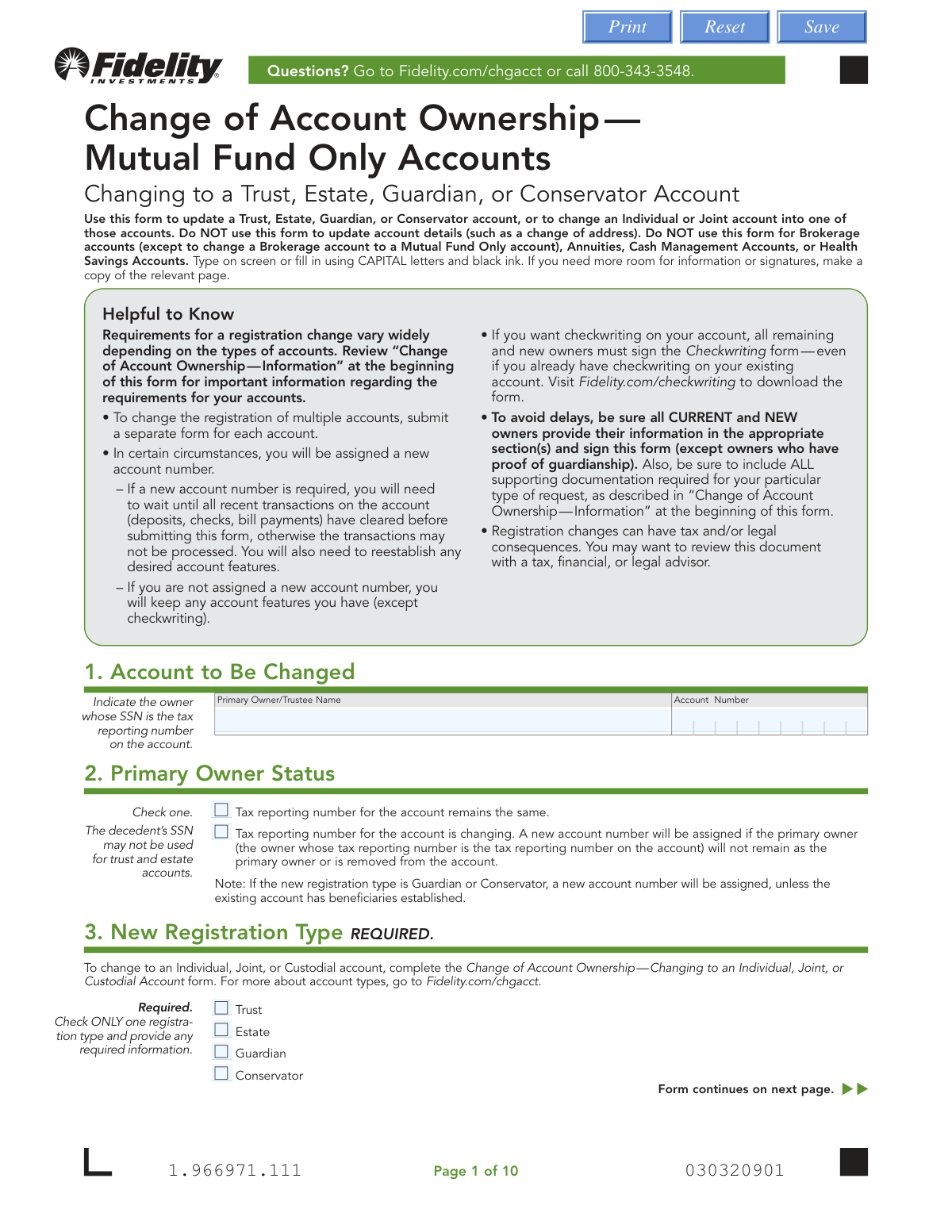
| Fidelity Change of Account Ownership — Mutual Fund Only Accounts (Changing to a Trust, Estate, Guardian, or Conservator Account) | Transfer mutual fund ownership to a trust or estate. | Account Re-registration | During estate planning or following a death. |
| Fidelity Change of Account Registration — Changing to a Trust, Estate, Guardian, or Conservator Brokerage Account | Update brokerage account title to a trust or fiduciary. | Legal Title Change | Moving assets into a newly formed trust. |
| Fidelity Trustee Certification — Adding or Removing Trustees | Formally update the list of active trustees on account. | Trustee Modification | When a trustee is added, resigned, or removed. |
| Housing Agency Retirement Trust Form #190, Request to Withdraw a Rollover Account | Request withdrawal or rollover of retirement trust funds. | Fund Distribution | Upon retirement or exiting the retirement plan. |
| Letter of Authorization to Change Account Title to a Grantor Revocable Trust | Retitle individual accounts to a Grantor Revocable Trust. | Ownership Transfer | Organizing personal assets for a living trust. |
| Merrill Edge Self-Directed Trust and Estate Cash Management Account (CMA Account) Account Application Booklet and Agreements | Open a CMA account for trusts and estates. | New Account Opening | Establishing financial infrastructure for a legal estate. |
| Merrill Edge® Self-Directed Trust Cash Management Account® (CMA® Account) Account Application Booklet and Agreements | Establish a new CMA investment account for a trust. | New Account Opening | When a trust needs a dedicated trading account. |
| New Fidelity Account® — Trust — Brokerage | Establish a new brokerage account for a trust entity. | New Account Opening | Creating a new investment home for trust assets. |
| Option Information — Corporate and Institutional Accounts; Sole Proprietorship Accounts; Merrill Lynch Trust Accounts | Authorize institutional or trust accounts for options trading. | Trading Approval | Before trading complex derivatives in a trust account. |
| Option Information — Individual, Joint and Trust Accounts | Evaluate suitability for options trading in trust accounts. | Strategy Approval | When seeking to use advanced investment strategies. |
| TIAA Trust, N.A. Authorization to receive client account information | Grant third-party access to trust account information. | Access Authorization | Sharing data with financial advisors or family members. |
| Vanguard Personal Investor – Unregulated Trust details – Account information update | Update trust structure and controlling person details. | Information Update | Complying with tax regulations or internal trust changes. |
Tips for trust account forms
A common mistake is paraphrasing the name of the trust on the form. Ensure the trust title matches your Trust Agreement word-for-word, including any dates or 'fbo' designations, to avoid processing delays or rejection by the financial institution.
Many trust withdrawal or transfer forms require more than just a standard signature. Check if the form specifically asks for a Medallion Signature Guarantee, which is a specialized security stamp provided by financial institutions that is different from a standard notary.
When a trustee is added or removed, you must update the financial institution immediately using a Trustee Certification form. Failing to keep these records current can lead to frozen accounts or the inability to execute urgent trades and withdrawals when they are needed most.
Depending on the trust type, you may need either the Grantor’s Social Security Number or a dedicated Employer Identification Number (EIN). Having this information verified and ready before you start prevents errors in the tax reporting sections of the forms.
Managing multiple trust accounts involves repetitive data entry that is prone to error. AI-powered tools like Instafill.ai can complete these forms in under 30 seconds with high accuracy, and the data stays secure during the process, making it a major time-saver for fiduciaries.
When changing an individual account to a trust account, always double-check your beneficiary designations. Coordinating these details ensures that assets flow correctly according to your estate plan and prevents potential legal conflicts between the trust and the account's direct beneficiaries.
Frequently Asked Questions
Trust account forms are legal documents used to establish, manage, or modify financial accounts held in the name of a trust rather than an individual. They allow trustees to update account titles, change authorized signers, or distribute assets to beneficiaries according to the trust's legal terms.
You typically need this form when moving personal assets into a newly created trust or when an estate needs to be settled after the original owner passes away. It legally transfers the title of the assets from an individual or joint registration to the trust entity.
To update who has authority over a trust account, you usually need a Trustee Certification or a specific "Adding/Removing Trustees" form. This ensures the financial institution has an up-to-date record of who is legally authorized to manage the trust's assets.
A Letter of Authorization (LOA) is used to grant specific permissions or request changes that fall outside of standard account updates, such as retitling an existing account to a Grantor Revocable Trust. It acts as a formal instruction from the current account holders to the brokerage or bank.
Many financial institutions require a Medallion Signature Guarantee for high-value transfers or significant ownership changes. This is a special certification stamp that confirms the signature's authenticity and is usually obtained from a bank or credit union.
This document allows trustees to certify the existence of a trust and their authority to act on its behalf without providing the entire trust document. It protects the privacy of the trust's specific distribution terms while giving the financial institution the legal assurance it needs.
Yes, you can use AI tools like Instafill.ai to complete complex trust forms by extracting relevant information from your trust documents or previous applications. These tools can accurately populate fields and generate a ready-to-sign PDF in under 30 seconds.
While manual entry for a multi-page trust application can take 20-30 minutes, using AI-powered services like Instafill.ai can reduce this to less than a minute. The AI identifies and places data from your source documents directly into the correct fields, ensuring both speed and accuracy.
A brokerage trust account typically allows for trading a wider variety of securities, such as individual stocks and bonds, while a mutual fund trust account is often limited to specific fund families. You must choose the form that matches the specific type of account you are opening or modifying.
Yes, if a trust is the beneficiary of a retirement account or holds rollover assets, you will likely need a specific withdrawal or distribution form. These forms help ensure the distribution is coded correctly for tax purposes and complies with regulations.
In addition to the completed forms, you may need to provide a copy of the trust agreement's first and last pages, a death certificate (if applicable), and government-issued identification for all trustees. Requirements vary between institutions like Vanguard, Fidelity, and TIAA.
Financial institutions are required by law to identify the individuals who ultimately control or benefit from a trust to prevent money laundering and ensure tax compliance. This information is standard for both domestic and international trust accounts to satisfy reporting requirements.
Glossary
- Form Complexity Index
- Instafill’s 0–100 measure of how much effort a form takes to complete, calculated deterministically from the form’s own structure rather than estimated. It combines the number of fillable fields (the largest factor), how difficult those fields are to complete based on their type, the number of pages that contain fields, the amount of conditional “fill-only-if” logic, and how many sections the form is divided into, then adds modifiers for tables and repeating lists, bundled instruction pages, and dense page layouts. A higher score means the form is harder to fill out by hand. The forms in this category have a median Form Complexity Index of 62/100 (Moderate). See exactly how it is calculated.
- Trustee
- A person or entity legally appointed to manage and hold assets for the benefit of others within a trust. They are responsible for making financial decisions and ensuring the trust's terms are followed correctly.
- Grantor
- The individual who creates the trust and transfers their assets into it. This person is also sometimes referred to as a 'settlor' or 'trustor' on various financial forms.
- Medallion Signature Guarantee
- A special certification stamp used by banks and financial institutions to verify that a signature is authentic and the signer has the legal authority to transfer securities. It provides more legal protection than a standard notary seal.
- TOA (Transfer of Assets)
- A standard process used to move cash or securities from one financial institution to another without liquidating the assets. This is commonly used when moving an existing trust account to a new brokerage like Fidelity or Merrill Lynch.
- Fiduciary
- A person or organization that is legally and ethically required to act in the best interest of another party. Trustees have a fiduciary duty to manage trust assets for the benefit of the beneficiaries rather than for their own gain.
- ERISA (Employee Retirement Income Security Act)
- A federal law that sets standards for retirement and health plans in private industry. In this context, an ERISA fidelity bond may be required to protect retirement trust assets from losses caused by fraud or dishonesty.
- Qualified Charitable Distribution (QCD)
- A direct transfer of funds from an IRA to a qualified charity. These distributions can count toward a required minimum distribution (RMD) and are generally not taxed as income.
- CMA (Cash Management Account)
- A type of brokerage account offered by firms like Merrill Lynch that combines investment capabilities with traditional banking features, such as check-writing and debit cards, for trusts or estates.