
Yes! You can use AI to fill out Fidelity Change of Account Ownership — Mutual Fund Only Accounts (Changing to a Trust, Estate, Guardian, or Conservator Account)
Don't type 173 fields by hand. Tell our AI about yourself, or upload a document you already have, and it fills every field in seconds. You check it, then download, print or sign.
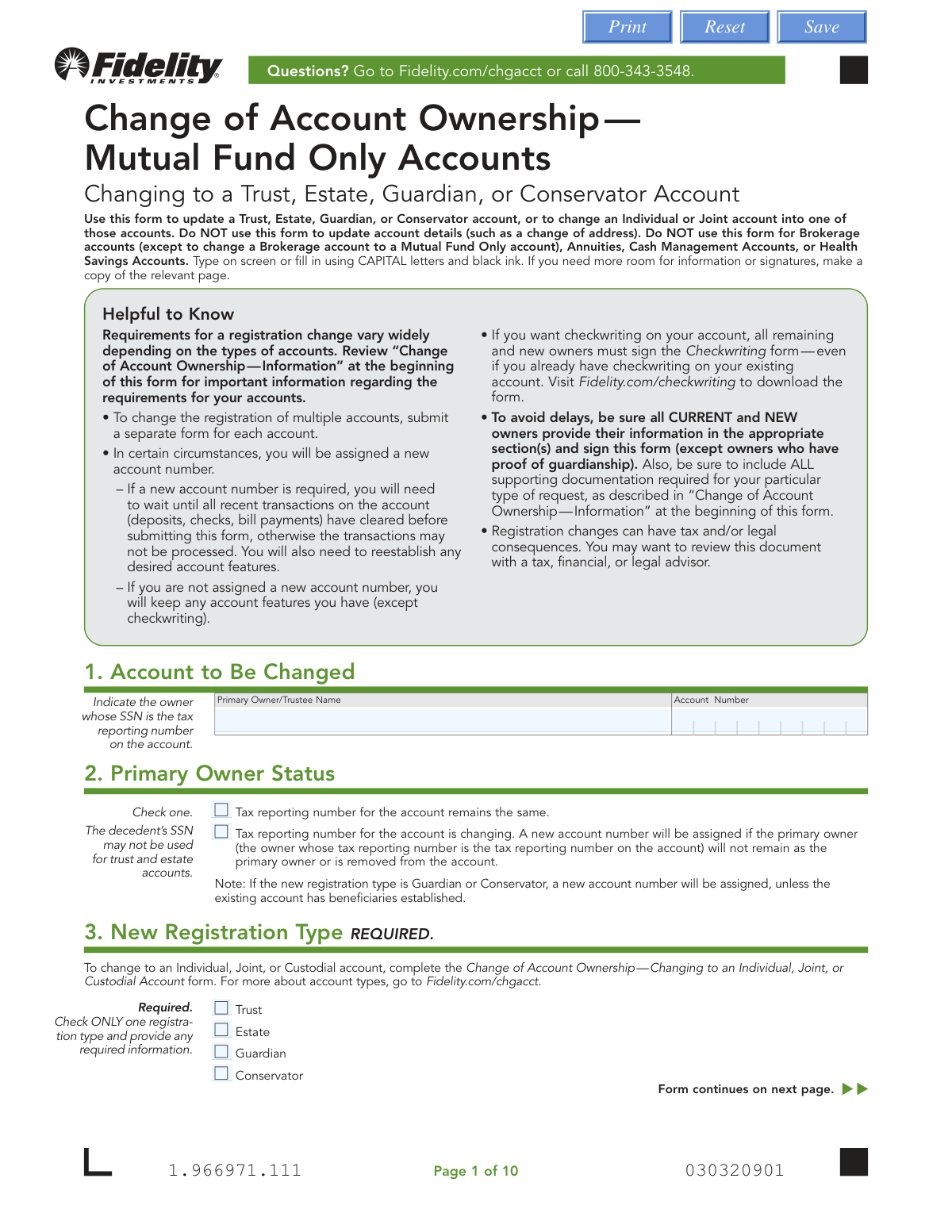
The AI does the filling. You just check it.
No typing into boxes, nothing to install.
What this form asks for
The AI fills all of it, from your answers or your documents.
The AI checks your answers before you download
15 checks built for this form, so a wrong date or a missing answer is caught before anyone else sees it.
This check verifies that the user has selected exactly one option in Section 3 ('New Registration Type'). This field is critical as it determines which subsequent sections are required and what supporting documentation is needed. Failure to select one and only one type will result in form rejection, as the system cannot determine how to process the account change.
This validation ensures that if 'Trust' is selected as the 'New Registration Type' in Section 3, then the user must complete Section 4 ('Trust or Estate Information') and Section 7 ('Beneficial Ownership for Trusts'). These sections gather essential details about the trust's legal structure, trustees, and beneficiaries, which are legally required for reregistration. If these sections are left blank for a trust reregistration, the submission will be incomplete and rejected.
This check confirms that all date fields across the form (e.g., Date of Birth, Date of Trust, ID Expiration Date) are entered in the specified MM DD YYYY format and are logically sound. For instance, a Date of Birth cannot be in the future, and an ID Expiration Date must be after the ID Issuance Date and not in the past. Incorrect or illogical dates can cause legal and processing errors, leading to the rejection of the application.
This validation verifies that all Social Security Numbers (SSN) or Taxpayer Identification Numbers (TIN) are entered as a 9-digit number. It also cross-references that for a new trust or estate account, the provided TIN is not the SSN of a deceased individual, as explicitly prohibited in the form instructions. Using an invalid or incorrect TIN will lead to tax reporting errors and immediate rejection of the form.
This check ensures that if an individual is identified as a 'Foreign citizen' in Sections 5, 6, or 7, all associated fields (Country of Citizenship, resident status, and Government Identification details) are fully completed. This information is mandatory for regulatory compliance, including anti-money laundering (AML) and tax reporting laws. An incomplete foreign citizen section will halt the account change process until the required information is provided.
This validation performs a logical check to ensure the correct parties have signed in the appropriate signature sections (9a or 9b) based on the specific account change scenario (e.g., 'Individual to Trust — Owner Deceased'). The information matrix on pages 1-3 dictates who must sign. Missing or incorrect signatures will render the legal authorization invalid, causing the entire request to be rejected.
And 9 more checks
- Confirms Presence of Required Medallion Signature Guarantee
- Validates Entity Name and Flags for Additional Forms
- Ensures Residential Address is a Physical Location
- Verifies Presence of Required Contact Information
- Validates Notarization Requirement for Certification of Trust
- Validates Account Number Format and Existence
- Ensures Government-Issued ID is Not Expired
- Logical Consistency of Primary Owner Tax Status
- Verifies Presence of Required Signer Title in Section 9b
Let AI fill out your 1.966971.111
No typing. Every field filled in seconds, checked, ready to sign.
How to Fill Out 1.966971.111 Online for Free in 2026
What the AI walks you through.
- Navigate to Instafill.ai and upload or select the Fidelity Change of Account Ownership form.
- Use the AI assistant to provide the current account information to be changed in Section 1.
- Specify the new registration type (Trust, Estate, Guardian, or Conservator) and provide the required details for the new entity in Sections 3 and 4.
- Enter the personal and contact information for the primary and any additional trustees, legal representatives, or guardians in Sections 5 and 6.
- If the new registration is a trust, complete Section 7 with information on all beneficial owners.
- Carefully review all the auto-filled information for accuracy, then follow the prompts to have all required parties electronically sign in Section 9.
- Download the completed form and gather any necessary supporting documents (e.g., Fidelity Certification of Trust, death certificate) to submit to Fidelity.
Common Mistakes in Completing 1.966971.111
The ones the AI is built to catch.
Failing to Submit All Required Supporting Documents
Confusing a Notary Stamp with a Medallion Signature Guarantee
Incorrectly Determining Who Signs in Section 9a vs. 9b
Forgetting to Complete the 'Fidelity Certification of Trust' Form
Using a Deceased Person's SSN for a Trust or Estate
Providing a Name That Does Not Exactly Match Government ID
Missing Required Notarization on the Certification of Trust
Using a P.O. Box for a Residential Address
Omitting Information for Beneficial Owners of a Trust
Submitting an Incomplete Form Packet
Frequently Asked Questions About 1.966971.111
Is it really free for 7 days?
Can I fill other forms too?
How do I cancel?
How does the AI fill out 1.966971.111?
What happens to my information?
How complex is 1.966971.111 to fill out?
What is the purpose of this Fidelity 'Change of Account Ownership' form?
Who needs to fill out this form?
What documents do I need to submit with this form?
What is a Medallion Signature Guarantee and when is it required?
The account owner is deceased. What is the process?
Where do I send the completed form?
Will my account number change after submitting this form?
How do I know who needs to sign the form in Section 9?
What is the 'Fidelity Certification of Trust' form?
What information is needed for the 'Beneficial Ownership for Trusts' section?
What happens to my account features like checkwriting?
Can I use AI to help me fill out this form?
How can I fill out this form online using Instafill.ai?
The PDF I downloaded is not fillable. What should I do?
Get your 1.966971.111 filled out by AI
$0 today. Cancel before Nov 2 and you pay nothing.
Other forms like this one
estate forms: Form 593, Real Estate Withholding, Form 1099-S, Proceeds From Real Estate Transactions, Inland Residential Real Estate Services LLC Application for Lease (Form 4301, Rev. 11/14), New licence application – Form 1–1 (IND), Application for an individual’s licence (Real estate agent, property auctioneer, resident letting agent, motor dealer, chattel auctioneer, field agent), Judicial Council of California Form DE-111, Petition for Probate (Probate—Decedents Estates), Texas Real Estate Commission (TREC) One to Four Family Residential Contract (Resale) (TREC No. 20-18), City of Harvey Real Estate Transfer Declaration & Application (with Certificate for Exemption), Judicial Council of California Form DE-120, Notice of Hearing—Decedent's Estate or Trust, Form DE-160/GC-040, Inventory and Appraisal (Declaration of Representative/Guardian/Conservator or Small Estate Claimant and Declaration of Probate Referee), Judicial Council of California Form DE-120, Notice of Hearing—Decedent's Estate or Trust, Fidelity Change of Account Registration — Changing to a Trust, Estate, Guardian, or Conservator Brokerage Account, Valuing Your Estate Worksheet (from Vanguard's 'Understanding the basics of estate planning' guide), Alaska Residential Real Estate Purchase Agreement, Merrill Edge Self-Directed Trust and Estate Cash Management Account (CMA Account) Account Application Booklet and Agreements, Affidavit for Collection of Personal Property California Probate Code Section 13100, Oklahoma Real Estate Commission Tenancy Guidelines (01-01-2026), Oklahoma Real Estate Commission Residential Property Condition Disclosure Exemption Form (RPCD EXEMPTION FORM), Oklahoma Real Estate Commission Residential Lease, Oklahoma Real Estate Commission Tenant Flood Notice (01-01-2026), Oklahoma Real Estate Commission Property Data Form (Residential)
trust forms: Form 8855, Election To Treat a Qualified Revocable Trust, Private Trust (Mod(PT).2005), Form 3520 (Rev. December 2023), Annual Return To Report Transactions With Foreign Trusts and Receipt of Certain Foreign Gifts, Judicial Council of California Form DE-120, Notice of Hearing—Decedent's Estate or Trust, Judicial Council of California Form DE-120, Notice of Hearing—Decedent's Estate or Trust, Fidelity Ownership Change to Trust, Fidelity Change of Account Registration — Changing to a Trust, Estate, Guardian, or Conservator Brokerage Account, Trusted Contact Authorization Form, I.B.E.W. & Electrical Industry Local 697 Money Purchase Plan and Trust Direct Rollover Request Form Due to Qualified Domestic Relations Order, Bechtel Trust & Thrift Plan Rollover Process, General Purpose Loan Application Packet, IW DC of SOV Annuity Trust, NYPD Superior Officers Council Annuity Trust Fund Plan Rollover Form, Trust Certification and Trustee Powers, Housing Agency Retirement Trust Form #190, Request to Withdraw a Rollover Account, The Housing Agency Retirement Trust 457(b) Deferred Compensation Plan Request For Distribution Form, Housing Agency Retirement Trust Transfer/Rollover Form, Qualified Retirement Plan and Trust Summary Plan Description, The Housing Agency Retirement Trust 457b Deferred Compensation Plan Change of Beneficiary Designation Form, TIAA Trust, N.A. Private Asset Management, Request for a Direct Transfer From IRA Contracts, TIAA Trust Rollover From Your Retirement Plan (ERISA)
ATO forms: Form 501A, Fantasy Contest Operator Personal Information Form (Commonwealth of Virginia, VDACS Office of Charitable & Regulatory Programs), Régie du logement Mandatory Form – LEASE of a Dwelling, Formato Solicitud de Afiliación (Persona Natural) – Cooperativa de Ahorro y Crédito Universidad Santo Tomás (USTACOOP), FDA Form 1572, Statement of Investigator, Form DE-160/GC-040, Inventory and Appraisal (Declaration of Representative/Guardian/Conservator or Small Estate Claimant and Declaration of Probate Referee), Tesorería General de la Seguridad Social (TGSS) — Mandato / Orden de domiciliación de adeudos directos SEPA para el pago de cuotas de la Seguridad Social (TC 1/15-3, 06-2022), California Department of Social Services Form RFA 07 (2/18), Resource Family Approval (RFA) Health Questionnaire (Mandatory), Dallas Area Rapid Transit Police Department Personal History Statement (Peace Officer / Telecommunicator), Fidelity Change of Account Registration — Changing to a Trust, Estate, Guardian, or Conservator Brokerage Account, ENVIRONMENTAL MONITORING LABORATORY, LLC Employment Application, Distribution Due to Death for Spouse Beneficiary - Elevator Constructors Union Local No. 1 Annuity and 401(k) Fund, Elevator Constructors Union Local No.1 Annuity and 401(k) Fund Distribution Request Due to Qualified Domestic Relations Order, Incoming Rollover Election for Elevator Constructors Annuity and 401(k) Retirement Plan, Mandatory Distribution Processing Authorization, Alberta Precision Laboratories General Laboratory Requisition (Form 21302), Contrato de Trabajo Indefinido, Contrato de Trabajo en Prácticas (Código 420), Professional Practice Employment Contract, Anthem Blue Cross Respiratory Syncytial Virus Enrollment Form, Formato de Inscripción al Registro Federal De Contribuyentes a Través de Oficina Virtual, Form CMS-209, CLIA Laboratory Survey Report Form
Fidelity forms: Fidelity Funds Account Transfer of Assets Form, Fidelity Stock Plan Services (SPS) Transfer Request Form, How to Transfer Assets from Morgan Stanley to Fidelity Investments (Fidelity Stock Plan Services Guide), Fidelity Investments Transfer/Rollover/Exchange Form, Fidelity Investments Standing Transfer Instructions Form, Fidelity Charitable 144/145 Contribution Form, One-Time Withdrawal – IRA, Fidelity Investments, Fidelity Investments Transfer/Rollover Form, Fidelity Advisor 403(b) Distribution Request Form, Fidelity Advisor IRA Distribution Request for Automatic Rollover Accounts, Special Tax Notice: Your Rollover Options - Fidelity Investments, Fidelity Charitable Letter of Authorization, Fidelity Advisor Trading Authorization and Indemnification, Fidelity Investment-Only (Non-Prototype) Retirement Account Application, Fidelity NetBenefits Send a Document Form, Fidelity NetBenefits Auditor's Guide: An Overview of Fidelity's 2024 Plan Year Reporting Package, Fidelity NetBenefits Distribution - Recurring Payments, Fidelity Investments® Beneficiary Distribution Form, Fidelity Investments Distribution Form, Fidelity One-Time Withdrawal Form — Nonretirement
mutual fund forms: Fidelity Investments Change of Account Ownership — Mutual Fund Only Accounts, Irrevocable Stock, Bond, or Mutual Fund Power and Authorization to Remove All Stops, Fidelity Mutual Fund Account Application, Application Form Franklin Templeton Investment Funds, Application Form: JPMorgan Liquidity Funds, BlackRock Fund Application Pack, Dividend and/or Capital Gain Distributions Authorization Form (G27569-13), Manning & Napier Fund, Inc. UGMA/UTMA Successor Custodian Designation Form, Thrivent Funds Transfer of Assets, Form MF11502
account ownership forms: Fidelity Investments Change of Account Ownership — Mutual Fund Only Accounts, Custodial Account – Transfer of Ownership Form
trust account forms: Fidelity Trustee Certification — Adding or Removing Trustees, Fidelity Change of Account Registration — Changing to a Trust, Estate, Guardian, or Conservator Brokerage Account, Housing Agency Retirement Trust Form #190, Request to Withdraw a Rollover Account, TIAA Trust, N.A. Authorization to receive client account information, Letter of Authorization to Change Account Title to a Grantor Revocable Trust, Vanguard Personal Investor – Unregulated Trust details – Account information update, Option Information — Corporate and Institutional Accounts; Sole Proprietorship Accounts; Merrill Lynch Trust Accounts, Merrill Edge Self-Directed Trust and Estate Cash Management Account (CMA Account) Account Application Booklet and Agreements, Merrill Edge® Self-Directed Trust Cash Management Account® (CMA® Account) Account Application Booklet and Agreements, Option Information — Individual, Joint and Trust Accounts, New Fidelity Account® — Trust — Brokerage (1.791205.136), New Fidelity Account® — Trust — Brokerage (1.791205.134)
Let AI fill out your 1.966971.111
Your trial starts once a card is added. You pay nothing before Nov 2.
Our AI already knows this form, all 173 fields of it. Skip the typing: tell it about yourself, or upload what you have, and it fills the whole form in seconds.
- AI fills every field on all 16 pages, checkboxes included
- No typing into boxes: answer a few questions, or upload a document you already have, an old copy of this form, a photo of a document
- The AI checks the answers; you review and change anything before you download
- Download the finished PDF, print it, or sign it online
- Encrypted, and never used to train AI
Cancel before Nov 2 and you pay nothing.
A card is needed to start the trial. Cancel in two clicks from your account.
Terms · Privacy