Fill out mutual fund forms
with AI.
Mutual fund forms are the administrative backbone of personal investing, serving as the primary method for managing how your assets are held and transferred. These documents ensure that your investments are correctly registered and legally compliant, whether you are dealing with major institutions like Fidelity or Charles Schwab. Accurate documentation is vital for maintaining clear legal title to your holdings and ensuring that your financial strategy remains aligned with your current life circumstances and long-term goals.
By continuing, you acknowledge Instafill's Privacy Policy and agree to get occasional product update and promotional emails.
About mutual fund forms
Investors typically encounter these forms during significant life transitions or while refining their estate plans. For instance, you may need a Change of Account Ownership form to add a spouse to a joint account or to transition assets into a trust, estate, or guardianship. Other situations, such as consolidating securities from different sources or authorizing the removal of restrictions on certificates, require specific legal authorizations like an Irrevocable Stock or Mutual Fund Power. These forms are essential for executors, trustees, and individual investors who need to maintain precise control over their portfolios during complex transitions.
Navigating financial paperwork can be a tedious process, often prone to manual errors when handling dense legal language. Tools like Instafill.ai use AI to fill these mutual fund forms in under 30 seconds, ensuring that your sensitive data is handled accurately and securely. This streamlines the administrative side of wealth management, allowing you to focus on your investment strategy rather than the logistics of document preparation.
Every form on this page can be completed without typing. Instafill is form filling software that reads a PDF and fills it for you — including flat and scanned documents that carry no fillable fields at all.
Forms in This Category
The forms in this category have a median Form Complexity Index of 61/100 (Moderate), measured across 10 forms by field count, input difficulty, length, conditional logic and structure. See how it is calculated.
| Form Name | Pages | FCI | |
|---|---|---|---|
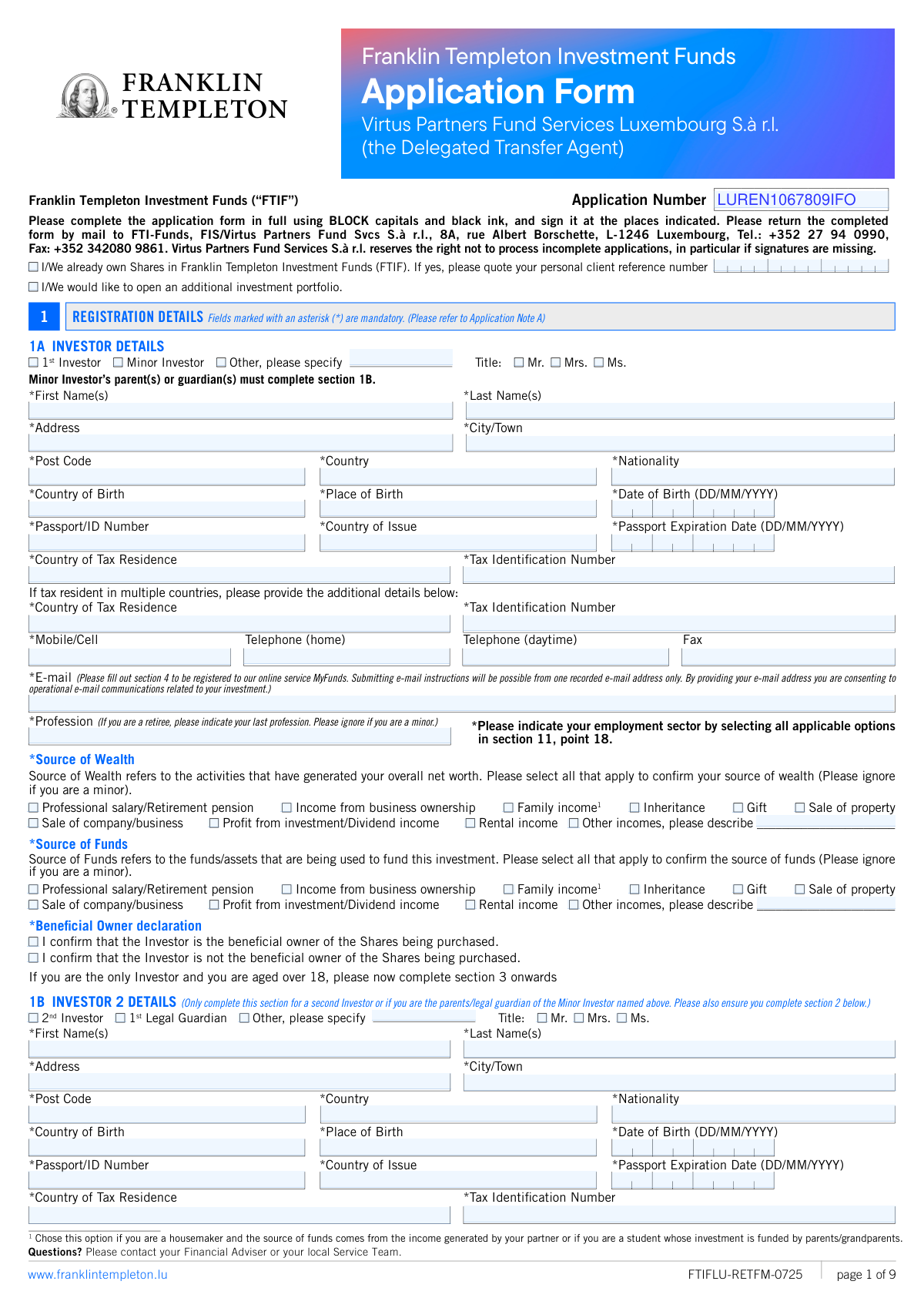
| 1. | Application Form Franklin Templeton Investment Funds | 1 | – |
| 2. | Application Form: JPMorgan Liquidity Funds | 1 | Complex 63 |
| 3. | BlackRock Fund Application Pack | 1 | Complex 69 |
| 4. | Dividend and/or Capital Gain Distributions Authorization Form (G27569-13) | 1 | – |
| 5. | Fidelity Change of Account Ownership — Mutual Fund Only Accounts (Changing to a Trust, Estate, Guardian, or Conservator Account) | 1 | Moderate 61 |
| 6. | Fidelity Investments Change of Account Ownership — Mutual Fund Only Accounts | 1 | Moderate 52 |
| 7. | Fidelity Mutual Fund Account Application | 1 | Moderate 62 |
| 8. | Irrevocable Stock, Bond, or Mutual Fund Power and Authorization to Remove All Stops | 1 | Basic 33 |
| 9. | Manning & Napier Fund, Inc. UGMA/UTMA Successor Custodian Designation Form | 1 | Basic 31 |
| 10. | Thrivent Funds Transfer of Assets, Form MF11502 | 1 | Moderate 50 |
- Enterprise-grade security & data encryption
- 99%+ accuracy powered by AI
- 1,000+ forms from all industries
- Complete forms in under 60 seconds
How to Choose the Right Form
Fidelity Account Ownership Changes
If you hold a Fidelity Mutual Fund Only account, your choice depends on the type of registration change you are performing. These forms are specialized for mutual fund accounts and should not be used for brokerage, retirement, or 529 plan accounts.
- Fidelity Investments Change of Account Ownership — Mutual Fund Only Accounts: Select this form for standard personal updates. This includes adding a spouse to create a joint account, removing a current owner, or updating the name of a custodian. It is the go-to document for most life events like marriage or divorce.
- Fidelity Change of Account Ownership — Mutual Fund Only Accounts (Changing to a Trust, Estate, Guardian, or Conservator Account): This is a more specialized legal document. Choose this version if you are transferring account ownership to a Trust, an Estate, or if a court has appointed a Guardian or Conservator to manage the assets.
Asset Transfers and Consolidating Investments
If you are managing investments through Charles Schwab rather than Fidelity, your requirements will differ significantly.
- Irrevocable Stock, Bond, or Mutual Fund Power and Authorization to Remove All Stops: This form is critical for consolidating your portfolio. Use this if you need to grant Schwab the authority to transfer securities into your account from another institution. It also serves the vital purpose of authorizing the removal of 'stops' on certificates that were previously reported as lost, which is necessary before those assets can be moved or liquidated.
Summary Checklist
- For Fidelity Personal Changes: Use the standard *Fidelity Investments Change of Account Ownership — Mutual Fund Only Accounts* form.
- For Fidelity Fiduciary Changes: Use the *Fidelity Change of Account Ownership (Changing to a Trust, Estate, Guardian, or Conservator Account)* version.
- For Schwab Transfers: Use the *Irrevocable Stock, Bond, or Mutual Fund Power and Authorization* to move assets or clear lost certificate stops.
Form Comparison
| Form | Primary Purpose | Institution | Typical Use Case |
|---|---|---|---|
| Fidelity Investments Change of Account Ownership — Mutual Fund Only Accounts | Transfer ownership of mutual fund accounts between individual owners or custodians. | Fidelity Investments | Updating registration due to marriage, divorce, or changing individual account owners. |
| Fidelity Change of Account Ownership — Mutual Fund Only Accounts (Changing to a Trust, Estate, Guardian, or Conservator Account) | Re-register mutual fund account ownership to a legal entity or fiduciary. | Fidelity Investments | Estate planning or managing assets for trusts, estates, and legal guardianships. |
| Irrevocable Stock, Bond, or Mutual Fund Power and Authorization to Remove All Stops | Authorize security transfers and remove stops on previously lost certificates. | Charles Schwab | Consolidating external investments and clearing restrictions on physical security certificates. |
Tips for mutual fund forms
Before filling out ownership change forms, confirm whether your assets are in a 'Mutual Fund Only' account or a broader brokerage account. Using the wrong form for a brokerage, 529 plan, or retirement account can lead to processing rejections by firms like Fidelity.
When changing ownership to a trust, estate, or guardian, you will often need to provide supplementary documents such as a Trust Agreement or Letters of Testamentary. Having these scanned and ready ensures you can complete the entire application package without interruption.
AI-powered tools like Instafill.ai can complete these complex investment forms in under 30 seconds with high accuracy. Your sensitive financial data stays secure during the process, providing a practical and fast solution for managing multiple ownership or authorization documents.
Many mutual fund companies require a Medallion Signature Guarantee rather than a standard notary for high-value ownership transfers. Review the form instructions carefully to see if you need to visit a participating financial institution to obtain this specific validation before submission.
Use authorization and 'power' forms to move scattered stocks, bonds, or mutual funds into a single managed account. This reduces the number of annual tax statements you receive and makes it significantly easier to track your overall investment performance and asset allocation.
When transferring ownership to a new entity like a trust or estate, ensure you are using the correct Employer Identification Number (EIN) or Social Security Number. Errors in these fields can cause significant tax reporting issues and may require you to re-file the paperwork from scratch.
Frequently Asked Questions
Mutual fund forms are legal documents used to manage, transfer, or update information related to your investment accounts. They are commonly used for tasks like changing account ownership, updating beneficiary information, or authorizing the transfer of securities between different financial institutions.
The choice depends on the type of entity you are transferring the account to. Use the standard "Mutual Fund Only" form for individual or joint ownership changes, but use the specialized version if you are moving assets into a trust, estate, or under the care of a guardian or conservator.
No, the specific Fidelity forms in this category are designed strictly for "Mutual Fund Only" accounts. Brokerage accounts, retirement plans like IRAs, and 529 college savings plans usually require different documentation tailored to the specific rules and tax regulations of those account types.
This form authorizes a financial institution, such as Charles Schwab, to move securities into your account from another source. It also provides the legal authority to remove "stops" on certificates that might have been previously reported as lost or stolen, which is a necessary step during asset consolidation.
Most forms require the current account number, the legal names of all current and new owners, and Social Security or Taxpayer Identification numbers. Depending on the nature of the change, you may also need to provide supporting legal documents, such as a death certificate, trust agreement, or letters of office.
Many financial institutions require a Medallion Signature Guarantee for ownership changes to protect against unauthorized transfers and fraud. This is a special certification stamp provided by a bank or brokerage firm that confirms the signature is authentic and the signer has the legal authority to execute the transfer.
Yes, AI tools like Instafill.ai can process these forms by accurately extracting data from your source documents and placing it into the correct fields. This technology can complete complex investment forms in under 30 seconds, significantly reducing the risk of manual entry errors.
While filling out these forms manually can be time-consuming due to the precise legal information required, using AI-powered automation can significantly speed up the process. Tools like Instafill.ai allow users to generate a completed, ready-to-sign PDF in less than a minute by intelligently mapping data to the form's requirements.
This change is often part of an estate planning strategy to ensure that assets are managed or distributed according to a person's wishes after they pass away. Moving a mutual fund account into a trust can also help avoid the probate process, making the transfer of wealth more efficient for beneficiaries.
Completed forms are typically submitted directly to the financial institution managing the account, such as Fidelity or Charles Schwab. Most companies provide a specific mailing address or a secure online upload portal for document submission, though some forms requiring original signatures or Medallion stamps may still need to be sent via physical mail.
Errors on legal investment documents can lead to processing delays or the total rejection of the request by the financial institution. It is often better to start with a fresh form rather than using corrective fluid; using digital tools can help ensure accuracy and legibility before the document is finalized and signed.
This is necessary when you are consolidating assets and have previously reported a physical certificate as lost, stolen, or destroyed. The authorization allows the receiving firm to clear those restrictions so the securities can be legally transferred and deposited into your new account without further interruption.
Glossary
- Form Complexity Index
- Instafill’s 0–100 measure of how much effort a form takes to complete, calculated deterministically from the form’s own structure rather than estimated. It combines the number of fillable fields (the largest factor), how difficult those fields are to complete based on their type, the number of pages that contain fields, the amount of conditional “fill-only-if” logic, and how many sections the form is divided into, then adds modifiers for tables and repeating lists, bundled instruction pages, and dense page layouts. A higher score means the form is harder to fill out by hand. The forms in this category have a median Form Complexity Index of 61/100 (Moderate). See exactly how it is calculated.
- Medallion Signature Guarantee
- A special certification stamp used by financial institutions to verify the authenticity of a signature and the signer's legal authority. It is more rigorous than a standard notary and is typically required for transferring or changing ownership of mutual fund shares.
- Account Registration
- The legal name and ownership structure under which a mutual fund account is held, such as Individual, Joint, or Trust. Changing a registration requires specific documentation to ensure the assets are legally transferred to the new owner or entity.
- Stock or Mutual Fund Power
- A legal document that acts as a limited power of attorney, authorizing the transfer of securities from one party to another. It allows a brokerage or financial institution to move shares without requiring the physical endorsement of the original certificates.
- Trust
- A legal entity created to hold and manage assets for the benefit of specific individuals or organizations. Mutual fund accounts are often moved into a trust to facilitate estate planning and avoid probate.
- Conservator/Guardian
- A person or entity legally appointed by a court to manage the financial affairs and assets of an individual who is unable to do so, such as a minor or an incapacitated adult.
- Remove All Stops
- A legal instruction to cancel any previous 'stop transfer' orders placed on a security that was formerly reported as lost, stolen, or destroyed. This is necessary to clear the title of the asset so it can be transferred into a new account.
- Custodian
- An adult or financial institution responsible for managing the assets in an account held for the benefit of a minor or another entity. The custodian has the legal authority to make transactions but does not personally own the assets.
- Irrevocable
- A legal term indicating that an agreement, authorization, or transfer cannot be revoked, amended, or canceled once it has been executed. This ensures that the transfer of mutual funds or securities is permanent and binding.