Fill out account ownership forms
with AI.
Account ownership forms are legal documents used to update, transfer, or change who holds legal control over a financial account. These changes are often necessary following major life events — a marriage, divorce, death, the establishment of a trust, or a child reaching adulthood. Because they affect who has rights to financial assets, these forms must be completed accurately and submitted with the appropriate supporting documentation.
By continuing, you acknowledge Instafill's Privacy Policy and agree to get occasional product update and promotional emails.
About account ownership forms
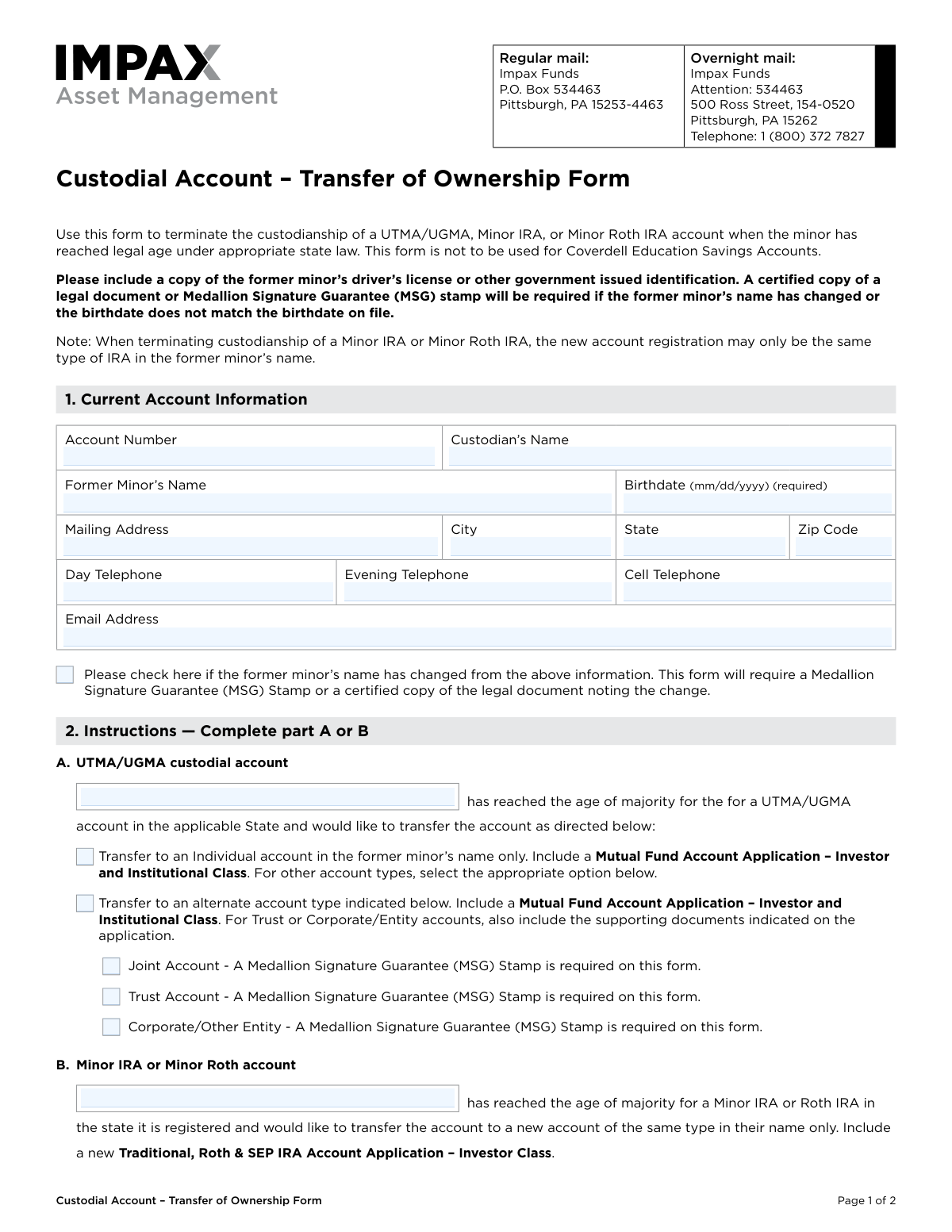
The forms in this category cover a range of common scenarios. For example, Fidelity's mutual fund ownership change forms allow account holders to add or remove owners, update joint registrations, or transfer accounts into a trust, estate, guardianship, or conservatorship. The Custodial Account Transfer of Ownership form handles a different but equally important transition: moving assets out of a UTMA/UGMA or minor IRA once the beneficiary reaches the age of majority, formally ending the custodianship. These situations are typically handled by individual investors, estate attorneys, financial advisors, legal guardians, or family members managing inherited or transferred assets.
Because these forms often involve precise legal and financial details, accuracy matters — errors can delay processing or create compliance issues. Tools like Instafill.ai use AI to fill these forms in under 30 seconds, helping ensure the information is entered correctly and securely, whether you're working with a fillable PDF or a scanned document.
Every form on this page can be completed without typing. Instafill is form filling software that reads a PDF and fills it for you — including flat and scanned documents that carry no fillable fields at all.
Forms in This Category
The forms in this category have a median Form Complexity Index of 52/100 (Moderate), measured across 3 forms by field count, input difficulty, length, conditional logic and structure. See how it is calculated.
| Form Name | Pages | FCI | |
|---|---|---|---|
| 1. | Custodial Account – Transfer of Ownership Form | 1 | Basic 30 |
| 2. | Fidelity Change of Account Ownership — Mutual Fund Only Accounts (Changing to a Trust, Estate, Guardian, or Conservator Account) | 1 | Moderate 61 |
| 3. | Fidelity Investments Change of Account Ownership — Mutual Fund Only Accounts | 1 | Moderate 52 |
- Enterprise-grade security & data encryption
- 99%+ accuracy powered by AI
- 1,000+ forms from all industries
- Complete forms in under 60 seconds
How to Choose the Right Form
Start by identifying why you need to change account ownership — your reason will point you directly to the right form.
Adding, Removing, or Updating an Owner on a Mutual Fund Account
If you need to make straightforward ownership changes — like adding a spouse, removing a co-owner, or updating a custodian — use the Fidelity Investments Change of Account Ownership — Mutual Fund Only Accounts form. This is the go-to option for personal registration updates tied to life events such as marriage or divorce.
> ⚠️ Note: This form applies only to mutual fund accounts. It does not cover brokerage, retirement, or 529 plan accounts.
Transferring a Mutual Fund Account to a Trust, Estate, or Legal Entity
If ownership needs to shift to a legal entity rather than an individual — for example, due to a death, estate settlement, or court-appointed guardianship — choose the Fidelity Change of Account Ownership — Mutual Fund Only Accounts (Changing to a Trust, Estate, Guardian, or Conservator Account). This form is specifically designed for situations involving estate planning or legal oversight.
- Use this if you're moving assets into a trust or estate
- Use this if a guardian or conservator has been legally appointed
- Not intended for simple individual-to-individual transfers
Releasing a Custodial Account to a Former Minor
If a minor has reached the age of majority and needs to take full ownership of their UTMA/UGMA, Minor IRA, or Minor Roth IRA, the Custodial Account – Transfer of Ownership Form is the right choice. This form officially ends the custodianship and moves assets into the former minor's own account.
- Best for: UTMA, UGMA, Minor IRA, or Minor Roth IRA accounts
- Requires the former minor to open a new account to receive the transferred assets
Quick tip: All three forms can be filled out accurately and efficiently using AI on Instafill.ai, even if the original PDF is non-fillable.
Form Comparison
| Form | Purpose | Who Files It | When to Use |
|---|---|---|---|
| Fidelity Investments Change of Account Ownership — Mutual Fund Only Accounts | Add, remove, or update owners on mutual fund accounts | Current account owner(s) or authorized parties | Marriage, divorce, death, or ownership restructuring |
| Fidelity Change of Account Ownership — Mutual Fund Only Accounts (Changing to a Trust, Estate, Guardian, or Conservator Account) | Transfer mutual fund account to trust, estate, or guardianship | Trustee, executor, guardian, or conservator | Estate planning, death of owner, or legal guardianship appointment |
| Custodial Account – Transfer of Ownership Form | Transfer custodial assets to former minor reaching adulthood | Former minor and outgoing custodian | When minor reaches age of majority and assumes full ownership |
Tips for account ownership forms
Account ownership forms are not interchangeable — each one covers a specific type of change, such as adding a co-owner, transferring to a trust, or releasing a custodial account to a former minor. Using the wrong form can delay processing or require you to start over. Read the form description carefully before you begin to make sure it matches your exact circumstance.
Most account ownership changes require supporting legal documents alongside the form — such as a trust agreement, death certificate, letters testamentary, or court order appointing a guardian. Having these ready before you begin filling out the form will prevent incomplete submissions. Missing attachments are one of the most common reasons these forms are rejected or delayed.
Errors in account numbers, legal names, or Social Security/Tax ID numbers can cause ownership transfers to be applied to the wrong account or rejected entirely. Cross-reference your existing account statements to ensure every detail matches exactly. Even small discrepancies like a middle initial can create processing problems.
Many account ownership forms require signatures from all current and new account owners, and some changes — particularly those involving trusts, estates, or guardianships — may require a Medallion Signature Guarantee or notarization. Check the form's instructions section before signing, as a standard notary is not always a substitute for a Medallion Signature Guarantee.
AI-powered tools like Instafill.ai can fill out account ownership forms quickly and accurately, reducing the risk of errors that lead to rejections. The process takes under 30 seconds, and your data stays secure throughout. This is especially valuable when you're managing multiple forms during a life event like a death in the family or a child reaching the age of majority.
Always save a copy of the completed form and any supporting documents before submitting them to your financial institution. If a form is lost in transit or a dispute arises about the date of submission, having your own records protects you. Store copies in a secure location alongside any confirmation numbers or correspondence you receive.
These forms specifically apply to mutual fund accounts and custodial accounts — they do not apply to brokerage accounts, retirement accounts, or 529 plans, which have their own separate ownership change processes. Submitting a mutual fund ownership form for a brokerage account will result in rejection and unnecessary delays. Confirm your account type before selecting and submitting any form.
Account ownership changes are not instantaneous — financial institutions typically need time to review, verify, and process these requests after receiving a completed form. If your ownership change is tied to a time-sensitive event like estate settlement or a minor's birthday, submit the form as early as possible. Contact your financial institution to ask about expected processing timelines.
Frequently Asked Questions
Account ownership forms are legal documents used to change, transfer, or update who holds ownership of a financial account. Common reasons include adding or removing a joint owner, transferring assets to a trust or estate, or moving funds from a custodial account to a former minor who has reached adulthood.
The right form depends on your specific situation. If you're adding or removing an individual owner on a Fidelity mutual fund account, use the standard Change of Account Ownership form. If you're transferring ownership to a trust, estate, guardianship, or conservatorship, use the entity-specific version. If a minor has reached the age of majority and needs to take control of a custodial account, use the Custodial Account Transfer of Ownership form.
No — the Fidelity account ownership forms in this category apply only to mutual fund accounts. They do not cover brokerage accounts, retirement accounts (such as IRAs or 401(k)s), or 529 college savings plan accounts. If you need to change ownership on those account types, you would need to contact Fidelity directly or use a different form.
These forms are typically filed following major life events such as marriage, divorce, the death of an account holder, the establishment of a trust, or when a minor reaches the age of majority. It's generally best to file as soon as the life event occurs to ensure the account reflects the correct legal ownership.
Requirements vary by form and situation, but commonly needed documents include a government-issued photo ID, trust or estate legal documents, court orders for guardianship or conservatorship, and the account number(s) being affected. For custodial account transfers, proof that the former minor has reached the age of majority is typically required.
Completed forms are generally submitted directly to the financial institution managing the account — in this case, Fidelity Investments. Submission methods may include mailing the form to a designated Fidelity address, faxing it, or delivering it to a local Fidelity Investor Center. Always check the specific form's instructions for the most current submission details.
Yes — AI-powered tools like Instafill.ai can fill out account ownership forms in under 30 seconds by accurately extracting and placing data from your source documents. Instafill.ai can also convert non-fillable PDF versions of these forms into interactive, fillable formats, making the process faster and reducing the risk of errors.
Manually completing an account ownership form can take anywhere from 15 to 30 minutes, depending on how much supporting information you need to gather. Using an AI tool like Instafill.ai, the form can be populated in under 30 seconds once your source documents are uploaded.
Most account ownership forms require signatures from all relevant parties, such as the current account owner and, in some cases, the new owner. Depending on the type of change — particularly for trust or estate transfers — notarization or a signature guarantee may also be required. Check the specific form's instructions for exact requirements.
In most cases, the assets remain in the account and are simply re-registered under the new owner's name or entity. For custodial account transfers, the assets are typically moved to a new account in the former minor's name, officially ending the custodianship. The specific outcome depends on the type of ownership change being made.
Yes — the Fidelity Change of Account Ownership form for trusts, estates, guardians, and conservators is specifically designed for this purpose. This form allows you to legally re-register a mutual fund account under an entity rather than an individual, which is common during estate planning or after the death of an account holder.
The age at which a minor can take ownership of a custodial account (UTMA/UGMA) varies by state, but it is typically 18 or 21 years old. Once the former minor reaches the applicable age of majority, they can use the Custodial Account Transfer of Ownership form to have the assets transferred into an account in their own name.
Glossary
- Form Complexity Index
- Instafill’s 0–100 measure of how much effort a form takes to complete, calculated deterministically from the form’s own structure rather than estimated. It combines the number of fillable fields (the largest factor), how difficult those fields are to complete based on their type, the number of pages that contain fields, the amount of conditional “fill-only-if” logic, and how many sections the form is divided into, then adds modifiers for tables and repeating lists, bundled instruction pages, and dense page layouts. A higher score means the form is harder to fill out by hand. The forms in this category have a median Form Complexity Index of 52/100 (Moderate). See exactly how it is calculated.
- Account Registration
- The official record of who owns an account, including the account holder's name, ownership type (individual, joint, trust, etc.), and legal status. Changing the registration is the primary purpose of account ownership forms.
- UTMA/UGMA
- Uniform Transfers to Minors Act / Uniform Gifts to Minors Act — laws that allow assets to be held in a custodial account on behalf of a minor until they reach the age of majority, at which point ownership must be transferred to them.
- Custodian
- An adult (typically a parent or guardian) who legally manages a minor's account assets until the minor reaches the age of majority, after which the custodian's authority ends and ownership transfers to the former minor.
- Age of Majority
- The legally defined age (typically 18 or 21, depending on the state) at which a minor becomes a legal adult and gains full control over assets held in their custodial account.
- Conservatorship
- A legal arrangement in which a court appoints a person (the conservator) to manage the financial affairs and assets of an individual who is unable to do so themselves due to incapacity or disability.
- Joint Account
- A financial account shared by two or more owners, each of whom typically has full rights to the assets. Ownership forms may be used to add or remove a joint owner, such as a spouse.
- Successor Trustee
- The person or entity designated to take over management of a trust's assets if the original trustee is unable or unwilling to continue, often relevant when transferring an account into a trust.
- Minor IRA / Minor Roth IRA
- A tax-advantaged retirement account opened on behalf of a minor, managed by a custodian until the minor reaches adulthood, at which point it must be retitled in the former minor's name.
- Medallion Signature Guarantee
- A special certification stamp from an authorized financial institution that verifies the authenticity of a signature on documents involving the transfer of securities or account ownership, often required on these forms.