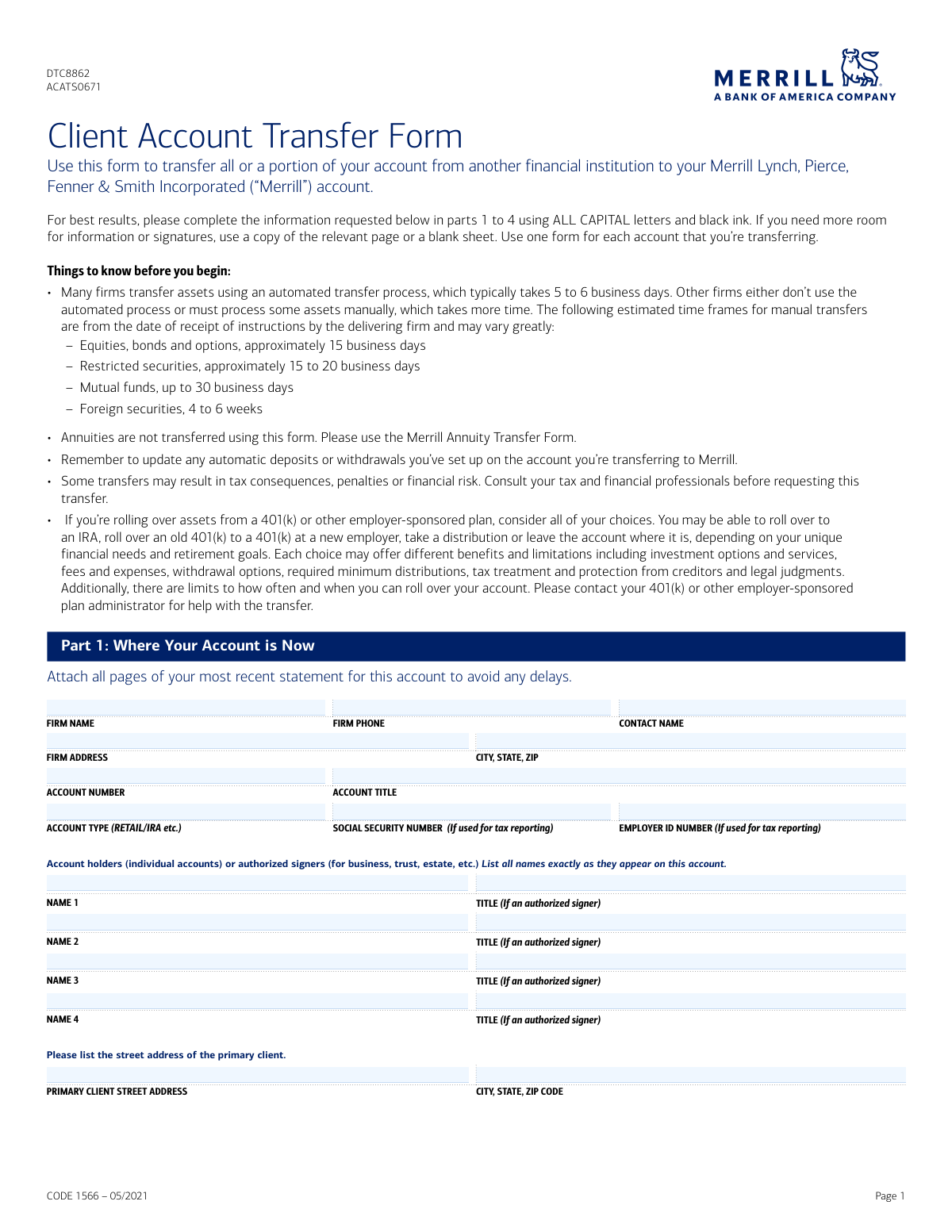
Yes! You can use AI to fill out Client Account Transfer Form to Merrill Lynch, Pierce, Fenner & Smith Incorporated

This form is an official request to transfer assets, such as stocks, bonds, and mutual funds, from an existing financial account at another firm to a new or existing account at Merrill Lynch, Pierce, Fenner & Smith Incorporated. It is a crucial document for consolidating investments, requiring detailed information about both the delivering and receiving accounts to ensure a smooth transfer process. Today, this form can be filled out quickly and accurately using AI-powered services like Instafill.ai, which can also convert non-fillable PDF versions into interactive fillable forms.
Our AI automatically handles information lookup, data retrieval, formatting, and form filling.
It takes less than a minute to fill out CODE 1566 using our AI form filling.
Securely upload your data. Information is encrypted in transit and deleted immediately after the form is filled out.

Form specifications

Form name: Client Account Transfer Form to Merrill Lynch, Pierce, Fenner & Smith Incorporated
Number of pages: 1
Language: English
Categories: corporate forms, account transfer forms, transfer forms, Merrill forms
main-image

Instafill Demo: How to fill out PDF forms in seconds with AI

How to Fill Out CODE 1566 Online for Free in 2026

Are you looking to fill out a CODE 1566 form online quickly and accurately? Instafill.ai offers the #1 AI-powered PDF filling software of 2026, allowing you to complete your CODE 1566 form in just 37 seconds or less.
Follow these steps to fill out your CODE 1566 form online using Instafill.ai:
  1. 1 Navigate to Instafill.ai and upload or select the Merrill Lynch Client Account Transfer Form.
  2. 2 Use the AI assistant to fill in Part 1 with the details of the financial institution and account you are transferring from.
  3. 3 Complete Part 2 by providing the information for the Merrill Lynch account that will receive the assets.
  4. 4 In Part 3, choose your transfer option, such as transferring all assets in-kind, liquidating the account, or transferring only specific assets.
  5. 5 Carefully review all the information auto-filled by the AI, ensuring account numbers, asset details, and personal information are correct.
  6. 6 Read the authorization terms in Part 4, then provide your digital signature to authorize the transfer.
  7. 7 Download the completed form, attach your most recent account statement as required, and submit it to Merrill Lynch.

Our AI-powered system ensures each field is filled out correctly, reducing errors and saving you time.

Why Choose Instafill.ai for Your Fillable CODE 1566 Form?

Speed

Complete your CODE 1566 in as little as 37 seconds.

Up-to-Date

Always use the latest 2026 CODE 1566 form version.

Cost-effective

No need to hire expensive lawyers.

Accuracy

Our AI performs 10 compliance checks to ensure your form is error-free.

Security

Your personal information is protected with bank-level encryption.

Frequently Asked Questions About Form CODE 1566

This form is used to transfer all or a portion of your financial account, including assets like stocks and bonds, from another financial institution to your Merrill Lynch account.

Any client who wishes to move assets from an account at another firm into a new or existing Merrill account should complete this form. A separate form is required for each account you are transferring.

To avoid processing delays, you must attach all pages of your most recent account statement from the institution you are transferring assets from.

Automated transfers typically take 5 to 6 business days. However, manual transfers for assets like mutual funds or foreign securities can take significantly longer, from 15 business days up to several weeks.

An 'in-kind' transfer moves your securities directly to Merrill without selling them. A transfer 'in cash' means your assets are sold (liquidated) and the money is moved, which may have tax consequences.

No, this form is not for transferring annuities. You must use the specific 'Merrill Annuity Transfer Form' for that purpose.

While this form may be part of the process, you should first contact your 401(k) plan administrator for help. They can guide you on your options and the correct procedure for an employer-sponsored plan rollover.

Yes, in Part 3 you can select option 4 to 'Transfer ONLY certain assets in-kind' and specify which ones. Ensure this partial transfer doesn't cause your other account to fall below its required minimum balance.

All account holders or authorized signers for both the account you are transferring from and the receiving Merrill account must sign the form. If your name appears differently on the accounts, you must sign with all name variations.

You can find all the necessary details, such as the firm's name, address, and your account number, on your most recent statement for that account.

Yes, services like Instafill.ai use AI to help you accurately auto-fill form fields with your saved information, which saves time and reduces the chance of errors.

Simply upload the Client Account Transfer Form to the Instafill.ai platform. The AI will make the document fillable online, allowing you to type your information, sign electronically, and download the completed PDF.

You can use a service like Instafill.ai, which can convert flat, non-fillable PDFs into interactive forms. Just upload the document, and the platform will make the fields fillable for you.

No, but to avoid delays, the receiving Merrill account must have at least one owner in common with the account you are transferring from.

Compliance CODE 1566
Validation Checks by Instafill.ai

1
Part 1 Required Field Completeness
This check ensures all fields in Part 1, 'Where Your Account is Now', are completed. This information, including the delivering firm's name, address, and account number, is critical for correctly identifying and locating the account to be transferred. A failure to provide this information will halt the transfer process, as Merrill will be unable to initiate the request with the other institution.
2
Tax ID Number Requirement (Part 1)
Validates that either a 'Social Security Number' or an 'Employer ID Number' is provided in Part 1, as one is required for tax reporting purposes. The system should check for the presence of one of these numbers to ensure the account can be properly identified and the transfer can be processed in compliance with financial regulations. An error will be flagged if neither or both fields are filled, as only one is appropriate for a given account.
3
Merrill Account Number Format
Verifies that the 'Merrill Account Number' in Part 2 is a valid 8-digit number, as specified in the form's delivery instructions. This number is the primary identifier for the destination account within the Merrill system. An incorrect or improperly formatted account number will cause the transfer to fail or be routed to the wrong account, creating significant financial and administrative problems.
4
Common Account Holder Verification
This check cross-references the account holder names listed in Part 1 (delivering account) and Part 2 (receiving Merrill account) to confirm at least one owner is in common. This is a critical security and compliance measure to prevent unauthorized transfers between unrelated accounts. If no common owner is found, the transfer request will be rejected to prevent potential fraud and ensure regulatory adherence.
5
Exclusive Transfer Option Selection
Ensures that exactly one of the four main transfer options in Part 3 is selected. The form allows for transferring all assets in-kind, liquidating all assets, transferring after specific liquidations, or a partial transfer, but these actions are mutually exclusive. Selecting multiple options creates ambiguity and makes the client's intent impossible to execute, thus the form will be rejected until a single choice is made.
6
Conditional Partial Transfer Specification
If transfer option 4, 'Transfer ONLY certain assets in-kind', is selected, this validation confirms that the client has specified which assets to transfer in the 'Cash' or 'Mutual Funds and Securities' sections on page 3. A partial transfer request without specifying the assets is incomplete and cannot be processed. The validation prevents submission of an ambiguous request that would otherwise be immediately rejected.
7
Conditional Liquidation Specification
If transfer option 3, 'Transfer my entire account after liquidating the assets listed on page 3', is chosen, this check verifies that at least one security is listed in the 'Mutual Funds and Securities' grid with the 'Liquidate and Transfer in Cash' box checked. This ensures the instructions are complete and actionable. Submitting this option without specifying which assets to liquidate would lead to processing delays and require manual follow-up.
8
CD Maturity Date Validation
When the option to 'Wait to liquidate CDs and transfer in cash when CDs mature' is selected, this validates that the provided date is in a valid MM/DD/YYYY format and is a future date. This is important for scheduling the transfer correctly to avoid early withdrawal penalties. A failed validation would indicate an invalid or past date, preventing the system from correctly timing the liquidation request.
9
Securities Grid Row Logic
For each row completed in the 'Mutual Funds and Securities' grid on page 3, this check ensures that a 'Quantity' is specified and that either 'Transfer In-Kind' or 'Liquidate and Transfer in Cash' is checked, but not both. This prevents contradictory or incomplete instructions for a specific asset. Failure to provide this information correctly for each listed security will result in the form being rejected for clarification.
10
Signature and Account Holder Correlation
This validation confirms that the number of signatures in Part 4 matches the total number of unique account holders and authorized signers listed in Part 1 and Part 2. A signature from every owner is legally required to authorize the account transfer. A mismatch in the number of signers will cause the transfer to be rejected for lack of proper authorization.
11
Statement Attachment Confirmation
Validates that the user has confirmed the attachment of their most recent account statement from the delivering firm, likely via a mandatory checkbox. The form states this is required to avoid delays, as the statement is used to verify account details and asset positions. Without this confirmation, the form submission would be blocked to ensure all necessary documentation is included from the start.
12
Merrill Account Type Selection
This check ensures that one of the 'Account Type' options (CMA, IRA, Roth, SEP, Other) is selected in Part 2 for the receiving Merrill account. If 'Other' is selected, it further validates that the corresponding text field is not empty. This information is crucial for ensuring the transferred assets are placed in the correct type of account with the appropriate tax and regulatory treatment.
13
Phone Number Format Validation
Verifies that the 'Firm Phone' in Part 1 and the client 'Phone Number' in Part 2 adhere to a standard phone number format (e.g., 10 digits, with optional formatting). Correctly formatted phone numbers are essential for communication if issues or questions arise during the transfer process. An invalid format could hinder the ability of the processing team to contact the client or the delivering firm, causing delays.
14
Signature Date Validity
This check ensures that each signature in Part 4 is accompanied by a date in a valid format (e.g., MM/DD/YYYY). It also verifies that the date is not in the future, as post-dating is not permissible for legal authorizations. An invalid or missing date can render the authorization void, leading to the rejection of the entire transfer request.

Common Mistakes in Completing CODE 1566

Mismatched Account Holder Names

This occurs when the names listed in Part 1 (delivering firm) and Part 2 (Merrill account) do not match exactly what is on the official account statements. People often use nicknames, omit middle initials, or forget to list all joint owners, causing the automated transfer system (ACATS) to reject the request. To avoid this, carefully copy the names and titles precisely as they appear on your statements for both accounts. The form also requires signatures for all name variations (e.g., maiden and married names), which is a frequently missed step.

Forgetting to Attach the Account Statement

The form explicitly states in two separate locations (Part 1 and Part 4) to attach all pages of the most recent statement from the delivering institution. Applicants often overlook this requirement, assuming the account number is sufficient. Without the statement, the receiving firm cannot verify the account details, assets, and ownership, which will always result in significant processing delays. Always include a complete, current statement with your submission.

Misunderstanding Transfer Options (In-Kind vs. In-Cash)

In Part 3, applicants must choose how to transfer assets, but often don't understand the consequences. Selecting 'Liquidate my entire account and transfer in cash' (Option 2) means all securities will be sold, which can trigger significant capital gains taxes and penalties. This mistake happens due to a misunderstanding of financial terms. To prevent this, carefully read the descriptions and consult a financial advisor if unsure; 'Transfer ALL my assets in-kind' (Option 1) is generally the default for moving securities without selling them.

Incorrect or Incomplete Delivering Firm Information

In Part 1, people may enter a common brand name (e.g., 'Vanguard') instead of the specific legal entity holding their assets (e.g., 'Vanguard Brokerage Services'). They might also provide a generic customer service number instead of the direct contact for transfers. This ambiguity can cause the transfer request to be misrouted or rejected. Use your account statement to find the precise firm name and address for transfers.

Missing Signatures from All Required Parties

The authorization in Part 4 requires signatures from all account holders listed on both the delivering and receiving accounts. For joint accounts, it's common for one owner to sign and forget to have the other sign, which invalidates the form. This simple oversight is a primary cause for rejection. Ensure every individual listed as an owner or authorized signer on both accounts provides their signature.

Using the Wrong Form for the Asset Type

The instructions clearly state this form is not for transferring annuities or for rolling over employer-sponsored plans like a 401(k). Applicants may not read the 'Things to know before you begin' section and attempt to use this form for those purposes. This will lead to an immediate rejection and wasted time, as annuities and 401(k) rollovers have separate, specific forms and processes. Always confirm you are using the correct form for the type of account or asset you are moving.

Incomplete Details for a Partial Transfer

When selecting Option 4 ('Transfer ONLY certain assets'), applicants must list the specific securities in the table on page 3. Common errors include omitting the quantity (number of shares), providing an incorrect ticker symbol or CUSIP, or leaving the security name ambiguous. This lack of detail makes it impossible for the firm to execute the request, causing it to be put on hold until clarification is received. For each asset, provide the full name, symbol/CUSIP, and the exact quantity of shares to transfer or write 'ALL'.

Illegible Handwriting and Formatting Errors

The form requests information be entered in 'ALL CAPITAL letters and black ink' to ensure it can be read and processed correctly. Users often submit forms with illegible handwriting or use blue ink, leading to data entry errors by the processing team and potential delays. Since this form is a non-fillable PDF, this is a frequent problem. Using a tool like Instafill.ai can convert the document into a fillable PDF, eliminating handwriting issues and ensuring data is entered in the correct format.

Mismatched Account Ownership Structure

A transfer request will be delayed or rejected if there isn't at least one common owner between the delivering and receiving accounts. For example, an individual might mistakenly try to transfer assets from their sole account into a trust account where they are only a trustee, not an owner. The names must match in an ownership capacity. Before submitting, verify that the ownership structure is compatible and that at least one person's name appears as an owner on both accounts.

Incorrectly Handling Proprietary Funds

Applicants often assume all their mutual funds can be transferred 'in-kind'. However, many firms have proprietary funds that cannot be held at another institution like Merrill. The form warns about this, but users may still request an in-kind transfer for these assets, which will be rejected. The applicant must then provide new instructions to either liquidate the fund or leave it at the original firm, causing delays. It is wise to check with the delivering firm if any of your funds are proprietary and non-transferable before filling out the form.
Saved over 80 hours a year

“I was never sure if my IRS forms like W-9 were filled correctly. Now, I can complete the forms accurately without any external help.”

Kevin Martin Green

Your data stays secure with advanced protection from Instafill and our subprocessors

Robust compliance program

Transparent business model

You’re not the product. You always know where your data is and what it is processed for.

ISO 27001, HIPAA, and GDPR

Our subprocesses adhere to multiple compliance standards, including but not limited to ISO 27001, HIPAA, and GDPR.

Security & privacy by design

We consider security and privacy from the initial design phase of any new service or functionality. It’s not an afterthought, it’s built-in, including support for two-factor authentication (2FA) to further protect your account.

Fill out CODE 1566 with Instafill.ai

Worried about filling PDFs wrong? Instafill securely fills client-account-transfer-form-to-merrill-lynch-pierce-fenner-smith-incorporated forms, ensuring each field is accurate.