Fill out brokerage transfer forms
with AI.
Brokerage transfer forms are essential documents used to facilitate the movement of financial assets between investment accounts, whether you are switching firms or consolidating your portfolio. These forms cover a wide range of transactions, including full account transfers, partial asset gifting, and the movement of specific securities like mutual funds or stocks. Proper documentation ensures that your assets are moved securely and that tax-advantaged statuses, such as those associated with IRAs or Health Savings Accounts, are maintained throughout the transition.
By continuing, you acknowledge Instafill's Privacy Policy and agree to get occasional product update and promotional emails.
About brokerage transfer forms
These forms are typically required by individual investors, estate planners, and high-net-worth individuals looking to streamline their financial management. For instance, someone might use an Incoming Account Transfer Form to bring external assets under a single management platform like TIAA or Merrill Lynch. Others may utilize Transfer on Death (TOD) agreements to ensure their investments bypass the lengthy probate process for their beneficiaries. Whether you are moving assets for a charitable donation or transitioning foreign securities through systems like CREST, having the correct paperwork is the first step in a successful transfer.
Completing these complex financial documents can be a tedious process, but tools like Instafill.ai use AI to fill these forms in under 30 seconds while ensuring data is handled accurately and securely. This allows investors to focus on their portfolio strategy rather than the administrative burden of manual data entry.
Every form on this page can be completed without typing. Instafill is form filling software that reads a PDF and fills it for you — including flat and scanned documents that carry no fillable fields at all.
Forms in This Category
The forms in this category have a median Form Complexity Index of 47/100 (Moderate), measured across 10 forms by field count, input difficulty, length, conditional logic and structure. See how it is calculated.
- Enterprise-grade security & data encryption
- 99%+ accuracy powered by AI
- 1,000+ forms from all industries
- Complete forms in under 60 seconds
How to Choose the Right Form
Selecting the right brokerage transfer form depends on whether you are consolidating assets, planning your estate, or making a charitable gift. Because different financial institutions require specific documentation to move securities "in-kind," identifying the destination firm is your first step.
Moving Assets into a New Account
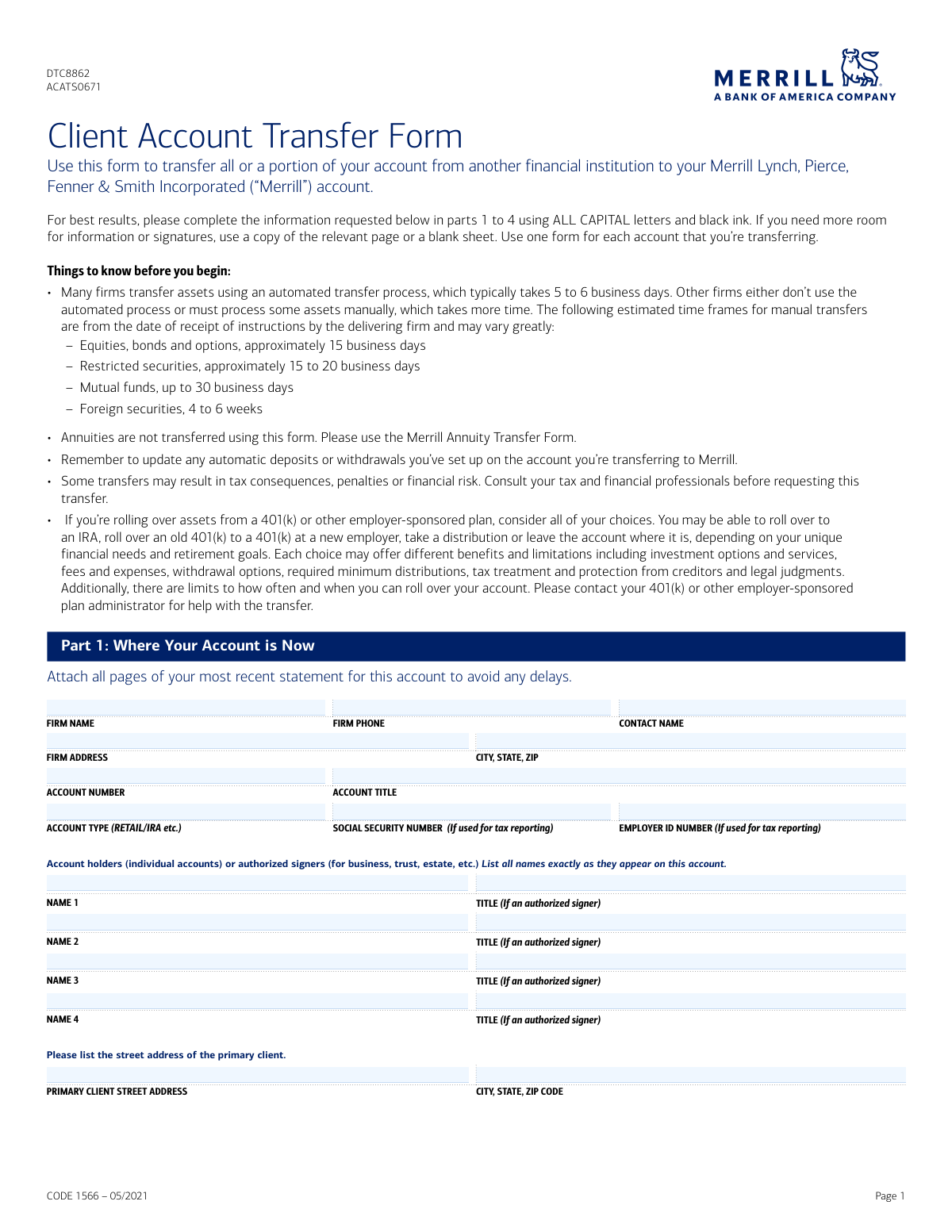
If you are consolidating your investments to a single firm, you must use the incoming transfer form specific to that institution. For those moving assets to Merrill Lynch, use the Client Account Transfer Form to Merrill Lynch, Pierce, Fenner & Smith Incorporated. If you are moving to TIAA, choose between the standard TIAA Brokerage Incoming Account Transfer Form or the TIAA Brokerage Incoming Managed Account Transfer Form (F11319) if you intend for the account to be professionally managed. For moves to U.S. Bank, select the U.S. Bancorp Investments Account Transfer Form. If you are dealing with foreign securities held in paper/certificated form, the Vanguard Brokerage Account CREST Transfer Form is the correct choice.
Estate Planning and Beneficiary Designations
To ensure your brokerage assets bypass the probate process, you should file a "Transfer on Death" (TOD) agreement. For individual account holders at TIAA, use Form F11004, TIAA Brokerage Individual Transfer on Death Account Agreement. If the account is owned by two or more people, use the TIAA Brokerage Joint Transfer on Death Account Agreement to designate how assets should be distributed after the final account owner passes away.
Gifting and Specialized Transfers
If you are making a non-cash donation, the Intra-Brokerage Securities Transfer form facilitates the move of securities to the WaterStone foundation. For Merrill clients who wish to gift specific securities to another person or institution without liquidating them, use the Outgoing Partial Asset/Gifting Transfer Authorization Letter. Lastly, for those managing healthcare-related investments, the Schwab Health Savings Brokerage Account (HSBA) to HSA Invest Choice Account Transfer Form is designed specifically for consolidating health savings investments.
Tips for brokerage transfer forms
One of the most common reasons for a rejected transfer is a name mismatch between the delivering and receiving firms. Verify that the names, middle initials, and account types (e.g., Individual vs. Joint) are identical on both accounts before submitting your forms.
Not all securities, such as proprietary mutual funds or certain annuities, can be moved 'in-kind' to a different brokerage. Check with your new firm to see if you need to liquidate specific assets into cash before initiating the transfer to avoid processing delays.
AI-powered tools like Instafill.ai can complete these complex brokerage forms in under 30 seconds with high accuracy. This is a significant time-saver for those consolidating multiple accounts, and your sensitive data remains secure throughout the entire process.
Most brokerage transfers use the Automated Customer Account Transfer Service (ACATS), which requires a specific four-digit DTC code for the delivering firm. Ensure you have the correct code and full account number from your most recent statement to prevent the request from being lost.
Beneficiary instructions, such as 'Transfer on Death' (TOD) agreements, do not automatically move with your assets to a new firm. Always complete a new beneficiary form for the receiving account to ensure your estate planning goals remain intact and assets bypass probate.
Referencing your latest brokerage statement is the best way to ensure you are listing the correct quantities and descriptions of your securities. This document provides the exact account details required by the receiving institution to verify the assets they are expecting to receive.
Frequently Asked Questions
These forms are used to move financial assets, such as stocks, bonds, or mutual funds, from one financial institution to another. They provide the legal authorization and account details required for the receiving firm to claim the assets from the delivering firm on your behalf.
You should select an incoming transfer form if you want to bring assets into a new account at a firm like Merrill Lynch or TIAA. Conversely, an outgoing transfer or gifting authorization form is used when you are moving assets away from your current brokerage to another institution or as a donation.
An 'in-kind' transfer allows you to move your actual investments, such as specific shares of a stock, without selling them and moving cash. This is often preferred to avoid triggering capital gains taxes or losing your market position during the transition period.
Generally, all registered owners of the account being transferred must sign the form. For joint accounts, both parties usually need to provide signatures, and in some cases, a Medallion Signature Guarantee may be required by the financial institution to verify the identity of the signers.
Yes, specific documents like the 'Transfer on Death' (TOD) agreement forms allow you to name individuals who will inherit the account assets. These forms are vital for estate planning as they allow assets to bypass the probate process and transfer directly to beneficiaries upon the owner's death.
You will typically need a recent statement from your current brokerage account to provide the account number, the exact name on the account, and a list of the assets you wish to move. You will also need the account number for your new destination account at the receiving firm.
Yes, you can use AI-powered tools like Instafill.ai to complete these documents quickly. The AI can accurately extract data from your existing brokerage statements and place it directly into the required fields on the transfer form, reducing the risk of manual entry errors.
Using AI tools can significantly speed up the process, often allowing you to complete a complex brokerage transfer form in under 30 seconds. This is much faster than manual typing and ensures that critical information like account numbers and DTC codes are transcribed accurately.
Yes, if you are moving investments held within a Health Savings Account, you must use specific forms like the Schwab HSBA to HSA Invest Choice transfer form. These documents ensure the tax-advantaged status of the account is maintained during the transfer between custodians.
A CREST transfer form, such as the one used by Vanguard, is specifically for moving foreign securities held as physical certificates into an electronic brokerage account. This process modernizes your holdings, making them easier to manage and trade within a digital platform.
Glossary
- Form Complexity Index
- Instafill’s 0–100 measure of how much effort a form takes to complete, calculated deterministically from the form’s own structure rather than estimated. It combines the number of fillable fields (the largest factor), how difficult those fields are to complete based on their type, the number of pages that contain fields, the amount of conditional “fill-only-if” logic, and how many sections the form is divided into, then adds modifiers for tables and repeating lists, bundled instruction pages, and dense page layouts. A higher score means the form is harder to fill out by hand. The forms in this category have a median Form Complexity Index of 47/100 (Moderate). See exactly how it is calculated.
- ACATS (Automated Customer Account Transfer Service)
- The standard electronic system used by the financial industry to transfer assets between different brokerage firms in a fast and secure manner.
- In-Kind Transfer
- The process of moving securities like stocks, bonds, or mutual funds from one account to another without selling them first, preserving the original purchase price and tax status.
- Transfer on Death (TOD)
- A legal designation that allows account assets to pass directly to named beneficiaries upon the owner's death, bypassing the lengthy and expensive probate process.
- Delivering Institution
- The financial firm or brokerage that currently holds your assets and will be sending them to your new account provider.
- DTC Number
- A unique four-digit identification number assigned to financial institutions by the Depository Trust Company to facilitate the electronic clearing and settlement of securities.
- Liquidation
- The act of selling securities and converting them into cash, often required when certain assets are not eligible for transfer to the new brokerage platform.
- Medallion Signature Guarantee
- A special certification stamp used by banks and brokerages to verify that a signature is genuine and that the signer has the legal authority to transfer securities.
- CREST
- The central securities depository for the United Kingdom and Ireland, used for the electronic settlement of shares and the transfer of paper-based certificates into electronic accounts.