Fill out corporate account forms
with AI.
Corporate account forms are the administrative foundation for businesses and organizations interacting with major financial institutions. These documents are essential for establishing legal entities within brokerage systems, authorizing complex trading activities, or consolidating assets between firms. By providing a clear framework for regulatory compliance—such as 'Know Your Customer' (KYC) protocols—these forms ensure that a company’s financial interests are properly registered and that authorized personnel are correctly identified.
By continuing, you acknowledge Instafill's Privacy Policy and agree to get occasional product update and promotional emails.
About corporate account forms
Typically, these forms are completed by corporate treasurers, business owners, or legal officers at C-Corps, S-Corps, and non-profits. Common scenarios include opening a Schwab One account for a newly incorporated organization or requesting a formal asset transfer to Merrill Lynch. Because these documents often require granular details regarding business activities, beneficial owners, and risk tolerance, they can be remarkably time-consuming to fill out by hand, particularly when dealing with non-interactive PDF formats.
Managing the paperwork for institutional accounts does not have to be a bottleneck for your business operations. Tools like Instafill.ai use AI to fill these corporate forms in under 30 seconds, ensuring that sensitive financial data is handled accurately and securely. This approach streamlines the onboarding process, allowing organizations to focus on their investment strategies and growth rather than the friction of manual data entry.
Every form on this page can be completed without typing. Instafill is form filling software that reads a PDF and fills it for you — including flat and scanned documents that carry no fillable fields at all.
Forms in This Category
The forms in this category have a median Form Complexity Index of 56/100 (Moderate), measured across 3 forms by field count, input difficulty, length, conditional logic and structure. See how it is calculated.
- Enterprise-grade security & data encryption
- 99%+ accuracy powered by AI
- 1,000+ forms from all industries
- Complete forms in under 60 seconds
How to Choose the Right Form
Navigating corporate financial paperwork depends on whether you are establishing a new entity presence, moving existing assets, or expanding your trading capabilities. Use the following guide to identify which document matches your current business objective.
Opening a New Brokerage Account
If your U.S.-based incorporated organization—such as a C-Corp, S-Corp, or Non-profit—needs to establish a primary brokerage presence, choose the Schwab One® Account Application for Incorporated Organizations. This form is the foundational document required to open an account at Charles Schwab, gathering essential data on business activities, authorized persons, and beneficial owners to meet federal compliance standards.
Moving Assets Between Institutions
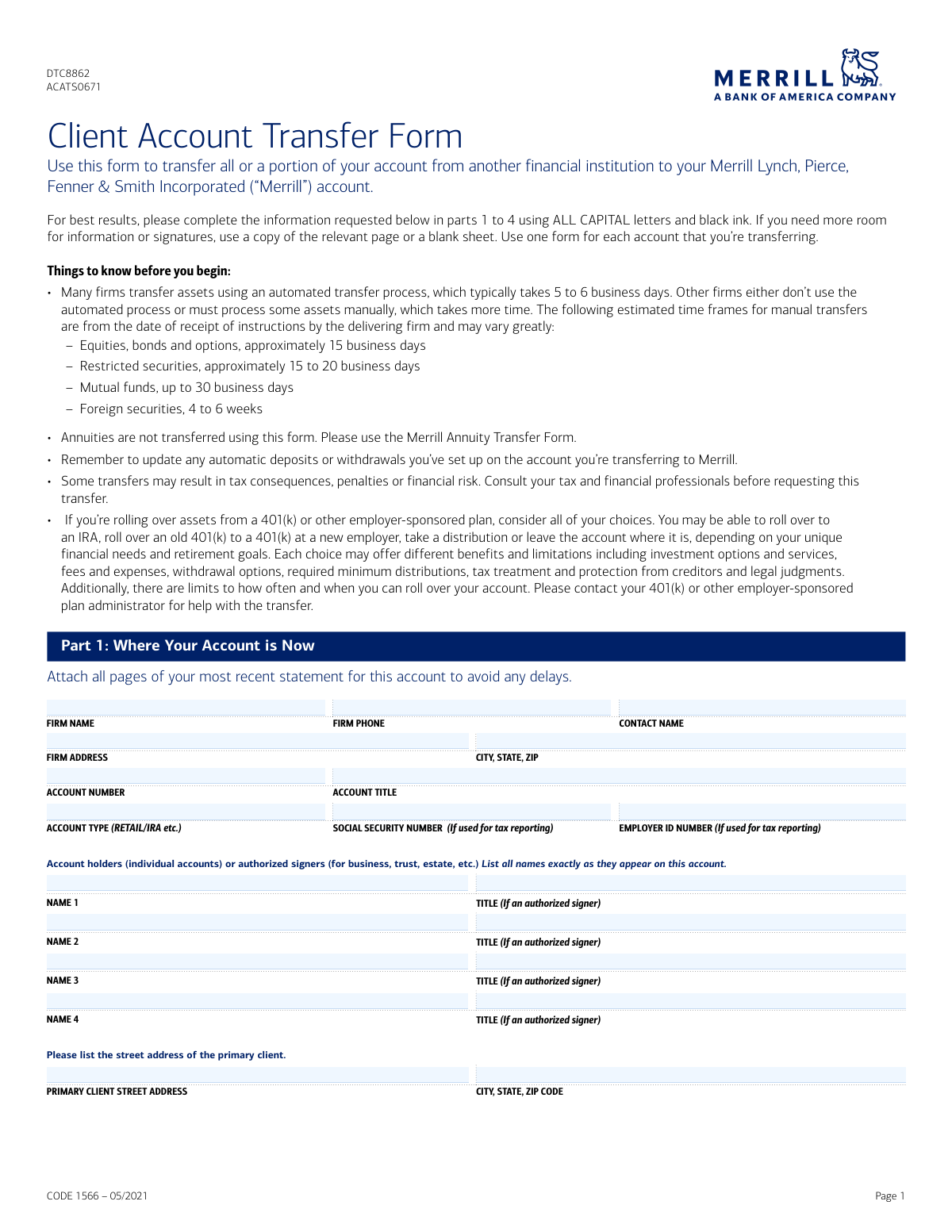
If your corporation already has investments held at another financial firm and you wish to consolidate them under a single roof, you need the Client Account Transfer Form to Merrill Lynch, Pierce, Fenner & Smith Incorporated. This form acts as an official request to pull stocks, bonds, and mutual funds from your current delivering firm and move them into a new or existing Merrill Lynch account. It is the primary tool for asset consolidation and portfolio migration.
Authorizing Advanced Trading Strategies
For organizations that already have a corporate or institutional account at Merrill Lynch but want to engage in high-risk investment vehicles, the Option Information — Corporate and Institutional Accounts; Sole Proprietorship Accounts; Merrill Lynch Trust Accounts form is required. Because options trading involves significant risk, this document is used to verify your organization’s financial standing, investment experience, and risk tolerance before the firm grants approval for trading listed options.
Quick Summary:
- To start a new Schwab account: Use the Schwab One® Application.
- To move funds to Merrill Lynch: Use the Client Account Transfer Form.
- To trade options at Merrill Lynch: Use the Option Information form.
Tips for corporate account forms
Financial regulations require corporations to disclose individuals with significant ownership or control during the application process. Ensure you have the Social Security numbers, residential addresses, and birthdates for all key stakeholders ready before you begin filling out the forms.
When transferring assets between firms, the name on the delivering account must match the name on the new corporate account exactly. Even minor discrepancies in suffixes like 'Inc.' or 'LLC' can cause significant delays or rejections in the asset transfer process.
Most brokerages require proof that the individual signing the form is legally authorized to act on behalf of the organization. Keep a digital copy of your corporate resolution or bylaws handy to confirm which officers have the power to open accounts and trade assets.
For option trading or institutional accounts, the financial data you report must justify the requested trading level and risk tolerance. Ensure your stated annual income, liquid net worth, and investment experience are consistent across all sections to avoid suitability flags during the review.
Managing complex corporate paperwork is a major time commitment, but AI-powered tools like Instafill.ai can complete these forms in under 30 seconds with high accuracy. Your sensitive business data stays secure during the process, providing a practical and fast solution for handling multiple account registrations.
For asset transfers, you must provide the correct account number and the delivering firm's specific DTC number. Providing an incorrect account type, such as listing a trust account as a corporate account, is a common error that can stall the consolidation of your investments.
If you are opening a brokerage account and applying for options trading privileges simultaneously, cross-reference your data to ensure total consistency. Maintaining a master profile of your corporation's financial standing allows you to fill out these related forms without searching for the same figures twice.
Frequently Asked Questions
Corporate account forms are legal and financial documents used by businesses to open, manage, or transfer investment accounts with brokerage firms. These forms help financial institutions verify the identity of the business entity and ensure compliance with federal anti-money laundering and 'Know Your Customer' regulations.
Authorized signers usually include corporate officers, directors, or individuals specifically named in the company’s corporate resolutions or bylaws. When submitting these forms, the financial institution may require a Secretary’s Certificate or a Board Resolution to prove the individual has the legal authority to act on behalf of the corporation.
Most applications require the corporation's legal name, Employer Identification Number (EIN), business address, and a description of the company’s primary business activities. You will also likely need to provide personal identification information for 'control persons' and any 'beneficial owners' who hold a significant stake in the company.
Yes, AI-powered tools like Instafill.ai can significantly streamline the process by extracting data from your existing corporate records and automatically placing it into the correct form fields. This technology helps maintain accuracy across complex financial documents and ensures that all required sections are addressed.
While manually completing these detailed forms can take a significant amount of time, using AI tools like Instafill.ai allows you to fill them in under 30 seconds. The AI accurately identifies the necessary information from your source documents and populates the PDF instantly.
An account application is used to establish a brand-new relationship with a brokerage firm, whereas a transfer form is used to move existing assets from one institution to another. If you are moving a corporate portfolio to a new firm, you will often need to complete both an application to open the new account and a transfer request to initiate the asset move.
Options trading involves a higher level of risk than standard stock or bond investing, requiring firms to conduct a more thorough suitability review. These specific forms assess the corporation’s investment experience, financial resources, and risk tolerance to ensure the entity is prepared for the complexities of derivative trading.
Many corporate account forms are designed to be used by various incorporated entities, including C-corps, S-corps, and non-profit organizations. Non-profits may be asked to provide additional documentation, such as their IRS determination letter, to verify their tax-exempt status during the application process.
Beneficial owners are individuals who directly or indirectly own a significant portion of the corporation, typically 25% or more. Financial institutions are required by federal law to collect this information to prevent financial crimes and ensure transparency regarding who ultimately controls the corporate assets.
Once completed and signed, these forms are typically submitted to the financial institution through a secure document upload portal, by mail, or in person at a branch office. Be sure to check if the specific firm requires original 'wet' signatures or if they accept digital signatures for the specific form you are filing.
Glossary
- Form Complexity Index
- Instafill’s 0–100 measure of how much effort a form takes to complete, calculated deterministically from the form’s own structure rather than estimated. It combines the number of fillable fields (the largest factor), how difficult those fields are to complete based on their type, the number of pages that contain fields, the amount of conditional “fill-only-if” logic, and how many sections the form is divided into, then adds modifiers for tables and repeating lists, bundled instruction pages, and dense page layouts. A higher score means the form is harder to fill out by hand. The forms in this category have a median Form Complexity Index of 56/100 (Moderate). See exactly how it is calculated.
- Beneficial Owner
- An individual who ultimately owns or controls more than 25% of a legal entity, or who exercises significant control over the organization's equity.
- Control Person
- A high-level individual with significant responsibility to manage a legal entity, such as a Chief Executive Officer, Chief Financial Officer, or Managing Member.
- Authorized Signatory
- A person who has been legally empowered by a corporation's board or governing body to sign documents and execute transactions on behalf of the company.
- ACATS (Automated Customer Account Transfer Service)
- The standard industry system used to automate the transfer of assets, like stocks and mutual funds, from one financial institution to another.
- Suitability
- A regulatory standard requiring financial firms to ensure that specific investment products, like options trading, align with a corporation's financial goals and risk profile.
- Listed Options
- Standardized financial contracts traded on an exchange that give the holder the right to buy or sell an underlying security at a fixed price within a specific timeframe.
- Risk Tolerance
- The degree of uncertainty or potential financial loss an organization is willing to accept in exchange for the possibility of higher investment returns.
- Delivering Firm
- The brokerage or financial institution that currently holds your assets and will be sending them to the new receiving firm during an account transfer.