Yes! You can use AI to fill out Form 41, Buyer Brokerage Services Agreement

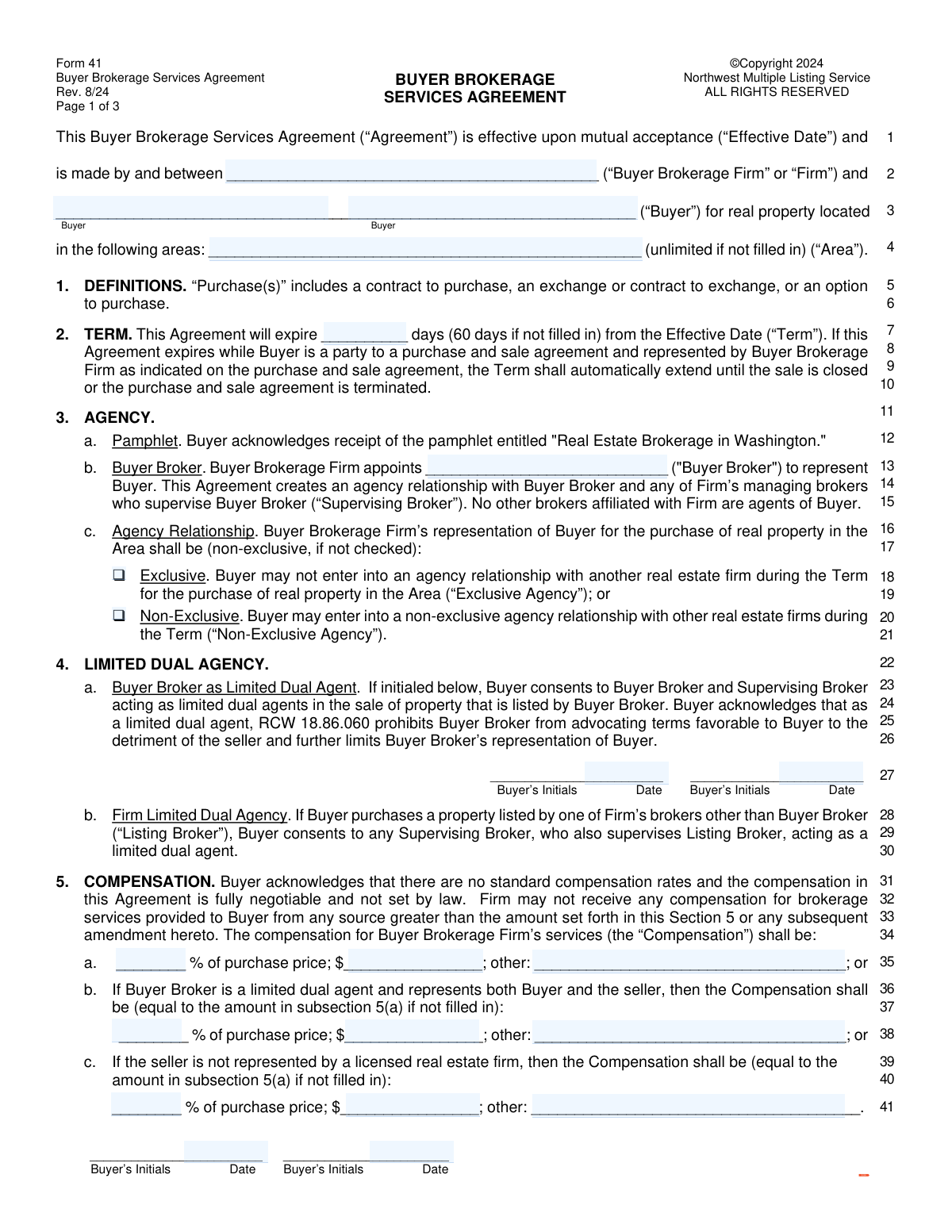
Form 41, officially known as the Buyer Brokerage Services Agreement, is a contract between a real estate buyer and a brokerage firm. It establishes the terms of the brokerage's representation of the buyer in purchasing property, including the scope of services, compensation, and the duration of the agreement. It is important for defining the legal relationship and responsibilities between the buyer and their brokerage firm.
Form 41 is part of the broker forms and brokerage forms categories on Instafill.
Our AI automatically handles information lookup, data retrieval, formatting, and form filling.
It takes less than a minute to fill out Form 41 using our AI form filling.
Securely upload your data. Information is encrypted in transit and deleted immediately after the form is filled out.

Form specifications

Form name: Form 41, Buyer Brokerage Services Agreement
Form issued by: Northwest Multiple Listing Service
Number of fields: 36
Number of pages: 3
Version: 2024
Language: English
main-image

Instafill Demo: How to fill out PDF forms in seconds with AI

How to Fill Out Form 41 Online for Free in 2026

Are you looking to fill out a FORM 41 form online quickly and accurately? Instafill.ai offers the #1 AI-powered PDF filling software of 2026, allowing you to complete your FORM 41 form in just 37 seconds or less.
Follow these steps to fill out your FORM 41 form online using Instafill.ai:
  1. 1 Visit instafill.ai and select Form 41
  2. 2 Enter buyer and firm details
  3. 3 Specify the property area
  4. 4 Choose agency type (exclusive/non-exclusive)
  5. 5 Agree to compensation terms
  6. 6 Sign and date electronically
  7. 7 Check for accuracy and submit

Our AI-powered system ensures each field is filled out correctly, reducing errors and saving you time.

Why Choose Instafill.ai for Your Fillable Form 41 Form?

Speed

Complete your Form 41 in as little as 37 seconds.

Up-to-Date

Always use the latest 2026 Form 41 form version.

Cost-effective

No need to hire expensive lawyers.

Accuracy

Our AI performs 10 compliance checks to ensure your form is error-free.

Security

Your personal information is protected with bank-level encryption.

Frequently Asked Questions About Form Form 41

The purpose of Form 41, Buyer Brokerage Services Agreement, is to establish a formal agreement between a buyer and a real estate broker or agent, outlining the terms and conditions under which the broker or agent will represent the buyer in the purchase of real estate. This includes the services to be provided, the compensation for those services, and the duration of the agreement.

The Effective Date in the Buyer Brokerage Services Agreement is determined by the date when both the buyer and the broker or agent have signed the agreement, making it legally binding. This date marks the beginning of the term during which the broker or agent will represent the buyer.

The Buyer Brokerage Services Agreement covers the geographical areas or types of properties the buyer is interested in purchasing. It specifies the scope of the broker's or agent's services, including searching for properties, arranging viewings, and negotiating purchases within the agreed-upon areas or property types.

If the term length is not specified in the Buyer Brokerage Services Agreement, the default duration may vary depending on local laws and regulations or the policies of the brokerage firm. It's important for both parties to clearly define the term length to avoid any misunderstandings.

If the Buyer Brokerage Services Agreement expires while the buyer is in the process of completing a purchase and sale agreement, the terms of the original agreement may still apply, especially regarding the broker's or agent's compensation. However, this depends on the specific terms outlined in the agreement and local real estate laws. It's advisable to extend the agreement if necessary to ensure continuous representation.

The 'Real Estate Brokerage in Washington' pamphlet is a crucial document that outlines the legal rights and responsibilities of both buyers and brokers in real estate transactions within Washington. It provides essential information about agency relationships, duties, and disclosures required by law. Reviewing this pamphlet ensures that the buyer is fully informed about the brokerage services and their implications before entering into the Agreement.

The Buyer Broker is appointed through the mutual agreement between the buyer and the brokerage firm, as detailed in the Buyer Brokerage Services Agreement. This agreement formalizes the relationship, specifying the broker's duties to represent the buyer's interests in the real estate transaction. The appointment is typically confirmed by the buyer signing the Agreement, thereby authorizing the broker to act on their behalf.

An Exclusive Agency agreement means the buyer agrees to work solely with the appointed broker for a specified period, and the broker is entitled to compensation if they find a property that meets the buyer's criteria, regardless of who finds the property. A Non-Exclusive Agency allows the buyer to work with multiple brokers, and the broker is only compensated if they are the ones who find the property the buyer purchases. The Agreement specifies which type of agency relationship is being established.

Limited Dual Agency occurs when a broker or brokerage firm represents both the buyer and the seller in the same transaction. In such cases, the broker's ability to advocate for either party is limited, as they must remain neutral. The Agreement must disclose this arrangement and obtain consent from both parties, as it affects the level of representation and advice the buyer can receive from the broker.

Compensation for the Buyer Brokerage Firm's services is typically outlined in the Agreement and can be structured in various ways, such as a percentage of the purchase price, a flat fee, or another agreed-upon method. The Agreement specifies the compensation terms, including how and when the broker will be paid, which is often at the closing of the transaction. It's important for buyers to understand these terms before signing the Agreement.

If the Buyer Broker is a limited dual agent, it means they are representing both the buyer and the seller in a transaction, but with limited responsibilities to each party. This arrangement requires full disclosure and consent from both parties. The broker must act impartially and cannot advocate for one party over the other, ensuring fairness and confidentiality for both sides.

If the seller is not represented by a licensed real estate firm, the compensation for the Buyer Broker is typically negotiated directly between the buyer and the broker. This agreement should be clearly outlined in the Buyer Brokerage Services Agreement to avoid any misunderstandings regarding payment terms and conditions.

The Seller’s Offer refers to the compensation amount that the seller is willing to pay to the buyer's broker for their services. This offer can affect the compensation by setting the baseline for what the buyer's broker will receive, which may be adjusted based on the agreement between the buyer and their broker. It's important for all parties to understand how the Seller’s Offer impacts the overall compensation structure.

In an Exclusive Agency agreement, the compensation is due to the Buyer Broker when they are the procuring cause of the sale, meaning they introduced the buyer to the property or were otherwise instrumental in the transaction. This holds true even if the buyer purchases the property through another source, as long as the agreement's terms specify such conditions.

In a Non-Exclusive Agency, the compensation is due to the Buyer Broker only if they are the ones who directly secure the buyer for the property. Unlike an Exclusive Agency, the buyer is free to work with multiple brokers, and compensation is only owed to the broker who successfully facilitates the purchase. The terms should be clearly defined in the agreement to ensure clarity and fairness.

The terms for compensation after the Agreement expires typically depend on the specific clauses outlined in the Agreement itself. Generally, if a buyer purchases a property that was introduced to them by the broker during the term of the Agreement, even after the Agreement has expired, the broker may still be entitled to compensation. It's important to review the Agreement carefully to understand these terms.

Cancelling the Agreement without legal cause may result in the buyer being liable for any expenses incurred by the broker up to the point of cancellation, and possibly a cancellation fee as stipulated in the Agreement. It's crucial to understand the terms regarding cancellation before signing the Agreement to avoid unexpected liabilities.

The Buyer is typically responsible for conducting all necessary property inspections and investigations to ensure the property meets their standards and requirements. This includes, but is not limited to, inspections for structural integrity, pest infestations, and compliance with local codes. The Agreement may outline specific timelines or conditions under which these inspections should be completed.

A 'Distressed Home Conveyance' refers to the sale of a property under financial distress, such as a foreclosure or short sale. The Agreement may have specific provisions addressing how such transactions are handled, including any additional disclosures required or adjustments to the broker's compensation. Buyers should be aware of these provisions as they may affect the terms of the purchase.

The Agreement must comply with all applicable fair housing laws, which prohibit discrimination in the sale, rental, and financing of dwellings based on race, color, religion, sex, national origin, familial status, or disability. The Agreement may include clauses affirming the broker's commitment to these laws and outlining the procedures for ensuring compliance throughout the brokerage services.

Compliance Form 41
Validation Checks by Instafill.ai

1
Verifies that the Buyer's initials and the date are entered at the top of the form.
Ensures that the Buyer's initials and the date are accurately entered at the top of the form to validate the agreement's commencement. Confirms the presence of these details to prevent any disputes regarding the agreement's timeline. Verifies the format and legibility of the initials and date to ensure they meet legal standards. Checks that these elements are not omitted, as they are crucial for the document's validity.
2
Confirms that the name of the Buyer Brokerage Firm and the Buyer are filled in to establish the parties to the agreement.
Confirms the inclusion of the Buyer Brokerage Firm's name and the Buyer's name to clearly identify the parties involved in the agreement. Ensures that these names are spelled correctly and match the legal entities or individuals they represent. Verifies that no fields are left blank, as this could invalidate the agreement. Checks for the accuracy of the information to prevent any future legal complications.
3
Ensures that the area(s) where the real property is located are specified to avoid an unlimited scope agreement.
Ensures the specification of the area(s) where the real property is located to define the agreement's scope clearly. Confirms that the description is detailed enough to avoid any ambiguity regarding the property's location. Verifies that the area(s) are accurately described to prevent disputes over the agreement's applicability. Checks that this section is completed to ensure the agreement is legally binding and enforceable.
4
Checks that the term of the agreement is defined by filling in the number of days it will be effective, defaulting to 60 days if left blank.
Checks the term of the agreement is explicitly defined by the number of days it will remain effective. Confirms that if the term is left blank, it defaults to 60 days, ensuring the agreement has a clear expiration date. Verifies the numerical value entered is reasonable and within typical industry standards. Ensures this detail is present to avoid any confusion about the agreement's duration.
5
Validates that the receipt of the 'Real Estate Brokerage in Washington' pamphlet is acknowledged by initialing where indicated.
Validates the acknowledgment of receiving the 'Real Estate Brokerage in Washington' pamphlet through initialing in the designated area. Confirms that this step is completed to comply with state regulations and consumer protection laws. Verifies the initials are present and match those at the top of the form for consistency. Ensures this requirement is met to safeguard both parties' understanding of their rights and obligations.
6
Confirms the appointment of the Buyer Broker by filling in their name in the designated space.
Ensures that the Buyer Broker's name is accurately recorded in the specified section of the form. This validation confirms the formal appointment of the Buyer Broker for the transaction. It checks for the presence of the name to avoid any ambiguity regarding the appointed broker. The absence of the name triggers a prompt for completion to ensure the agreement's validity.
7
Ensures that the choice between an Exclusive or Non-Exclusive Agency relationship is made by checking the appropriate box, defaulting to Non-Exclusive if neither is checked.
Verifies that the form clearly indicates whether the agency relationship is Exclusive or Non-Exclusive by checking the corresponding box. This validation ensures that the nature of the relationship is explicitly stated to prevent misunderstandings. If no selection is made, it defaults to Non-Exclusive to maintain clarity and agreement enforceability. This step is crucial for defining the scope of the broker's authority and obligations.
8
Verifies that consent to limited dual agency is acknowledged by initialing the provided spaces.
Confirms that the parties involved have acknowledged and consented to the possibility of a limited dual agency by initialing the designated areas. This validation checks for the presence of initials as evidence of informed consent. It ensures that all parties are aware of and agree to the dual agency arrangement, safeguarding against potential conflicts of interest. The absence of initials prompts a review to ensure compliance with legal and ethical standards.
9
Checks that the compensation terms for the Buyer Brokerage Firm's services are specified by filling in the percentage of the purchase price, a fixed amount, or other agreed terms.
Ensures that the compensation for the Buyer Brokerage Firm's services is clearly defined, whether as a percentage of the purchase price, a fixed amount, or other agreed-upon terms. This validation verifies the completeness of the compensation details to avoid disputes. It checks for the presence of at least one method of compensation to ensure the broker's services are adequately remunerated. The clarity in compensation terms is vital for the agreement's transparency and enforceability.
10
Ensures that the terms regarding seller compensation offers, compensation after expiration, and other compensation-related clauses are reviewed and understood.
Confirms that all parties have reviewed and understood the terms related to seller compensation offers, compensation after the agreement's expiration, and any other compensation-related clauses. This validation checks for acknowledgment of these terms to ensure full comprehension and agreement. It emphasizes the importance of understanding all compensation aspects to prevent future disagreements. The process ensures that the agreement reflects a mutual understanding of all financial obligations and rights.
11
Confirms that all parties have signed and dated the agreement at the bottom of the form, including the Buyer, Buyer Brokerage Firm, and Buyer Broker, and that contact information is provided.
Ensures that the agreement is legally binding by verifying the signatures and dates from all involved parties. Confirms that the Buyer, Buyer Brokerage Firm, and Buyer Broker have duly signed the document. Validates the presence of contact information to facilitate communication between the parties. This check is crucial for the enforceability of the agreement.
12
Validates that the entire agreement is reviewed to ensure all sections are understood and filled out correctly before signing.
Verifies that every section of the Form 41 has been thoroughly reviewed for accuracy and completeness. Ensures that all parties have a clear understanding of the agreement's terms before proceeding. Checks for any discrepancies or misunderstandings that could lead to disputes. This step is essential for maintaining transparency and trust between the Buyer and the Brokerage Firm.
13
Ensures that all blanks are filled in accurately to reflect the agreement between the Buyer and the Buyer Brokerage Firm.
Confirms that every required field in the form is completed to accurately represent the agreement's terms. Checks for any inaccuracies or omissions that could affect the agreement's validity. Ensures that the information provided aligns with the mutual understanding of both parties. This validation is key to preventing future legal complications.
14
Checks that if any section is left blank, default terms as specified in the form are understood and accepted.
Verifies that any sections not filled out are intentionally left blank and that the default terms are acknowledged. Ensures that all parties are aware of and agree to the standard terms as outlined in the form. Confirms that the acceptance of default terms is done knowingly and willingly. This check safeguards against unintentional agreement to unfavorable terms.
15
Recommends consulting with a legal professional if there are any questions or uncertainties about the agreement terms.
Advises seeking legal counsel to clarify any ambiguities or concerns regarding the agreement. Ensures that all parties are fully informed about their rights and obligations under the contract. Checks for any complex terms that may require professional interpretation. This recommendation is aimed at preventing misunderstandings and ensuring a fair agreement for all involved.

Common Mistakes in Completing Form 41

Not initialing and dating at the top of the form

Failing to initial and date at the top of the form can lead to questions about the validity and timeliness of the agreement. This oversight may result in delays or disputes during the transaction process. To avoid this, always ensure that both parties initial and date the form at the designated area. This simple step confirms that all parties have reviewed and agreed to the terms at a specific point in time.

Leaving the Buyer Brokerage Firm name blank

Omitting the Buyer Brokerage Firm name invalidates the agreement as it fails to identify the service provider. This mistake can cause confusion and legal issues regarding who is responsible for providing the brokerage services. Always double-check to fill in the firm's name accurately to ensure clarity and enforceability of the agreement. This detail is crucial for establishing the professional relationship between the buyer and the brokerage firm.

Not specifying the area(s) for the real property

Not detailing the specific area(s) for the real property can lead to misunderstandings about the scope of the brokerage services. This vagueness might result in the broker showing properties outside the buyer's desired location, wasting time and resources. Clearly define the geographical areas or property types of interest to align expectations and focus the search effectively. Precise specifications enhance the efficiency and satisfaction of the property search process.

Leaving the term of the agreement blank

Neglecting to specify the term of the agreement leaves the duration of the brokerage services undefined, potentially leading to indefinite obligations or premature termination disputes. It's essential to clearly state the start and end dates or conditions under which the agreement expires. This clarity protects both parties by setting clear expectations for the engagement period. A well-defined term ensures that the agreement is legally binding and mutually understood.

Not acknowledging receipt of the pamphlet

Failing to acknowledge receipt of the pamphlet may violate legal or regulatory requirements, depending on the jurisdiction. This oversight can delay the transaction or result in penalties for non-compliance. Always ensure that the buyer acknowledges receiving and reviewing any required educational or disclosure pamphlets. This acknowledgment serves as proof that the buyer was informed of their rights and responsibilities, fulfilling legal obligations.

Failing to appoint the Buyer Broker

Failing to appoint the Buyer Broker can lead to misunderstandings about representation and services provided. It is crucial to clearly identify the broker who will be representing the buyer's interests. This ensures that the buyer has dedicated professional support throughout the transaction. Always verify the broker's credentials and ensure their name is accurately listed on the form.

Not choosing between Exclusive or Non-Exclusive Agency

Not specifying whether the agreement is Exclusive or Non-Exclusive can create confusion about the broker's obligations and the buyer's rights. An Exclusive Agency means the broker has sole rights to represent the buyer, while a Non-Exclusive allows the buyer to work with multiple brokers. Clearly indicating the type of agency helps set expectations and avoid disputes. Review the implications of each option carefully before making a selection.

Not initialing for limited dual agency consent

Overlooking the requirement to initial for limited dual agency consent can invalidate the agreement or lead to legal complications. Limited dual agency occurs when the same broker represents both the buyer and the seller, which requires explicit consent. Ensure that all parties understand the implications and provide their initials where required. This step is essential for transparency and compliance with real estate laws.

Leaving compensation terms unspecified

Leaving compensation terms unspecified can result in disputes over broker fees and payment obligations. The agreement should clearly outline how and when the broker will be compensated, including any contingencies. Both parties should review and agree to these terms to prevent misunderstandings. Always document compensation details to ensure clarity and enforceability.

Not reviewing seller compensation offers terms

Not reviewing the terms of seller compensation offers can lead to unexpected costs or conflicts. Buyers should understand how the seller's offer of compensation to the broker affects their overall transaction. It is important to discuss and clarify these terms with the broker before signing the agreement. Thoroughly reviewing all compensation-related clauses helps avoid surprises during the transaction.

Missing signatures or dates from required parties

Failing to obtain all necessary signatures or including dates can invalidate the agreement or lead to disputes. It's crucial to ensure that every party involved in the transaction signs and dates the document as required. This oversight can delay the process or result in legal complications. Always double-check the document for completeness before submission.

Omitting contact information

Leaving out contact details can hinder communication between parties and delay the transaction process. Accurate and complete contact information ensures that all parties can be reached promptly for any clarifications or updates. This mistake can lead to misunderstandings or missed opportunities. Verify that all contact fields are filled out correctly and completely.

Not reviewing the entire agreement before signing

Signing without thoroughly reviewing the agreement can lead to unforeseen obligations or misunderstandings. It's essential to understand every clause and term to ensure they align with your expectations and legal rights. This oversight can result in binding agreements that are unfavorable or not as intended. Take the time to read and comprehend the entire document, possibly with legal counsel, before signing.
Saved over 80 hours a year

“I was never sure if my IRS forms like W-9 were filled correctly. Now, I can complete the forms accurately without any external help.”

Kevin Martin Green

Your data stays secure with advanced protection from Instafill and our subprocessors

Robust compliance program

Transparent business model

You’re not the product. You always know where your data is and what it is processed for.

ISO 27001, HIPAA, and GDPR

Our subprocesses adhere to multiple compliance standards, including but not limited to ISO 27001, HIPAA, and GDPR.

Security & privacy by design

We consider security and privacy from the initial design phase of any new service or functionality. It’s not an afterthought, it’s built-in, including support for two-factor authentication (2FA) to further protect your account.

Fill out Form 41 with Instafill.ai

Worried about filling PDFs wrong? Instafill securely fills 41 forms, ensuring each field is accurate.

Related forms by category

broker forms Letter of Authorization to Broker, Form 1099-B, Proceeds From Broker Transactions, Fannie Mae Residential Broker Price Opinion (BPO) (Revised 03/99), Fidelity Change of Account Registration: Changing to an Individual, Joint, or Custodial Brokerage Account, Fidelity Change of Account Registration — Changing to a Trust, Estate, Guardian, or Conservator Brokerage Account, Move Assets from My Schwab Brokerage Account, Open a Schwab One® Brokerage Account, Charles Schwab PCRA Self-Directed Brokerage Account, Move Assets from My Schwab Brokerage Account, Schwab Health Savings Brokerage Account (HSBA) to HSA Invest Choice Account Transfer Form, Intra-Brokerage Securities Transfer, Moving your Vanguard funds to a Vanguard Brokerage Account Disclosure statement, Vanguard Brokerage Account CREST Transfer Form, Moving your Vanguard funds to a Vanguard Brokerage Account Disclosure statement, TIAA Brokerage Incoming Account Transfer Form, TIAA Brokerage Joint Transfer on Death Account Agreement, TIAA Brokerage IRA Distribution Request (Form F11025), Request for a Qualified Charitable Distribution (QCD) from a Brokerage Individual Retirement Account (IRA), Form OL 75, Auto Broker Log, TIAA Brokerage Authorization To Gift Securities · + 16 more →
brokerage forms Fidelity Change of Account Registration: Changing to an Individual, Joint, or Custodial Brokerage Account, Fidelity Change of Account Registration — Changing to a Trust, Estate, Guardian, or Conservator Brokerage Account, Move Assets from My Schwab Brokerage Account, Open a Schwab One® Brokerage Account, Charles Schwab PCRA Self-Directed Brokerage Account, Move Assets from My Schwab Brokerage Account, Schwab Health Savings Brokerage Account (HSBA) to HSA Invest Choice Account Transfer Form, Intra-Brokerage Securities Transfer, Moving your Vanguard funds to a Vanguard Brokerage Account Disclosure statement, Vanguard Brokerage Account CREST Transfer Form, Moving your Vanguard funds to a Vanguard Brokerage Account Disclosure statement, TIAA Brokerage Incoming Account Transfer Form, TIAA Brokerage Joint Transfer on Death Account Agreement, TIAA Brokerage IRA Distribution Request (Form F11025), Request for a Qualified Charitable Distribution (QCD) from a Brokerage Individual Retirement Account (IRA), TIAA Brokerage Authorization To Gift Securities, Form F11014, TIAA Brokerage Power of Attorney (POA) Form, TIAA Brokerage Durable Power Of Attorney Affidavit Of Full Force And Effect, TIAA Brokerage Incoming Managed Account Transfer Form (F11319), Form F11015, TIAA Brokerage Designation of Beneficiary · + 37 more →