
Yes! You can use AI to fill out Form 1099-B, Proceeds From Broker Transactions
Don't type 163 fields by hand. Tell our AI about yourself, or upload your W-2 or last year's return, and it fills every field in seconds. You check it, then download, print or sign.
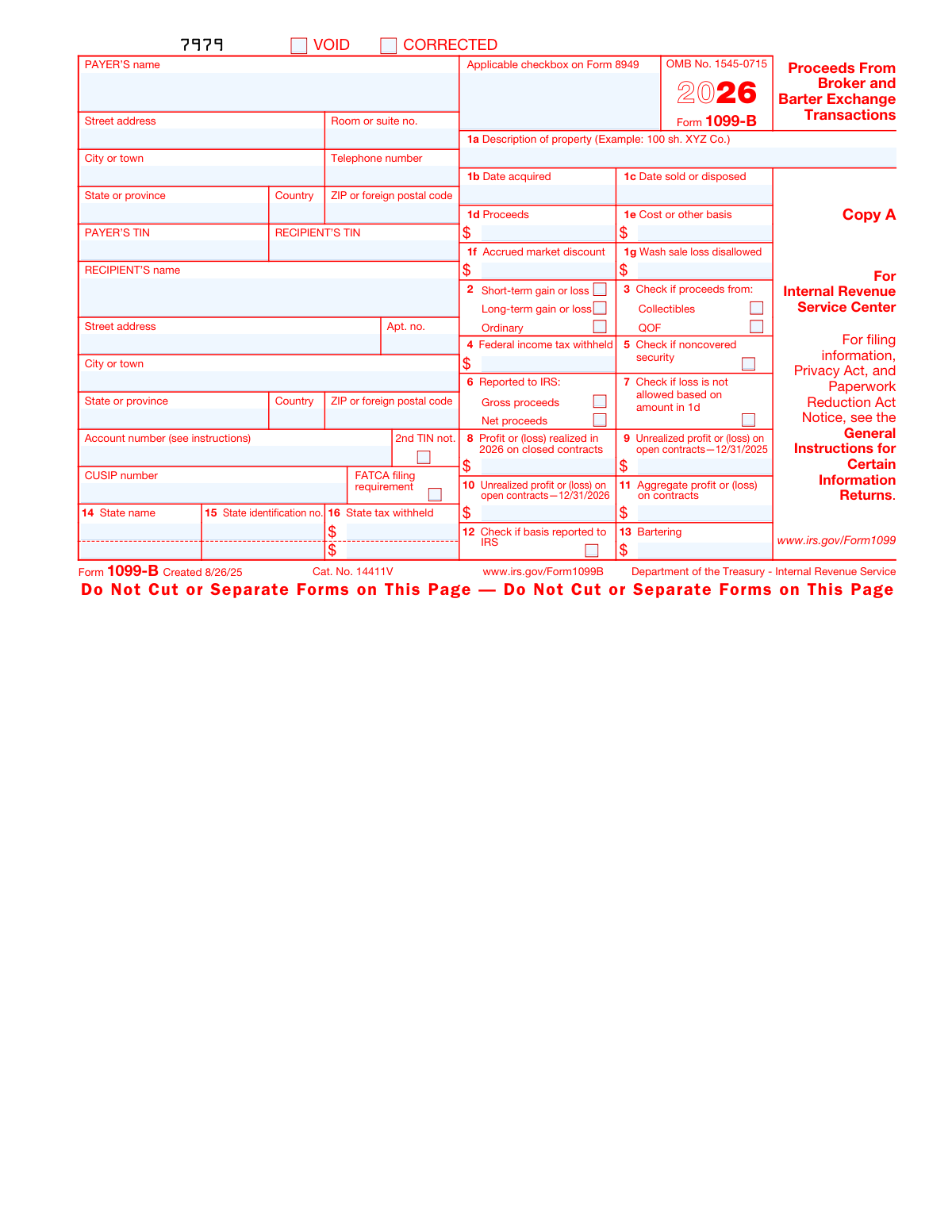
The AI does the filling. You just check it.
No typing into boxes, nothing to install.
What this form asks for
The AI fills all of it, from your answers or your documents.
The AI checks your answers before you download
15 checks built for this form, so a wrong date or a missing answer is caught before anyone else sees it.
This validation check ensures that the PAYER'S information on Form 1099-B is accurate and properly formatted. It verifies that the name is complete and matches official records. The address is checked for correct formatting and adherence to United States Postal Service (USPS) standards, which includes the street address, city, state, and ZIP code. Additionally, the telephone number is validated to ensure it is in the correct North American Numbering Plan format.
This validation check verifies the integrity of the PAYER'S Taxpayer Identification Number (TIN) on Form 1099-B. It confirms that the TIN provided is a nine-digit number, following the standard format with two digits, a hyphen, and then seven digits (XX-XXXXXXX). The check also includes a validation algorithm to ensure that the number sequence is potentially valid for tax reporting purposes.
This validation check confirms that the RECIPIENT'S TIN on Form 1099-B is a legitimate Taxpayer Identification Number. It ensures that the TIN is not only correctly formatted but also that it corresponds with the name of the recipient provided on the form. This cross-referencing helps prevent identity mismatches and potential tax filing issues.
This validation check scrutinizes the RECIPIENT'S name entry on Form 1099-B. It checks that the full legal name is provided without any abbreviations or missing parts. The name is then cross-checked against the associated TIN to ensure that they match, which is crucial for accurate tax reporting and identification.
This validation check is focused on the recipient's address details on Form 1099-B. It validates that the full address is accurately entered, including the street name, city, state, and ZIP code. If an apartment number or other secondary address information is applicable, the check ensures that this detail is also included and correctly formatted.
The AI ensures that an account number is provided on Form 1099-B if it is applicable to the taxpayer's situation. It verifies that the account number follows the standard formatting rules, which typically include a specific combination of letters and numbers without any special characters. The AI also checks for the correct length of the account number to prevent any truncation or padding errors. If the account number is not applicable, the AI ensures that this field is left blank or is marked as not applicable in accordance with IRS instructions.
And 9 more checks
- Verifies the 2nd TIN not. box is checked only if a second TIN notification has been issued.
- Confirms the CUSIP number is entered if applicable and is correctly formatted.
- Checks the FATCA filing requirement box is marked if applicable.
- Ensures the correct checkbox on Form 8949 is marked to indicate where to report the transaction.
- Validates the description of property (1a) is provided and accurately describes the transaction.
- Confirms the dates acquired (1b) and sold or disposed (1c) are properly formatted and logical (sale date is not before acquisition date).
- Verifies the proceeds (1d) are accurately calculated and reduced by any commissions or transfer taxes.
- Checks the cost or other basis (1e) is entered and is a plausible figure for the securities sold.
- Ensures the type of gain or loss (short-term, long-term, ordinary) is correctly indicated in section 2.
Let AI fill out your Form 1099-B
No typing. Every field filled in seconds, checked, ready to sign.
How to Fill Out Form 1099-B Online for Free in 2026
What the AI walks you through.
- Visit instafill.ai site and select Form 1099-B
- Enter payer's information
- Input recipient's TIN and details
- Provide property description and dates
- Report proceeds and cost basis
- Fill in additional financial details
- Sign and date the form electronically
- Check for accuracy and submit form
Common Mistakes in Completing Form 1099-B
The ones the AI is built to catch.
Filling out the wrong copy of the form
Incorrect or incomplete payer's name and address
Omitting payer's telephone number
Entering incorrect payer's TIN
Entering incorrect recipient's TIN
Incomplete recipient's name and address
Failing to enter the account number
Not checking the 2nd TIN notification box when required
Leaving the CUSIP number blank if applicable
Not checking the FATCA filing requirement box
Incorrect checkbox on Form 8949
Vague description of property in 1a
Incorrect date of acquisition in 1b
Incorrect date of sale or disposal in 1c
Incorrect proceeds amount in 1d
Incorrect cost or other basis in 1e
Omitting accrued market discount in 1f
Not reporting wash sale loss disallowed in 1g
Incorrect type of gain or loss in 2
Not checking the box for proceeds from Collectibles, QOF in 3
Omitting federal income tax withheld in 4
Not checking if security is noncovered in 5
Incorrect reporting of gross or net proceeds to IRS in 6
Not checking if loss is not allowed in 7
Incorrect profit or loss realized in 2025 in 8
Incorrect unrealized profit or loss on 12/31/2024 in 9
Incorrect unrealized profit or loss on 12/31/2025 in 10
Incorrect aggregate profit or loss on contracts in 11
Not checking if basis reported to IRS in 12
Incorrect bartering information in 13
Incorrect state name, identification no., or tax withheld in 14-16
Not keeping a copy of the form for personal records
Submitting the form with inaccurate information
Frequently Asked Questions About Form 1099-B
Is it really free for 7 days?
Can I fill other forms too?
How do I cancel?
How does the AI fill out Form 1099-B?
What happens to my information?
How complex is Form 1099-B to fill out?
What is Form 1099-B used for?
Where can I find the official IRS instructions for Form 1099-B?
What should I do if I receive a Form 1099-B with incorrect information?
How do I report proceeds from broker and barter exchange transactions on my tax return?
What is the difference between Copy A, Copy B, and Copy 1 of Form 1099-B?
Can I print and file Copy A of Form 1099-B downloaded from the IRS website?
What are the penalties for filing a scannable Form 1099-B that can't be scanned by the IRS?
Is electronic filing required for Form 1099-B?
What is the threshold for mandatory e-filing of Form 1099-B?
What should I do if I have fewer than 10 information returns to file?
What is the purpose of the CUSIP number on Form 1099-B?
What does the FATCA filing requirement checkbox indicate on Form 1099-B?
How do I determine the cost basis for securities sold, as reported on Form 1099-B?
What is a wash sale loss and how is it reported on Form 1099-B?
What are the implications of a checked box for 'noncovered security' on Form 1099-B?
What should I do with the state information provided on Form 1099-B?
How do I report a loss from a reportable change in control or capital structure?
What are regulated futures contracts, foreign currency contracts, and Section 1256 option contracts as mentioned in Form 1099-B?
What is the significance of the 'basis reported to IRS' checkbox on Form 1099-B?
Where can I find more information about developments related to Form 1099-B?
Get your Form 1099-B filled out by AI
$0 today. Cancel before Nov 1 and you pay nothing.
Other forms like this one
1099 forms: Form 1099-NEC, Nonemployee Compensation, Form 4852, Substitute for Form W-2 or 1099-R, Form 1099-MISC, Miscellaneous Information, Form 1099-INT, Interest Income, Form 1099-DIV, Dividends and Distributions, Form 1099-R, Distributions From Pensions etc., Form 1099-S, Proceeds From Real Estate Transactions, Form 1099-G, Certain Government Payments, Form 1099-C, Cancellation of Debt, Form 1099-K, Payment Card and Third Party Network Transactions, Form 1099-OID, Original Issue Discount, Form 1099-PATR, Taxable Distributions from Cooperatives, Form 1099-Q, Payments From Qualified Education Programs, Form 1099-SA, Distributions from HSA/MSA, Form 1099-NEC, Nonemployee Compensation, Form 1099-NEC, Nonemployee Compensation, Form 1099-NEC, Nonemployee Compensation, Form 1099-NEC, Nonemployee Compensation, Instructions for Forms 1099-R and 5498, Form 1099-MISC, Miscellaneous Information
broker forms: Letter of Authorization to Broker, 41, Fannie Mae Residential Broker Price Opinion (BPO) (Revised 03/99), Fidelity Change of Account Registration: Changing to an Individual, Joint, or Custodial Brokerage Account, Fidelity Change of Account Registration — Changing to a Trust, Estate, Guardian, or Conservator Brokerage Account, Move Assets from My Schwab Brokerage Account, Open a Schwab One® Brokerage Account, Charles Schwab PCRA Self-Directed Brokerage Account, Schwab Health Savings Brokerage Account (HSBA) to HSA Invest Choice Account Transfer Form, Intra-Brokerage Securities Transfer, Moving your Vanguard funds to a Vanguard Brokerage Account Disclosure statement, Vanguard Brokerage Account CREST Transfer Form, Moving your Vanguard funds to a Vanguard Brokerage Account Disclosure statement, TIAA Brokerage Incoming Account Transfer Form, TIAA Brokerage Joint Transfer on Death Account Agreement, TIAA Brokerage IRA Distribution Request (Form F11025), Request for a Qualified Charitable Distribution (QCD) from a Brokerage Individual Retirement Account (IRA), Form OL 75, Auto Broker Log, TIAA Brokerage Authorization To Gift Securities, Form F11014, TIAA Brokerage Power of Attorney (POA) Form
Let AI fill out your Form 1099-B
Your trial starts once a card is added. You pay nothing before Nov 1.
Our AI already knows this form, all 163 fields of it. Skip the typing: tell it about yourself, or upload what you have, and it fills the whole form in seconds.
- AI fills every field on all 6 pages, checkboxes included
- No typing into boxes: answer a few questions, or upload your W-2 or last year's return, an old copy of this form, a photo of a document
- The AI checks the answers; you review and change anything before you download
- Download the finished PDF, print it, or sign it online
- Encrypted, and never used to train AI
Cancel before Nov 1 and you pay nothing.
A card is needed to start the trial. Cancel in two clicks from your account.
Terms · Privacy