Fill out 1099 forms
with AI.
The 1099 series of IRS forms is a cornerstone of the American tax system, used to report various types of income other than regular wages or salaries. These information returns are essential for ensuring that taxpayers accurately report supplemental income, such as earnings from freelance work, interest from bank accounts, or distributions from retirement plans. By providing a record of payments made to individuals and businesses, these forms help the IRS track financial transactions and verify that the correct amount of tax is being paid on diverse income streams.
By continuing, you acknowledge Instafill's Privacy Policy and agree to get occasional product update and promotional emails.
About 1099 forms
A wide range of people and entities require these forms throughout the tax year. Small business owners and companies typically use forms like the 1099-NEC to report payments made to independent contractors, while financial institutions issue forms like the 1099-INT or 1099-DIV to report interest and dividends to investors. Additionally, individuals may encounter these forms when receiving government payments, such as unemployment compensation, or when dealing with real estate transactions. Whether you are an employer documenting non-employee compensation or a recipient tracking your annual distributions, having the correct documentation is vital for staying compliant with federal tax laws.
Managing these documents can be time-consuming, but tools like Instafill.ai use AI to fill these forms in under 30 seconds while ensuring data is handled accurately and securely. This automated approach simplifies the process of preparing multiple tax documents during the busy filing season.
Every form on this page can be completed without typing. Instafill is form filling software that reads a PDF and fills it for you — including flat and scanned documents that carry no fillable fields at all.
Forms in This Category
The forms in this category have a median Form Complexity Index of 58/100 (Moderate), measured across 21 forms by field count, input difficulty, length, conditional logic and structure. See how it is calculated.
- Enterprise-grade security & data encryption
- 99%+ accuracy powered by AI
- 1,000+ forms from all industries
- Complete forms in under 60 seconds
How to Choose the Right Form
Not sure which 1099 form you need? The right form depends on the *type of income* being reported. Here's a quick breakdown:
For Businesses Paying Contractors or Freelancers
- Form 1099-NEC is your go-to if you paid an independent contractor, freelancer, or vendor $600 or more during the tax year. This is one of the most commonly filed 1099s.
- Form 1099-MISC covers other business payments like rents, royalties, medical payments, and prizes — but *not* contractor compensation (that moved to 1099-NEC in 2020).
For Investment & Financial Income
- Form 1099-INT — received interest income from a bank or financial institution
- Form 1099-DIV — received dividends or distributions from stocks or mutual funds
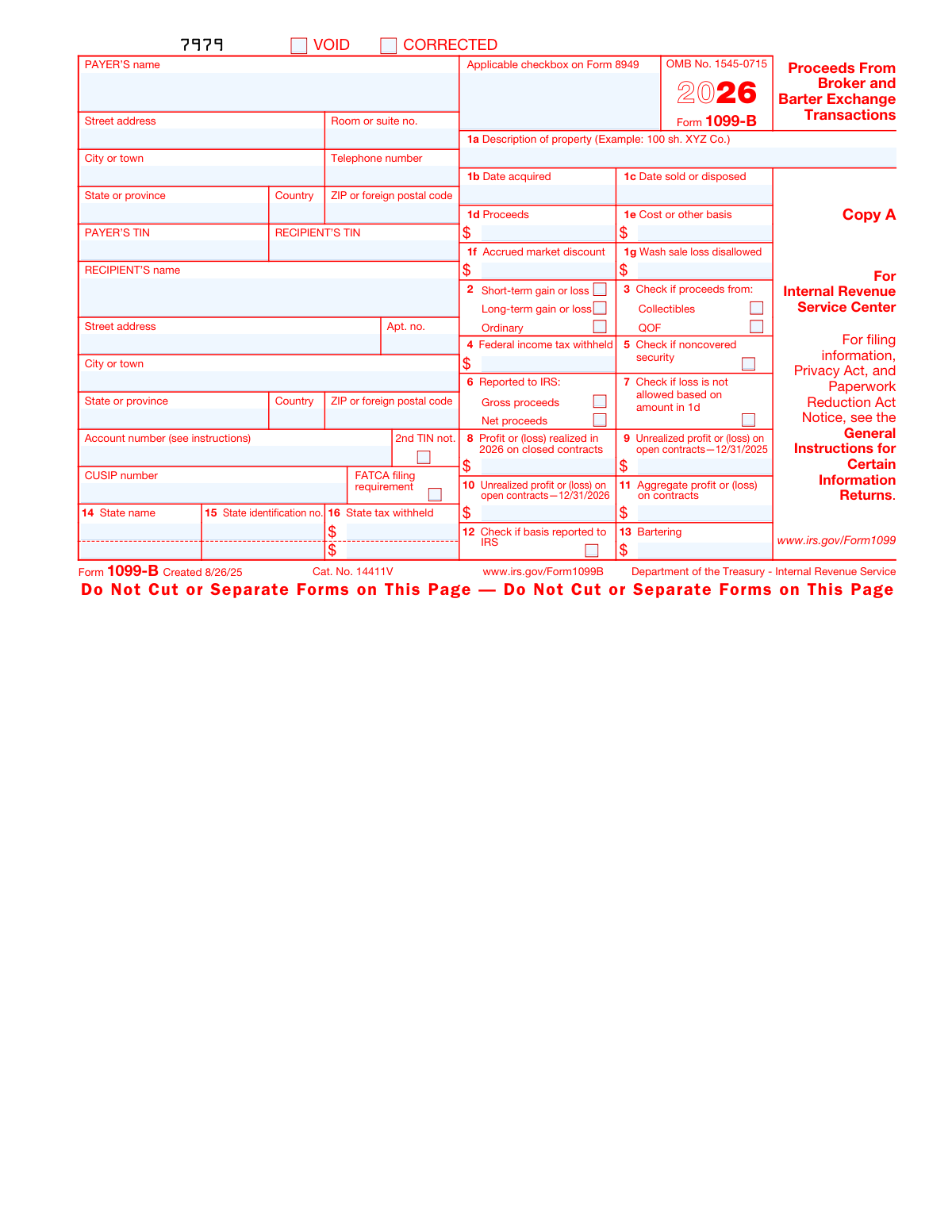
- Form 1099-B — sold securities, commodities, or participated in barter exchange transactions
- Form 1099-OID — have debt instruments with original issue discount interest
For Retirement, Pensions & Education Accounts
- Form 1099-R — took distributions from a pension, IRA, annuity, or retirement plan. Pair it with the Instructions for Forms 1099-R and 5498 if you're a plan administrator.
- Form 1099-SA — took distributions from an HSA or Archer MSA
- Form 1099-Q — received payments from a 529 plan or Coverdell Education Savings Account
For Real Estate, Government Payments & Debt
- Form 1099-S — sold or exchanged real estate
- Form 1099-G — received unemployment compensation or a state tax refund
- Form 1099-C — had a debt of $600 or more cancelled by a creditor
- Form 1099-K — processed payments through a payment card or third-party network (e.g., PayPal, Stripe)
Missing a Form or Received an Incorrect One?
- Use Form 4852 as a substitute if your employer or payer never sent your W-2 or 1099-R, or if the form you received has errors.
Cooperative Members
- Form 1099-PATR applies if you received taxable distributions from a cooperative.
> Tip: Most individuals filing taxes will need the form *sent to them* by a payer — not the one they file themselves. Businesses and payers are typically responsible for submitting 1099s to the IRS.
Form Comparison
| Form | Purpose | Who Files It | When to Use |
|---|---|---|---|
| Form 1099-NEC, Nonemployee Compensation | Report payments to independent contractors | Businesses and payers | Paid $600+ to non-employees during the year |
| Form 1099-MISC, Miscellaneous Information | Report rents, royalties, and misc. income | Businesses and payers | Paid misc. income not covered by other 1099s |
| Form 1099-INT, Interest Income | Report interest income paid to investors | Banks and financial institutions | Paid $10+ in interest to account holders |
| Form 1099-DIV, Dividends and Distributions | Report dividends and capital gain distributions | Brokers and mutual fund companies | Paid dividends or distributions to investors |
| Form 1099-R, Distributions From Pensions etc. | Report retirement plan distributions | Plan administrators and financial institutions | Made distributions of $10+ from retirement accounts |
| Form 1099-S, Proceeds From Real Estate Transactions | Report gross proceeds from real estate sales | Settlement agents and real estate brokers | Closed a real estate sale or exchange |
| Form 1099-G, Certain Government Payments | Report unemployment and government payments | Government agencies | Paid unemployment compensation or tax refunds |
| Form 1099-C, Cancellation of Debt | Report canceled debt of $600 or more | Creditors and lenders | Canceled or forgave a debtor's debt |
| Form 1099-K, Payment Card and Third Party Network Transactions | Report payment card and network transactions | Payment settlement entities | Processed qualifying payment transactions for sellers |
| Form 1099-B, Proceeds From Broker Transactions | Report securities sales and barter exchanges | Brokers and barter exchanges | Sold securities or commodities through a broker |
| Form 1099-Q, Payments From Qualified Education Programs | Report distributions from 529 or ESA accounts | Education program administrators | Made distributions from qualified education accounts |
| Form 4852, Substitute for Form W-2 or 1099-R | Substitute when W-2 or 1099-R is missing/incorrect | Individual taxpayers | Employer failed to provide or issued incorrect form |
Tips for 1099 forms
With 23 forms in this category, choosing the correct 1099 variant is critical. For example, use 1099-NEC for contractor payments, 1099-DIV for dividends, and 1099-INT for interest income — mixing these up can trigger IRS notices. Always verify which form applies to the specific type of income before you start filling it out.
Every 1099 form requires a valid Taxpayer Identification Number (TIN) for both the payer and the recipient. Missing or incorrect TINs are one of the most common errors on 1099 forms and can result in IRS penalties. Use a W-9 form to collect this information from contractors and vendors before the tax season begins.
Many 1099 forms, including the 1099-NEC and 1099-MISC, only require filing when payments reach $600 or more to a single recipient during the tax year. However, some forms like 1099-INT and 1099-DIV have different thresholds, so check the specific rules for each form type. Tracking payments throughout the year makes it much easier to determine who needs to receive a form.
1099 forms have multiple copies — one goes to the IRS, one to the recipient, and in some cases one to the state tax agency. Failing to provide recipients with their copy by the IRS deadline is a separate violation from failing to file with the IRS. Always confirm you've fulfilled both obligations for every form you issue.
AI-powered tools like Instafill.ai can complete 1099 forms in under 30 seconds with high accuracy, which is a major time-saver when you're managing multiple contractors or income sources. Your data stays secure throughout the process, so you don't have to worry about sensitive financial information being exposed. This is especially useful for businesses that issue dozens of 1099-NECs or 1099-MISCs each year.
If a recipient fails to provide a valid TIN or the IRS notifies you of a TIN mismatch, you may be required to withhold a percentage of their payment — known as backup withholding. This amount must be reported in the appropriate box on the 1099 form and submitted to the IRS. Ignoring this field when it applies can lead to compliance issues for the payer.
If you received a retirement distribution but never got your 1099-R, or if the form you received contains errors, Form 4852 lets you report the income yourself using your own records. This ensures you can still file your tax return on time without waiting for a corrected form. Keep statements from your plan administrator or financial institution handy to estimate the figures accurately.
Whether you're a business issuing 1099s or an individual receiving them, maintaining organized digital records makes tax filing and potential audits far less stressful. Store copies alongside supporting documentation like contracts, payment records, or brokerage statements. A simple folder structure organized by tax year and form type can save hours of searching later.
Frequently Asked Questions
1099 forms are IRS information returns used to report various types of income received outside of traditional employment, such as contractor payments, interest, dividends, retirement distributions, and government payments. They are used by businesses, financial institutions, government agencies, and individuals to report income paid to others, as well as by recipients to accurately file their tax returns.
There are over 20 variants of the 1099 form, each designed for a specific type of income or payment. For example, Form 1099-NEC is for contractor payments, 1099-INT is for interest income, 1099-DIV is for dividends, 1099-R is for retirement distributions, and 1099-G is for government payments like unemployment compensation. Choosing the right form depends on the nature of the income being reported.
1099 form deadlines vary by form type, but most are generally due to recipients by late January and to the IRS by late February (paper filing) or late March (electronic filing) of the year following the tax year. It's important to check the IRS website or the specific form's instructions for the exact deadline, as some forms have different due dates.
Generally, businesses are required to file Form 1099-NEC only when they have paid a nonemployee $600 or more during the tax year. However, there are exceptions depending on the type of payment and the form involved, so it's advisable to review the specific IRS instructions for the relevant 1099 form.
Form 1099-NEC is specifically used to report nonemployee compensation, such as payments to independent contractors and freelancers, and was reintroduced in 2020 to replace Box 7 of Form 1099-MISC for this purpose. Form 1099-MISC is still used to report other types of miscellaneous income, including rents, royalties, medical payments, and certain other payments not classified as nonemployee compensation.
If you did not receive a 1099 form from your employer, payer, or financial institution, you should first contact them to request the form. If you still cannot obtain it, you can use Form 4852 as a substitute for a missing or incorrect W-2 or 1099-R, allowing you to still file your tax return on time using your own records of income and withholding.
No, 1099 forms cover a wide range of income types beyond self-employment. They are also issued to investors (1099-INT, 1099-DIV, 1099-B), retirees (1099-R), real estate sellers (1099-S), individuals who received government payments (1099-G), and anyone who had a debt canceled (1099-C), among others. Essentially, anyone who receives certain types of non-wage income may receive a 1099 form.
In most cases, the payer must both file the 1099 form with the IRS and provide a copy to the recipient (the person or entity that received the income). Some states also require copies to be filed with state tax agencies. The filing method can be paper or electronic, though businesses filing a large number of forms are generally required to file electronically.
Yes, AI-powered tools like Instafill.ai can fill out 1099 forms in under 30 seconds by accurately extracting and placing data from your source documents. This significantly reduces manual data entry errors and speeds up the preparation process, whether you're completing a single form or multiple 1099s across different categories.
Traditionally, filling out 1099 forms manually can take several minutes per form, especially when dealing with multiple recipients or complex financial data. With AI tools like Instafill.ai, the process can be completed in under 30 seconds per form, as the AI automatically extracts and populates the required fields from your existing documents.
Filing a 1099 form with incorrect information or after the deadline can result in IRS penalties, which vary based on how late the form is filed and the size of the business. It's important to review all information carefully before submitting and to correct any errors promptly by filing a corrected 1099 form with the IRS.
Generally, recipients do not need to physically attach 1099 forms to their federal tax returns, but they must use the information reported on the forms to accurately complete their return. The IRS receives copies directly from payers and uses them to verify that all income has been properly reported by the taxpayer.
Glossary
- Form Complexity Index
- Instafill’s 0–100 measure of how much effort a form takes to complete, calculated deterministically from the form’s own structure rather than estimated. It combines the number of fillable fields (the largest factor), how difficult those fields are to complete based on their type, the number of pages that contain fields, the amount of conditional “fill-only-if” logic, and how many sections the form is divided into, then adds modifiers for tables and repeating lists, bundled instruction pages, and dense page layouts. A higher score means the form is harder to fill out by hand. The forms in this category have a median Form Complexity Index of 58/100 (Moderate). See exactly how it is calculated.
- Information Return
- A tax form filed with the IRS to report income paid to others, rather than to report your own taxes owed. 1099 forms are a type of information return used by payers to report income to both the IRS and the recipient.
- Nonemployee Compensation (NEC)
- Payments made to individuals who are not employees, such as independent contractors or freelancers, for services rendered. This type of income is reported on Form 1099-NEC and is generally subject to self-employment tax.
- TIN (Taxpayer Identification Number)
- A unique number used by the IRS to identify individuals or businesses for tax purposes, which can be a Social Security Number (SSN), Employer Identification Number (EIN), or Individual Taxpayer Identification Number (ITIN). TINs are required on all 1099 forms for both the payer and the recipient.
- Backup Withholding
- A mandatory federal tax withholding that payers must apply to certain payments when a recipient has not provided a valid TIN or has previously underreported income. The current backup withholding rate is 24% of the payment amount.
- Original Issue Discount (OID)
- The difference between a bond's face value (what it pays at maturity) and its lower original purchase price, which the IRS treats as taxable interest income spread over the life of the bond. This is reported annually on Form 1099-OID.
- Cancellation of Debt (COD)
- When a lender forgives or cancels a debt you owe, the forgiven amount is generally considered taxable income by the IRS. Creditors report canceled debts of $600 or more on Form 1099-C.
- Patronage Dividend
- A distribution paid by a cooperative to its members based on the volume of business they conducted with the cooperative during the year. These distributions are reported on Form 1099-PATR and may be taxable income.
- Qualified Education Program (529 Plan / Coverdell ESA)
- Tax-advantaged savings accounts designed to pay for education expenses, where earnings grow tax-free when used for qualified costs. Distributions from these accounts are reported on Form 1099-Q.
- Gross Distribution
- The total amount paid out from an account or plan before any taxes, penalties, or other deductions are subtracted. On forms like 1099-R and 1099-SA, the gross distribution is reported separately from the taxable amount.
- Payment Settlement Entity (PSE)
- A bank, payment processor, or third-party network (such as PayPal or credit card companies) that processes payment transactions between buyers and sellers. PSEs are required to report transactions to the IRS on Form 1099-K.